1 317 résultats
réf. 4814Berlioz est charg dune commission par Franz Liszt.Berlioz s'affaire avant son dpart pour la Belgique ...Je ne puis donc aller vous voir pour la commission dont Liszt ma charg. Il sagirait de lui procurer les livrets, rglemens, et documents de toute espce qui se rattachent lorganisation de nos socits dartistes. Il a lintention de former une association allemande de la mme nature et il a besoin dun guide tel que vous ; car cest vous qui avez en quelque sorte dict page page tous les crits relatifs ces belles institutions...Fonde en 1843 et prside par le baron Taylor (1789-1879), lAssociation des artistes musiciens se constituait afin de pourvoir lamlioration du statut social du musicien, notamment par un fonds de pension et de secours, et la promotion de lart musical. Runissant plusieurs milliers de membres partout en France mais aussi ltranger, elle organise, pour alimenter sa caisse, diverses manifestations dont de nombreux concerts, et parvient fdrer dans un esprit fraternel dentraide les actions des artistes musiciens. Dirige par un comit form dminentes personnalits (Berlioz, Liszt, Meyerbeer, Auber, Thalberg, Zimmerman, Herz, rard, etc.), lassociation laissa dimposantes archives, qui stendent jusquen 1968.
1888réf. 76843Librairie de l'art | Paris 1888 | 24.50 x 32.50 cm | relié
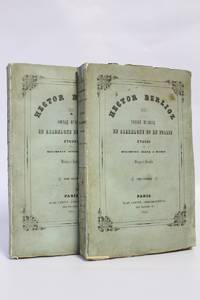
1844réf. 62537Jules Labitte | Paris 1844 | 14.50 x 22.50 cm | 2 volumes brochés sous chemises et étuis
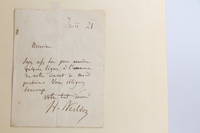
1888réf. 76843Paris: Librairie de l'art 1888. Fine. Librairie de l'art Paris 1888 24.50 x 32.50 cm relié First edition one of 30 numbered copies on Japan paper deluxe issue. Work illustrated with 14 original lithographs by Adolphe Fantin-Latour printed on China paper as well as 12 portraits of Hector Berlioz 3 plates hors-texte and 122 engravings facsimiles of autographs caricatures. Binding in full red morocco spine with five raised bands gilt rolls on headcaps endpapers and pastedowns of combed paper fine engraved bookplate mounted on one pastedown gilt dentelle border on pastedowns covers preserved all edges gilt double gilt fillets on edges perfect contemporary binding signed Cuzin. Our copy is enhanced with an autograph note signed by Hector Berlioz mounted on an endpaper: ""Jeudi 21 / Monsieur soyez assez bon pour accorder quelques lignes à l'annonce de notre concert de mardi prochain. Vous obligerez beaucoup votre tout dévoué H. Berlioz."" ""Thursday 21st / Sir please be so kind as to grant a few lines to the announcement of our concert next Tuesday. You would greatly oblige your most devoted H. Berlioz."" Fine copy perfectly established and enhanced with an autograph note signed by Hector Berlioz. Librairie de l'art hardcover
1844réf. 62537Paris: Jules Labitte 1844. Fine. Jules Labitte Paris 1844 14.50 x 22.50 cm 2 volumes brochés sous chemises et étuis Rare first edition of Hector Berlioz's first book. Some restorations to the top spine-end volume label on the spine of the second volume not fully visible boards strengthened or lined first board of the first volume some stains on the first boards of both volumes. Fine condition inside almost without any foxing. Our copy is housed in green half shagreen chemises and slipcases marbled paper boards slipcases lined with the same shagreen gilt titles and dates on the spine. Rare. Jules Labitte hardcover
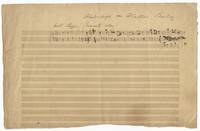
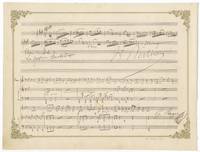
réf. 416811 leaf. Oblong folio 268 x ca. 170 mm. 7 measures notated in black ink on one side of the leaf. Unsigned. Several notes crossed out and a final passage rewritten. A first draft of a polyphonic theme. Identified in German in contemporary manuscript at head: "Handschrift von Hector Berlioz Erste Skizze. Benvenuto Cellini." Some wear and browning; slightly creased at folds; lower edge unevenly trimmed. The present manuscript not recorded in Holoman. Benvenuto Cellini an opéra semi-seria in two acts to a libretto by Léon de Wailly and Auguste Barbier assisted by Alfred de Vigny was based on the memoirs of Benvenuto Cellini. Set in 16th century Rome during the papacy of Clement VII the work premiered in Paris on 10 September 1838 at the Opéra and was produced in a revised version in Weimar at the Grossherzogliches Hoftheater on 20 March 1852 and with further revision in three acts on 17 November 1852. "Whether it originated as a serious or a comic opera the result in all its many versions is a compound a characteristic blend of idealism and farce grandeur and wit breadth and vivacity. Berlioz poured into Benvenuto Cellini every drop of invention and feeling at his command in a torrent of notes that make up a long and very lively opera and its heterogeneity so baffling to Parisians in 1838 and Londoners in 1853 is one of its main virtues." Macdonald: Berlioz p. 106. "Berlioz stands as the leading musician of his age in a country France whose principal artistic endeavour was then literary in an art music whose principal pioneers were then German. In many senses the Romantic movement found its fullest embodiment in him yet he had deep Classical roots and stood apart from many manifestations of that movement. His life presents the archetypal tragic struggle of new ideas for acceptance to which he gave his full exertions as composer critic and conductor. And though there were many who perceived greatness in his music from the beginning his genius only came to full recognition in the 20th century. . In Berlioz's own words Benvenuto Cellini 'contains a variety of ideas an energy and exuberance and a brilliance of colour such as I may perhaps never find again.' " Hugh Macdonald in Grove Music Online A rare working manuscript from one of Berlioz's important stage works evidencing the compositional process through its autograph revisions. While short musical quotations in Berlioz's hand are not rare his sketch leaves are very rare to the market; we have located only one example at auction in over 30 years. unknown
réf. 416811 leaf. Oblong folio 268 x ca. 170 mm. 7 measures notated in black ink on one side of the leaf. Unsigned. Several notes crossed out and a final passage rewritten. A first draft of a polyphonic theme. Identified in German in contemporary manuscript at head: "Handschrift von Hector Berlioz Erste Skizze. Benvenuto Cellini." Some wear and browning; slightly creased at folds; lower edge unevenly trimmed. The present manuscript not recorded in Holoman. Benvenuto Cellini an opéra semi-seria in two acts to a libretto by Léon de Wailly and Auguste Barbier assisted by Alfred de Vigny was based on the memoirs of Benvenuto Cellini. Set in 16th century Rome during the papacy of Clement VII the work premiered in Paris on 10 September 1838 at the Opéra and was produced in a revised version in Weimar at the Grossherzogliches Hoftheater on 20 March 1852 and with further revision in three acts on 17 November 1852. "Whether it originated as a serious or a comic opera the result in all its many versions is a compound a characteristic blend of idealism and farce grandeur and wit breadth and vivacity. Berlioz poured into Benvenuto Cellini every drop of invention and feeling at his command in a torrent of notes that make up a long and very lively opera and its heterogeneity so baffling to Parisians in 1838 and Londoners in 1853 is one of its main virtues." Macdonald: Berlioz p. 106. "Berlioz stands as the leading musician of his age in a country France whose principal artistic endeavour was then literary in an art music whose principal pioneers were then German. In many senses the Romantic movement found its fullest embodiment in him yet he had deep Classical roots and stood apart from many manifestations of that movement. His life presents the archetypal tragic struggle of new ideas for acceptance to which he gave his full exertions as composer critic and conductor. And though there were many who perceived greatness in his music from the beginning his genius only came to full recognition in the 20th century. . In Berlioz's own words Benvenuto Cellini 'contains a variety of ideas an energy and exuberance and a brilliance of colour such as I may perhaps never find again.' " Hugh Macdonald in Grove Music Online A rare working manuscript from one of Berlioz's important stage works evidencing the compositional process through its autograph revisions. While short musical quotations in Berlioz's hand are not rare his sketch leaves are very rare to the market; we have located only one example at auction in over 30 years. unknown books
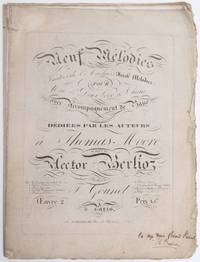
1830réf. 1528Paris: Schlesinger 1830. First edition. Signed and inscribed on title page by Berlioz in brown ink: "To my dear fried Robert. Untrimmed. Pages moderately chipped occasional foxing throughout. Overall in fine condition. First edition. Signed and inscribed on title page by Berlioz in brown ink: "To my dear fried Robert". 2 33 1 p. Inscribed copy of the first edition of Berlioz's nine songs on Irish poetry. The nine poems of the Neuf Mélodies taken from Thomas Moore's Irish Melodies translated into French by Thomas Gounet. The last song is a paraphrase of the speech of the he Irish rebel Robert Emmet just before his execution in 1803. Their settings include solo romances duos and choral pieces accompanied by the piano. . Schlesinger unknown
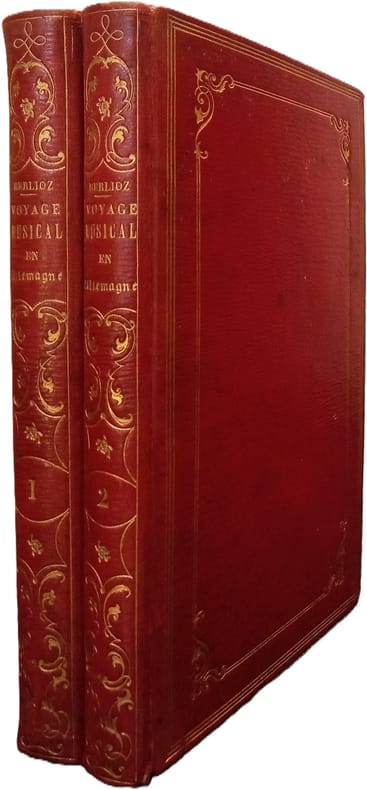
1844réf. 1131Paris, Jules Labitte, 1844 ; 2 vol. in-8 de [3] ff., 422 pp. ; [2] ff., 370 pp., 1 f. bl., reliures de l'époque maroquin à long grain cerise, double encadrement de filets dorés sur les plats, fleurons dans les angles, dos lisses ornés en long, roulette intérieure, tranches dorées.
1844réf. 1165Paris, Jules Labitte, 1844 ; 2 vol. in-8 de [3] ff., 422 pp. ; [2] ff., 370 pp., 1 f. bl., reliures de l’époque maroquin à long grain cerise, double encadrement de filets dorés sur les plats, fleurons dans les angles, dos lisses ornés en long, roulette intérieure, tranches dorées.
réf. 5432Deux importants volumes contenants 29 theses medicales datant du tout debut XIX em siecle, in 4 carré , reliés demi veau dos lisses, decorés pas de pages de titres ni de tables , les theses s'enchainenet les unes aux autres : pas de pagination continue. A Paris , imprimerie Didot Jeune , pour la majorité , photos sur demande
1862réf. 71549Michel Lévy frères | Paris 1862 | 12.50 x 19 cm | relié
1859réf. 68513A. Bourdilliat & Cie | Paris 1859 | 11.50 x 18 cm | reliure de l'éditeur
réf. 4168015 measures titled and signed below the music: "Thème e Bal e La Symphonie Fantastique. H. Berlioz." Undated but ca. 1840-1850. The complete main theme of the second movement "Un Bal" carried by the violins in measures 38 to 54 of the full score. 1 leaf. Notated in dark brown ink within decorative dark gold borders on Lard-Esnault paper. Oblong quarto 227 x 300 mm. "The composition of the 'Symphonie fantastique' was a momentous event in Berlioz's career his first full-scale masterpiece and equally momentous in the history of music as the first unequivocal declaration of romantic ideas in style and musical language and its echo has pervaded all music of passion and personal experience to this day . Of Harriet Smithson's identity as the 'beloved' portrayed by an 'idée fixe' in the form of an obsessive theme that recurs in all the movements there can be no question." MacDonald: Berlioz p. 18. With: - Roger Gustave-Hippolyte 1825-1879. Autograph musical quotation signed "G. Roger" being a 12-measure song for voice and piano commencing "d'autiens tu beau miage" to lower portion of recto. With to verso: - Adam Adolphe 1803-1856. Autograph musical quotation signed "Ad. Adam" being a 16-measure waltz for pian. - Halévy Fromental 1799-1862. Autograph musical quotation signed "F. Halévy" being a 22-measure work for piano titled "Suite." A dynamic excerpt from one of the great revolutionary works of the Romantic period constructed around a recurring "idée fixe" a concept originating with Berlioz's revolutionary Symphonie Fantastique and presenting here as a recurring theme associated with Berlioz's obsession with Irish actress Harriet Smithson. A unique artifact incorporating a rare quotation from one of the most outstanding works of the symphonic repertoire of the Romantic period the whole linking Berlioz with three important French musical figures of the mid-19th century. unknown
réf. 4168015 measures titled and signed below the music: "Thème e Bal e La Symphonie Fantastique. H. Berlioz." Undated but ca. 1840-1850. The complete main theme of the second movement "Un Bal" carried by the violins in measures 38 to 54 of the full score. 1 leaf. Notated in dark brown ink within decorative dark gold borders on Lard-Esnault paper. Oblong quarto 227 x 300 mm. "The composition of the 'Symphonie fantastique' was a momentous event in Berlioz's career his first full-scale masterpiece and equally momentous in the history of music as the first unequivocal declaration of romantic ideas in style and musical language and its echo has pervaded all music of passion and personal experience to this day . Of Harriet Smithson's identity as the 'beloved' portrayed by an 'idée fixe' in the form of an obsessive theme that recurs in all the movements there can be no question." MacDonald: Berlioz p. 18. With: - Roger Gustave-Hippolyte 1825-1879. Autograph musical quotation signed "G. Roger" being a 12-measure song for voice and piano commencing "d'autiens tu beau miage" to lower portion of recto. With to verso: - Adam Adolphe 1803-1856. Autograph musical quotation signed "Ad. Adam" being a 16-measure waltz for pian. - Halévy Fromental 1799-1862. Autograph musical quotation signed "F. Halévy" being a 22-measure work for piano titled "Suite." A dynamic excerpt from one of the great revolutionary works of the Romantic period constructed around a recurring "idée fixe" a concept originating with Berlioz's revolutionary Symphonie Fantastique and presenting here as a recurring theme associated with Berlioz's obsession with Irish actress Harriet Smithson. A unique artifact incorporating a rare quotation from one of the most outstanding works of the symphonic repertoire of the Romantic period the whole linking Berlioz with three important French musical figures of the mid-19th century. unknown books
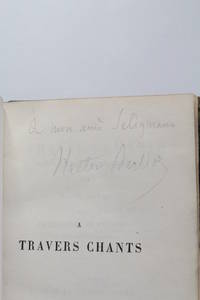
1862réf. 71549Paris: Michel Lévy frères 1862. Fine. Michel Lévy frères Paris 1862 12.50 x 19 cm relié First edition. Half shagreen binding spine with five raised bands with gilt decorations date at foot marbled paper covers original soft front cover preserved. Rare and precious signed autograph inscription by the composer: à mon ami Seligmann - Hector Berlioz ""to my friend Seligmann - Hector Berlioz"" Hippolyte-Prosper Seligmann 1817-1882 cellist and composer was an active member of the Philharmonic Society founded by Berlioz in 1849. Provenance: R. & B. L. library with his bookplate pasted on the back of the first endpaper. Michel Lévy frères hardcover
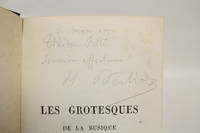
1859réf. 68513Paris: A. Bourdilliat & Cie 1859. Fine. A. Bourdilliat & Cie Paris 1859 11.50 x 18 cm reliure de l'éditeur Les Grotesques de la musique The Musical Madhouse A. Bourdilliat & Cie Paris 1859 11.5 x 18 cm publisher's original binding First edition. Publisher's green cloth spine and boards ruled in blind yellow endpapers and pastedowns pastedowns soiled edges spotted. A little light foxing. A rare and handsome autograph inscription signed by Hector Berlioz in pencil to title: ""à mon ami Théodore Ritter souvenirs affectueux"" Théodore Ritter son of composer Eugène Prévost was Berlioz's student for whom he composed a piano arrangement of L'Enfance du Christ The Childhood of Christ Berlioz inscriptions are rare and highly sought-after. A. Bourdilliat & Cie hardcover