20.202 Ergebnisse
Best.-Nr. DADAX0618096353New unknown
Best.-Nr. 7777o.J. Opernsängerin. 1841-49 Primadonna der Münchner Oper. Heiratete den Reg.Rat von Mangstl. 1822 Freising - 1888 Haag b. München. Halbfigur, in der Rechten Notenrolle. Lithographie von Merseburger um 1845. Ca. 315 x 245 mm.
Best.-Nr. 21462o.J. Opernsänger. 1836 Ljubljana, 1838 Budapest, 1840 Hamburg, 1844-53 Hofoper Wien, 1853 Riga, 1856 Hamburg, 1858 Köln, Riga, 1862-65 in Dessau, lebte seit 1865 in Würzburg, unternahm zahlreiche Gastspiele. 1815 Wien - 1874 Würzburg. Fast Halbfigur im Sessel. Lithographie von Kriehuber 1845. ca. 190 x 190 mm.
Best.-Nr. 10630o.J. ital. Opernsängerin. Venedig, Kopenhagen, Berlin. Lebte in Mailand. 1823 Castel San Giovanni b. Piacenza - 1881 Mailand. Fast Kniestück. Lithographie von Tegner. Ca 294 x 215 mm.
Best.-Nr. 11929o.J. Xaver Ferenc Steger, eigentl. Ferenc Staszic. Opernsänger, Tenor. 1852 Budapest, 1853 Hofoper Wien, 1853-67 Nationaloper Budapest, zahlreiche Gastpiele in ganz Europa. 1824 Szent Endre (Ungarn) - 1914 ebd. Brustbild nach halblinks. Lithographie von Kriehuber 1857. Ca. 180 x 170 mm.
Best.-Nr. 67130London,, Barmerlea Book Sales, 1940 Original blue cloth. binding, 61 pages + VII plates full pages. 290 x 225 mm, In fine condition.
Best.-Nr. 580804Paris, A. Quantin, 1885. Grand in-8, broché, couverture de papier vélin teint en brun, 148 pp., frontispice, bandeaux, lettrines et culs-de-lampe, 6 planches hors texte. Edition originale.
1969cm. 18 x 25,5, xii-896 pp. Historiae Musicae Cultores - Biblioteca 1080 gr. xii-896 p.
Best.-Nr. 125326Libretto Opera - I Visionari: Dramma Giocoso per Musica - ed. 1773 - Testo in lingua italiana. Pagine 52 - Copertina semirigida. - Condizioni buone con segni del tempo come da foto. - - unknown
Best.-Nr. 52001Musica - Gran metodo elementare per violino composto e dedicato al suo genitore dai f.lli Alday - Torino Racca e Balegno fine '800 - Pag. 149 con alcune illustrazioni. - Copertina rigida - Testo in italiano. - Buone condizioni. - unknown
Best.-Nr. 95744Spartiti - Il Furioso - Opera in due Atti di Gaetano Donizetti per Pianoforte - ed. 1890 ca. - Formato piccolo. Pagine 110 - Copertina rigida. - Condizioni buone con segni del tempo come da foto. - unknown
Best.-Nr. 9979Undated. England 1880s. 4to 4 pp. Bifolium. 87 lines. Text clear and complete. Fair on aged paper with wear to extremities and a spike hole to one corner. Written in ink in a Victorian hand and with three changes in pencil. Docketed at head 'The art of Vocalization'. Towards beginning writes that the subject is one which he has 'studied many years in close connexion with the most eminent Masters of Italy most of whom I may rank among my personal friends and the pith of whose conversations added to my own experience I propose embodying in a few short essays upon the Formation of the Voice'. Gives 'the advice of a tenor singer of some renown in Otello &c literally as I heard it spoken to a student - the author died two years ago at Milan' beginning: 'I know but little of music - in comparison to me you are a professor - my voice was by nature imperfect - my figure is diminutive - yet I have been 1st tenor of some of the best Theatres and with success - mark me if you want to sing .'. Ends with offer to extend his remarks 'to the other Voices' in 'a future number'. Undated. [England, 1880s? unknown
1998New New English Original bdg. Dust wrapper. In special slip-case. 4to. (31 x 24 cm). In Turkish. 173, [2] p., color ills. Müsellesten ücgene: Ihap Hulusi [Görey]. Text: Turgut Yasalar. Edited by Ender Merter. Ihap Hulusi Görey was the first Turkish graphic artist best known for his illustrations on posters and labels of several Turkish brands in the Republican era. Ihap Hulusi's father was a well-known architect in Cairo and he wanted his son become a successful diplomat. For this Ihap Hulusi was sent to English schools in Cairo. However, his primary interest was in painting. In the meantime, he took lessons in painting by mail from Germany. In 1920, after graduating from the high school, Ihap Hulusi went to Munich, Germany, and studied painting for five years specializing in illustrations. Following his return, Ihap Hulusi's father enrolled him to the Ministry of Foreign Affairs in Istanbul against his will. So Ihap Hulusi dropped off after a while and devoted himself to commercial graphic art. Ihap Hulusi's first work was the illustration for a toothpaste advertisement poster. In 1929 he established his first workshop in Istanbul and designed 1930 the famous bottle label for the Turkish liquor Raki brand "Kulüp Rakisi". This artwork on the bottle label is still in use today. With the Latin alphabet reform in 1928, Atatürk commissioned him in 1934 to make illustrations in order to promote the adoption of the new Turkish alphabet. The graphic artwork showed Atatürk teaching the new Turkish alphabet to a little girl, Atatürk's adoptive daughter Ülkü. His first private exhibition was held in 1935 in Istanbul. Several exhibitions followed at home and abroad. Ihap Hulusi Görey got famous and performed illustrations for state and private companies until 1977. He worked uninterruptedly 45 years for the tickets of the Turkish State lottery, which come out three times a month. He designed the bottle labels of various products of the Turkish State Monopoly 35 years long. He illustrated also posters for the famous brands like the British whisky John Haig, Italian Cinzano and Fernet Branca. Görey designed also logos for some companies, which helped them get easily recognized and well known. In his late life he was much involved in performing calligraphy. He was called the "man who illustrated the Republic" or the "king of the graphic art". Ihap Hulusi Görey died on March 27, 1986 in Istanbul. He was succeeded by his fourth wife... (Wikipedia). Printed to 1000 copies.
Best.-Nr. 100368Libretto Opera - Carlo Magno dramma serio - ed. 1817 Teatro Parma pp. 49 - Rara edizione per il carnevale 1817 - - Lingua italiana - Copertina rigida. - Condizioni molto buone - unknown
Best.-Nr. DADAX019814556XNew unknown
1976Best.-Nr. 99606Monte-Carlo Comite de Gestion de l'Orchestre National de l'Opera de Monte-Carlo 1976. 1976. Fine. - An original invitation from the Palais de Monaco printed on 9-3/8 inch high by 6-1/8 inch wide glossy card stock with an integral attached blank leaf with the country's seal at the head. Mostly printed with "Monsieur et Madame Hugues Gall" and "ils seront" invites penned in ink. The invitation to the gala held at the Opera de Monte-Carlo on the occasion of the Fete Nationale is to be held on Friday November 19th 1976 "Par ordre de Leurs Altesses Serenissimes l'Aide de Camp a l'honneur d'informer Monsieur et Madame Hugues Gall qu'ils seront invites a la soiree de gala. en l'honneuyr de Leurs Altesses Serenissimes le Prince Rainier III et la Princesse de Monaco." The invitation is accompanied by the program for the Opera de Monte-Carlo November 20 1976 gala choregraphique. The 10-5/8 inch high by 8-1/4 inch wide program is bound in stiff cream wraps titled in gilt with a color illustration mounted on the front cover. The 8-page program includes performances of "Le Pecheur et son Ame / creation mondiale avec Tetsutaro Shimizu Yoko Morishita Egon Madsen et le Ballet de l'Opera de Monte-Carlo" and "Les Grands pas de Deux avec par ordre alphabetique Richard Cragun - Michael Denard - Marcia Haydee - Egon Madsen - Yoko Morishita - Merle Park - Tetsutaro Shimizu - Ghislaine Thesmar - Helgi Tomasson" as well as short extracts from other works. Near fine. The National Day of Monaco was first celebrated on November 19th 1952 by decree of Prince Rainier III. The day is marked every year by celebration music and festivals etc. The French opera manager Hugues Gall 1940-2024 was head of the Grand Theatre de Geneve and the Paris Opera. He held several influential positions in art and cultural organizations and was director of the Fondation Monet in Giverny. Monte-Carlo, Comite de Gestion de l'Orchestre National de l'Opera de Monte-Carlo, 1976. paperback
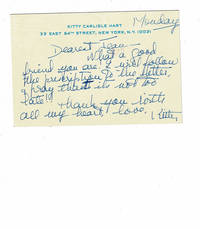
1985Best.-Nr. 100069New York October 8 1985. 1985. Fine. - Over 30 words penned on her embossed 4-1/8 inch high by 6-1/8 inch wide personal postcard stock. The actress Kitty Carlisle thanks her good friend City Center producer Jean Dalrymple "What a good friend you are! I will follow the prescription to the letter & pray that its sic not too late!!" Signed "Kitty". The card is addressed in her hand on the verso and postmarked from New York on October 8 1985. Fine. Inducted into the American Theater Hall of Fame in 1999 Kitty Carlisle Hart 1910-2007 was an American stage & screen actress opera singer and television personality. A spokesperson for the arts she served on the New York State Council for the Arts for 20 years. Kitty Carlisle played the leading lady opposite Groucho in the Marx Brothers movie "A Night at the Opera" and regularly appeared on "To Tell the Truth". Jean Dalrymple 1902-1998 was the dynamic producer and director of theater and light-opera at Manhattan's City Center. Dalrymple began her career in Vaudeville appearing with James Cagney and Cary Grant in the early 1930s. She was a founding member of the American Theatre Wing the theatre service organization. She worked over the years as a personal manager for the likes of Leopold Stokowski Mary Martin Jose Iturbi Andre Kostalanetz Nathan Milstein and Lily Pons. She began her work at City Center with its founding in 1943 serving as a board member producer and publicist. Her productions there from the 1940s through the 1960s were a revitalizing influence on the whole New York theatre scene. In 1951 Jean Dalrymple married Major-General Philip deWitt Ginder commander of the Thunderbirds in Korea. She was a friend to Presidents and entertainment personalities throughout the world. New York, (October 8), 1985.
1906Best.-Nr. 0007583Boston: Perry Mason Company 1906. First edition. Hardcover. Good. Folio 672 pages in publisher's embossed "yearbook" cloth with original wrappers bound in; occasional clips missing rehinged insect damage at fore-edge of top cover. This poem by Robert Lee Frost at p. 38 appeared without his knowledge - ignorant for years - long before its first book appearance in A BOY'S WILL see Crane's Frost bibliography E44. Other contributors include Hamlin Garland Gen. Charles King H. Rider Haggard Margaret Deland Gen. A. W. Greely Agnes C. Laut Jack London Capt. A. T. Mahan Robert E. Peary William McLeod Raine Charles G. D. Roberts Margaret E. Sangster Luther Burbank Mary Austin Grover Cleveland Helen Keller and Emerson Hough on Davy Crockett. Perry Mason Company hardcover
1980Best.-Nr. 010713Scholar Book Publishers 1980. Book. Fine Condition. Cloth. 324 pages. Folio sized hardcover bound in cream colored cloth and wrapped in an illustrated paper dustjacket. Not dated in English but possibly published c. 1980. Texts in Chinese with a single paged English summary separately laid in. The binding is tight and crisp with no interior markings. The dustjacket now protected by a Mylar cover is in equally fine condition with no tears or losses. Lavishly illustrated with large full color drawings photographs and paintings as well as a number of smaller black and white images that help even the non-Chinese reader to grasp the changes in style and ornament throughout the history of perhaps the oldest civilization of the world. The reader of Chinese will benefit from the great amount of text which presumably offers a scholarly context for the images The English summary counted nine chapters 160000 words and 834 illustrations including 346 color photographs. Beginning with what looks to be a deer pelt adorned with a necklace of shells this history of fashion concludes with the modern stylings of the twentieth century woman in slacks and knee-length dresses. Scholar Book Publishers Hardcover
Best.-Nr. 72198Peking China: Peking Opera 200. Presumed first edition/first printing. Hardcover. Fair. Lavishly illustrated including illustrating on otherwise clear plastic. Text in Chinese and English. Cover has slight wear and soiling. Some pages are disbound but present and suitable for framing. Appears complete. Peking opera or Beijing opera is a form of Chinese opera which combines music vocal performance mime dance and acrobatics. It arose in the late 18th century and became fully developed and recognized by the mid-19th century. The form was extremely popular in the Qing dynasty court and has come to be regarded as one of the cultural treasures of China. The art form is also preserved in Taiwan Republic of China where it is known as Guójù literally: "National theatre". Peking opera features four main types of performers. With their elaborate and colorful costumes performers are the only focal points on Peking opera's characteristically sparse stage. They use the skills of speech song dance and combat in movements that are symbolic and suggestive rather than realistic. Above all else the skill of performers is evaluated according to the beauty of their movements. Performers also adhere to a variety of stylistic conventions that help audiences navigate the plot of the production. The layers of meaning within each movement must be expressed in time with music. . Melodies include arias fixed-tune melodies and percussion patterns. The repertoire of Peking opera includes over 1400 works which are based on Chinese history folklore and increasingly contemporary life. Types of facial makeup are a special method of makeup in Chinese traditional operas. Since every historical character or characters of a certain type are provided with a particular facial type similar to music scores for singing and playing music such a method of makeup is named "Types of facial makeup". Among all Chinese traditional operas types of facial makeup in Peking Opera have developed into the most systematic and mature one. Historical characters in Chinese traditional Peking Opera are provided with different types of facial makeup. They can reflect the identity status personality and appearance of the characters and therefore can intensify the artistic appeal on stage. As an impressionistic and exaggerated art types of facial makeup in Peking Opera is featured by painting brows eyelids and jowls in various patterns such as bat swallow wing and butterfly wing. Also it is characterized by portraying facial expressions with exaggerated nasal fossas and lipped fossas. The age can be reflected by the height and shape of "Crow's-feet" temperament by the opening and closing of "Chordal furrow" and personality by different patterns of "Glabella furrow". Additionally in the types of facial makeup in Peking Opera there exist some invariable images including white-faced Tsao Tsao and black-faced Bao Zheng. The white-faced image symbolizes wickedness and viciousness while black-faced image stands for equity and selflessness. Due to unchangeable rules in types of facial makeup personalities of a character with certain facial makeup can be seen from the facial colors and figures. As one of the onstage art techniques various types of facial makeup in Peking Opera enable the audience to know a character's personality easily and accordingly get more involved in the appreciation of the performance. Thus types of facial makeup enjoy the fame of "Interior Pictures" which is an extremely crack skill of art exclusively existing in Chinese operas. Patterns of theatrical masks have served as a symbol of China. Nowadays on the market there appear many exquisite and aesthetic commodities and stamps printed with such patterns which are of high appreciating and collecting values. Peking Opera hardcover
Best.-Nr. 3735785New-York: Samuel French 121 Nassau Street 1855. 8vo. 34 2pp. Original printed wrappers ornamental border; light wear partial splitting along length of spine clean and well-preserved. Scarce American libretto for a mid-19th-century English opera troupe’s rendition of Rossini’s Cinderella performed at the Broadway Theatre in New York. While Rossini’s score is credited the adaptation is Anglicized and adjusted to suit the Broadway Theatre’s stage and audience. Based loosely on Rossini’s La Cenerentola 1817 this booklet was sold or distributed at performances serving both as a libretto and souvenir. This 1855 production starred Miss Louisa Pyne in the title role and Mr. W. Harrison as Prince Felix two leading figures of the Pyne & Harrison Troupe known for popularizing English-language opera in America during the 1850s. The cast list includes comic and magical roles such as Dandini Clorinda Thisbe and the Fairy Queen. unknown
Best.-Nr. 51-1774San Francisco: 1971. . Poster. 34 x 22 inches. Photography by Pete Peters. San Francisco: 1971. unknown
1977Best.-Nr. 100072March 5 1977. 1977. Fine. - One-and-a-half pages with over 85 words penned on both sides of 10-3/8 inch high by 7-1/8 inch wide creamy white paper. The Opera director and producer tells Jean Dalrymple that he'd "be delighted to hear Jay Willoughby. However I'm off to San Francisco very shortly for Carmen". He asks if Willoughby could contact him when he's back. He goes on to invite Jean to the "second set of performances May 19-22 - featuring the first performance of Dominick Argento's monologue A Water Bird Talk and an incredible chamber opera written in Theresienstadt concentration camp - The Emperor of Atlantis." Signed in full "Ian Strasfogel". Folded for mailing the edges are very faintly darkened. Near fine. The one-act opera "The Emperor of Atlantis or The Disobedience of Death" Der Kaiser von Atlantis oder Die Tod-Verweigerung was composed by Viktor Ullmann and Peter Kien while interned at the Theresienstadt concentration camp in 1943. It was not allowed to be performed and the script was not finished until the 1970s. The poet Aaron Kramer prepared an English translation which the San Francisco Spring Opera Theater first performed in April 1977 and which had its New York premiere at the New Opera Theatre of the Brooklyn Academy of Music on May 19 1977. The world premiere of Dominic Argento's "A Water Bird Talk" also took place at the Brooklyn Academy of Music that same evening. The opera director and producer Ian Strasfogel born 1940 was the author of several plays screenplays and librettos and of a novel titled "Operaland". Strasfogel directed over 100 productions throughout Europe and North America and frequently collaborated with Gyorgy Ligeti Luciano Berio Bruno Maderna Hans Werner Henze and Otto Piene. Jean Dalrymple 1902-1998 was the dynamic producer and director of theater and light-opera at Manhattan's City Center. Dalrymple began her career in Vaudeville appearing with James Cagney and Cary Grant in the early 1930s. She was a founding member of the American Theatre Wing the theatre service organization. She worked over the years as a personal manager for the likes of Leopold Stokowski Mary Martin Jose Iturbi Andre Kostalanetz Nathan Milstein and Lily Pons. She began her work at City Center with its founding in 1943 serving as a board member producer and publicist. Her productions there from the 1940s through the 1960s were a revitalizing influence on the whole New York theatre scene. In 1951 Jean Dalrymple married Major-General Philip deWitt Ginder commander of the Thunderbirds in Korea. She was a friend to Presidents and entertainment personalities throughout the world. March 5, 1977. unknown
1970Very Good Turkish Original report with autograph signatures and notes. 1 p. 23 x 17 cm. In Turkish. It's a 'play report' of Ulvi Uraz Theater in Üsküdar, Baglarbasi district in Istanbul. Dated 8/7/1970. Written play's name: Murtaza. As stage manager (rejisör) signed by Ulvi Ural (owner of theater house) and as stage administrator signed by famous Turkish actor Kemal Sunal, (1944-2000). He was a Turkish actor. With Hababam Sinifi, Kapicilar Krali and Davaro, Sunal gained large popularity amongst Turkish cinema goers and was famed for his character "Saban", a role he frequently played. His characters in films often reflected the problems common Turkish people faced in their country. Scarce.
Best.-Nr. 17347o.J. österr. Sängerin. 1825 Wiener Hofoper, 1832 am Königstädtischen Theater in Berlin, 1841-45 an der Berliner Hofoper, Gesangspädagogin in Berlin, später in Wien. 1807 Wien - 1849 ebd. Halbfigur. Lithographie von Kriehuber 1840. Ca. 200 x 170 mm.