19.476 resultados
1867ref. A114289Sydney: Gibbs Shalllard & Co. 1867. Very Good. small octavo. card covers 36pp. Advertisements inside & on the rear wrapper suggests that this is for a Sydney performance. Wrappers loose & rather worn but complete & tight. Very scarce Gibbs, Shalllard & Co. unknown
ref. BN370497Stanley Roseman and the Dance - Drawings from the Paris Opera Hardcover Stanley Roseman and the Dance - Drawings from the Paris Opera Hardcover Stanley Roseman and the Dance - Drawings from the Paris Opera Hardcover hardcover
1956ref. HALL512162Paperback. 1956. 58pp illustrated throughout card covers 4to London 1956. Loosely inserted are programmes for the 1956 production of The Sleeping Beauty and the 1957 productions of The Prince of the Pagodas & Le Lac des Cygnes. Silver covers slightly rubbed. . paperback
ref. HALL512161Paperback. 64pp 4to card covers illustrated throughout some in colour London 1956. Contains details of 13 ballet productions. Silver covers slightly rubbed. . paperback
ref. HALL512134Paperback. 193. 36pp 4to card covers Paris 1931 Detailed programme with illustrations and photographs. Covers slightly worn. . paperback
1931ref. 003197Brattleboro VT: Vermont Printing Company 1931. Limited edition. Hardcover. Good. Epstein Abner J. Tall 8vo. 11 double-leaved pages. Bound in black cloth-backed boards with art deco design in magenta purple white black silver and gold. Illustrations in dark pink by Abner J. Epstein. Limited Edition of 250 copies this copy is number 94. Reprinted from Opera Guyed by Newman Levy. Inscribed by Levy: "To Harry -/Add this to your/collection of limited editions/Newman/Jacoby - '97." Good interior is heavily foxed and age-toned binding is rubbed especially at extremities some sunning to spine minor fraying to head and tail of spine. Solid copy in a striking binding. Vermont Printing Company hardcover
1937ref. HALL507629Paperback. 1937. 1937 June - October. 4th Season. 46pp including 21 tipped-in coloured ills. black & white ills. throughout card covers 4to London 1937. The coloured illustrations include 4 costumes & designs by Goncharova 3 by Bakst 3 by Derain 2 by Miro & 2 by Berard. The cover illustration is by Berard. Covers a little worn contents very good. . paperback
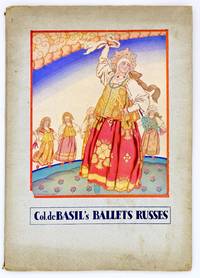
1936ref. 300382Paris: Alliance de Publicite et de'Impression 1936. Full color program for the 1936-1937 season of Ballet Russe de Monte Carlo presented by Col. de Basil. Cover illustration by I. Bilibine on silver paper jacket folded over plain covers~ ~66pp. with 4 pages of tipped-in color plates on both sides picturing different aspects of the production such as the costumes and scenery. Some wear to cover edges and bottom of spine. Good. Alliance de Publicite et de'Impression unknown
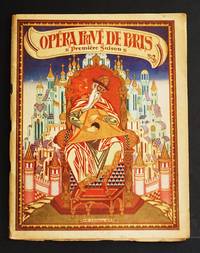
1929ref. 20354Paris: Opéra Privé de Paris 1929. Good/No Dust Jacket As Issued. RUSSIAN MODERNISM REBORN ON THE PARISIAN STAGE. A visually striking Première Saison program documenting the post-Diaghilev continuation of Russian operatic and theatrical culture in interwar Paris. Issued by the newly founded Opéra Privé de Paris in 1929 this richly illustrated production program for Rimsky-Korsakov's 'Tsar Saltan' preserves the artistic language of the Ballets Russes through tipped-in color costume and scenic designs after Ivan Bilibin and Alexandre Korovine. Founded immediately following the death of Sergei Diaghilev the Opéra Privé de Paris sought to sustain the creative energy of Russian émigré theater in Western Europe. This production united performers designers and musicians associated with the Russian diaspora transforming Pushkin's fairy-tale opera into a vivid expression of émigré modernism transplanted into the cultural life of Paris. PHYSICAL DESCRIPTION: Quarto format approximately 9.5 × 12.5 inches. Stapled illustrated wraps with full-color chromolithographic cover after Ivan Bilibin. Illustrated with six tipped-in color chromolithographs of costume designs after Bilibin executed from stage maquettes by Alexandre Korovine together with two additional tipped-in scenic plates and a tipped-in color portrait of Madame Maria Kousnezoff-Massenet by Nicolas Kousnezoff. Numerous illustrated period advertisements throughout including several full-page advertisements. CONDITION: One advertisement leaf detached but present. Plates remain vivid and visually strong with only light handling wear to the wraps. Staples sound. A well-preserved and unusually attractive example of interwar Parisian opera ephemera. Première Saison issue. Première Saison programs of the Opéra Privé de Paris survive in comparatively small numbers particularly examples retaining the full suite of tipped-in color plates after Ivan Bilibin. Comparable illustrated programs from this short-lived company appear only intermittently in the market especially in near-complete condition. HISTORICAL SIGNIFICANCE - The Opéra Privé de Paris was co-directed by the Russian soprano Maria Kousnezoff-Massenet and functioned as an important cultural bridge for displaced Russian artists after the Revolution. Though short-lived the company preserved important elements of Russian operatic staging and Ballets Russes visual identity during a transitional moment in European theater history. Ivan Bilibin's influence on Russian stage aesthetics remained profound well into the twentieth century and his designs for productions such as 'Tsar Saltan' helped define the visual mythology of Russian folklore on the international stage. This program captures a pivotal moment in the evolution of Russian theatrical modernism after the dissolution of the Ballets Russes. Following Diaghilev's death in 1929 Russian émigré artists in Paris sought new institutional forms through which to continue the aesthetic innovations that had transformed European stage culture during the previous two decades. The production of Rimsky-Korsakov's 'Tsar Saltan' adapted from Pushkin's fairy-tale poem provided an ideal vehicle for this visual and musical continuity. The decorative richness of Ivan Bilibin's folkloric imagery combined with the scenic interpretation of Alexandre Korovine preserves the highly ornamental stage language that became synonymous with Russian theatrical design in the early twentieth century. Beyond its theatrical importance the program also presents a vivid portrait of interwar Parisian cultural life. Its advertisements portraiture typography and chromolithographic inserts collectively illustrate the commercial and artistic environment surrounding Russian émigré performance culture in France between the wars. SUBJECTS: Ballets Russes Legacy Ivan Bilibin Stage Design Russian Émigré Art Paris Theater History Rimsky-Korsakov Tsar Saltan Interwar Opera Culture Russian Opera In Paris Chromolithographic Illustration Illustrated Performance Programs Opera Ephemera Theater History Russian Modernism Illustrated Programs. Opéra Privé de Paris unknown
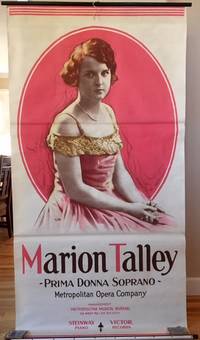
1924ref. 51696New York NY; Hollywood CA; Taos NM: Underwood & Underwood Anderson Lumiere Guard Vitaphone Studios Metropolitan Music Bureau 1924-1927. Twenty seven items. With 24 photographs 3 sized 3.5 x 5.5 in.; 6 sized 5 x 7.75 in.; 1 w/ colour-tinted blue sized 7.25 x 9.5 in.; 16 sized 8 x 10 in.; many w/ annotations dating the photos in pencil some of the press photos and studio photos stamped on versos with attached newsreel information blurbs many w/ text in negative at lower corner of image; 1 very large colour lithograph poster printed on linen showing the young opera star seated and colours of pink gold and black sized 40 x 80 in. w/ wood bars at upper & lower for hanging some minor creasing from rolling but in Fine condition; and TLS from Lawrence H. Smith at Underwood & Underwood Inc. News Picture Division to Miss Marion Talley. These photographs and giant lobby poster provide splendid artifacts for the lavish attention paid to a young star at the beginning of her career during the Jazz Age. The very large poster is a beautiful example of colour lithography showing her demurely seated against a pink lozenge background with advertisements at the foot of the poster for Steinway Piano and Victor Records. Marion Talley 1906-1983 was the daughter of a telegraph operator for the Missouri Pacific Railroad and by 15 she was appearing in the Kansas City Grand Opera Company of Mignon by Abroise Thomas and quickly became a local celebrity often performing benefit concerts. She studied with music teacher Frank LaForge famed soprano composer who maintained a close relationship with the Metropolitan Opera and was placed under contract in 1925 by Giulio Gatti-Casazza at age 19 becoming the youngest principal female performer in the Met’s history to that point. Her debut performance was Feb. 17 1926 as Gilda the daughter of the title character in Verdi’s Rigoletto. The press photos show her surrounded by the many flowers she received in the 18 encores her performance on stage meeting the opera diva Ernestine Schumann-Heinck d. 1936 as well as her appearance on radio with Marguerite D’Alvarez and Giovanni Martinelli singing Home! Sweet Home!. In addition she also starred in the first Vitaphone short sound films released in 1926 with Don Juan starring John Barrymore and another Vitaphone short performing “Bella figlia dell’amore” from Rigoletto but the critics were savage criticizing her performances and her lack of appeal on camera. During this period she traveled extensively to Europe and through the southwest as evidenced by the series of photos showing her in Taos with the burros young Native American children and adults in regalia as well as her automobile. The photo of the young star by Samuel Lumiere 1878-1971 is a very nice example of his portrait work during the height of the 1920s when he was under contract to shoot celebrities for the Chicago Tribune. See: Barrios A Song in the Dark: The Birth of the Musical Film pp. 20-29; Vitaphone Marks 80th Anniversary Vitaphone News The Vitaphone Project Vol. 8 No. 1 2006; Crafton The Talkies: American Cinema’s Transition to Sound 1926-1931 1999. Underwood & Underwood, Anderson, Lumiere, Guard, Vitaphone Studios, Metropolitan Music Bureau, unknown
1817ref. AQ35026London: s.n. 1817. Single leaf broadside. Browning and staining to edges with very small loss to lower right corner small hole and tear to title slightly obscuring final letters. A scarce playbill recording an early effort by London's Lyceum Theatre renamed The English Opera House in the summer of 1817 to present an illumination of the 'audience part of the theatre' during a performance of 'Free and Easy' a comic opera. Although the use of gaslight in street-lamps had first been demonstrated a decade prior in 1807 the goal to introduce gaslighting to the commercial stage took years to evolve into the competitive landscape of 1817 where three of London's premier West End venues the Theatre Royal Covent Garden Theatre Royal Drury Lane and the Lyceum Theatre entered into a rapid race to produce the first fully-gaslit public performances in a West End venue. The Royalty an East End theatre later renamed The East London Theatre had previously installed gas piping and lighting fixtures across both the auditorium and the stage in 1816 demonstrating the viability of such a project. The English Opera House led by director Samuel Arnold proudly boasted on August 6 1817 that 'Gas Lighting will this evening be introduced over the whole stage' seemingly claiming themselves the winners of the century's most contested technical theatre contest. Despite this the lack of an illuminated auditorium meant that the theatre's audience remained in candlelight until a month later when the venue opened fully illuminated for the first time. The Theatre Royal Drury Lane despite only revealing its gaslit stage on the 6th September 1817 was able to argue that due to their introduction of gaslighting into the auditorium several weeks prior they were in fact the first of the three theatres to achieve the much vied- for feat. On the same night The Theatre Royal Covent Garden also offered a demonstration of gaslight on their stage finally concluding the rivalry and introducing a vital element of technical staging into London's leading venues for the remainder of the century. Rare; COPAC records no copies in the UK OCLC adds a single copy overseas Yale. . Dimensions 170 x 340 mm. [s.n.] unknown
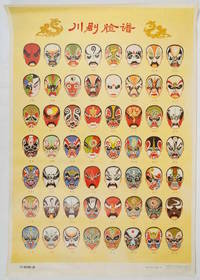
1986ref. 223029Sichuan.: 四川美术出版社. Sichuan meishu chubanshe. 1986. Poster showing 56 captioned Chinese Sichuan Opera facepaint masks. Text in simplified Chinese characters 76 x 52.5cm occasional light creasing corner pinholes in very good and bright condition. In Chinese opera individual characters are distinguished by highly codified facial make-up often described as painted “masks” and in some regional traditions particularly Sichuan opera by the use of actual masks. These visual conventions function as an interpretive guide for audiences signalling a character’s identity personality and moral attributes. Musical style facial design and costume vary markedly between regional operatic forms including Beijing opera Sichuan opera Yue opera and Cantonese opera reflecting distinct local performance traditions and aesthetic systems. . 四川美术出版社. [Sichuan meishu chubanshe]. unknown
1986ref. 628687Scholar Books Publishers 1986. 324 pp. 5 pp. folded leaf. 38.5 x 27 cm. White cloth covered boards with gilt lettering and illustration to spine and cover in a glossy pictorial dustjacket with gitl lettering with a folded booklet with title and contents in English. Light bumps and some rubbing and light wear to spine ends and corners of dustjacket. Price tag at tail of spine of jacket which is protected in a mylar cover. Interior is clean and unmarked. Binding sound. Due to the considerable size and weight of this book additional shipping may be required for expedited and international orders. . Hard Cover. Very Good/Very Good. Scholar Books Publishers hardcover
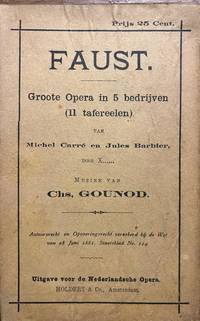
ref. R1166-013Original paper binding on yellow paper some discoloration and folds but further in good condition. Songtext printed on paper 16 x 10 cm.Klassik Stitung Weimar. Herzogin Anna Amalia Bibliothek dates this song at around 1881 in Worldcat catalogue.Liedtekst - Songtext - Song - Lied - Opera Faust unknown
ref. 0865340277.Gpaperback. Good. Access codes and supplements are not guaranteed with used items. May be an ex-library book. paperback
1808ref. 354London: Lowndes Printer 1808. First Edition. Broadside. Fine. Broadside approximately 11 1/2 x 8 1/2 inches untrimmed. Portion of bottom line of text unprinted. Small remnants of paper tape on verso else fine. Broadside advertising the twelfth performance of the opera KAIS OR LOVE IN THE DESERTS at Drury Lane starring and produced by the renowned English tenor John Braham. John Braham ca. 1774-1856 rose from poverty and orphanhood in London to the heights of European opera where he celebrated as one of the great voices of his age. As a British Jew he also represented a major shift in Jewish status and social potential in the late Georgian era becoming not only an artist of acclaim but also eventually the father-in-law of several English aristocrats. KAIS was based on the ancient Arabian love story of Layla and Majnun which had been adapted into a famous work by Persian Poet Nizami Ganjavi in the 12th century which in turn became the source for numerous later poets and mystics throughout the Middle East and Central and South Asia. The story gained great popularity in Europe after Isaac DIsraeli published an English translation in the early 19th century. It was upon this translation that Isaac Brandon based the libretto for KAIS. Braham and William Reeve composed the music for the opera which opened in 1807. Lowndes, Printer
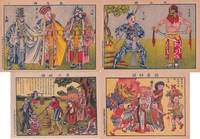
ref. 219368Tianjin.: 毓順成 芳記. Yushuncheng fangji. Early 20th Century. Four handbills showing popular images two 13.2 x 18.4 are images of characters from Peking Opera and two 12.2 x 16.5cm depict themes important in Chinese society at the time. Text in traditional Chinese characters. Light even browning tiny closed tears at margin of one sheet repaired with washi. Very good. Chinese opera characters in the style of traditional woodblock prints were popular in the late Qing dynasty and early Republican period. Handbills of characters from Beijing opera were sold as collectible items that also helped to familiarise people with the characters of different operas; their costumes make up weapons and names. In this case there are two characters from the opera 白水灘 on one handbill and three characters from the opera 落馬湖 on the other. Images with social themes also made popular handbills especially in places such as Tianjin where the influence of foreigners was pronounced. In 福壽財源 we see an immortal carrying a peach of longevity surrounded by images of fertility - a young woman and boys carry fruit and flowers as well as other items symbolic of wealth - a coin a vase gold ingots and so on probably issued for New Year. The final handbill of the four 娶大媳婦 tells the tale of a girl of eighteen married to a boy of seven. The Chinese custom of marrying a young boy to an older girl adopted into the family is thus open for discussion - everyone in the image clearly has a different opinion of the situation; from the young husband the older farmer in the background and the two men in long scholars robes to the modern young man in a western suit with leather shoes as well as the girl herself. The practice of adopting a girl to bring up as a future wife for a male child was made illegal in 1949. The text mentions some of the ways in which the girl would be expected to help in her adoptive family's home. . 毓順成 芳記. [Yushuncheng fangji] hardcover
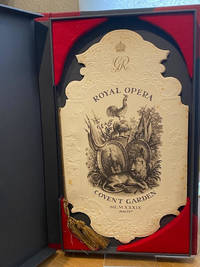
1939ref. 63657London: Royal Opera House 1939. Folio. 8 pp. Large pictorial stiff card wrappers with tassels at spine. In custom made half red morocco solander box with leather title label and felt corner-pieces. Front and rear cover designs by Rex Whistler. Printed programme. Spotting to covers. Internally fresh. A performance by the Vic-Wells Ballet under the direction of Ninette de Valois and The London Philharmonic Orchestra conducted by Constant Lambert and Sir Thomas Beecham. Scarce. Very good example. . Near Fine. Wraps. 1939. Royal Opera House 1939 paperback
ref. 4-39274Roma 1927 8vo br. pp. 85 con tav. fot. f.t. unknown
ref. 113823Turnhout Brepols 1969. 1088 columns. H.cl. 28 cm Rebound unknown
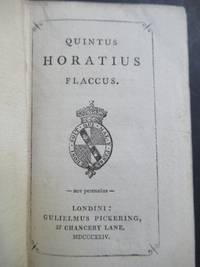
1824ref. 24569London: William Pickering 1824. Pickering's Diamond Classics. Spine faded as usual spine label with chip. Bookplate. Pickering's Diamond Classics". Miniature book 3 1/2" x 2". 192p. In the publisher's original binding of cloth with paper spine label. Welsh 3564; Kelly 1824.3; Bondy p. 87; Keynes p. 73. William Pickering unknown
1910ref. 42191AB1910. Lugano Cooperativa Umanista no year c.1910. 15.2cm x 10.3cm. 23 pages. Original softcover. Very good condition with only minor signs of external wear. paperback
1828ref. 19680London: William Pickering 1828. Pickering's Diamond Classics. Endpapers discolored from the binding else fine. Pickering's Diamond Classics". Miniature book 4 3/8" x 2". 192p. With DOUBLE FORE-EDGE paintings by Martin Frost depicting Roman scenes within geometric panels. Bound in full green morocco a.e.g. the spine with gilt titles and simple panel ornaments covers with multiple rules in blind pink endpapers dentelles. Welsh 3565. William Pickering unknown
ref. 0960584404.Gplastic_comb. Good. Access codes and supplements are not guaranteed with used items. May be an ex-library book. unknown
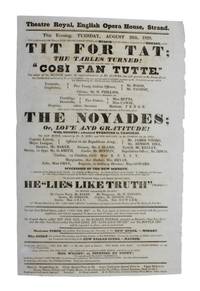
1828ref. AQ34991London: S. G. Fairbrother Lyceum Printing Office 1828. Single leaf broadside. Browned with chipping to edges. Small hole to lower left-hand side touching text without loss of sense. A Regency playbill advertising the performance of Tit for Tat a comic opera adapted from Mozart's opera buffa Così fan tutte first performed in England during May 1811 at the King's Theatre London. Mozart's libretto and score was adapted by William Hawes 1785-1846 director of music at the English Opera Lyceum. . Dimensions 337 mm x 216 mm. S. G. Fairbrother, (Lyceum Printing Office) unknown