20.251 risultati
rif. 201015863Paris, Fernand Nathan, 1979 ; in-4, 238 pp., cartonnage d'éditeur avec jaquette. Très bon état - mais un peu jauni sur les bords.
rif. 202501850Paris, Editions du Chene, 2000 ; grand in-4, 199 pp., cartonnage de l'éditeur. Très bon état avec sa jaquette.
rif. 201612056Paris, Editions du Chene, 2000 ; grand in-4, 199 pp., cartonnage de l'éditeur. Très bon état avec sa jaquette.
rif. 201222220Paris, Editions sauret, 1993 ; in-8, 371 pp., br.
rif. 201221342Paris, Calmann Lévy, s.d. ; in-12, 93 pp., br.
rif. 201012305Paris, Henri Guichaoua éditeur - les grandes mises en scène du XXe siècle - série opéra, 1956 ; in-8, 70 pp., broché, couverture illustr. TRÈS BON ÉTAT - musique de Jean-Philippe Rameau révision musicale de Paul Ducas et Henri Busser préludes parlés de rené Fauchois - exemplaire sur alfa mouse navarre n° 278/3000.
rif. 593968Paris, Choudens fils, s.d. (fin XIXe). In-4, rel. de l'ép. plein maroquin vert, dos à 5 nerfs, titre doré, double encadrement à froid sur les plats, dentelle intérieure ; titre illustré, 202 pp. de musique.
1980rif. 97733Paris, Arthéna 1980 In-4 29 x21,5 cm. Reliure éditeur pleine toile bleu-roi, jaquette en couleurs, 195 pp., 12 illustrations en couleurs, 223 illustrations en noir & blanc, biographies des artistes, table des matières. Exemplaire en bon état.
rif. 201001723Paris, Opéra national de paris - opéra bastille, 2003 ; in-8, 148 pp., broché, couverture illustr. Saison 2003-2004 - très bon état.
rif. 201413824Paris, Desclée de brouwer , 1984 ; in-4, 124 pp., br.
rif. 201900593Toulouse, Editions Ombres, 1990 ; in-4, cartonnage de l'éditeur. Avec jaquette.
rif. L7791Théâtre des Champs Elysées, 1930. Plaquette in-4 agrafée. Premier plat illustré par Ivan Bilibine. Programme de la 2 e. saison. Prince Igor, musique de Borodine, avec Féodor Chaliapine dans le rôle du Prince Galitzky. Chorégraphie d'après M. Fokine, avec Alexandra Balachova. Reproductions en couleurs des décors et costume d'après I. Bilibine, contrecollées. Présentation par Charles-Morrice. Présentation de l'Opéra avec de Borodine et distribution des rôles. Nombreuses photographies, publicités, etc. E.O.
rif. L12237Bureau des écrivains afro-asiatiques, 1967. In-12 agrafé. Couverture illustrée. Photographies hors-texte. Pièce modèle de l'Opéra de Pékin à thème révolutionnaire contemporain. E.O.
rif. 200908176Paris, CALMANN LEVY , s.d. ; in-12, 50 pp., broché.
rif. 200907744Paris, CALMANN LEVY , s.d. ; in-12, 50 pp., broché.
rif. L16652Publication du Théâtre Bolchoï, 1935. In-4 br. Portrait de Rimski-Korsakov contrecollé en frontispice. Premier et second plats illustrés de bois par A.A. Souvorov. Illustrations en couleurs et en noir & blanc de V.F. Smirnov et S.I. Aferov. Livret de Rimski-Korsakov, d'après les bylines et légendes populaires russes. Postfaces de S.V. Bakhrouchine et S. Dmitriev. Textes en russe. E.O.
rif. 2905Recueil factice de 7 livrets d'opéras, reliés en un volume in 16, reliure demi chagrin cerise à coins, dos lisse orné, tranches dorées (plats légèrement frottés) ; petites mouillures claires marginales aux dernières pages ; piqûres éparses.
rif. 8772CAHIERS DE LA COMPAGNIE RENAUD-BARRAULT, N° 24, Julliard, novembre 1958. In-12, broché.
1817rif. AQ35026London: s.n. 1817. Single leaf broadside. Browning and staining to edges with very small loss to lower right corner small hole and tear to title slightly obscuring final letters. A scarce playbill recording an early effort by London's Lyceum Theatre renamed The English Opera House in the summer of 1817 to present an illumination of the 'audience part of the theatre' during a performance of 'Free and Easy' a comic opera. Although the use of gaslight in street-lamps had first been demonstrated a decade prior in 1807 the goal to introduce gaslighting to the commercial stage took years to evolve into the competitive landscape of 1817 where three of London's premier West End venues the Theatre Royal Covent Garden Theatre Royal Drury Lane and the Lyceum Theatre entered into a rapid race to produce the first fully-gaslit public performances in a West End venue. The Royalty an East End theatre later renamed The East London Theatre had previously installed gas piping and lighting fixtures across both the auditorium and the stage in 1816 demonstrating the viability of such a project. The English Opera House led by director Samuel Arnold proudly boasted on August 6 1817 that 'Gas Lighting will this evening be introduced over the whole stage' seemingly claiming themselves the winners of the century's most contested technical theatre contest. Despite this the lack of an illuminated auditorium meant that the theatre's audience remained in candlelight until a month later when the venue opened fully illuminated for the first time. The Theatre Royal Drury Lane despite only revealing its gaslit stage on the 6th September 1817 was able to argue that due to their introduction of gaslighting into the auditorium several weeks prior they were in fact the first of the three theatres to achieve the much vied- for feat. On the same night The Theatre Royal Covent Garden also offered a demonstration of gaslight on their stage finally concluding the rivalry and introducing a vital element of technical staging into London's leading venues for the remainder of the century. Rare; COPAC records no copies in the UK OCLC adds a single copy overseas Yale. . Dimensions 170 x 340 mm. [s.n.] unknown
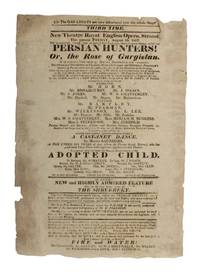
1817rif. AQ35159London: s.n. 1817. Single leaf broadside. Browned with staining and chipping to edges and some loss to upper right corner. An apparently unrecorded playbill displaying an early effort by London's Lyceum Theatre renamed The English Opera House in the summer of 1817 to present an illumination of the 'audience part of the theatre' during a performance of The Persian Hunters or the Rose of Gurgistan a comic opera featuring music by English composer Charles Edward Horn 1786-1849. Although the use of gaslight in street-lamps had first been demonstrated a decade prior in 1807 the goal to introduce gaslighting to the commercial stage took years to evolve into the competitive landscape of 1817 where three of London's premier West End venues the Theatre Royal Covent Garden Theatre Royal Drury Lane and the Lyceum Theatre entered into a rapid race to produce the first fully-gaslit public performances in a West End venue. The Royalty an East End theatre later renamed The East London Theatre had previously installed gas piping and lighting fixtures across both the auditorium and the stage in 1816 demonstrating the viability of such a project. The English Opera House led by director Samuel Arnold proudly boasted on August 6 1817 that 'Gas Lighting will this evening be introduced over the whole stage' seemingly claiming themselves the winners of the century's most contested technical theatre contest. Despite this the lack of an illuminated auditorium meant that the theatre's audience remained in candlelight until a month later when the venue opened fully illuminated for the first time. The Theatre Royal Drury Lane despite only revealing its gaslit stage on the 6th September 1817 was able to argue that due to their introduction of gaslighting into the auditorium several weeks prior they were in fact the first of the three theatres to achieve the much vied- for feat. On the same night The Theatre Royal Covent Garden also offered a demonstration of gaslight on their stage finally concluding the rivalry and introducing a vital element of technical staging into London's leading venues for the remainder of the century. . Dimensions. [s.n.] unknown
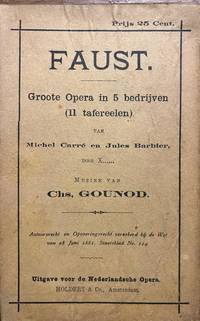
rif. R1166-013Original paper binding on yellow paper some discoloration and folds but further in good condition. Songtext printed on paper 16 x 10 cm.Klassik Stitung Weimar. Herzogin Anna Amalia Bibliothek dates this song at around 1881 in Worldcat catalogue.Liedtekst - Songtext - Song - Lied - Opera Faust unknown
rif. 564618Firenze, Leo S. Olschki, 1952. Grand in-8 carré, rel. d'éditeur toile bordeaux titrée en doré, sous étui cartonné, XXIV-652 pp. (Biblioteca di Bibliografia Italiana -Supplementi Periodici a la Bibliofilia, XXIII). Exemplaire numéroté.
rif. 201900886S.l., Gerard billaudot editeur, 1971 ; in-8, 301 pp., br.
rif. 45435P., Gennequin, 1877, in 4° relié demi-basane verte, dos lisse orné, 208 pages de partitions et 108 pages ; quelques rousseurs ; des défauts à la reliure.
rif. 564385A Paris, Chez Naderman, 152 et 157 (Ecrit par Ribière), s.d. [ca 1785] 2 sonates de ce musicien réunies en un vol. In-folio, cartonnage de l'époque bleu, marbré, étiquette de titre manuscrite "Accompagnement de Basse, pour deux oeuvres de Sonates de Kozeluch", 14 pages texte et musique gravés, partitions pour violoncelle, Sonata 1.