39.873 Ergebnisse
1986Best.-Nr. 221360Princeton University Press 1986-02-21. paperback. Good. 7x1x10. Clean has a good binding no marks or notations. Princeton University Press paperback books
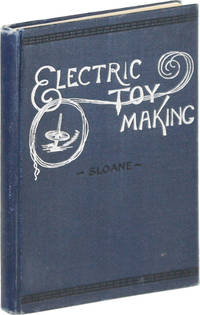
1899Best.-Nr. 52423New York: Munn & Co 1899. Early reprint. 12mo 18cm. Publisher's blue cloth board title decoratively stamped in silver on front board; viii9-140pp; illus; 4pp publisher's ads. Trace of rubbing at spine ends and board corners; text clean tight and unmarked; Very Good or better. A highly technical treatise and possibly the first manual of its kind. First published in 1891 OCLC notes reprints as late as 1921. Munn & Co unknown books
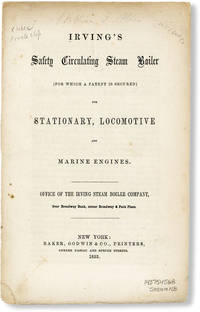
1853Best.-Nr. 48954New York: Baker Godwin & Co 1853. First Edition. Octavo 23.5cm.; side-stitched self-wrappers; 8pp. Faint vertical fold some light toning and wear to extremities bottom half of spine split 20th century private library rubberstamp to title page verso else Good or better overall. Errata slip laid in. Apparently unrecorded advertising pamphlet for Irving's boiler mentioned in an article in "Scientific American" in the same year: "Those who want cheap steam in the growing scarcity and advancing price of fuel would do well to give this boiler a serious examination." Not catalogued in OCLC as of April 2020. Baker, Godwin & Co unknown books
1828Best.-Nr. 50246Philadelphia / London: Judah Dobson / John Miller 1828. Octavo 21cm.; removed; 51pp.; illus. in text. Some foxing to textblock small damp spot at top fore-edge corner of first few leaves else Very Good and sound. First edition for a British readership. Missed by Sabin. Judah Dobson / John Miller unknown books
1850Best.-Nr. 50089New York: J.S. Redfield 1850. First Edition. Octavo 22.5cm.; removed; 10210adspp.; text illus. throughout publisher's advertisements in rear printed wtihin decorative border. Some foxing throughout else Very Good and sound albeit lacking wrappers. Much of the contents are devoted to an article on the propulsion of steamers with detailed and generously illustrated observations on animal propellers including that of fish marine mammals birds and bats. Uncommon. J.S. Redfield unknown books
1885Best.-Nr. 49879Boston: Geo. H. Ellis 1885. First Edition. Slim octavo 23cm.; publisher's tan printed wrappers; 28pp. Upper cover separated but present with a few small losses to extremities some toning and light dust-soil else Good internally sound. Inscribed and signed at head of upper cover "Dr. Bowditch with the regards of G.L. Vose." Possibly inscribed to the physician and abolitionist Henry Ingersoll Bowditch 1808-1892 son of Nathaniel Bowditch. Geo. H. Ellis unknown books
1870Best.-Nr. 48955Troy NY: American Association for the Advancement of Science 1870. First Edition. Octavo 23cm.; publisher's green printed wrappers; 23pp. Wrappers a bit soiled with some shallow creasing and dog-earing to textblock else Very Good and sound. At head of title page: "Metallurgical Papers No. 15." Scarce published edition of the author's first scientific paper read before the American Association for the Advancement of Science at Troy New York August 20 1870 and described as "the first account of the Bessemer steel process published in the United States and a useful analogue of the earth's own blast furnaces" anb.org. AAS only in OCLC as of April 2020. American Association for the Advancement of Science unknown books
1887Best.-Nr. 48930La Salle IL: Democrat-Press Print 1887. First Edition. 24mo 13cm.; publisher's tan printed stitched wrappers; 16pp. Light soil to upper cover extensive but fairly inoffensive contemporary scribbles to rear cover else Very Good or better. Apparently unrecorded we find no separately catalogued copies in OCLC as of April 2020. Democrat-Press Print unknown books
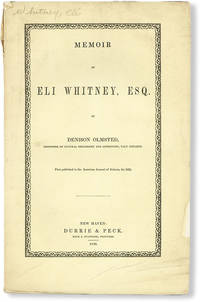
1846Best.-Nr. 49661New Haven: Durrie & Peck 1846. First Separate Edition. Octavo 23cm.; original pale yellow wrappers printed within decorative border; 80pp.; engraved portrait frontispiece and one additional plate pink tissue guards. Wrapper extremities a bit chipped and worn with shallow loss at spine crown general dust-soil else Very Good internally fine. Lengthy biographical article first published in the "American Journal of Science" 1832. Missed by Sabin. Durrie & Peck unknown books
1815Best.-Nr. 49862New-York: David Longworth 1815. First Edition. Octavo 20.5cm.; removed; 148pp. Top third of first few leaves quite darkened title page serving as upper cover somewhat chipped with a few tiny losses none approaching text else Good to Very Good overall. From the DAB: ".considered a lucid account of the current state of American scientific research." The discourse pp. 3-38 is followed by more than one hundred pages of notes and citations. SABIN 13715; SHAW & SHOEMAKER 34371. David Longworth unknown books
1909Best.-Nr. 44796New York: D. Appleton and Company 1909. First Edition. Octavo 19.5cm.; publisher's terracotta cloth lettered in gilt; xi1270pp.; photographic frontispiece illus. throughout. Light shelf wear corners a bit bumped slight spine lean contemporary ownership signature else Very Good to Near Fine. D. Appleton and Company unknown books
1921Best.-Nr. 9012801Boston: MIT 1921. Hardcover. Very good condition. Published by the Junior Class. The gilt on the front cover and spine has been rubbed and faded. Stains to the covers. Foxing to some pages and the edges. MIT hardcover books
1972Best.-Nr. S11345Mexico City:: Sociedad Mexicana de Historia de la Ciencia y de la Tecnologia 1972-79. 1972. 3 volumes nos. 3 4 & 5; Vols. 4-5 stated one of 1000 copies. 8vo. iv 352; iv 348; iv 147 pp. Original printed wrappers; lightly smudged and rubbed rear cover Vol. 4 with small closed hole. Burndy Library bookplates. Very good. Featuring an entire volume dedicated to the memory of Izquierdo a prolific Mexican doctor and historian of science who specialized in physiology. Sociedad Mexicana de Historia de la Ciencia y de la Tecnologia, 1972-79. unknown books
1937Best.-Nr. 39320Berlin: Deutsche Reichspost 1937. Near fine. Trilingual booklet produced to accompany the Deutsche Reichspost's videophone service exhibited and displayed in the German Pavilion at the 1937 Paris Exposition. Illustrated with black and white photographs this work produced under the Nazi regime shows an operator seated in the "cabin of the television-telephone" equipped with handset and view-screen: "For the talky transmission a highly qualified apparatus made by Telefunken is used a telecine scanner fitted with a Cinema-projector with a constant film transport and optical picture balance works together with an iconoscope in such a way that this scanning apparatus with another iconoscope can be easily interchanged." An uncommonly early work in the development of television and the electronic transmission of visual imagery melding German nationalism with futurism. 8" x 5.75". Saddle-stapled color pictorial wraps. 21 pages. Minor edgewear; faint touches of soil to back cover. Deutsche Reichspost unknown books
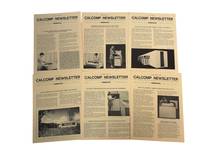
1976Best.-Nr. 238791976. California Computer Products corporate newsletter run from 1976 documenting CalComp's expansion from the computer plotters that established its early reputation into disk storage automated tape libraries printers and integrated peripheral systems for corporate and scientific computing. The six issues follow the company's products into working installations at ARCO Getty Oil hotel information systems and other commercial environments while international distribution reports trace sales activity in Europe Canada Iran and Turkey. A recurring "Gallery of Fine Art" supplies a parallel record of computer graphics practice reproducing portraits mathematical abstractions landscapes and other images produced through CalComp plotting equipment. CalComp Newsletter. Anaheim California: California Computer Products Inc. 1976. Six bimonthly issues constituting the January/February through November/December 1976 run. 8.5 x 11 inches. Illustrated throughout with photographs of equipment and installations technical diagrams and computer generated artwork. 1 CalComp Newsletter January/February 1976. Announces the new CalComp 836 "high performance low cost table top plotter" describing a 36 inch drawing speed and intended applications in design laboratories offices and similar environments. The verso "Gallery of Fine Art" includes a portrait submitted by Michael Ward Computer Applications Division Earth Satellite Corporation. 2 CalComp Newsletter March/April 1976. Leads with "CALCOMP UNVEILS HIGH CAPACITY DISK DRIVE SHOWS NEW PLOTTER FOR FIRST TIME AT NCC" introducing the Trident disk drive family and CalComp 960 plotter. The latter is described as a vertical plotter capable of operating at 30 inches per second; the verso reproduces a circular computer generated composition submitted by Bob Matzel of Stanford Linear Accelerator. 3 CalComp Newsletter May/June 1976. Reports "CALCOMP AUTOMATED TAPE LIBRARY AT ARCO LOS ANGELES" describing an installation at the ARCO Los Angeles Data Center designed to process the company's computing requirements through automated tape handling. The "Gallery of Fine Art" includes a landscape generated on a CalComp system and an interior view of the automated tape mechanism. 4 CalComp Newsletter July/August 1976. Leads with "HOTEL INFORMATION SYSTEM USES TRIDENT DISK DRIVES" describing CalComp Trident T 50 disk drives in an EECO hotel information system and identifying installations at the MGM Grand Hotel and the Aladdin in Las Vegas the Sheraton Waikiki the El Dorado Beach Hotel and the Hotel Inter Continental Paris. Its computer art page reproduces a portrait after an eighteenth century subject and announces expanded CalComp organization in Canada and an Iranian distributorship agreement. 5 CalComp Newsletter September/October 1976. Announces a distribution agreement with Agfa Gevaert of Antwerp for CalComp products in Western Europe and an expansion of the company's 1035/235 disk storage systems. The "Gallery of Fine Art" reproduces "Unequal Mass Particles" submitted by Professor Norton Starr of Amherst College's Department of Mathematics a plotted mathematical form generated with a CalComp plotter. 6 CalComp Newsletter November/December 1976. Leads with "GETTY OIL COMPANY USES CALCOMP 936 IN MANY WAYS" describing use of the 936 drum plotting system for seismic exploration financial charts pipeline monitoring and related technical work. A second report describes North American Business Equipment's use of CalComp disk graphics and automated tape library systems. The final "Gallery of Fine Art" presents a multicolored geometric composition submitted by Gary J. Soukup systems engineer with The Upjohn Company produced through a CalComp graphics program and three color pens. California Computer Products occupied a specialized position in the postwar computing industry by producing machinery that converted computer data into stored printed and plotted information. By 1976 the newsletters show the breadth of that business through named installations rather than product announcements alone. ARCO's automated tape library addresses the physical management of large quantities of magnetic tape; Getty Oil's 936 plotting system converts seismic and financial data into working charts; hotel installations connect disk storage to reservation and information systems; and international distribution agreements document the movement of American peripheral equipment into overseas markets. The "Gallery of Fine Art" pages extend the same technology beyond routine corporate output. Their portraits mathematical surfaces landscapes and geometric abstractions show users testing plotting equipment as a graphic medium including work originating at Stanford Linear Accelerator Amherst College Earth Satellite Corporation and The Upjohn Company. No major signs of wear or creasing; sheets remain clean and well preserved. Overall very good condition. A complete 1976 corporate record of CalComp technology moving between data storage industrial computing scientific visualization and computer generated graphic production. unknown books
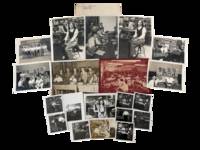
1940Best.-Nr. 233241940. Dictaphone Corporation factory photographs documenting women and men manufacturing dictating machines in Bridgeport Connecticut circa 1940s showcasing the postwar expansion of women's employment inside a growing communications technology industry. The group centers on Dictaphone's Bridgeport plant at 335 Howard Avenue where workers appear at long rows of benches with recording and transcription equipment tool drawers lamps wiring and partly assembled machines placing this archive within the larger World War II and postwar reorganization of American factory labor. Several photographs give women a central place within that system not as incidental figures but as seated operators bench workers and posed employees inside the production rooms themselves grounding the archive in the history of women's industrial employment as office technology manufacturing expanded beyond clerical use into large scale commercial production. Archive of 21 pieces including 20 black and white and one red photographs ranging from 2" x 2" to 5" x 7" and original envelope. Bridgeport Connecticut circa 1940s. One original company envelope is printed "DICTAPHONE CORPORATION / 335 HOWARD AVENUE / BRIDGEPORT CONN." fixing the factory location. Interior views show crowded production rooms under fluorescent strip lighting with dozens of workers seated at benches operating or assembling dictating machines and related components; in the largest image male workers fill a deep factory floor while several men in the foreground lean into handsets or testing devices at stations packed with equipment. One view shows a male worker alone at a bench in a long machine lined room with belts tools and suspended mechanisms overhead; several smaller prints show women seated at desks or worktables women and men posed together on the shop floor and mixed groups of workers assembled outdoors or around demonstration tables with supervisors and visiting men in suits. The images repeatedly emphasize rows of benches machine bodies cords lamps and standardized work positions while the envelope and repeated factory interiors tie the lot to Dictaphone's manufacturing operation rather than to sales or office promotion alone. During World War II and the immediate postwar years firms producing office equipment occupied an important place in the broader American communications and business machine economy supplying devices that organized dictation transcription record keeping and administrative workflow for corporations law offices and government users. This archive makes that industrial system visible at the level of labor showing how the growth of business technology relied on factory discipline gendered employment patterns and the integration of women into production space during a period when wartime labor demand altered who worked at the bench and who appeared in the industrial workforce. Light edge wear envelope toned. Overall very good condition. A concentrated visual record of 1940s office machine manufacturing placing women's industrial labor inside the production history of one of the leading American dictation companies. unknown books
1956Best.-Nr. 231011956. Guided Missiles USSR Coild War Soviet guided missile technology archive documenting Russian weapons development and civil defense planning during the Cold War when ballistic missile systems and nuclear strategy defined global military competition between the United States and the Soviet Union. Issued by Soviet military and state publishing bodies these works provide direct evidence of how missile guidance rocket engineering and industrial survivability were formalized taught and disseminated within Soviet scientific and defense institutions. All text in Russian. The archive supports research into Cold War military science Soviet technological education and the integration of weapons systems knowledge with civil defense planning under conditions of anticipated nuclear conflict. Archive of five books published between the mid-1950s and early 1970s encompassing both technical instruction and applied military doctrine. The group includes translated and domestically produced works on guided missile systems as well as a civil defense manual addressing industrial resilience under nuclear conditions. Archive includes: 1 Burgess Eric. Guided Weapons. London 1957; Russian translation: Moscow: Izdatelstvo Inostrannoy Literatury 1958. Illustrated blue boards. 8vo. 325 pages. Technical overview of guided missile systems including propulsion control mechanisms and early missile design principles based on Western research. 2 Lyapunov B. V. Guided Projectiles. Moscow: Voennoe Izdatelstvo Ministerstva Oborony SSSR 1956. Illustrated wrappers. 8vo. 136 pages. Introductory military-scientific text explaining the structure and function of guided munitions within Soviet weapons systems. This volume establishes foundational terminology and conceptual frameworks for missile technology within Soviet military education. A few pen markings and ex-libris stamps. 3 Petrov V. P. Guided Missiles and Rockets. Moscow: Izdatelstvo DOSAAF 1957. Illustrated wrappers. 8vo. 118 pages. Expanded treatment of rocket systems and guided weapons likely intended for paramilitary or technical training audiences associated with DOSAAF. Some minor loss to spine and foxing on cover. Binding tight. 4 Marisov V. I. and Kucherov I. K. Guided Projectiles. Moscow: Military Publishing House of the Ministry of Defense. 1959. Illustrated blue and yellow boards. 8vo. 259 pages. Mid-century instructional work focused on guided weapons systems with emphasis on operational and mechanical principles. This volume reinforces standardized Soviet instruction on missile technology. Some pen and pencil markings on title page and back pastedown. 5 Headquarters of Civil Defense of the USSR. Manual on Increasing the Stability of Industrial Operations in a Missile Nuclear War. Moscow: Voennoe Izdatelstvo Ministerstva Oborony SSSR 1972. Light blue wrappers. 8vo. 95 pages. Civil defense manual detailing procedures for maintaining industrial productivity and infrastructure resilience under conditions of missile and nuclear attack. Some loss to spine minor markings on cover and title page. Binding tight. Together these works document the convergence of military engineering scientific education and civil defense policy in the Soviet Union during the height of the Cold War when guided missile technology and nuclear strategy reshaped both warfare and domestic planning. The inclusion of both technical manuals and civil defense instruction shows how missile systems were not only weapons platforms but also organizing principles for industrial and societal preparedness. Light wear including edge wear creasing and handling marks; some volumes with softcover wear and minor staining; binding sound on all volumes; overall very good condition. This archive offers material evidence of how the Soviet state disseminated complex military knowledge across professional educational and civilian sectors contributing to broader studies of Cold War science technology transfer and defense infrastructure. unknown books
1960Best.-Nr. 224301960. Space and Aviation Military LeGalley Donald P. ed. Ballistic Missile and Space Technology: Fifth Symposium on Ballistic Missile and Space Technology - Invited Addresses. New York and London: Academic Press 1960. First edition. 4to. Volume IV of four titled Re-entry and Vehicle Design. 46 pages. Brown cloth boards with gilt title lettering. Published proceedings from the Fifth Symposium on Ballistic Missile and Space Technology held August 29-31 1960 at the University of Southern California this volume documents high-level invited addresses from a watershed Cold War gathering of over 1000 military scientists engineers and corporate contractors. The symposium was co-sponsored by the U.S. Air Force Ballistic Missile Division Space Technology Laboratories and the newl Aerospace Corporation. It marks a critical moment in the integration of Cold War military strategy with emerging space exploration infrastructure as the field transitioned from classified weapons development toward publicly visible space initiatives. The preface recounts that the symposium was conceived to provide "a free exchange of technical information and ideas among the engineers and scientists working on the United States ballistic missile and space programs." In 1960 this included domains such as "hypersonics aerodynamic heating material structures propulsion communications computers bio-astronautics guidance etc." The featured keynote address by Lt. Gen. Bernard A. Schriever-widely regarded as the architect of the U.S. Air Force's ballistic missile program-is titled "The Importance of Management in the Ballistic Missile and Space Vehicle Programs." In it Schriever offers a revealing fiscal and institutional overview noting "Our budget at BMD this year for ballistic missile and space activities is just about $3 billion. in the last six years something on the order of $10 billion has been put into the program." He underscores that the technical marvels of the nuclear rocket age were matched by vast logistical and bureaucratic scale: "This means people organizations policies procedures-many things." Minor shelfwear light rubbing to cloth but internally clean and tightly bound. Overall very good condition. unknown books
1974Best.-Nr. 176821974. The First Ad Spot for a Personal Computer in Print 1974 QST Magazine Vol. 58 number 3. Newington Connecticut. March 1974 edition. 6.5" x 9.5" inches. This edition of QST Magazine an amateur radio enthusiast magazine has the first ever advertisement in print of a personal computer. In 1974 computers were mostly associated with government and research institutions but the SCELBI-8H was the first personal computer to hit the consumer market. Fewer than 150 board sets and assembled systems were ever sold. Later in 1975 the availability of systems based on the more flexible 8080 processor reduced demand for the slower 8008-based product. The company discovered that the demand for books on microcomputers was very high and published several books; the publishing business was sold in 1982. While not much came of SCELBI this magazine is unique as it is the first glimpse of the incoming digital revolution that has changed our lives. In near fine condition; binding is tight and interior is clean. unknown books
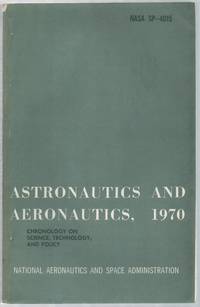
1972Best.-Nr. 456908Washington D.C.: NASA Scientific and Technical Information Office 1972. Softcover. Very Good. First edition. Tall octavo. 510pp. Illustrated. Printed wrappers. Light general wear a very good or better copy. A day-by-day account of aerospace-related events of 1970. NASA SP-4015. NASA Scientific and Technical Information Office unknown books
1823Best.-Nr. 94781823. Warden David Bailie. Irish Geographer. He published "Statistical Political and Historical Account of the United States of North America" "Bibliotheca Americana Septentrionalis and "Bibliotheca Americana." Autograph letter signed April 15 1823 Paris addresses the mechanical causes of boiler explosions in early American steamboat navigation and provides a contemporary technical comparison between low and high pressure steam engine systems operating on the Ohio and Mississippi Rivers. The letter records measured pressure differentials and construction details Warden writes in his hand ".The explosion of the boilers in the cases mentioned were with low pressure engines acting with a force of but 4 pounds on every square inch. The high pressure engine of Evans exerts a force of 145 pounds on the square inch. It was in use in Philadelphia before the patent was given to Mr. Gravetich for a similar one whose pressure did not exceed 60 pounds.Evans boiler is rod iron and cylindrical 30 inches diameter." He then mentions steam boats with 60 to 75 horsepower. Signed "D.B. Warden". In excellent condition. Warden further notes prior use of Evans's engine in Philadelphia and compares it to other patented systems emphasizing differences in pressure capacity and design. Warden David Bailie. Autograph Letter Signed. Paris April 15 1823. One page approximately 8 x 10 inches. The manuscript provides detailed commentary on boiler construction and engine performance including reference to cylindrical rod-iron boilers "30 inches diameter" and discussion of steam vessels operating at "60 to 75 horsepower." The document is entirely in Warden's hand and signed "D.B. Warden" preserving a technical analysis grounded in firsthand observation and transatlantic knowledge exchange regarding American industrial practice. Written during the rapid development of steam-powered transportation in the early nineteenth century the letter contributes to the documentary record of engineering experimentation preceding later federal regulation of steamboat safety in the United States. Its focus on pressure tolerances material construction and comparative engine design aligns with broader efforts to standardize and improve steam technology as river traffic intensified along major commercial corridors. Light handling wear; clean and legible throughout; signature clear. Overall very good condition. unknown books
1855Best.-Nr. 53Glasgow: Blackie and Son 1855. First Edition. Original publisher's brown cloth. Very good; occasional spotting to the plates; small wear spot to the head of the spine of vol. 1. 4to I - 2 xii i - xliv 1022 6 adverts pp.; II - 6 1172 4 adverts pp. 52 engraved plates. Morton edited this work from the best contemporary sources for all fields. The purpose was to provide a detailed reference manual for farming that covered the myriad topics confronting those who farmed. The plates are well drawn and illustrate machinery building design and construction etc. There are text illus. as well. The text is detailed providing scientific up-to-date information. An excellent insight into farming techniques of the 19th century. Perkins #1234 - citing only a later edition. Blackie and Son hardcover books
1988Best.-Nr. 51935Washington D.C.: G.P.O. 1988. First edition 8vo pp. vii 1 118 2; illustrated throughout; original pictorial wrappers; accompanied by a 24-page Summary also in pictorial wrappers; both in a custom-made brown cloth clamshell box lettered in gilt on spine; fine. G.P.O. unknown books
1986Best.-Nr. 589802Tolland Connecticut: Gerber Garment Technology 1986. Hardcover. Near Fine. Sales presentation photo album. Small quarto. Measuring 11½" x 10". Heavy duty three-ring binder A-frame stand bound into the lower board illustrated with 36 color prints laid into sleeves. Text facing the image when opened like a book is presumably talking points for the salesperson visible to the salesperson while the prospective customer is dazzled by images of the new technology. Protective sleeves with light rippling and a tiny bit of offsetting from the text pages onto the sleeves near fine. Dated on the final page 1-9-86." A salesman's book offering images and talking points for Gerber Garment Technology's computerized systems for pattern making pattern cutting and inventory management. According to their introductory material Gerber at that time had 1750 systems in place and an international headquarters in Brussels. They have been acquired by another company but are still in business today. A fascinating and presumably extremely uncommon snapshot of the technological revolution in fashion production. Gerber Garment Technology hardcover books
1910Best.-Nr. List3897United States 1910. Nine real photo postcards most standard postcard size several postally used with divided backs. Images include families and groups gathered on porches and in yards with phonographs or gramophones lakeside and camp scenes with record players an interior scene showing a man posed beside a piano and phonograph and several portraits of men with tabletop and horn machines. Some wear silvering soiling and handling; generally very good. A group of real photo postcards documenting the domestic and social use of gramophones and phonographs in the early twentieth century. The cards date from the period in which recorded sound was moving from novelty to common household entertainment. Victor introduced the internal-horn Victrola in 1906 and by the following decade phonographs had become recognizable features of parlors porches camps and other informal leisure settings. The commercial growth of the industry was rapid: Victor's 1904 Red Seal recording of Enrico Caruso singing "Vesti la giubba" is generally described as the first million-selling record while less expensive records and machines helped bring recorded music into a broader range of American homes.1 The group shows the machines among families vacationers young men porch groups and domestic interiors centering the new technology in social gatherings during the period. 1 Marc Hogan "How Much Is Music Really Worth" Pitchfork April 16 2015 accessed July 21 2026 https://web.archive.org/web/20150501155808/https://pitchfork.com/features/articles/9628-how-much-is-music-really-worth/. . unknown books