GLAUBER Johann RudolphMareMagnum

49,382 results
1654In-16 p. (mm. 156x95), 8 parti in 1 vol., mz. pergam. antica, titolo impresso al dorso. Questa importante opera è così suddivisa: Pars prima (1654) pp. 77 - Pars secunda: De vegetabilium, animalium & mineralium praeparatione, per solvens universale (1656) pp. 128 - Tertia pars: Vegetabilia, animalia & mineralia per salem & ignem spagyrica methodo mundandi.. (1661) pp. 48 - Quarta pars: Medicinae quatuor columnas primarias, nempe sulphur, vitriolum, antimonium & mercurium tractans.. (1661) pp. 76, 2 cc.b. - Quinta pars: De vera medicina universali, summisque illis arcanis, tam universalibus quam particularibus.. (1663) pp. 75, 1 c.b. "Mancano le 2 tavole fuori testo ripieg." - Pars sexta: Sive lumen nuperrime ortum & clavis fortis.. (1664) pp. 87 - Pars septima: In qua uberius pertractatur, qualiter ex hominis urina secretum philosophorum sal armoniacum praeparetur.. (1668) pp. 87 - Prima Appendix in Pharmacopoeiae spagyricae partem septimam (1669) pp. 48. Importante opera, tutta in "edizione originale" ad eccezione della parte III (la cui prima ed. è del 1657). Molto raro trovarla completa di tutte le sue 7 parti + il vol. di Appendice. Cfr. Sallander “Bibliotheca Walleriana”,3577 e 3578 la sola bibliografia che segnala l’opera completa dell’Appendice - Wellcome,III, p. 123 non cita l’Appendice - Krivatsy,4804 solo 5 parti - Duveen, p. 257 e Caillet,II,4586 solo 3 parti. Celebre alchimista tedesco, Johann Rudolph Glauber (1604-1668) fu soprannominato il “Paracelso della sua epoca” e, come quest’ultimo, si dimostrò partigiano delle operazioni e teorie alchemiche le più strane. “Iniziò lo studio teorico della affinità chimica, e si occupò di diversi processi tecnologici fra cui la preparazione di acidi minerali (acido cloridrico) e di sali (solfato sodico, sali d’antimonio), la distillazione del legno, ecc. Sotto il nome di "Sale di Glauber" ancora oggi si indica spesso il solfato di sodio idrato che i medici del tempo di Glauber, chiamarono anche "sale mirabile" per le sue proprietà terapeutiche". Così Diz. Treccani,V, p. 461. Con antiche postille e sottolineature a penna; fiorit., lievi aloni margin. e arross. per la qualità della carta, ma complessivam. discreto esemplare.
1929ref. 025041Pasadena 1929. Original Drawing . No Binding. Near Fine. 13 3/4" x 12 1/4. Original Pencil Engineering Drawing Of Three Views Of A "Latitude Finder At Any Hour Angle With Three Reflections" Dated 1929 Signed Rwp. The Drawing Is 9 5/8" X 11 1/8" With Ample Margins. Porter Is Famous For His Prescient Pre-Construction Drawings Of The Palomar Observatory And Its Telescopes Machinery And Buildings So Well Visualized That They Were Used As Guides During Construction. unknown
1880S.-Peterburg, 1880. 8vo. Contemporary half calf. Capitals and corners with wear. Some crayon-underlinings and some brownspotting. (2),160 " 80 pp + 12 folded plates.
1910ref. 028079New York City: D. Van Nostrand 1910. 1st Edition 1st Printing. Hardcover. Good/No Jacket. 56 Illustrations. Xii 119 Large Catalog At End. Green Cloth Lightly Worn But Most Of Fragile White Lettering Has Rubbed Away No Fraying Or Stains. Hinges Solid. Signature Of "George F Haller / Sept 14 1910" On Front Endpaper With Remains Of Tipped In Printed Paper Label Beneath The Signature Of Which Only A "T" Remains Possibly A Publisher's Note. In 1915 Cunningham 1889-1965 Started The Audio Tron Sales Company In San Francisco. Based On The West Coast He Was In Direct Competition With Lee De Forest A Leading Manufacturer Of Triodes Sold Under The Audion Brand. Before 1915 Triode Vacuum Tubes Were Spherical Or Shaped Like An Incandescent Light Bulb. Cunningham Took A Different Route. His Triode Tube Was Tubular And Had The Capability Of Being Double Sided. This Design Allowed Dual Filaments Which Provided Longer Operating Life. Cunningham Was Able To Produce This Vacuum Tube In Large Numbers And Maintain Quality. The Rise In Amateur Radio Interest Was A Great Asset To Audio Tron Sales. This Design Proved Influential On Vacuum Tube Production And Prompted De Forest To Come Up With A Tubular Audio. Another Important Design In The Audio Tron Tube Is The Use Of A Cylindrical Plate Instead Of The Typical Flat Plate In The Audion. The Cylindrical Plate Provided Better Gain And Tube Efficiency. This Design For The Audio Tron Was Probably Inspired By George Halle.In 1916 Elmer T. Cunningham And His Writing Partner George Haller Formed The Haller-Cunningham Company. The Main Purpose Was To Sell And Make Wireless Equipment. In Addition Cunningham Provided Financial Backing To Otis B. Moorehead Late In 1915 To Start A New Vacuum Tube Company Called Moorehead Laboratories Also Based In San Francisco Ca. In July 1916 Otis Moorehead Marketed The Electron Relay Tube. This Vacuum Tube Was Similar In Appearance As Cunningham's Audio Tron. Like The Audio Tron Moorehead's Tube Would Cut Into De Forest's Tube Business On The West Coast And De Forest Would Take Legal Action On Moorehead As Well. Moorehead Would Later Make The First Military Tubes For The Us And United Kingdom During World War I. In 1919 The Radio Corporation Of America Rca Took Legal Action Against Cunningham For The Violation Of The Flemming And Deforest Patents. The Decision Made By The Us District Court For Northern California Proved Quite Favorable To Cunningham. By 1921 Audio Tron Manufacturing Company Started Slowly Changing Their Name To "E.T. Cunningham Inc." In Later Years After The Court Decision Cunningham Played A Bigger Part In Rca's Business Activities. According To The Rca Publication " Rca A Historical Perspective" By 1931 The E.T. Cunningham Company Became An Integral Part Of Rca And Consolidated With The Rca Radiotron Company Giving Rca Rights To The Use Of The Cunningham Brand. In Addition Elmer T. Cunningham Became A Part Of The Rca Organization. In 1932 His Name Appears On Page 16 Of The August-September Edition Of "Music Trade Review" As President Of Rca Radiotron Division Vacuum Tube Production And Distribution. By The Mid 1930S He Rose To The Position Of President Of Rca Manufacturing Division. Haller Was In A Responsible Position With Westinghouse In 1910. He Wrote The Use And Care Of Storage Batteries In 1916. He Became Vice President And General Manager Of Haller Cunningham Electric And In 1917 Was Traveling Throughout The U.S. Arranging For Installation Of Their Extensively Patented Wireless Equipment On Steamers. By 1923 He Was President Of The San Francisco Labor Council And That Year Became A Member Of The California Commission On Immigration And Housing. D. Van Nostrand hardcover
1880ref. 49439S.-Peterburg, 1880. 8vo. Contemporary half calf. Capitals and corners with wear. Some crayon-underlinings and some brownspotting. (2),160" 80 pp + 12 folded plates.
1862(København, 1862). Folio. (52,5 x 36,5 cm.). Samtidigt hldrbd. Ryg slidt og revner i skindet ved kapitæler. Indeholder 16 Sectioner med ialt 65 kortplaner i dobbelt-folio, enkelte endnu større, alle litograferede og med sektionstitler. De fleste med signaturer i farver og kolorerede efter signaturerne, som omfatter linieføring, veje, broer, amts-sogne-by etc. - skel, veje, broer, niveauer, viadukter etc. etc. og med indtegning og angivelse af samtlige berørte matrikler, skove, vandløb, søer etc.Sectionerne har overskrifterne ""Jydske Jernbane 1ste - 10 + (11.-16.) Section"": 1. Aarhus-Randers. - 2. Langaa-Viborg. - 3. Viborg-Skive-Struer. - 3A. Viborg-Skive-Struer II. - 4. Struer-Holstebro. - 5. Nyborg-Odense-Lille Belt. - 5A. Nyborg-Odense-Lille Belt II. - 6. Vamdrup-Kolding-Fredericia. - 7. Fredericia-Veile. - 8. Veile-Horsens-Aarhus. - 8A. veile-Horsens-Aarhus II. - 9. Randers-Hobro. - 10. Hobro-Aalborg. - 11. Skanderborg-Silkeborg. - 12. Nörre-Sundby-Hjörring. - 13. Hjörring-Frederikshavn. - 14. Esbjerg-Lunderskov. - 15. Bramminge-Ribe. - 16. Randers-Grenaa.
1592Urbino, Bartholomeo, e Simone Ragusij fratelli, 1592. Small 4to. Hcalf (19th century), gilt spine, raised bands, titlelabel with gilt lettering. Spine a little rubbed and fronthinge weakening. Corners strenghtened with vellum. Ff (4),82. With around 90 woodcuts in the text including one on the title-page. A stamp on verso of titlepage (the Salamander Collection). Title-page with light browning. A few scattered brownspots, but internally clean. Verso of last leaf with errata. Light fraying to the first 3 leaves.
1720Augsburg, Jeremiae Wolffens, 1720, 1715, 1718. Small folio. Contemp. hcalf. Gilt spine. Titlelabel with gilt lettering. A paperlabel pasted on upper part of spine. Stamps on first title-page. 1: 18 pp. and 10 engraved plates. - 2: (28) pp. and 8 engraved plates. - 3: With engraved title-page. (14),35 pp. and 51 engraved plates (numb. I-XLII and extra with A-numbering). A few minor dampstains, but fine and clean.
1732Paris, Cellot, 1782-90. 4to. Bound in 4 uniform contemporary full sprinkled calf. Tome-and title-labels in leather on spines. Five raised bands and richly gilt compartments. Wear to 2 spine ends. Corners a bit bumped. Some minor scratches to covers. Engraved frontispiece, 3 engraved title-vignettes. (8), XII, (4), 412 (6), XIV, (2), 423,XXVIII (8), 412,XXXII " VIII, 480, XXXVI pp. and 215 (44+55+56+60) folded engraved plates. Engraved chapter-vignettes. A few scattered brownspots, but clean, with broad margins and printed on good paper.
1839Bruxelles, Hauman & Comp., 1839. - (Atlas:) Paris, Carilian-Goeury et Vor Dalmont, 1839-41. Royal 8vo. and Folio. (53 x 35,5 cm.). Textvol.: Contemp. hcalf. Gilt spine with gilt lettering. A paperlabel pasted on upper part of spine. Stamps on title-page. (6),312 pp. and 9 large folded engraved plates. Atlas: Contemp. hcalf. Gilt spine. Some wear to spine. Some cracks at upper joints. Containing 180 engraved plates with numerous illustrations. (gravé par Adam). The first 5 plates with a faint dampstain in lower left corners. A few mostly marginal faint brownspots. Otherwise clean and fine.
1791London, Printed for the Author by H. Hughs, 1791. Large folio. Later clothbacked marbled boards. Large engraved titlevignette. XIV,198 pp., 23 engraved plates of which 4 are maps/charts. Some dampstaining to upper part of title-page. The first 5 leaves with marginal brownspots. A few plates with light toning. Plates with scattered brownspots.
1925ref. 60077Cleveland OH: The Superior Die Casting Co. The Heiser Co. Commercial Photographers; Rebman Photo Service ca. 1925-1944. Twelve items; 1st - Oblong 4to. 12.5 x 9 in. With 41 linen-backed silver gelatin photographs sized 9.5 x 7.5 in. mounted on linen hinges at gutter margin most with typescript inscriptions on linen versos most dated 2 images of promotional articles bound as folding double-page panoramic photo. Contemporary ribbed flexible calf post-binder gilt lettering stamped on front cover Company logo of SuperCast in lower left corner margin some chipping to head & foot of spine edgewear scuffing minor soiling to rear pastedown still a VG copy; 2nd - Folio. 12.5 x 14 in. Two parts in one vol. Left hand half features 32 pp unpaginated. w/ mylar sleeves each w/ colour-tinted printed mylar film cell recto & verso of each comprising an additional 64 leaves overlaying the 32 silver gelatin product images sized 8.5 x 11 in. revealed below carefully identifying the cast parts; 34 pp unpaginated. mylar sleeves holding 22 black & white silver gelatin photos sized 8.5 x 11 in. on glossy photo stock photographer’s imprint stamped on verso along with printed text & sales figures tables for Superior Die Casting Co. Contemporary flexible pebbled cafl facing 22-ring binders at gutter fore-edges khaki-coloured zipper around fore-edges gilt stamping & logo on front cover minor scuffing edgewear some curling to mylar cell overlays still a VG exemplar; 3rd-14th - 4to. 4; 4; 4; 2; 2; 2; 2; 2; 4 including three SuperCast product catalogues from the 1920’s a Better Methods catalogue; Die Casting Adler Bag linen bag leaf w/ 8 Superior Die Casting Co. business cards dated in MS from 1925-1927 camera-ready add copies envelopes and even loose leaves touting the newly completed factory to be opened in 1928. These salesman sample photo albums and ancillary ephemera vividly document the die cast alloy products churned out by the fast growing Superior Die Casting Co. founded in 1919 following World War I by two intrepid Jewish-American engineers. The first album composed entirely of linen-backed photographs open with images of the newly opened SuperCast Die Cast factory and reproductions of trade magazines touting the company’s new ally with 50000 lbs. of tensile strength with 25% greater permanency when subjected to extreme heat and steam as well as greater strengths when subjected to sub-zero testing in 1930. The myriad of inventive and eye-catching product photographs depict oil pump bodies Motometer mounts partition castings piston and crank assemblies fans rotors pulls speedometer drives rumble seat arm rests auto pedals oil gauge parts auto door panel glass holders and more. Of particular interest are the photographs depicting the vast nearly surrealist collage product exhibits created for the 8th National Exposition of Power & Mechanical Engineering in Grand Central Palace New York 1929; the 1929 Cleveland Automobile Show at the Public Auditorium or the 1927 Cleveland Industrial Exposition. The second sales album featuring 54 silver gelatin photographs and 32 of them designed with a nearly avante-garde creativity with ingeniously arranged product collages augmented with colour-tinted overlays. The SuperCast castings display a wide range of Wartime products including gun sight components computer cams for targeting gun turrets flight instruments Army Air Force automatic pilot and bomb sight parts and more. In addition a myriad of ticket marking machines metering instruments auto heaters refrigerator parts vending machine frames hair dryers T.V. antenna rotators pump impellers railroad speed recorders and much more spill across the large photos. This sales album focuses on the SuperCast zinc alloy die castings some with electro-plating along with machined aluminum alloy castings. A few of the Wartime Homefront factory photographs show a significant number of women working to aid the War effort in the packing and shipping department and the factory production floor. Harry Weiss 1882-1975 and Adrian Weiss 1894-1964 were both machinists and engineers with Adrian serving as engineer in the AEF in Europe from 1917-Dec. 1919 while Harry Weiss arranged financing and began producing the initial products of iron and steel castings sheet metal steel wire and steel products. From the 1920’s until after World War II the company produced die castings for automobiles electric motors appliances engines phonographs calculating machines mechanical toys motion picture projectors and more. Heiser 1881-1938 was art and commercial photographer in Cleveland OH who maintained a large staff of photographers and engravers. He frequently taught classes in and around Cleveland along with W.H. Bass of Indianapolis on how to build successful commercial photography businesses and detailing how to prepare product photos. Rebman 1910-1962 formed his commercial studio during World War II after leaving his job working as pressman and photographer for the Cleveland Plain Dealer and his commercial Rebman Photo Service expanded and continued operating as a family business following his death. Family tradition would be continued later by his nephew Mort Tucker who had enhanced the business of Rebman Photo by focusing more on department store and fashion photography as well as architects financial institutions and more. This cataloguer could find almost no remaining historical reference or physical presence of any photographs related to the company and in fact the sole portfolio of undated company trade literature under SuperCast Die Castings is held by Cleveland State. The Superior Die Casting Co., The Heiser Co., Commercial Photographers; Rebman Photo Service, unknown
1592ref. 54283Urbino, Bartholomeo, e Simone Ragusij fratelli, 1592. Small 4to. Hcalf (19th century), gilt spine, raised bands, titlelabel with gilt lettering. Spine a little rubbed and fronthinge weakening. Corners strenghtened with vellum. Ff (4),82. With around 90 woodcuts in the text including one on the title-page. A stamp on verso of titlepage (the Salamander Collection). Title-page with light browning. A few scattered brownspots, but internally clean. Verso of last leaf with errata. Light fraying to the first 3 leaves.
1732ref. 54894Paris, Cellot, 1782-90. 4to. Bound in 4 uniform contemporary full sprinkled calf. Tome-and title-labels in leather on spines. Five raised bands and richly gilt compartments. Wear to 2 spine ends. Corners a bit bumped. Some minor scratches to covers. Engraved frontispiece, 3 engraved title-vignettes. (8), XII, (4), 412 (6), XIV, (2), 423,XXVIII(8), 412,XXXII" VIII, 480, XXXVI pp. and 215 (44+55+56+60) folded engraved plates. Engraved chapter-vignettes. A few scattered brownspots, but clean, with broad margins and printed on good paper.
1791ref. 56783London, Printed for the Author by H. Hughs, 1791. Large folio. Later clothbacked marbled boards. Large engraved titlevignette. XIV,198 pp., 23 engraved plates of which 4 are maps/charts. Some dampstaining to upper part of title-page. The first 5 leaves with marginal brownspots. A few plates with light toning. Plates with scattered brownspots.
Folio. Engr., folding frontispiece, t. p., (2), 378 [but: 380], 108, (20) pp. With 10 folding plates, woodcut arms on title-page, and numerous ornamental woodcut initials ins vignettes. Contemporary calf, dated 1681, with giltstamped spine title. Only edition of this elaborate fête book, depicting the funeral festivities and sermon for the popular Duke Ernest I of Saxe-Gotha-Altenburg (b. 1601, d. 26 March 1675). "One of the great memorial volumes of the Baroque" (Jantz). The frontispiece (dated 1678), showing the bust of Duke Ernest, is signed by Jacob von Sandrart (1630-1708, cf. Thieme/Becker XXIX, 397), as are the fine portrait of the Duke and a scene showing him lying in state among angels; the three views of the closed coffin, the funeral procession, the plate of memorial coins, and the three plates showing the order of the procession are very likely his work as well. The end is brought up by Kaspar von Stieler's "Hoch-Fürstlicher Ehren-Altar", "a giant-sized poem of 616 rhymed trochaic eight-beat lines, followed, with special title page, by 'Josias, Das ist: Der weyland Durchläuchtigste Fürst und Herr, Herr Ernst Herzog zu Sachsen [...] Mit dem Gottseligen Könige Josia verglichen von M. Heinrich Ernst Treibern [...]'; 208 alexandrine lines, with annotations" (Faber du F.). The poet, jurist, and lexicographer Stieler (1632-1707) is often cited as possible editor of the entire fêtebook. - No other copy with 10 plates is known: contains not only the frequently missing portrait (c. 60 x 44 cm), but also both views of the un-draped coffin. Occasional slight paper damage to multiple folds; slight edge tear to portrait. Calf binding shows signs of professional restoration. Giltstamped spine has initials "F.V.W. | S.N.C." and year of binding "1681" together with tetragrammaton stamps. A clean, well-preserved and unbrowned copy on good paper. VD 17, 23:249754Q (only 7 plates). Hollstein 39, 93, 391-400. Jantz 3357. STC W 1222. Vinet 734. Ornamentstichslg. Berlin 3111. Lipperheide Sbe 8. Bulling 70. Seebaß, N. F., 879 (last 10 ff. only). Dünnhaupt (Stieler) 28. Bircher, Kat. der Fruchtbringenden Gesellschaft, 749. Faber du Faur, 347a. Jantz 3357. Not in Ruggieri.
Oblong 4to (290 x 224 mm). 38 pp. Original green card wrapper with pasted title lables in Arabic and German and printed ornamental borders to the covers. Stapled. Rare art nouveau specimen book of Arabic typefaces for Arabic, Turkish, Hausa, and other oriental languages produced by the famous German typographic foundry D. Stempel AG. Apart from the typefaces, the catalogue includes initials, geometrical and floral borders, vignettes and other ornaments, religious calligraphy, and coats of arms. The bilingual introduction advertises the typefaces both to German scholars as well as to clients in the Near to the Middle East. Among the editors of the sample texts were academics from Syria, Egypt, and Turkey, as well as the German linguist and polyglot scholar Ludwig Harald Schütz (1873-1941). - After World War I, David Stempel's D. Stempel AG had bought the famous type foundry of the printer Drugulin in Leipzig. This purchase enabled Stempel to offer types for most written languages of the world, including the Arabic typefaces for the various languages advertised in the book. - Minimal browning. Cover slightly worn and yellowed. A single copy in libraries internationally (German National Library Leipzig). OCLC 724066809.
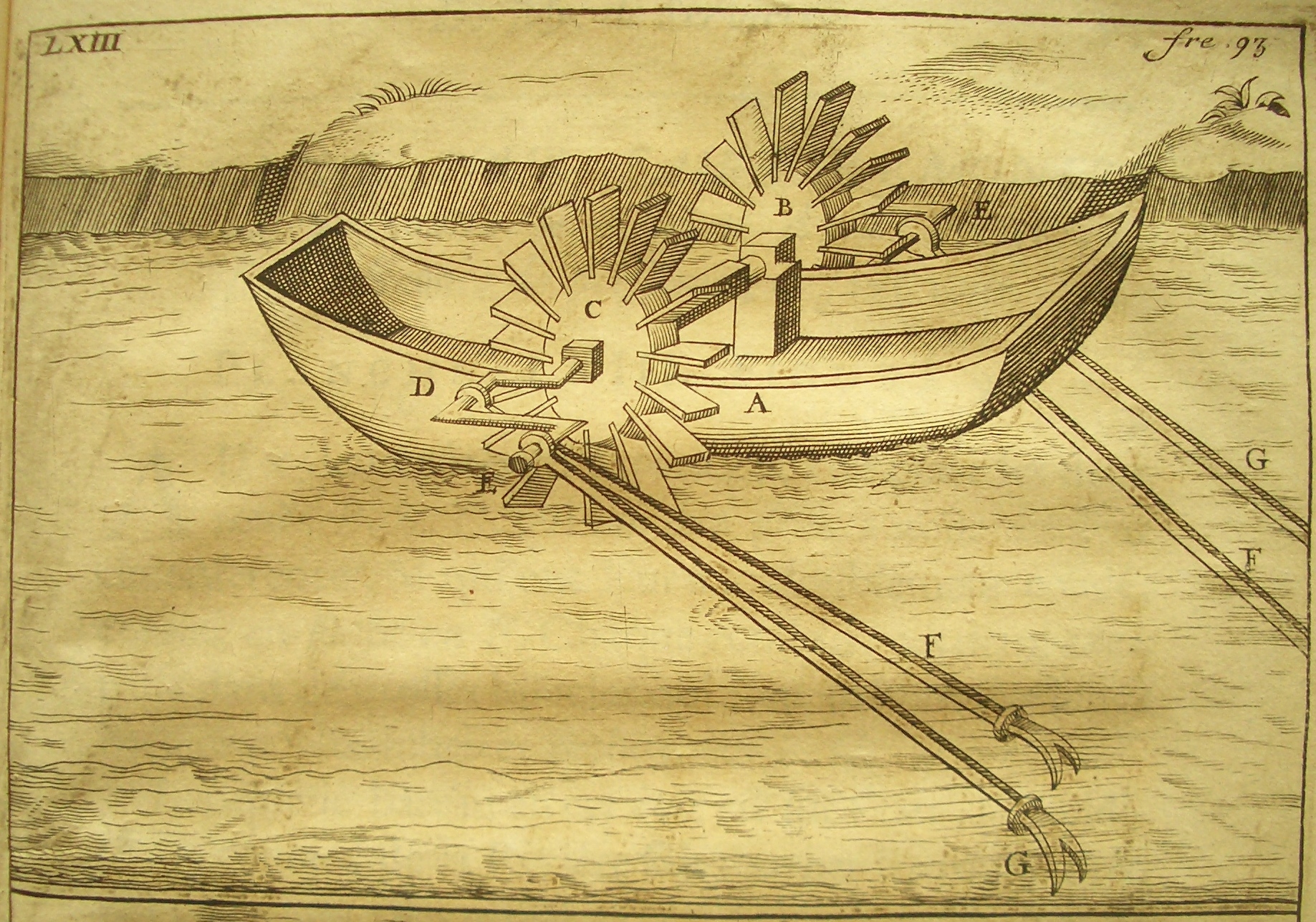
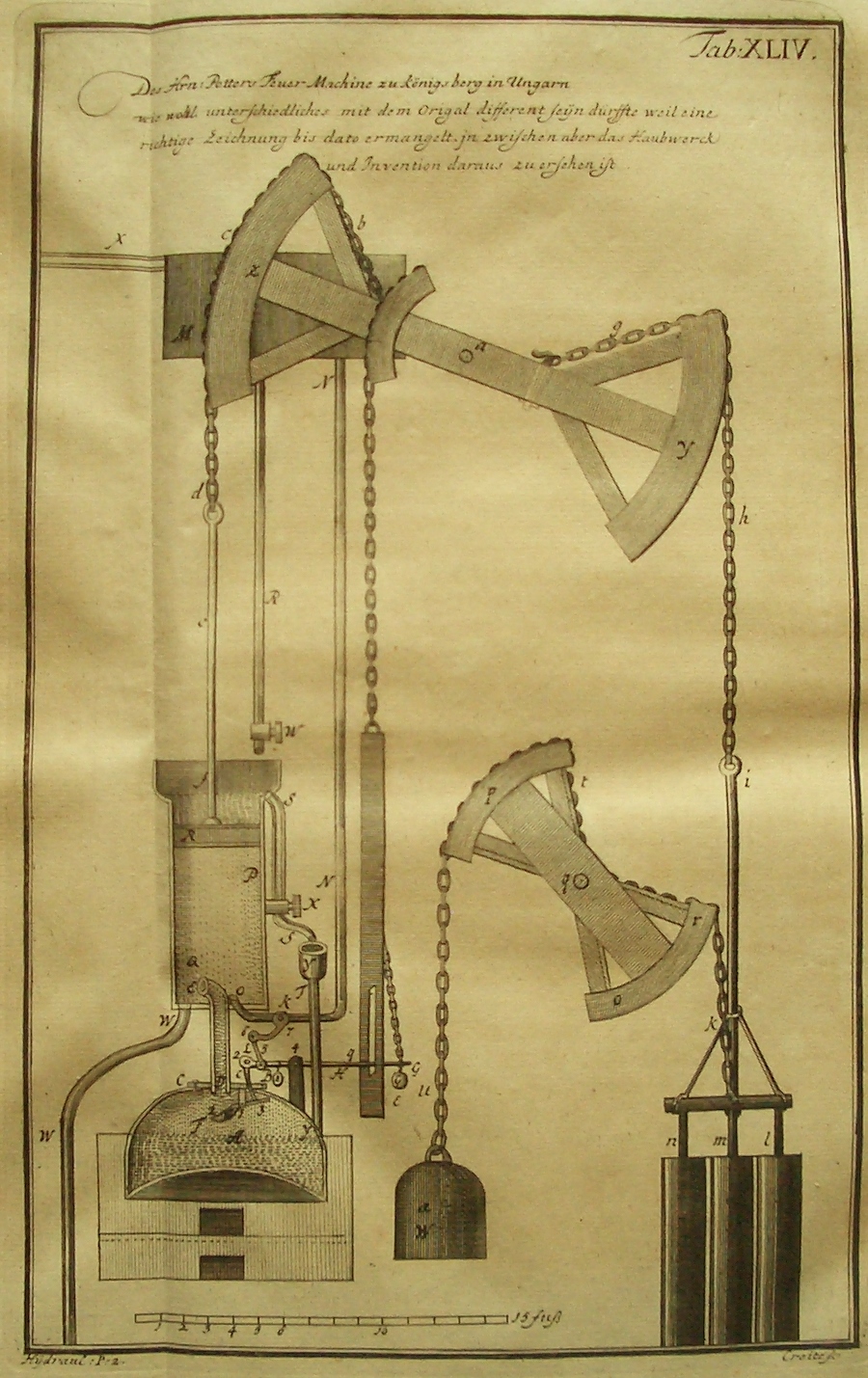
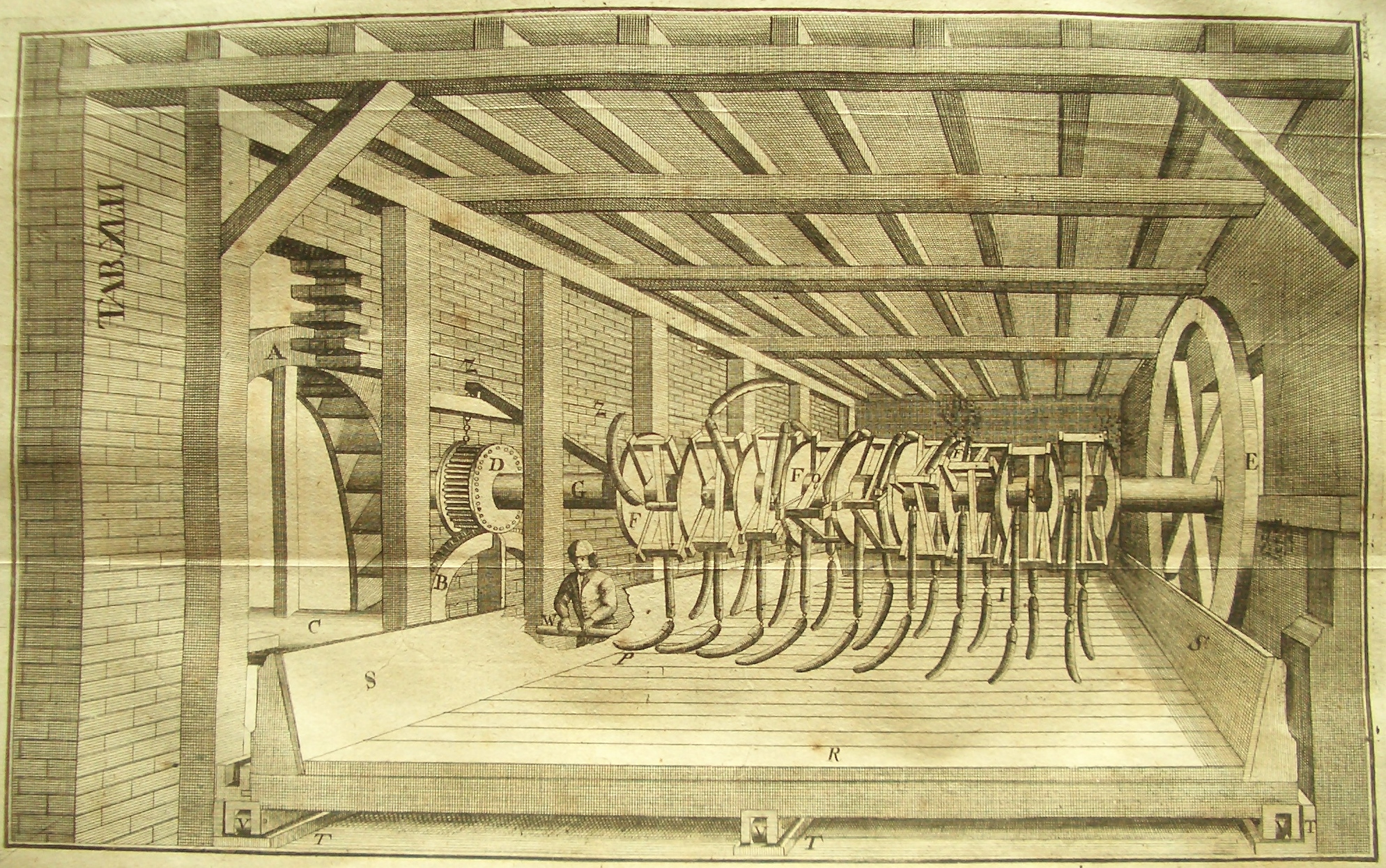
1751ref. 3803Par M. [Gaspard] Grollier de Servière, son petit fils ... Seconde édition. Revûe, corrigée & augmentée de nouvelles Machines. Mit 93 gest. Tafeln von Daudet. Paris, Ch. A. Jombert, 1751. 4to. (25,0 x 19,0 cm). (26), 152, (8) S. Register. Gefleckter Kalblederband d. Zt. mit goldgeprägtem Rückenschild u. reicher Rückenvergoldung. [3 Warenabbildungen]
1725ref. 6194Oder: Schau-Platz der Wasser-Künste. Band 1 u. 2. Mit 107 gest. Tafeln auf 105 meist ausfaltbaren Blatt. Leipzig, Zufinden bey dem Autore u. J. F. Gleditsch Sohn, gedruckt von Chr. Zunkel, 1724-1725. Folio (35,8 x 23,5 cm). 1: (14), 172, (2) S. 2: (18; statt 20), 165, (3) S. Neuer Halblederband im Stil d. Zt. u. Lederband d. Zt. mit reicher Rückenvergoldung.
1735ref. 6197... Ausgefertiget und zusammen getragen von Johann Matthias Beyer und Consorten. 2 Teile in 1 Band. Mit gest. Kopfvign. u. 43 ausfaltbaren gest. Tafeln. Leipzig, W. Deer, 1735. Folio (38,0 x 25,0 cm). (16), 125, (7) S.; (12), 206 (recte 204), 49, (3) S. Neuer Lederband mit blindgeprägtem Rücken.
1829M. Le Comte Dejean Iconographie et histoire naturelle des coleopteres d'Europe 5 Tomi. , Chez Mequignon - Marvis 1829 - 183, Cinque tomi in lingua francese. I cinque tomi sono in progressione di date dal 1829 al 1836. Copertine rigide mancanti. Pagine ingiallite con abbondanti fioriture. Mediocre (Poor) .
1838With engraved half-title, lithogr. title, 5 engraved vignettes and 27 (2 folded) engraved and 1 lithogr. plates. - Imperial folio (54:38 cm). First edition. - Orig. boards with autograph dedication by the author to front board (spine and margins with some damage and material loss, the boards a little waterstained and dusty). - Rare work on the cathedral of Monreale with plans, inside and outside views and numerous detail views. - Uncut and on better paper, multiply stamped, 1 plate with small tear at joint, block with burst, minor staining. Brunet V, 311. Graesse VI, 372.
1936520 pages. Black and white illustrations. Text in French, English, German and a fourth language which is presumably Yugoslavian. Some Russian may also be mixed in. The language used seems to depend upon that of the contributor. Contains a wealth of technical content, the bulk of which appears to be in German and French. Includes reprint of an 1892 Electrical Engineer article on "The Tesla Multiphase Motors" plus "Nikola Tesla: The Problem of increasing human energy" reprinted from The Century Magazine, June 1900, 'The Tesla Patents' from Electrical Review, September 19, 1900 and much more. Index card laid in states this copy was presented by Comite yougoslave de l'URSI to Professor Charles. R. Burrows, whose signature appears atop front flyleaf. Printed on poor quality paper which has become embrittled, chipped and yellowed, particularly at extremities. Binding extremely fragile. Please Note: pages 6 through 10 missing. This may not be too dramatic a loss as the Table of Contents omits pages 1-8 and first lists page 9 which may have contained the Preface in Russian. Some pages uncut. Front cover and all pages prior to page 17 loose but present aside from pages listed above. Page 519-150 and back cover loose but present. Although strictly a Reading Copy, this remains a rare and substantial Tesla reference. Book
1998ref. 2110502151003497elementary school 1998. Soft Cover. Fine. Number of books: 5 elementary school paperback
1973xix, [3], 3-243 pages. Appendices, Patents Index, Name Index, and Subject Index. Black and white diagrams and reproductions of photos. "Written for all who are interested in mirrors; the manufacturer, his manager and his apprentice, for the practical experimentalist and, perhaps, even for the scientist and explorer of present and future possibilities. Part I provides a short survey of the whole field. Part II goes into detail, beginning with a brief history of mirrors and a fairly comprehensive description of all the silvering processes at present employed in the mirror and related industries. A chapter is devoted to the possibility of explosions, and the necessary precautions to avoid them. The appendices contain lists of literature, of learned and trade societies, schools, museums and patents - information which cannot be found anywhere else in such completeness." - dust jacket. Dr. Schweig was a Consulting Chemist to the glass and mirror industry who visited 500 mirror factories and did business in 38 countries in the course of his illustrious career. Faint paperclip markings atop first three leaves otherwise contents clean and unmarked. Binding tight and square. Light wear to black boards. Moderate wear to red dust jacket now preserved in archival-grade Brodart. A sound copy of this elusive and extraordinary reference. Book