348 résultats
1818réf. 1302957Nürnberg, Schrag, 1818. S. 258 - 368, 2 Bl. OBroschur (Umschl. etwas fleckig u. m. kl. Randläsuren, leicht gebräunt, unaufgeschnitten).
1844réf. 043994Paris: Fortin Masson 1844. First Edition. Softcover. Very Good Condition. 3 volumes in original plain blue card covers. Light foxing heavier in spots and to the plates spines a touch sunned scattered minor paper flaws and stains. The three volumes comprising the year 1844. 512pp 5 folding plates; 512pp 4 folding plates; 628 3 folding plates. Complete. Including the classic electrified frog legs experiment. Size: Octavo 8vo. Quantity Available: 1. Shipped Weight: Under 1 kilo. Category: Science & Technology; Inventory No: 043994. Fortin, Masson paperback books
1845réf. 043995Paris: Fortin Masson 1845. First Edition. Softcover. Very Good Condition. 3 volumes in original plain blue card covers. Light foxing heavier in spots and to the plates spines a touch sunned scattered minor paper flaws and stains. The three volumes comprising the year 1845. 512pp 4 folding plates; 512pp 6 folding plates one with color; 512 3 folding plates. Complete. Size: Octavo 8vo. Quantity Available: 1. Shipped Weight: Under 1 kilo. Category: Science & Technology; Inventory No: 043995. Fortin, Masson paperback books
1841réf. 043992Paris: Fortin Masson 1841. First Edition. Softcover. Very Good Condition. 3 volumes in original plain blue card covers. Light foxing heavier in spots and to the plates spines a touch sunned a few minor flaws and stains. The three volumes comprising the year 1841. 512pp 3 folding plates; 544pp 3 folding plates; 512pp 7 folding plates - all complete. Size: Octavo 8vo. Quantity Available: 1. Shipped Weight: Under 1 kilo. Category: Science & Technology; Inventory No: 043992. Fortin, Masson paperback books
1827réf. 043176Paris: Joseph de Boffe 1827. First Edition. Hardcover Half Leather. Good Condition. 3 volumes in 1/4 red calf over marbled boards a few library marks to spines and titles moderate general wear. 448pp 1 folding plate 448pp 2 folding plates 448pp 1 folding plate. Pouillet on electricity Kupffer on magnetism Berzelius on indigo Faraday on evaporation etc. Size: Octavo 8vo. Scattered foxing but text mostly clean. Quantity Available: 1. Shipped Weight: Over 3 kilos. Category: Science & Technology; Antiquarian & Rare. Inventory No: 043176. Joseph de Boffe hardcover books
Paris, Gallimard Avril 1966. In-12, broché, non coupé, 172 pp. Edition originale. Un des 35 exemplaires numérotés sur vélin pur fil Lafuma-Navarre, seul tirage en grand papier, en parfait état. N° 3.
Paris, Gallimard., Septembre 1961. In-12, broché, non coupé, 192 pp. Edition originale. Un des 25 exemplaires numérotés sur vélin pur fil Lafuma-Navarre, seul tirage en grand papier, en parfait état.
Paris, Gallimard, 1959. In-12, broché, non coupé, 220 pp. Edition originale. Un des 25 exemplaires numérotés sur vélin pur fil Lafuma-Navarre, seul tirage en grand papier avec 5 hors-commerce, N° 3 en parfait état.
Paris, Gallimard, 1964. In-12, broché, non coupé, 164 pp. Edition originale. Un des 30 exemplaires numérotés sur vélin pur fil Lafuma-Navarre, seul tirage en grand papier, en parfait état.
Paris, Gallimard, 1963. In-12, broché, non coupé, 204 pp. Edition originale. Un des 20 exemplaires numérotés sur vélin pur fil Lafuma-Navarre, seul tirage en grand papier, en parfait état. N° 1.
Paris, Gallimard 5 avril 1968. In-12, broché, couverture à rabats, 184 pp. Edition originale. Un des 30 exemplaires numérotés sur vélin pur fil Lafuma-Navarre seul tirage en grand papier, Bel exemplaire en parfait état. N° 19.
Paris, Gallimard 1955. In-12, broché, 272 pp. Edition originale. Un des 28 exemplaires numérotés sur pur chiffon de Lana, seul tirage en grand papier, Bel exemplaire en parfait état. N° 12.
1817réf. 733K4Paris: Chez Crochard Libraire 1817. Leather. Good. 8" by 5". None. An uncommon volume of this French scientific journal illustrated with a demonstrative folding plate and containing a scarce work by French mathematician Joseph Fourier. Uncommon. Volume six of series two Series two was published between 1816 and 1840 and was made up of seventy five issues. With two plates to the rear of the work one of which is folding. Lacking the publisher's advertisements as usual. Annales de Chimie et de Physique was a scientific journal first published in France in 1789. The work was published for over one hundred years and was a pioneering work containing articles from some of the most influential scientists of the period. This particular edition is of note as it contains the work Questions sur la Théorie-Physique de la Chaleur rayonnante by French mathematician Joseph Fourier. In a half calf binding with marbled boards. Externally smart with bumping to the extremities. Rubbing to the boards and extremities. Joints are cracked but firm. Bookplate to front pastedown. Internally firmly bound. Pages are generally bright and clean with marginal age toning and scattered spots slightly heavier to the first and last few pages. Good Chez Crochard Libraire hardcover
1820réf. ZB1182545Paris: Crochard 1820. 448 pp. 3 folding plates; original printed paper wrappers covers chipped spine and margins darkened old paper label to the base of the spine library markings to the verso & recto of the half-title page else internally clean and tight. - If you are reading this this item is actually physically in our stock and ready for shipment once ordered. We are not bookjackers. Buyer is responsible for any additional duties taxes or fees required by recipient's country. Photos available upon request. Paris: Crochard unknown
1832réf. S14238Paris :: de l'impr. Royale 1832. 1832. 4to. 88 pp. 6 engraved folding plates of apparatus by Le Blanc; heavily foxed. Contemporary marbled boards with manuscript spine label; extremities somewhat shelf worn. Very good. 170 First edition of this work on the testing of silver materials using a wet method published by the Commission on Coins and Medals. / "Gay-Lussac made a major contribution to chemical analysis in 1832 when he introduced a volumetric method of estimating silver which he justly claimed was much more accurate than the centuries-old method of cupellation. He proposed two parallel procedures for this method one gravimetric which he said was the more accurate and one volumetric which had the advantage of simplicity. The principle of both methods was the precipitation of silver chloride. He prepared a standard solution of sodium chloride of such concentration that 100 milliliters precipitated rather less than one gram of silver. Another standard solution of sodium chloride one-tenth of the concentration of the first was also prepared. One gram of silver was accurately weighed and then dissolved in nitric acid; 100 milliliters of the concentrated sodium chloride solution was added and the precipitate of silver chloride was allowed to settle. The procedure was continued until further addition caused no precipitation. This final excess of sodium chloride was found exactly by back-titrating with standard silver nitrate solution. It was characteristic of Gay-Lussac's standard solutions that they could be used only for specific analysis and for given weights of a sample since the concentration of his solutions had no chemical basis related to equivalent weights. While therefore Gay-Lussac must be given credit for showing volumetric analysis to be convenient rapid and accurate the establishment of a general system of volumetric analysis had to wait until the achievements of Fredrik Mohr in the next generation of chemists." – DSB. REFERENCES: Bolton 1893 471; Cole 509; DSB V pp. 317-27; Edelstein 960; Ferchl 174; Neville I p. 504; Partington IV p. 85; Poggendorff I pp. 860-864 putting the imprint date for this item as 1833. See: Maurice Crosland Gay-Lussac: Scientist and bourgeois Cambridge University Press 1978 pp. 188-190 219-222. de l'impr. Royale, 1832. hardcover
1820réf. 22536Paris: Chez Crochard 1820. First Edition. Boards. Very Good. First Edition. 448 pages plus 5 plates 1 folding. 8vo. Contemporary quarter calf over marbled boards with black spine labels. Early label Coquard a Epinal on front pastedown. The entire volume of "Annales de Chimie et de Physique" Vol. Quinzieme XV 15 offered. Surface wear/damage to the leather finish resulting in minor loss to gilding and top label and minor fraying to the head/tail spine panel. Small spot of worming inside lower rear board at the gutter. Text generally bright and clean. This volume contains the original journal appearance of the separately issued "Memoires sur l'Action Mutuelle de Deux Courans Electriques" in three sections over two articles pp. 59-76 & 170-218. Section 1: "De l'Action mutuelle de deux courans electriques" pages 59-76 continued as "Suite Du Memoire sur l'Action mutuelle entre deux courans electriques entre un courant electrque et un aimant ou le globe terrestre et entre deux aimans" on pages 170-188. Section 2: "Direction des courans electriques par l'action du globe terrestre" on pages 188-196. Section 3: "De l'Action mutuelle entre un conducteur electrique et un aimant" pages 196-218. Plus plate number 4 in the rear which illustrates the articles. Boards. Ampere is today celebrated for his fundamental work in the new field of electrodynamics. The three part paper offered here established “the relationship between electric current-flow and magnetism and established the new science of electrodynamics.” Norman “In a four page circular dated Copenhagen July 21st 1820 H.C. Orsted communicated his great discovery that a closed voltaic circuit exerts forces on an adjacent magnetic needle. In more modern language: a current-carrying electric circuit gives rise to magnetic forces in its surroundings. Orsted had found the long sought affinity between electricity and magnetism. The letter reached Arago … who at the next meeting of Academie des Sciences on Sept. 11th 1820 with Ampere in attendance presented the letter and Orsted's experiment. It was indeed a memorable meeting. Already at the next weekly meeting on Sept. 18th Ampere delivered an explanation of Orsted's experiment and supported it with new experiments of his own. At every weekly meeting in the following months Ampere produced new results.” Ekelof 'In this first paper Sept. 18 he explains the law determining the position of the magnetic needle in relation to the electric current and he also makes known his intended experiments with spiral of helical wires which he predicts will acquire and retain the properties of magnets so long as the electrical current flows through them He constructed his spirals and helices and to the astonishment of all he produced magnets formed only of spools of copper wire traversed by electric currents.' Mottelay The Honeyman sale #82 notes that the paper offered here is "The first appearance of the first of a series of important papers reporting Ampere's discoveries on the electric current." Honeyman also had #83 the first separate appearance of these journal articles published as "Memoires sur l'Action mutuelle de deux courans electriques." which we believe had additional information not present in this journal appearance and hence is not a traditional "offprint" but a later state of the work. Norman notes that Ampere developed the science of electrodynamics over the next seven years publishing in a "bewildering array of journal articles offprints and revisions of earlier works.further noting some 'reprints' of Ampere's articles appear in as many as five different versions." This is an opportunity to own the original first printed appearance of Ampere's fundamentally important work in Electrodynamics. It would be an interesting collection to build the variations of Ampere's work over those seven years to see how his thought evolved. As far as we are aware there is no standard bibliographic reference for Ampere's work. LITERATURE Dibner Heralds of Science 62 first separate edition Honeyman Sale 82 original journal appearance Mottelay Bibliographical History of Electricity and Magnetism p. 472 Norman 43 first separate edition. Ekelof Catalogue of Books and Papers in Electricity and Magnetism pp 284-286 Sparrow Milestones of Science p33 first separate edition. Chez Crochard unknown
1810réf. 43627Halle Rengerschen Buchhandlung 1810. Without wrappers as published in "Annalen der Physik. Herausgegeben von Ludwig Wilhelm Gilbert" Bd. 36 Neuntes Stück. The entire issue offered =Heft 9. Titlepage to vol. 36. Pp. 1-112. a. 2 engraved plates. Gay-Lussac's papers: pp. 6-36 a. pp. 37-51. First German edition of this classic paper in chemistry in which he states the law that when two gases combine chemically they do so that the volumes are in the ratio of whole small numbers."In 1805 with Alexander von Humboldt he observed the already known fact that hydrogen and oxygen combines in the ratio of 2 to 1 by volume. Stimulated by this work he studied the reactions of other gases to see whether there were other simple relationshipas and in 1808 he announced the la of combining volumes which is now known as GAY-LUSSAC'S LAW This generalization obviously connected with some fundamental property of matter was in part responsible for Avogadro's hypothesis."Leicester & Klickstein.Parkinson "Breakthroughs" 1809 C. - Leicester & Klickstein "A Source Book in Chemistry" pp. 292 ff. unknown
1808réf. 43299Paris Chez Mad. Ve. Bernard 1808 Contemp. hcalf. gilt spine. Some scratches to binding. Verso of titlepage and plates with small stamps.In: "Annales de Chimie" Vol. 68. - 358 pp. a. 3 engraved plates. The entire volume offered. Gay-Lussac's a. Thenard's paper: pp. 169-174. First announcement of the results that they had obtaines by treating boric acid with potassium showing that acid is composed of a combustible substance and oxygen. "Before regarding their proof of the existance of a new element as complete Gay-Lussac and Thenard wished not only to decomposed boric acid but to recompose it. On November 30 of the same year they were able to state in the 'Annales de Chemie et de Physique" the paper offered that "the composition of boracid s no longer problematical. In fact said they "we decompose and we recompose this acid at will" Weeks "Discovery of the Elements" p. 160. - Parkinson "Breakthroughs" 1808 C. - Bunch 1808.The volume contains other importent paper Davy's famous paper on electrolysis in first French translations Gayton-Morveau"Description d'un hygrometre pour le gaz." d¨'Arcet "Observations sur la potasse et sur la soude préparées à l'alcool" etc. unknown
1818réf. 49063Leipzig Barth 1818. No wrappers. In: "Annalen der Physik. Neue Folge. Herausgegeben von L.W. Gilbert" Bd. 28 Erstes Stück. Pp. 1-120 a. 1 engraved plate. Entire issue offered. Gay-Lussac's paper: pp. 29-53. First German edition of Gay-Lussac's "Sur les combinaisons de l’azote avec l’oxigène" in which he identified 5 oxides of nitrogen."In 1809 Gay-Lussac carried out a study of the combining volumes of nitric oxide and oxygen. This was a more complex problem than he then realized but he returned to it in 1816 after criticism of his earlier work by Dalton; this time his results were of permanent value. He recognized five oxides of nitrogen." unknown
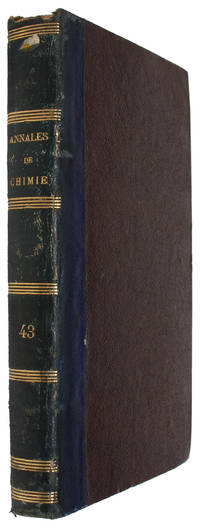
1802réf. 43078Paris Chez Fuchs An X 1802. Contemp. hcalf. Spine gilt. Top of spine with wear. A few scratches to binding. In: "Annales de Chimie ou Recueil de Mémoires concernant la Chemie" Tome 43. 3324 pp. 2 engraved plates the entire volume offered. Gay-Lussac's paper: pp. 137-175. The first 20 leaves a bit brownspotted otherwise with a few marginal brownspots. 1 leaf pp. 197-98 torn with loss of some letters. Gay-Lussac's paper fine and clean. First printing of this extremely important discovery in which Gay-Lussac first formulated the law Gay-Lussac's Law stating that if the mass and pressure of a gas are held constant then gas volume increases linearly as the temperature rises. This is sometimes written as V = k T where k is a constant dependent on the type mass and pressure of the gas and T is temperature on an absolute scale. In terms of the ideal gas law k = n R / P."In 1802 he Gay-Lussac showed that different gases all expanded by equal amounts with rise in temperature. Charles had made the same discovery some years earlier but had not published it; the credit therefore belongs to Gay-Lussac at least as much and probably more. This was an extremely importent discovery which Avogadro was to use within the decade to formulate hid long-neglected hypothesis that equal volumes of different gases at equal temperatures contained equal numbers of particles."Asimov.Magie "A Source Book in Physics" p.165-172 - Leicester & Klickstein "A Source Book of Chemistry" p. 374-379. - Parkinson "Breakthroughs" 1802 C.The volume contains other importent papers in chemistry by Humphrey Davy first French translation of his announcement of the finding of "Laughing Gas" Nitrous Oxide Parmentier Vauquelin Clement et Desormes Thenard Guyton Chenivix unknown
1803réf. 44130Halle Rengerschen Buchhandlung 1803. Without wrappers as extracted from "Annalen der Physik. Herausgegeben von Ludwig Wilhelm Gilbert" Bd. 12. Pp. 257-291 a. 1 folded engraved plate showing the experimental apparatus used. First appearance in German of this extremely important paper in which Gay-Lussac first formulated the law the Gay-Lussac's Law stating that if the mass and pressure of a gas are held constant then gas volume increases linearly as the temperature rises. This is sometimes written as V = k T where k is a constant dependent on the type mass and pressure of the gas and T is temperature on an absolute scale. In terms of the ideal gas law k = n R / P."In 1802 he Gay-Lussac showed that different gases all expanded by equal amounts with rise in temperature. Charles had made the same discovery some years earlier but had not published it; the credit therefore belongs to Gay-Lussac at least as much and probably more. This was an extremely importent discovery which Avogadro was to use within the decade to formulate hid long-neglected hypothesis that equal volumes of different gases at equal temperatures contained equal numbers of particles."Asimov.Magie "A Source Book in Physics" p.165-172 - Leicester & Klickstein "A Source Book of Chemistry" p. 374-379. - Parkinson "Breakthroughs" 1802 C. unknown
1828réf. 45506Paris Chez Crochard 1828. Without wrappers. In: "Annales de Chimie ou Recueil de Mémoires concernant la Chemie" Ser. II Tome 39 Cahier 4. Pp. 337-444 Entire issue offered. Gay-Lussac's paper: pp. 337-368 and 1 engraved plate. First printing of this paper in which he describes acide normale "normal acid" as a standard solution of l00 grams of sulfuric acid diluted to one liter. Gay-Lussac used litmus as an indicator and describes accurately the color transition in different reactions. unknown
1821réf. 44122Paris Crochard 1821. No wrappers. In: "Annales de Chimie et de Physique Par MM. Gay-Lussac et Arago." tome 16 Cahier 4. Pp. 337-445. The entire issue offered. Rapport: pp. 389-427. First printing of the official raport on captain Freycinet's voyage. He sailed from Toulon on 17 September 1817 in L'Uranie with his wife Rose who secreted herself aboard and who wrote a separate account of the voyage. After refreshing at the Cape of Good Hope and Mauritius he landed at Shark Bay on 12 September 1818 where he set up an observatory thoroughly surveyed the inlets and the coastal districts and removed the plate left by Willem de Vlamingh which he had found and re-erected in 1801. He then sailed north to Timor. His accounts and description of the landscape and life and customs of that and other islands in the East Indies captivated the attention of people in Europe much more than his Australian reports and a widespread interest developed in the expedition. Leaving Timor on 27 November he sailed via the Moluccas the Carolines the Marianas and the Sandwich Islands and reached Port Jackson on 19 November 1819 the scientists on board adding constantly to their store of information on hydrography botany cartography and anthropology. After spending Christmas ashore they sailed on 26 December and falling in with the westerlies set a course for Cape Horn.On 13 February 1820 L'Uranie was wrecked on the Falkland Islands; the scientific records and notes were saved before the vessel foundered but 2500 of the 4175 plant specimens were lost. Freycinet returned to France in November 1820 and died on 18 August 1842. unknown
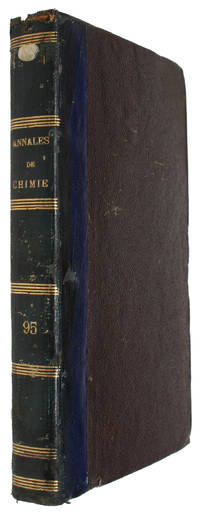
1815réf. 43079Paris Chez Crochard 1815 Contemp. hcalf. Spine gilt. Top of spine with wear. A few scratches to binding. In: "Annales de Chimie ou Recueil de Mémoires concernant la Chemie" Tome 95. - 336 pp. the entire volume offered. Gay-Lussac's paper: pp. 136-231. Some scattered brownspots throughout. First appearance of this milestone paper in organic chemistry in which Gay-Lussac describes the preparation the chemical reactions and the determination of the physical properties of prussic acid."One of the most importent contributions of Gay-Lussac was his work on hydro-cyanid acid and its compounds. In the course of his investigations on the combining volumes of gases he had prepared gaseous hydrogen cyanide. This led him to the study of related compounds and in 1815 he published a paper "Recherches sur l'acide prussique" the paper offered wherein he announced the discovery of cyanogen and chlor-cyanogen and the composition of hydrocyanic acid. His demonstartion that hydrogen cyanide contains no oxygen added another oxygen-free acid to those already known hydrogen halides and sulfide and contributed to the overthrow of Lavoisier's oxygen theory of acids. Gay-Lussac found that the cyano radicalthe first orgianic radical clearly recognized could act as an element analogous to chlorine passing unchanged through various reactions. This concept of an organic radical was importent to organic chemistry."Leicester & Klickstein "A Source Book of Chemistry" p. 293. - Partington IV p.85 a. p. 253. - Roy G. Neville p. 505. - Parkinson "Breakthroughs" 1815 C. unknown
1814réf. 43080Paris Chez Crochard 1814. Contemp. hcalf. Spine gilt. Top of spine with wear. A few scratches to binding. In: "Annales de Chimie ou Recueil de Mémoires concernant la Chemie" Tome 91. - 336 pp. a. 1 engraved plate.the entire volume offered. Gay-Lussac's paper: pp. 5-160. Some scattered brownspots. First printing of Gay-Lussac's classic paper on Iodine discovered 1811 by J.C. Courtois in which he showed that the new substance was an element analogous of chlorine and in which he named the substance Iode from the Greek ioeides meaning "violet colored".Gay-Lussac's and Davy's rechearches on iodine were carried out simultaneously which makes it difficult to assaign priority. Gay-Lussac was annoyed at Davy's introsion. His work however is considered as a model of experimental research. Leicester & Klickstein "A Source Book of Chemistry" p. 293."Gay-Lussac's major publication on iodine was not ready to be read to the Institute until August 1814 by which time not only Davy but Vaquelin had explored the subject fairly extensively. Gay-Lussac however deserves full credit for his detailled study of hydrogen iodide which he found to have a 50 percent hydrogen content by volume. He contrasted its thermal decomposition with the stability of hydrogen chloride. By the action of chlorine and iodine he pepared independently of Davy and at about the same time iodine monochloride and trichloride. After further carefull study of the properties of iodine he prepared and examined a number of iodides and iodates. He prepared for the first time ethyl iodide by distilling together concentrated hydriodic acid with absolute alcohol. The close analogy that he emphasized between chlorine and iodine led him to further investigation of the former and he discovered chloric acid by the action of sulfuric acid on a solution of barium chlorate."DSB V pp. 322-23. - Parkinson "Breakthroughs" 1814 C. - Duveen p. 237.The volume contains other importent chemical papers A. Séguin: "Premier-Second Mémoire sur le Quinquina" pp.273-284 a. 304-317 and 3 other papers by him one together with Lavoisier by Guyton-Morveau Payssé Colin etc. unknown