1334 risultati
1816rif. 46401857Paris, Au Cabinet des Arts, Imprimerie Le Normant, 1816 ; in-8, demi-basane fauve, dos orné, tr. jaspées. (Reliure de l’époque). xxiv pp., 187 pp. - 7 superbes planches dépliantes gravées et finement aquarellées.ÉDITION ORIGINALE de cette traduction française. Elle est anonyme. La première édition en anglais a paru 1815, suivie la même année d’une 2e édition et d’une troisième revue et augmentée en 1816. L’édition française est faite sur la dernière. Un des livres majeurs du chimiste allemand Frédéric Accum (Bückebourg 1769 - Berlin 1838). En 1793 il s’établit à Londres comme assistant de la Maison Brande, pharmaciens du roi. En 1800 il ouvrit son propre laboratoire. En 1820 il fut pris alors qu’il mutilait des livres à la bibliothèque royale. Le scandale qui suivit l’obligea à fuir en Allemagne. Accum s’est appliqué à exploiter les progrès scientifiques pour des applications pratiques. Ses activités de professeur, auteur, directeur de laboratoire, chercheur et commerçant lui facilitèrent le succès à une époque où commençait de s’opérer la révolution industrielle.Son livre sur le gaz d’éclairage est un traité novateur extrêmement important. Accum entreprend le travail expérimental nécessaire à la validation du procédé de H. A. Winsor en 1804. Il devient ainsi le chimiste attitré de la Gas-light and Coke Company. qui obtint les plus importants marchés. Voir DSB I, 44 - Duveen 2 qui cite, sous la même date une édition parue “chez l’auteur et Nepveu” en 176 pp. - Pas cité par Cole qui décrit tous les autres traités de l’auteur. - Sotheran I, p. 2, pour les diverses éditions en anglais.
1880rif. 42765(London, Harrison and Sons, 1880). 4to. No wrappers as extracted from ""Philosophical Transactions"", Year 1879, Vol. 171 - Part II. Pp. 231-256. Clean and fine.
1880rif. 42765London Harrison and Sons 1880. 4to. No wrappers as extracted from "Philosophical Transactions" Year 1879 Vol. 171 - Part II. Pp. 231-256. Clean and fine. First appearance of a major paper on Gas Dynamics creating a whole new science. One of Maxwell's major investigations was on the kinetic theory of gases. Originating with Daniel Bernoulli this theory was advanced by the successive labours of John Herapath John James Waterston James Joule and particularly Rudolf Clausius to such an extent as to put its general accuracy beyond a doubt; but it received enormous development from Maxwell who in this field appeared as an experimenter on the laws of gaseous friction as well as a mathematician."Maxwell's last major paper on any subject was "On Stresses in Rarified Gases arising from Inequalities of Temperature." Between 1873 and 1876 the scientific world had been stirred by William Crooke's experiments with the radiometer the well-known device composed of a partuially evacuated chamber containing a paddle wheel with vanes blackened on one side and silvered on the other which spins rapidly when radiant heat impinges on it.Reynolds called this new effect "thermal transpiration". Maxwell gave a simple qualitative explanation in his report and in an appendix added to his own paper in May 1879 he developed a semiempirical theory accounting for it and for the radiometer effect.Maxwell's paper created the science of rarified gas dynamics. His formulas for stress and heat flux in the body of the gas were contributions of permanent value while his investigations of surface effects started a vast body of research extending to the present day.One other contribution of great beauty contained in notes added to the papwer in May and June 1879 was an application of the methods of spherical harmonic analysis to gas theory."DSB IX p. 224-25. unknown
1928Very Good Turkish, Ottoman (1500-1928) Original wrappers. Demy 8vo. (21 x 14 cm). In Ottoman script (Old Turkish with Arabic letters). 83 p. Chipped on extremities of pages and cover, minor stains on edges. Otherwise a good copy. First and only edition of this first work in book form on Baku and Azerbaijani oil. After the occupation of the Republic of Azerbaijan by the Red Army, many Azerbaijani intellectuals such as Mehmed Emin Resûlzâde (1884-1955) sought refuge in Turkey, established a publishing house called "Milli Azerbaycan Nesriyâti" [i.e. National Azerbaijan Publication] in 1928, Istanbul, and to make the voice of Azerbaijanis heard in exile to influence world public opinion. This book was published as the 9th publication of this publishing house. It was printed in Orhaniye Printing house in 1928 and was actually composed of the articles written by the author in the "Azeri-Turk" magazine. The first article appeared in the issue dated 15 August 1928, with other articles following it. The book, in which Mehmed Emin Rasülzade also penned a presentation, consists of the chapters: The Role of Oil in the World War, Azerbaijan at the Genoa Conference, Azerbaijan at the Hague Conference, the American Rivalry in Britain, A Common Front against the Bolsheviks, the Pursuits of the Oil Competition. Compiled from Mehdiyev's articles, is not only a propaganda work against the Russian occupation but also the first in-depth work written on Baku and Azerbaijan oil. Many sources in the text are referenced in footnotes. Mehdiyev says that world politics is shaped by the economy and oil is the most important factor in this context. In addition to expressing how important it is for the First World War, he also makes predictions about how oil will shape world politics in the future. According to Mehdiyev, whoever dominates the world's oil reserves will be the strongest state in the world. Based on M. Fanning, Mehdiyev states that Azerbaijani and Baku oil has an estimated 8 million barrels of resource rather than Mexican, American, Turkish, and Iranian oil. Only one paper copy in Bogaziçi University's Library in Turkey according to the OCLC: 82001141.; Özege 1960.
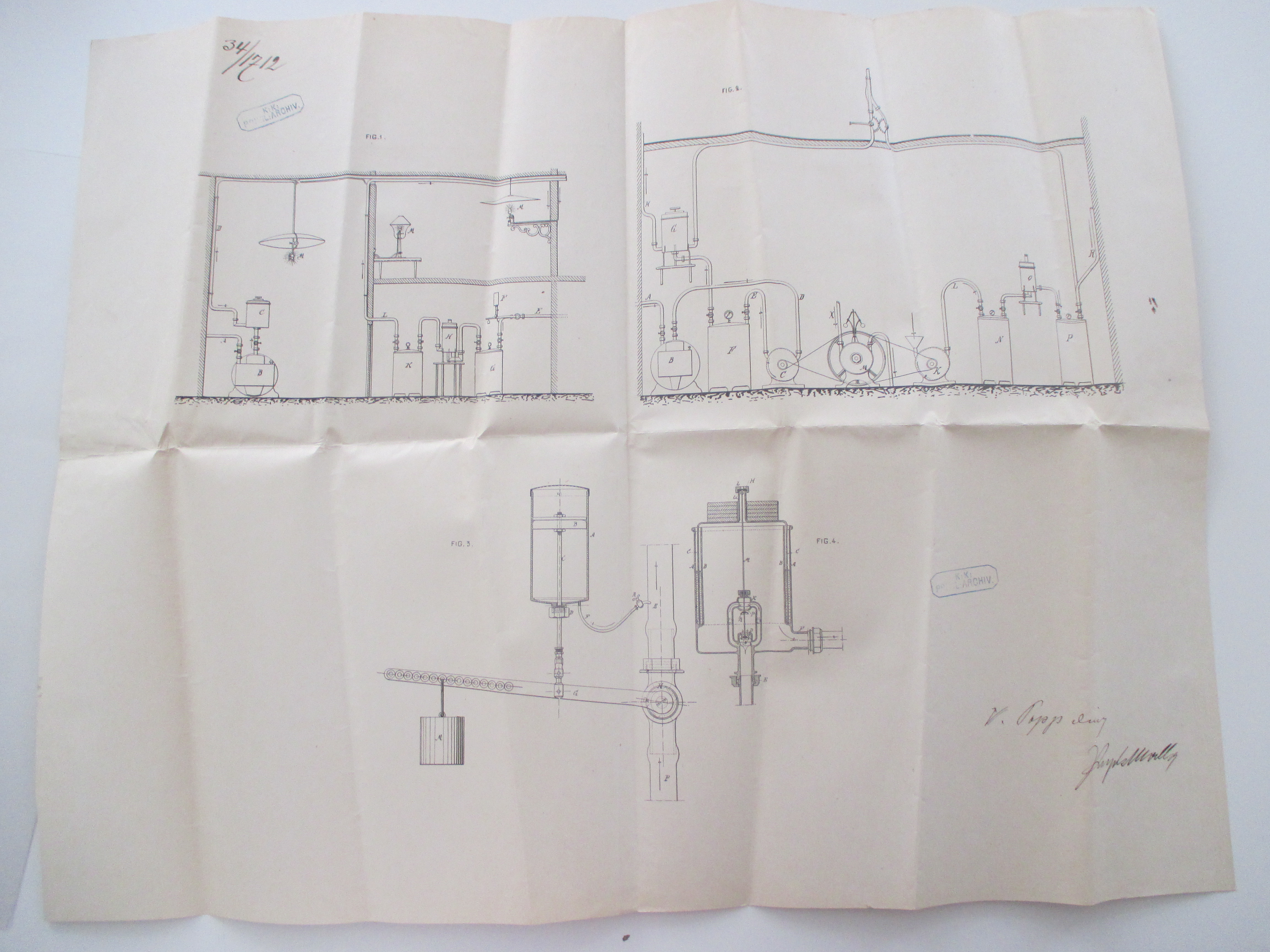
1884rif. 16781ABWien, Jänner 1884. 36 : 24 cm. 7 1/2 Seiten auf 4 Blatt, mit 2 dazugehörigen Modellzeichnungen auf separaten Blättern (500:647 mm und 485:318 mm).
1884rif. 16781AB1884. Wien Jänner 1884 36 : 24 cm. 7 1/2 Seiten auf 4 Blatt mit 2 dazugehörigen Modellzeichnungen auf separaten Blättern 500:647 mm und 485:318 mm. Bei dem Erfinder der durch die Firma Paget & Moeller - dem ersten internationalen Privilegien Patent- Büros in Wien - vertreten wurde handelt es sich um einen gewissen "Victor Popp in wien" der wohl ident ist mit dem Wiener Uhrmacher gleichen Namens der 1879 nach Frankreich übersiedelt war und dort der "Companie Générale des Horologes Pneumatiques Systéme Popp-Resch" vorstand die ab 1879 in Paris ein Netz von über 50 km Luftdruckleitungen errichtete an das um die 8000 pneumatische Nebenuhren angeschlossen waren. - Das vorliegende Mansukript beschreibtdetailliert die Funktionsweise des pneumo-hydraulischen Systems der "verschiedenen nothwendigen Apparate" und des "Quecksilberregulators für comprimirte Gase". - Jewiels mit Stmpel der K.K. Priv.-Archiv. - Mit dem Original-Kuvert mit Siegel etwas beschädigt. - Gefaltet. unknown
1735rif. 9457Paris, Debure l'Ainé (Imprimerie Jacques Vincent), 1735 ; in-4 ; plein veau moucheté havane, dos à nerfs décoré et doré, pièce de titre grenat, roulette dorée sur les coupes, tranches rouges (reliure de l'époque) ; XVIII, (8) (table et errata), 408, (2) pp., 20 planches en 10 feuilles dépliantes.
1912Beardslee was a designer and manufacturer of gas fixtures, electroliers, and combination fixtures with manufactory and salesrooms at 216, 218 and 220 South Jefferson Street, Chicago. This massive catalogue of electric light fixtures is printed upon glossy stock and includes 284 fifteen by twelve inch black and white photographic plates, numbered 222 through 506, each proudly displaying an average of three models for a total of over eight-hundred different offerings, complete with pricing, dimensions and other details. Plates 499-506 present photos and detailed drawings of a diverse assortment of shades, brass parts, lamps (bulbs), sockets, reflectors, glassware, etc. A two-page index indicates the plate upon which each model number can be found. Last page is a colour plate illustrating the nine colours of art glass used in the fixtures and shades illustrated. Binding intact. Minor warp to navy cloth front board which features brilliant silver decoration and lettering. Minor bits of writing upon dark brown front free endpaper. Copyright date underlined. No other markings. Fore-edges of boards degraded by decades-past moisture exposure which also affected almost the entire fore-edge of all pages with the result that approximately one-eighth to one-quarter inch of the coated paper has disintegrated. Fortunately, no text or images affected by this loss. On some pages, dampstaining inpacts up to one-quarter inch in from fore-edge, again with no impact to text or images. Presents a magnificent spectrum of American electric lighting from the early 1900s. Book
rif. 63966Paris: Union des chambres syndicales de l'industrie du pétrole 1962. Original colour-printed map of the world on Mercator's projection 99 x 120 cm highlighting the key oil producing regions. With inset maps of Venezuela North America and the Middle East along with a legend and diagrams. Old ownership inscription to upper right margin. Generally an excellent example with no soiling and bright colours. This wall-sized map depicts the global oil and gas industry with particular focus on the key producing regions. Orange circles show the key regions that produce oil stripes and gas crosshatched with the size of the circle representing the relative amount produced. The dark green and red areas are the oil and gas fields while the light green regions are sedimentary lands that are likely to contain petroleum. Six inset maps provide additional detail including a world map showing the regions with proven oil reserves and maps of Venezuela United States Middle East and Europe and northern Africa locating current pipelines pipeline projects and refineries. A line graph at bottom right shows the evolution of the primary sources of energy coal oil natural gas and hydraulic power worldwide between 1900-60. A scarce map with only three copies listed on OCLC at Cornell Kansas and Minnesota. Paris: Union des chambres syndicales de l'industrie du pétrole, 1962. unknown