Doorley, John/ Garcia, Helio FredBiblio.com

365 Ergebnisse
2025Best.-Nr. x-1032577991Routledge 2025. Hardcover. New. 5th edition. 360 pages. 10.00x7.00x10.00 inches. Routledge hardcover
2002Best.-Nr. ZB1352516Nova Science Pub Inc 2002. 313 pp. hardcover minor library markings else text clean & binding tight. - If you are reading this this item is actually physically in our stock and ready for shipment once ordered. We are not bookjackers. Buyer is responsible for any additional duties taxes or fees required by recipient's country. Photos available upon request. Nova Science Pub Inc hardcover
2006Best.-Nr. Alibris.0017607Torrance CA: Gracie Publications. 2006. Hard cover. New in new dust jacket. Sewn binding. Paper over boards. With dust jacket. 273 p. Contains: Illustrations. Audience: General/trade. . Gracie Publications hardcover
2006Best.-Nr. DADAX0975941119Brand: Black Belt Books 2006-05-01. First Edition. paperback. New. 11.43x8.82x0.95. Buy with confidence. Excellent Customer Service & Return policy. Brand: Black Belt Books paperback
1869Best.-Nr. 59086(Paris, Gauthier-Villars), 1869. 4to. In: ""Comptes Rendus Hebdomadaires des Séances de L'Academie des Sciences"", Tome 68, No 7. Pp. (349-) 408. (Entire issue offered). Janssen's paper pp. 367-376.
1869Best.-Nr. 59086Paris Gauthier-Villars 1869. 4to. In: "Comptes Rendus Hebdomadaires des Séances de L'Academie des Sciences" Tome 68 No 7. Pp. 349- 408. Entire issue offered. Janssen's paper pp. 367-376. First printing of the paper in which Janssen announced the discovery of a new element. On August 18 1868 Janssen managed to do just that. He became the first person to observe helium an element never before seen on Earth in the solar spectrum. At the time though Janssen didn’t know what he’d seen"just that it was something new""Helium the second most abundant element in the universe was discovered on the sun before it was found on the earth. Pierre-Jules-César Janssen a French astronomer noticed a yellow line in the sun's spectrum while studying a total solar eclipse in 1868. Sir Norman Lockyer an English astronomer realized that this line with a wavelength of 587.49 nanometers could not be produced by any element known at the time. It was hypothesized that a new element on the sun was responsible for this mysterious yellow emission. This unknown element was named helium by Lockyer." unknown
1895Best.-Nr. 49284London, arrison and Sons, 1895. - (Paris, Gauthier-Villars), 1895. 8vo. and 4to. Later full cloth, gilt lettering to spine (Ramsay) and without wrappers (Cleve). In ""Proceedings of the Royal Society"" (Ramsay), Vol. 58. (Entire vol. offered). And in ""Comptes Rendus Hebdomadaires des Séances de L'Academie des Sciences"" (Cleve), Tome 120, No 15. Pp. (797-) 850. (Entire issue offered). Ramsay's papers: pp. 65-67 and pp. 81-89. - Cleve's paper: p. 834. Stamps tp edges and a few corners a bit bumped on vol. 58, otherwise clean and fine.
1895Best.-Nr. 49284London arrison and Sons 1895. - Paris Gauthier-Villars 1895. 8vo. and 4to. Later full cloth gilt lettering to spine Ramsay and without wrappers Cleve. In "Proceedings of the Royal Society" Ramsay Vol. 58. Entire vol. offered. And in "Comptes Rendus Hebdomadaires des Séances de L'Academie des Sciences" Cleve Tome 120 No 15. Pp. 797- 850. Entire issue offered. Ramsay's papers: pp. 65-67 and pp. 81-89. - Cleve's paper: p. 834. Stamps tp edges and a few corners a bit bumped on vol. 58 otherwise clean and fine. First printing of both papers in which Ramsay and Cleve - independently - announced their discovery of Helium on the Earth. Although Ramsay announced the discovery of Helium before Cleve had completed his research the Swedish chemist was independent discoverer of the element.Helium was discovered in the sun already in 1868 by Jules Janssen and independently by Lockyer the same year. Janssen discovered helium in the sun when he observed a total eclipse in India by studying the spectra of the suns chromosphere and Lockyer also by spectroscopy found that the new line in the spectrum did not belong to any element then known and he named it Helium for the sun.In the same volume as Ramsays paper there are 5 papers by NORMAN LOCKYER dealing with the discovery of Helium on the earth examining Ramsay's and Cleve's findings.Parkinson "Breakthroughs" 1895. hardcover
Best.-Nr. 9781604568943NOVA SCIENCE PUBLISHERS INC
1878Best.-Nr. 44231Paris, G. Masson, 1878. 8vo. Contemp. hcalf, raised bands, gilt spine. Light wear along edges. Small stamps on verso of titlepage. In: ""Annales de Chimie et de Physique"", 4e Series - Tome 15. 512 pp. a. 3 folded engraved plates. (The entire volume offered). Janssen's memoir: pp. 414-426.
1878Best.-Nr. 44231Paris G. Masson 1878. 8vo. Contemp. hcalf raised bands gilt spine. Light wear along edges. Small stamps on verso of titlepage. In: "Annales de Chimie et de Physique" 4e Series - Tome 15. 512 pp. a. 3 folded engraved plates. The entire volume offered. Janssen's memoir: pp. 414-426. First appearance of this milestone paper in chemistry physics and astronomy announcing the discovery of the helium lines in the spectrum of the sun. It was Lockyer in the same year that named it 'helium' for Helios the Greek God of the Sun. Helium was not discovered on the earth before 1895 by William Ramsay and it was Crookes who established its identity with the helium Janssen and Lockyer observed in the spectrum of the sun."He Janssen met immortality by travelling to India in 1868 to study the total eclipse. It was then that he observed the helium line and forwarded the spectral data to ockyer. He also noted the size of the solar prominences. The day after the eclipse he attempted to take their spectra again and succeeded despite the absence of the obscuring moon. he then announced jubilantly that it was the day after the eclipse that was the real eclipse day for him. Lockyer also reported this method of studying prominences without an eclipse.Like Lockyer he lived to see his observation of the helium line vindicated by Ramsay's discovery of that element on earth."Asimov."This the discovery of helium lines in the sun by Lockyer was announced on the same day by the French astronomer Janssen who was in India observing a total eclipse. As a result the French government some ten years later struck a medallion showing the heads of both scientists.By that time the two men had made a much more dramatic discovery at the same time this time in cooperation. Janssen studying the spectrum ofthe sun during the eclipse had noted a fine line he did not recognize. he send a report on this to Lockyer an acknowledges expert on solar spectra. Lockyer compared the reported position of the line with lines of known elements concluding that it must belong to a yeat unknown element possibly not even existing on the earth. He named the element from the Greek word for the sun."Asimov.Parkinson "Breakthroughs" 1868 A. - The volume contains other notable papers by Dumas Berthelot et al. hardcover
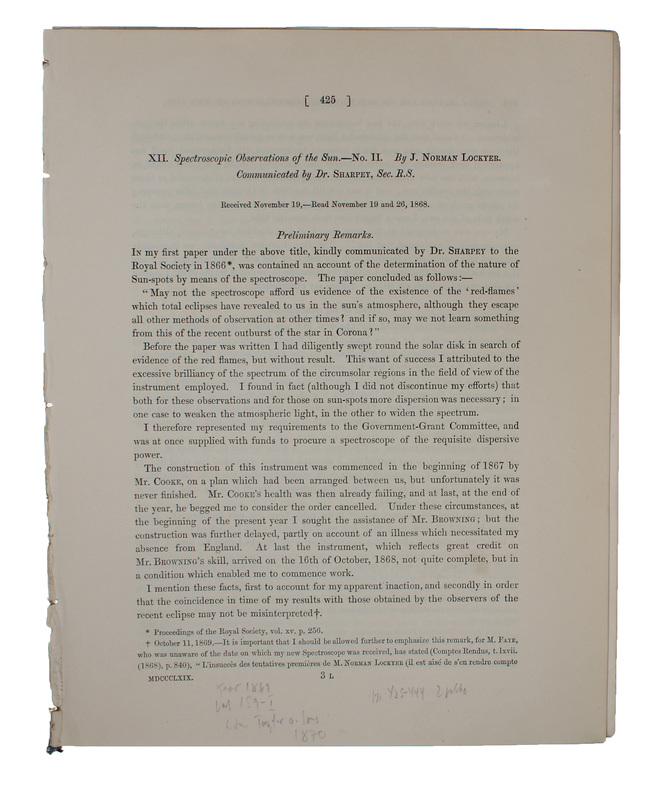
1870Best.-Nr. 42423(London, Taylor and Sons, 1870). 4to. No wrappers as extracted from ""Philosophical Transactions"" 1869, Vol. 159 - Part I. Pp. 425-444 and 2 lithographed plates (1 with the spectrum of helium, 1 with his spectroscope (not requiring eclipses to function)). Clean and fine.
1870Best.-Nr. 42423London Taylor and Sons 1870. 4to. No wrappers as extracted from "Philosophical Transactions" 1869 Vol. 159 - Part I. Pp. 425-444 and 2 lithographed plates 1 with the spectrum of helium 1 with his spectroscope not requiring eclipses to function. Clean and fine. First appearance of this milestone paper in chemistry physics and astronomy announcing the discovery of helium in the sun and naming it 'helium' for Helios the Greek God of the Sun. In the same paper he demonstrates his invention of the spectroscope by which the prominences of the sun could be observed and studied without an eclipse by leading the light from the very edge of the sun through a prism. - Helium was not discovered on the earth before 1895 by William Ramsay and it was Crookes who established its identity with the helium Lockyer observed in the spectrum of the sun."This the last discovery was announced on the same day by the French astronomer Janssen who was in India observing a total eclipse. As a result the French government some ten years later struck a medallion showing the heads of both scientists.By that time the two men had made a much more dramatic discovery at the same time this time in cooperation. Janssen studying the spectrum ofthe sun during the eclipse had noted a fine line he did not recognize. he send a report on this to Lockyer an acknowledges expert on solar spectra. Lockyer compared the reported position of the line with lines of known elements concluding that it must belong to a yeat unknown element possibly not even existing on the earth. He named the element from the Greek word for the sun."Asimov. unknown
2007Best.-Nr. 78055TP. New. Paperback. FREE UPGRADE to Courier/Priority Shipping Upon Request - IN STOCK AND IMMEDIATELY AVAILABLE FOR SHIPMENT - Flawless copy brand new pristine never opened -- Text in English. 136 pp. With 91 ills. 25 col. . 25 x 19 cm. -- with a bonus offer--; Helio Oiticia 1937-80 was one of the most ground-breaking and influential artists of the late twentieth century instrumental in re-mapping our understanding of what art can be. In his hands elements from international modernist art movements are combined with specifically Brazilian flavours to create a new vocabulary in which colour is given three-dimensional form and the viewer becomes part of the art-work itself. At the end of the 1960s Oiticica was invited to exhibit at the Whitechapel Art Gallery in London. The exhibition which he preferred to call The Whitechapel Experiment was one of the most radical avant-garde visual arts events of the era the shock-waves of which continue to reverberate. Oiticica was present at the gallery for much of its duration writing letters and meeting friends and fellow artists. Members of the public were invited to "nest" in special environments or wander bare-foot through sandy groves populated with live parrots. The freedom Oiticica had to work on a large scale at the Whitechapel and the connections he made while he lived in London were important for the rest of his career. This crucial period has never been thoroughly investigated before. With interviews of Oiticica's contemporaries that provide new insights writings by the artist translated for the first time essays by leading critics and facsimile pages from the original Whitechapel catalogue the book captures not only a pivotal moment in the life and career of a unique artist but also in the development of the avant-garde in London. . 2007. 1854377477 . TP paperback
2007Best.-Nr. 72723Abrams Distributor . New. Paperback. FREE UPGRADE to Courier/Priority Shipping Upon Request - IN STOCK AND IMMEDIATELY AVAILABLE FOR SHIPMENT - Flawless copy brand new pristine never opened -- Text in English. 416 pp. With 556 ills. 477 col. . 29 x 25 cm. -- with a bonus offer-- . 2007. 1854377434 . Abrams (Distributor) paperback