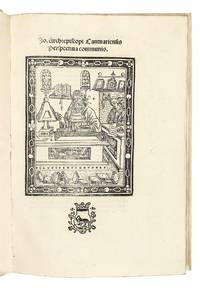
1504ref. 5444Venice: Giovanni Battista Sessa June 1504. THIRD OR FOURTH EDITION of the two editions of 1504 priority has not been determined. THE FIRST TO BE EDITED BY LUCA GAURICO. Hardcover. Fine. Bound in modern vellum. Title with large woodcut showing the author in his study surrounded by books lecturing his students one of whom takes notes. Sessa's cat-and-mouse printer's device appears on the same leaf.The text is illustrated with 77 woodcut diagrams. A very fine copy crisp and bright. There is a very light stain on the title page a bit of soiling in the gutter of leaf A3 and a discreet paper repair to the fore-edge of the final leaf. "The 'Perspectiva communis' was the most widely used of all optical texts from the early fourteenth until the close of the sixteenth century and it remains today the best index of what was known to the scientific community in general on the subject" DSB. It was first printed in Milan around 1482 then in 1503 it was included in a collection by Thomas Bradwardine "Praeclarissimum mathematicarum opus"Valencia. This 1504 edition the first edited by Luca Gaurico can be considered the third although another edition of the pre-Gaurico version was also published in 1504 at Leipzig. A mathematician from Naples and teacher of Scaliger Gaurico who also edited the works of Archimedes and Ptolemy completely revised the text. "The work on which Pecham's fame has chiefly rested is the Perspectiva communis probably written between 1277 and 1279 during Pecham's professorship at the papal curia. In the first book Pecham discussed the propagation of light and color the anatomy and physiology of the eye the act of visual perception physical requirements for vision the psychology of vision and the errors of direct vision. In book II he discussed vision by reflected rays and presented a careful and sophisticated analysis of image formation by reflection. Book III was devoted to the phenomena of refraction the rainbow and the Milky Way. "The central feature of Pecham's optical system and the dominant theme of book I of the 'Perspectiva communis' is the theory of direct vision. Here as elsewhere Pecham endeavored to reconcile all the available authorities-Aristotle Euclid Augustine al-Kindi Ibn al-Haytham Ibn Rushd Grosseteste and Bacon. Following Ibn al-Haytham Pecham argued that the emission of visual rays from the observer's eye is neither necessary nor sufficient as an explanation of sight; the primary agent of sight is therefore the ray coming to the eye from a point on the visible object. But in an attempt to follow Aristotle al-Kindi and Grosseteste as well Pecham argued that visual rays do nevertheless exist and perform the important but not always necessary function of moderating the luminous rays from the visible object and making them "commensurate with the visual power." Thus Pecham like Bacon resolved the age-old debate between the emission and intromission theories of vision in favor of a twofold radiation although to be sure priority was given to rays issuing from the visible object. "The rays issuing from points on the visible object fall perpendicularly onto the cornea and penetrate without refraction to the sensitive ocular organ the glacial humor or crystalline lens; nonperpendicular rays are weakened by refraction and therefore can be largely ignored. Since only one perpendicular ray issues from each point of the visible object and the collection of such perpendicular rays maintains a fixed order between the object and the eye a one-to-one correspondence is established between points on the object and points on the glacial humor and unconfused perception of the visual field is thus achieved. Vision is not "completed" however in the glacial humor. There is a further propagation of the rays or species through the vitreous humor and optic nerve to the common nerve where species from the two eyes combine and eventually to the anterior part of the brain and the "place of interior judgment." "Pecham's optical system included significantly more than a theory of direct vision. He briefly discussed the doctrine of species; treated at length the propagation of rays; and developed a theory to explain how solar radiation when passing through noncircular apertures gives rise to circular images. He expressed the full law of reflection and applied it to image formation by plane spherical cylindrical and conical mirrors; in this analysis he revealed an implicit understanding of the nature of the focal point of a concave mirror. Although he did not possess a mathematical law of refraction he successfully applied the general qualitative principles of refraction to the images that result from refraction at plane and circular interfaces between transparent media of various densities. In his discussion of the rainbow Pecham again attempted to reconcile different theories. He argued that all three kinds of rays rectilinear reflected and refracted concur in the generation of the rainbow. "Pecham's 'Perspectiva communis' is still extant in more than sixty manuscripts and went through twelve printed editions including a translation into Italian between 1482 and 1665. It was used and cited by many medieval and Renaissance natural philosophers including Dominicus de Clavasio Henry of Langenstein Blasius of Parma Lorenzo Ghiberti Leonardo da Vinci Albert Brudzewski Francesco Maurolico Giambattista della Porta Girolamo Fabrici Johannes Kepler Willebroad Snellius and G. B. Riccioli. It was lectured upon in the late Middle Ages at the universities of Vienna Prague Paris Leipzig Cracow Würzburg Alcala and Salamanca."DSB. Giovanni Battista Sessa, June hardcover books
1628ref. 4005Venice: Lucio Spineda 1628. SOLE EDITION. Hardcover. Fine. Contemporary limp vellum in fine condition paste-down torn. The text is in excellent condition with a few instances of light toning in gatherings O S and X and a small worm-track in the margin of the first few lvs. The text is illustrated with woodcut diagrams. An extremely rare book. OCLC cites only 1 copy in North America Columbia University and 5 other institutional copies outside of Italy two in Denmark two in France one in Switzerland. Vagnetti described the book without having seen a copy. Riccardi described an incomplete copy. First and only edition of this wide-ranging work on selected problems in perspective and its underlying geometry largely organized around what the author considers to be commonly found theoretical or practical errors. Diano proves himself to be well read in the contemporary literature of optics and perspective citing Kepler Maurolico Aguilon and others. The final two chapters describe perspective instruments of the variety used by Dürer. Ferdinando di Diano born around 1571 was an Italian mathematician philosopher and theologian author of some fifteen texts on various subjects including the natural sciences. In "The Eye Wandering from Reason Emended. Perspective"1628 Diano distinguishes between 'perspectiva naturalis' physiological optics and 'perspectiva artificialis' the graphic method that allows the rationalization of space. Diano considers human perception via 'perspectiva naturalis' to be fallible; one cannot be sure what one perceives visually is true or merely a 'deception of the mind'. That is the observer does not know if the images that reach the retina are altered in some way by the mind. By contrast through 'perspectiva artificalis' using optical and measuring tools to "construct" an accurate perspective view the individual can affirm the reliability of one's senses. It is this enhancement of the ability of men to thwart the illusions of visual perception that is at the heart of the "The Eye Wandering from Reason Emended. Perspective." In Diano's views it is the ability to distinguish our perception from reality that distinguishes the soul of rational people from those of madmen and beasts. Lucio Spineda hardcover
1628ref. 4005Venice: Lucio Spineda 1628. SOLE EDITION. Hardcover. Fine. Contemporary limp vellum in fine condition paste-down torn. The text is in excellent condition with a few instances of light toning in gatherings O S and X and a small worm-track in the margin of the first few lvs. The text is illustrated with woodcut diagrams. An extremely rare book. OCLC cites only 1 copy in North America Columbia University and 5 other institutional copies outside of Italy two in Denmark two in France one in Switzerland. Vagnetti described the book without having seen a copy. Riccardi described an incomplete copy. First and only edition of this wide-ranging work on selected problems in perspective and its underlying geometry largely organized around what the author considers to be commonly found theoretical or practical errors. Diano proves himself to be well read in the contemporary literature of optics and perspective citing Kepler Maurolico Aguilon and others. The final two chapters describe perspective instruments of the variety used by Dürer. Ferdinando di Diano born around 1571 was an Italian mathematician philosopher and theologian author of some fifteen texts on various subjects including the natural sciences. In "The Eye Wandering from Reason Emended. Perspective"1628 Diano distinguishes between 'perspectiva naturalis' physiological optics and 'perspectiva artificialis' the graphic method that allows the rationalization of space. Diano considers human perception via 'perspectiva naturalis' to be fallible; one cannot be sure what one perceives visually is true or merely a 'deception of the mind'. That is the observer does not know if the images that reach the retina are altered in some way by the mind. By contrast through 'perspectiva artificalis' using optical and measuring tools to "construct" an accurate perspective view the individual can affirm the reliability of one's senses. It is this enhancement of the ability of men to thwart the illusions of visual perception that is at the heart of the "The Eye Wandering from Reason Emended. Perspective." In Diano's views it is the ability to distinguish our perception from reality that distinguishes the soul of rational people from those of madmen and beasts. Lucio Spineda hardcover books
1611"Marca tipografica frontespizio e numerosi diagrammi xilografici nel testo. 4 p.l., 78 pp., 1 carta di errata. Piccolo 4to, pergamena coeva. Venezia: T. Baglionus, 1611. Frontespizio con un piccolo restauro. Prima edizione di questa rara e importante opera nella storia dell'ottica e del telescopio; ha avuto una grande influenza sulle teorie ottiche di Newton ed è di grande interesse galileiano. De radiis visus et lucis si occupa di lenti, telescopi e arcobaleno. De Dominis sapeva come la luce si rifrangeva nel suo passaggio da un mezzo all'altro. Dopo l'invenzione del telescopio De Dominis ha aggiunto la sua spiegazione teorica al suo lavoro. La sua spiegazione non fu del tutto soddisfacente, tuttavia, perché la sua conoscenza della legge di rifrazione era incompleta. De Dominis descrive in modo particolareggiato l'effetto sull'angolo di vista di una lente di maggiore curvatura o di maggiore distanza tra la lente e l'oggetto che si sta osservando. Con la stessa accuratezza ha esaminato le combinazioni di lenti, in particolare la combinazione di un oggetto di vetro convesso e di un oculare concavo. Questo lavoro ha portato alla sua scoperta delle condizioni in cui è possibile l'ingrandimento di un'immagine. ""- DSB, IV, p. 158. Nella prefazione, Giovanni Bartoli, che fu ambasciatore della Toscana a Venezia e uno dei primi sostenitori delle scoperte di Galileo, descrive il cannocchiale di nuova invenzione (attribuendo la sua invenzione a Galileo) e le scoperte rese possibili da questo strumento. De Dominis fornisce anche un resoconto del cannocchiale (pp. 34-43) e suggerisce addirittura i tiranti, entrati in uso molto più tardi . Questo libro contiene anche la famosa teoria dell'arcobaleno di De Dominis che influenzò molto Newton. Nel 1704, Newton scrisse nel suo Optics: ""Questa rifrazione è stata recentemente scoperta e spiegata più completamente dal famoso Arcivescovo Antonius de Dominis di Spalato, nel suo libro De Radiis Visus et Lucis, pubblicato dall'amico Bartolus a Venezia, nell'anno 1611, e scritto sopra 20 anni prima. Perché vi insegna come l'arco interno è realizzato da gocce di pioggia rotonde da due rifrazioni della luce solare. ""Per una discussione approfondita sulla spiegazione dell'arcobaleno di De Dominis, vedere Boyer, The Rainbow (pp. 187-92 & passim ), che lo definisce ""superiore a qualsiasi altro pubblicato nell'intervallo di tre secoli dal 1311 al 1611"". Newton possedeva una copia del presente libro che ora si trova al Trinity College di Cambridge (vedi Harrison, The Library of Isaac Newton, 535). De Dominis (1560-1626), gesuita dalmata, tenne conferenze di matematica, logica e filosofia a Verona, Padova e Brescia. In seguito fu nominato arcivescovo di Spalato (Spalato). La sua fede nell'unità di tutti i cristiani chiese e la pace tra le nazioni lo portarono a fuggire in Inghilterra. Poco dopo il suo ritorno a Roma, fu imprigionato dall'Inquisizione. Morì in una prigione e dopo la sua morte fu riconosciuto colpevole di eresia e il suo corpo fu bruciato. Goethe scrisse di De Dominis che ""ha scoperto lo spettro solare mentre diceva messa"" Cinti 33. Poggendorff, I, 589-90. Riccardi, I, 417-18– ""importantissimo libro"". Printer’s mark on title page & numerous woodcut diagrams in the text. 4 p.l., 78 pp., 1 leaf of errata. Small 4to, contemporary calf. Venice: T. Baglionus, 1611. Title page with a small restoration. First edition of this rare and important work in the early history of optics and the telescope; it had a major influence on the optical theories of Newton and is of great Galilean interest. De radiis visus et lucis deals with lenses, telescopes, and the rainbow. De Dominis knew how light was refracted in its passage from one medium to another. After the invention of the telescope Dominis added its theoretical explanation to his work. His explanation was not entirely satisfactory, however, because his knowledge of the law of refraction was incomplete. De Dominis describes in particular detail the effect on the angle of sight of a lens of greater curvature or of a greater distance between the lens and the object being viewed. With the same thoroughness he examined lens combinations, in particular the combination of a convex object glass and a concave eyepiece. This work led to his discovery of the conditions under which the magnification of an image is possible.""–D.S.B., IV, p. 158.In the Preface, Giovanni Bartoli, who was Tuscan Ambassador at Venice and an early advocate of Galileo’s discoveries, describes the newly invented telescope (attributing its invention to Galileo) and the discoveries made possible by this instrument. De Dominis also provides an account of the telescope (pp. 34-43) and even suggests draw-tubes, which came into use much later. This book also contains De Dominis’ famous theory of the rainbow which greatly influenced Newton. In 1704, Newton wrote in his Optics: ""This Refraction was of late more fully discover’d and explain’d by the famous Antonius de Dominis, Archbishop of Spalato, in his book De Radiis Visus et Lucis, published by his friend Bartolus at Venice, in the Year 1611, and written above 20 Years before. For he teaches there how the interior Bow is made in round Drops of Rain by two Refractions of the Sun light."". For a thorough discussion of De Dominis explanation of the rainbow, see Boyer, The Rainbow (pp. 187-92 & passim), who calls it ""superior to any other published in the interval of three centuries from 1311 to 1611."" Newton owned a copy of the present book which is now at the Trinity College, Cambridge (see Harrison, The Library of Isaac Newton, 535). De Dominis (1560-1626), a Dalmatian Jesuit, lectured on mathematics, logic, and philosophy at Verona, Padua, and Brescia. He was later appointed archbishop of Split (Spalato). His belief in the unity of all Christian churches and peace among nations caused him to flee to England. Soon after his return to Rome, he was imprisoned by the Inquisition. He died in a dungeon and after his death he was found guilty of heresy and his body was burned. Goethe wrote of De Dominis that ""he discovered the solar spectrum while celebrating Mass"" Cinti 33. Poggendorff, I, 589-90. Riccardi, I, 417-18–""importantissimo libro"" "
