704 results
ref. ria9780471215721_inpHardback. New. New Book; Fast Shipping from UK; Not signed; Not First Edition; This second independent volume of Govind Agrawal's Lightwave Technology is devoted to the systems design issues with emphasis on WDM systems. It informs practicing engineers and students of both the physics and engineering of lightwave hardcover
ref. ria9781119737360_inpHardback. New. New Book; Fast Shipping from UK; Not signed; Not First Edition; N/A hardcover
ref. ria9781119563778_inpHardback. New. New Book; Fast Shipping from UK; Not signed; Not First Edition; N/A hardcover
ref. ria9780198854234_inpPaperback / softback. New. New Book; Fast Shipping from UK; Not signed; Not First Edition; An introduction to the fascinating subject of quantum mechanics. Almost entirely algebra-based this book is accessible to those with only a high school background in physics and mathematics. In addition to the foundations of quantum me paperback
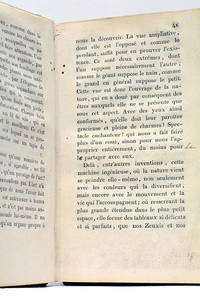
ref. 41333Paris Maradan et La Rochelle Bouyer 1820. 228 pages. 19x115 Cm. Demi basane de l'époque. Dos lisse orné. Coiffes manquantes. Coins émoussés. Ouvrage curieux dans lequel l'auteur étudie le phénomène de la vision en distinguant plusieurs types de vue: "Vue prismatique" "Vue téléscopique" "Vue achromatique" "Vue ampliative" etc. Réferences aux instruments optiques. Quelques trous de vers et mouillures claires. Rares taches et rousseurs. Paris, Maradan et La Rochelle, Bouyer, 1820. unknown
1891ref. 61761London: Longmans Green & Co. 1891. 8vo. viii 426 2 pp. plus 24 pp. publisher’s ads. With 232 woodcut engraved text illustrations & diagrams. Green embossed publisher’s cloth ruled borders at upper & lower fore-edges rebacked black & gilt morocco spine label still G copy w/ former exlib ownership stamps on interior pages. Second edition of this well-illustrated and informative Victorian handbook on use of the magic lantern and many other scientific optical instruments in creating effects for scientific study as well as for exhibition and instruction. Included are significant sections on manipulating the magic lanterns creating glass slides carriers & special effects; colour theory and instruments depicting colour polarizing apparatus magnetism revealed by optical projection and more. Longmans, Green & Co., hardcover
1978ref. BN507353La Documentation française 1978. 1978. Softcover. Matériaux et composants optiques Matériaux et composants optiques Groupe Instrumentation optique France et Direction de la documentation française France La Documentation française paperback
ref. DADAX1461366585New unknown
ref. DADAX1461429331New unknown
ref. DADAX383647929XNew unknown
ref. DADAX0943396468New unknown
1999ref. 014830London United Kingdom: Kluwer Academic Publishers 1999. Cloth/Laminated Boards. Like New/No d/j as Published. 8vo - over 7¾" - 9¾" tall. Type: Book This text provides a comprehensive coverage of the design and modelling of the devices and systems required for optical communication networks. It should be a useful reference text for those engineers implementing and designing such networks and deals with modelling and simulation of optical links at the levels both of devices and of systems. Simulation experiments and results are included as are details of devices under development in research laboratories. Optical and telecommuntications scientists working in research and development and design engineers working in the field should find this text to be a useful resource.318pp. Kluwer Academic Publishers hardcover
1973ref. CH-22Michigan: Ann Arbor Science 1973. Classic comprehensive reference set presents by photomicrographs and electron micrographs the relationship between the appearance of images of many different types of particles and their identities including improvements in ultramicroscopy automatic image analysis electron microprobe analyses fractionation methods source testing applications of dispersion staining etc. Set includes: Vol. 1: Principles and Techniques Vol. II: The Light Microscopy Atlas Vol. III: The Electron Microscopy Atlas Vol. IV: The Particle Analyst's Handbook Vol. V: Light Microscopy Atlas and Techniques & Vol. VI: Electron Optical Atlas and Techniques. 1454 pp. collectively. Illustrated. Gilt front covers and spines. Corners and spine edges slightly rubbed on some volumes. Vol. I rear endpaper taped and tiny chip to bottom of pp. 295-296. Former ownership label pastedown and small stamps on the front endpaper title page and outer edge of all volumes. Minor light rubbing to lower spine on some volumes from label removal no residue. Text crisp and clean with no marks or highlights. Minimal shelfwear. Heavy item. Scarce. . . Second Edition. Hard Cover. Very Good. Folio - over 12" - 15" tall. Ex-Professional Library. Ann Arbor Science hardcover
1971ref. OP-10Boulder CO.: Golem Press 1971. Classic highly acclaimed text translated from the original Russian by the late Prof. Petr Beckmann presents a detailed treatment of problems and results applied to a wide range of antennas including random antenna arrays; radar ambiguity functions; field statistics of the diffraction pattern in the focal plane of an aperture antenna; phenomena observed in tropospheric propagation; minimization of beam pointing errors; optimization of antennas with respect to beamwidth gain side lobe level radiation pattern etc. 370 pgs. Illustrated. Some isolated sections with random highlights- does not adversely affect the general text. Prior owner's name on front endpaper and outer edge. Dustjacket has some minor rubbing to corners and edges; tiny closed tear on top edge; price-clipped front inside flap; in mylar. Scarce. First Edition. Hard Cover. Very Good/Very Good. 8vo - over 7¾" - 9¾" tall. Golem Press hardcover
1986ref. EG-434Cambridge U.K.: Cambridge University Press 1986. Comprehensive revised and updated Second Edition text presents aspects of electromagnetic theory of direct relevance to the transmission of information by electromagnetic waves: in free space by transmission line wave guide or optical fiber. In revising the first edition the authors have taken the opportunity to extend the coverage significantly by adding new material on optical transmission. Throughout the theory is applied to the working of practical systems and the constraints imposed by fundamental properties are emphasised. 458 pp. Illustrated. Minimal shelfwear. Second Edition. Soft Cover. Very Good/ . 8vo - over 7¾" - 9¾" tall. Cambridge University Press paperback
2002ref. OP-109Warrendale PA.: Materials Research Society 2002. Comprehensive text presents detailed coverage of the progress of interband and intersubband transitions in semiconductor materials including III-V IV and II-VI materials and quantum novel devices. Topics also covers processing issues for optoelectronic devices work on solar cell and lasers materials utilizing low nitrogen concentration compounds VCSELs quantum dots quantum wells and heterostructures. Materials ranged over the III-V aand II-VI semiconductors including GaAs GaAsN InP ZnSe and others. Technological applications ranged over infrared detectors microelectronics optical materials lasers solar cell applications and design and VCSELs. 732 pp. Illustrated. Small minor prior ownership stamp on front endpaper. Lower front corner slightly bumped. Minimal shelfwear. First Edition. Hard Cover. Very Good. 8vo - over 7¾" - 9¾" tall. Materials Research Society hardcover
1999ref. EG-621New York: John Wiley & Sons 1999. Comprehensive highly acclaimed text is the first book devoted exclusively to the application of genetic algorithms to electromagnetic device design. Contains detailed coverage of a revolutionary technique for overcoming problems in electromagnetic design Genetic algorithms are stochastic search procedures modeled on the Darwinian concepts of natural selection and evolution. The machinery of genetic algorithms utilizes an optimization methodology that allows a global search of the cost surface via statistical random processes dictated by the Darwinian evolutionary concept. These easily programmed and readily implemented procedures robustly locate extrema of highly multimodal functions and therefore are particularly well suited to finding solutions to a broad range of electromagnetic optimization problems. Text describes numerous applications of genetic algorithms to the design and optimization of various low- and high-frequency electromagnetic components. 480 pgs. Illustrated. Lower corners slightly bumped. Minimal shelfwear. First Edition. Hard Cover. Fine. 8vo - over 7¾" - 9¾" tall. John Wiley & Sons hardcover
1504ref. 5444Venice: Giovanni Battista Sessa June 1504. THIRD OR FOURTH EDITION of the two editions of 1504 priority has not been determined. THE FIRST TO BE EDITED BY LUCA GAURICO. Hardcover. Fine. Bound in modern vellum. Title with large woodcut showing the author in his study surrounded by books lecturing his students one of whom takes notes. Sessa's cat-and-mouse printer's device appears on the same leaf.The text is illustrated with 77 woodcut diagrams. A very fine copy crisp and bright. There is a very light stain on the title page a bit of soiling in the gutter of leaf A3 and a discreet paper repair to the fore-edge of the final leaf. "The 'Perspectiva communis' was the most widely used of all optical texts from the early fourteenth until the close of the sixteenth century and it remains today the best index of what was known to the scientific community in general on the subject" DSB. It was first printed in Milan around 1482 then in 1503 it was included in a collection by Thomas Bradwardine "Praeclarissimum mathematicarum opus"Valencia. This 1504 edition the first edited by Luca Gaurico can be considered the third although another edition of the pre-Gaurico version was also published in 1504 at Leipzig. A mathematician from Naples and teacher of Scaliger Gaurico who also edited the works of Archimedes and Ptolemy completely revised the text. "The work on which Pecham's fame has chiefly rested is the Perspectiva communis probably written between 1277 and 1279 during Pecham's professorship at the papal curia. In the first book Pecham discussed the propagation of light and color the anatomy and physiology of the eye the act of visual perception physical requirements for vision the psychology of vision and the errors of direct vision. In book II he discussed vision by reflected rays and presented a careful and sophisticated analysis of image formation by reflection. Book III was devoted to the phenomena of refraction the rainbow and the Milky Way. "The central feature of Pecham's optical system and the dominant theme of book I of the 'Perspectiva communis' is the theory of direct vision. Here as elsewhere Pecham endeavored to reconcile all the available authorities-Aristotle Euclid Augustine al-Kindi Ibn al-Haytham Ibn Rushd Grosseteste and Bacon. Following Ibn al-Haytham Pecham argued that the emission of visual rays from the observer's eye is neither necessary nor sufficient as an explanation of sight; the primary agent of sight is therefore the ray coming to the eye from a point on the visible object. But in an attempt to follow Aristotle al-Kindi and Grosseteste as well Pecham argued that visual rays do nevertheless exist and perform the important but not always necessary function of moderating the luminous rays from the visible object and making them "commensurate with the visual power." Thus Pecham like Bacon resolved the age-old debate between the emission and intromission theories of vision in favor of a twofold radiation although to be sure priority was given to rays issuing from the visible object. "The rays issuing from points on the visible object fall perpendicularly onto the cornea and penetrate without refraction to the sensitive ocular organ the glacial humor or crystalline lens; nonperpendicular rays are weakened by refraction and therefore can be largely ignored. Since only one perpendicular ray issues from each point of the visible object and the collection of such perpendicular rays maintains a fixed order between the object and the eye a one-to-one correspondence is established between points on the object and points on the glacial humor and unconfused perception of the visual field is thus achieved. Vision is not "completed" however in the glacial humor. There is a further propagation of the rays or species through the vitreous humor and optic nerve to the common nerve where species from the two eyes combine and eventually to the anterior part of the brain and the "place of interior judgment." "Pecham's optical system included significantly more than a theory of direct vision. He briefly discussed the doctrine of species; treated at length the propagation of rays; and developed a theory to explain how solar radiation when passing through noncircular apertures gives rise to circular images. He expressed the full law of reflection and applied it to image formation by plane spherical cylindrical and conical mirrors; in this analysis he revealed an implicit understanding of the nature of the focal point of a concave mirror. Although he did not possess a mathematical law of refraction he successfully applied the general qualitative principles of refraction to the images that result from refraction at plane and circular interfaces between transparent media of various densities. In his discussion of the rainbow Pecham again attempted to reconcile different theories. He argued that all three kinds of rays rectilinear reflected and refracted concur in the generation of the rainbow. "Pecham's 'Perspectiva communis' is still extant in more than sixty manuscripts and went through twelve printed editions including a translation into Italian between 1482 and 1665. It was used and cited by many medieval and Renaissance natural philosophers including Dominicus de Clavasio Henry of Langenstein Blasius of Parma Lorenzo Ghiberti Leonardo da Vinci Albert Brudzewski Francesco Maurolico Giambattista della Porta Girolamo Fabrici Johannes Kepler Willebroad Snellius and G. B. Riccioli. It was lectured upon in the late Middle Ages at the universities of Vienna Prague Paris Leipzig Cracow Würzburg Alcala and Salamanca."DSB. Giovanni Battista Sessa, June hardcover
1968ref. 5-5X006NY: Dover 1968. Oversize Paperback. GOOD. Tight bright clean interior. Covers are creased with rubbed edges and sticker smudges. Owner's name on title page and a few folded page corners. "unabridged and corrected republication of the work originally published by Oxford University Press in 1954 to which have been added a new preface and a series of thirteen papers by the author originally published in the 'Journal of the Optical Society' of America." 424 indexed pages. 6.5x9.25" 16.5x23.5cm Dover paperback
1628ref. 4005Venice: Lucio Spineda 1628. SOLE EDITION. Hardcover. Fine. Contemporary limp vellum in fine condition paste-down torn. The text is in excellent condition with a few instances of light toning in gatherings O S and X and a small worm-track in the margin of the first few lvs. The text is illustrated with woodcut diagrams. An extremely rare book. OCLC cites only 1 copy in North America Columbia University and 5 other institutional copies outside of Italy two in Denmark two in France one in Switzerland. Vagnetti described the book without having seen a copy. Riccardi described an incomplete copy. First and only edition of this wide-ranging work on selected problems in perspective and its underlying geometry largely organized around what the author considers to be commonly found theoretical or practical errors. Diano proves himself to be well read in the contemporary literature of optics and perspective citing Kepler Maurolico Aguilon and others. The final two chapters describe perspective instruments of the variety used by Dürer. Ferdinando di Diano born around 1571 was an Italian mathematician philosopher and theologian author of some fifteen texts on various subjects including the natural sciences. In "The Eye Wandering from Reason Emended. Perspective"1628 Diano distinguishes between 'perspectiva naturalis' physiological optics and 'perspectiva artificialis' the graphic method that allows the rationalization of space. Diano considers human perception via 'perspectiva naturalis' to be fallible; one cannot be sure what one perceives visually is true or merely a 'deception of the mind'. That is the observer does not know if the images that reach the retina are altered in some way by the mind. By contrast through 'perspectiva artificalis' using optical and measuring tools to "construct" an accurate perspective view the individual can affirm the reliability of one's senses. It is this enhancement of the ability of men to thwart the illusions of visual perception that is at the heart of the "The Eye Wandering from Reason Emended. Perspective." In Diano's views it is the ability to distinguish our perception from reality that distinguishes the soul of rational people from those of madmen and beasts. Lucio Spineda hardcover
ref. 026079029X.Gpaperback. Good. Access codes and supplements are not guaranteed with used items. May be an ex-library book. paperback
ref. 0428560393.Ghardcover. Good. Access codes and supplements are not guaranteed with used items. May be an ex-library book. hardcover
ref. 0365631000.Gpaperback. Good. Access codes and supplements are not guaranteed with used items. May be an ex-library book. paperback
1994ref. 97035Bellingham Washington: SPIE The International Society for Optical Engineering 1994. 1994. Very good. - Quarto 11 inches high by 8-1/2 inches wide. Softcover bound in printed yellow wraps. The corners of the covers are lightly creased and an early ink price has been partially erased from the top corner of the front cover. vii i & 150 pages with textual illustrations and diagrams. The corners of the pages are lightly bumped. Very good. SPIE is the Society of Photo-Optical Instrumentation Engineers. Bellingham, Washington: SPIE The International Society for Optical Engineering, (1994). paperback