Optique, Electricite, MagnetismeBiblio.com

624 résultats
réf. 0428560393.Ghardcover. Good. Access codes and supplements are not guaranteed with used items. May be an ex-library book. hardcover
1870réf. 39789Paris Hennuyer et Fils s.d. [vers 1870] in-16 broché, couverture beige imprimée, rousseurs
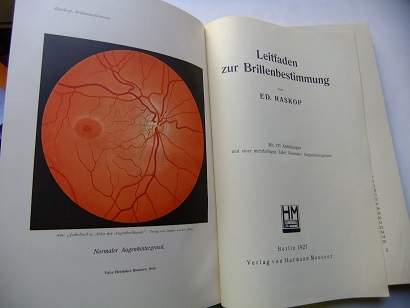
1927réf. 3561Berlin. H. Meusser Verlag. 1927. 192, (2) Seiten. Mit 171 Abbildungen u. einer mehrfarbigen Tafel. Original-Leinwand-Einband (Einband teils fleckig) 23x17 cm
2011réf. 136326Freiburg. Optik Nosch GmbH. & Co. KG. 2011. 220 Seiten. Mit zahlreichen teils farbigen u. teils faks. Abbildungen u. Dokumenten. Farbig illustrierter OKart.-Einband. 22x15 cm
1910réf. 29424Eßlingen u. München. J. F. Schreiber Verlag. Zweite, verbesserte u. vielfach vermehrte Auflage. (1910). VIII, 155, XVI Seiten. Mit 202 farbigen Textabbildungen. Illustrierter Original-Halbleinwand-Einband 21x15 cm
1964réf. 725280PN. New. 1964. Soft Cover. Date is original print. This is a reprint edition. . PN paperback
1628réf. 4005Venice: Lucio Spineda 1628. SOLE EDITION. Hardcover. Fine. Contemporary limp vellum in fine condition paste-down torn. The text is in excellent condition with a few instances of light toning in gatherings O S and X and a small worm-track in the margin of the first few lvs. The text is illustrated with woodcut diagrams. An extremely rare book. OCLC cites only 1 copy in North America Columbia University and 5 other institutional copies outside of Italy two in Denmark two in France one in Switzerland. Vagnetti described the book without having seen a copy. Riccardi described an incomplete copy. First and only edition of this wide-ranging work on selected problems in perspective and its underlying geometry largely organized around what the author considers to be commonly found theoretical or practical errors. Diano proves himself to be well read in the contemporary literature of optics and perspective citing Kepler Maurolico Aguilon and others. The final two chapters describe perspective instruments of the variety used by Dürer. Ferdinando di Diano born around 1571 was an Italian mathematician philosopher and theologian author of some fifteen texts on various subjects including the natural sciences. In "The Eye Wandering from Reason Emended. Perspective"1628 Diano distinguishes between 'perspectiva naturalis' physiological optics and 'perspectiva artificialis' the graphic method that allows the rationalization of space. Diano considers human perception via 'perspectiva naturalis' to be fallible; one cannot be sure what one perceives visually is true or merely a 'deception of the mind'. That is the observer does not know if the images that reach the retina are altered in some way by the mind. By contrast through 'perspectiva artificalis' using optical and measuring tools to "construct" an accurate perspective view the individual can affirm the reliability of one's senses. It is this enhancement of the ability of men to thwart the illusions of visual perception that is at the heart of the "The Eye Wandering from Reason Emended. Perspective." In Diano's views it is the ability to distinguish our perception from reality that distinguishes the soul of rational people from those of madmen and beasts. Lucio Spineda hardcover books
1628réf. 4005Venice: Lucio Spineda 1628. SOLE EDITION. Hardcover. Fine. Contemporary limp vellum in fine condition paste-down torn. The text is in excellent condition with a few instances of light toning in gatherings O S and X and a small worm-track in the margin of the first few lvs. The text is illustrated with woodcut diagrams. An extremely rare book. OCLC cites only 1 copy in North America Columbia University and 5 other institutional copies outside of Italy two in Denmark two in France one in Switzerland. Vagnetti described the book without having seen a copy. Riccardi described an incomplete copy. First and only edition of this wide-ranging work on selected problems in perspective and its underlying geometry largely organized around what the author considers to be commonly found theoretical or practical errors. Diano proves himself to be well read in the contemporary literature of optics and perspective citing Kepler Maurolico Aguilon and others. The final two chapters describe perspective instruments of the variety used by Dürer. Ferdinando di Diano born around 1571 was an Italian mathematician philosopher and theologian author of some fifteen texts on various subjects including the natural sciences. In "The Eye Wandering from Reason Emended. Perspective"1628 Diano distinguishes between 'perspectiva naturalis' physiological optics and 'perspectiva artificialis' the graphic method that allows the rationalization of space. Diano considers human perception via 'perspectiva naturalis' to be fallible; one cannot be sure what one perceives visually is true or merely a 'deception of the mind'. That is the observer does not know if the images that reach the retina are altered in some way by the mind. By contrast through 'perspectiva artificalis' using optical and measuring tools to "construct" an accurate perspective view the individual can affirm the reliability of one's senses. It is this enhancement of the ability of men to thwart the illusions of visual perception that is at the heart of the "The Eye Wandering from Reason Emended. Perspective." In Diano's views it is the ability to distinguish our perception from reality that distinguishes the soul of rational people from those of madmen and beasts. Lucio Spineda hardcover
1504réf. 5444Venice: Giovanni Battista Sessa June 1504. THIRD OR FOURTH EDITION of the two editions of 1504 priority has not been determined. THE FIRST TO BE EDITED BY LUCA GAURICO. Hardcover. Fine. Bound in modern vellum. Title with large woodcut showing the author in his study surrounded by books lecturing his students one of whom takes notes. Sessa's cat-and-mouse printer's device appears on the same leaf.The text is illustrated with 77 woodcut diagrams. A very fine copy crisp and bright. There is a very light stain on the title page a bit of soiling in the gutter of leaf A3 and a discreet paper repair to the fore-edge of the final leaf. "The 'Perspectiva communis' was the most widely used of all optical texts from the early fourteenth until the close of the sixteenth century and it remains today the best index of what was known to the scientific community in general on the subject" DSB. It was first printed in Milan around 1482 then in 1503 it was included in a collection by Thomas Bradwardine "Praeclarissimum mathematicarum opus"Valencia. This 1504 edition the first edited by Luca Gaurico can be considered the third although another edition of the pre-Gaurico version was also published in 1504 at Leipzig. A mathematician from Naples and teacher of Scaliger Gaurico who also edited the works of Archimedes and Ptolemy completely revised the text. "The work on which Pecham's fame has chiefly rested is the Perspectiva communis probably written between 1277 and 1279 during Pecham's professorship at the papal curia. In the first book Pecham discussed the propagation of light and color the anatomy and physiology of the eye the act of visual perception physical requirements for vision the psychology of vision and the errors of direct vision. In book II he discussed vision by reflected rays and presented a careful and sophisticated analysis of image formation by reflection. Book III was devoted to the phenomena of refraction the rainbow and the Milky Way. "The central feature of Pecham's optical system and the dominant theme of book I of the 'Perspectiva communis' is the theory of direct vision. Here as elsewhere Pecham endeavored to reconcile all the available authorities-Aristotle Euclid Augustine al-Kindi Ibn al-Haytham Ibn Rushd Grosseteste and Bacon. Following Ibn al-Haytham Pecham argued that the emission of visual rays from the observer's eye is neither necessary nor sufficient as an explanation of sight; the primary agent of sight is therefore the ray coming to the eye from a point on the visible object. But in an attempt to follow Aristotle al-Kindi and Grosseteste as well Pecham argued that visual rays do nevertheless exist and perform the important but not always necessary function of moderating the luminous rays from the visible object and making them "commensurate with the visual power." Thus Pecham like Bacon resolved the age-old debate between the emission and intromission theories of vision in favor of a twofold radiation although to be sure priority was given to rays issuing from the visible object. "The rays issuing from points on the visible object fall perpendicularly onto the cornea and penetrate without refraction to the sensitive ocular organ the glacial humor or crystalline lens; nonperpendicular rays are weakened by refraction and therefore can be largely ignored. Since only one perpendicular ray issues from each point of the visible object and the collection of such perpendicular rays maintains a fixed order between the object and the eye a one-to-one correspondence is established between points on the object and points on the glacial humor and unconfused perception of the visual field is thus achieved. Vision is not "completed" however in the glacial humor. There is a further propagation of the rays or species through the vitreous humor and optic nerve to the common nerve where species from the two eyes combine and eventually to the anterior part of the brain and the "place of interior judgment." "Pecham's optical system included significantly more than a theory of direct vision. He briefly discussed the doctrine of species; treated at length the propagation of rays; and developed a theory to explain how solar radiation when passing through noncircular apertures gives rise to circular images. He expressed the full law of reflection and applied it to image formation by plane spherical cylindrical and conical mirrors; in this analysis he revealed an implicit understanding of the nature of the focal point of a concave mirror. Although he did not possess a mathematical law of refraction he successfully applied the general qualitative principles of refraction to the images that result from refraction at plane and circular interfaces between transparent media of various densities. In his discussion of the rainbow Pecham again attempted to reconcile different theories. He argued that all three kinds of rays rectilinear reflected and refracted concur in the generation of the rainbow. "Pecham's 'Perspectiva communis' is still extant in more than sixty manuscripts and went through twelve printed editions including a translation into Italian between 1482 and 1665. It was used and cited by many medieval and Renaissance natural philosophers including Dominicus de Clavasio Henry of Langenstein Blasius of Parma Lorenzo Ghiberti Leonardo da Vinci Albert Brudzewski Francesco Maurolico Giambattista della Porta Girolamo Fabrici Johannes Kepler Willebroad Snellius and G. B. Riccioli. It was lectured upon in the late Middle Ages at the universities of Vienna Prague Paris Leipzig Cracow Würzburg Alcala and Salamanca."DSB. Giovanni Battista Sessa, June hardcover books
1504réf. 5444Venice: Giovanni Battista Sessa June 1504. THIRD OR FOURTH EDITION of the two editions of 1504 priority has not been determined. THE FIRST TO BE EDITED BY LUCA GAURICO. Hardcover. Fine. Bound in modern vellum. Title with large woodcut showing the author in his study surrounded by books lecturing his students one of whom takes notes. Sessa's cat-and-mouse printer's device appears on the same leaf.The text is illustrated with 77 woodcut diagrams. A very fine copy crisp and bright. There is a very light stain on the title page a bit of soiling in the gutter of leaf A3 and a discreet paper repair to the fore-edge of the final leaf. "The 'Perspectiva communis' was the most widely used of all optical texts from the early fourteenth until the close of the sixteenth century and it remains today the best index of what was known to the scientific community in general on the subject" DSB. It was first printed in Milan around 1482 then in 1503 it was included in a collection by Thomas Bradwardine "Praeclarissimum mathematicarum opus"Valencia. This 1504 edition the first edited by Luca Gaurico can be considered the third although another edition of the pre-Gaurico version was also published in 1504 at Leipzig. A mathematician from Naples and teacher of Scaliger Gaurico who also edited the works of Archimedes and Ptolemy completely revised the text. "The work on which Pecham's fame has chiefly rested is the Perspectiva communis probably written between 1277 and 1279 during Pecham's professorship at the papal curia. In the first book Pecham discussed the propagation of light and color the anatomy and physiology of the eye the act of visual perception physical requirements for vision the psychology of vision and the errors of direct vision. In book II he discussed vision by reflected rays and presented a careful and sophisticated analysis of image formation by reflection. Book III was devoted to the phenomena of refraction the rainbow and the Milky Way. "The central feature of Pecham's optical system and the dominant theme of book I of the 'Perspectiva communis' is the theory of direct vision. Here as elsewhere Pecham endeavored to reconcile all the available authorities-Aristotle Euclid Augustine al-Kindi Ibn al-Haytham Ibn Rushd Grosseteste and Bacon. Following Ibn al-Haytham Pecham argued that the emission of visual rays from the observer's eye is neither necessary nor sufficient as an explanation of sight; the primary agent of sight is therefore the ray coming to the eye from a point on the visible object. But in an attempt to follow Aristotle al-Kindi and Grosseteste as well Pecham argued that visual rays do nevertheless exist and perform the important but not always necessary function of moderating the luminous rays from the visible object and making them "commensurate with the visual power." Thus Pecham like Bacon resolved the age-old debate between the emission and intromission theories of vision in favor of a twofold radiation although to be sure priority was given to rays issuing from the visible object. "The rays issuing from points on the visible object fall perpendicularly onto the cornea and penetrate without refraction to the sensitive ocular organ the glacial humor or crystalline lens; nonperpendicular rays are weakened by refraction and therefore can be largely ignored. Since only one perpendicular ray issues from each point of the visible object and the collection of such perpendicular rays maintains a fixed order between the object and the eye a one-to-one correspondence is established between points on the object and points on the glacial humor and unconfused perception of the visual field is thus achieved. Vision is not "completed" however in the glacial humor. There is a further propagation of the rays or species through the vitreous humor and optic nerve to the common nerve where species from the two eyes combine and eventually to the anterior part of the brain and the "place of interior judgment." "Pecham's optical system included significantly more than a theory of direct vision. He briefly discussed the doctrine of species; treated at length the propagation of rays; and developed a theory to explain how solar radiation when passing through noncircular apertures gives rise to circular images. He expressed the full law of reflection and applied it to image formation by plane spherical cylindrical and conical mirrors; in this analysis he revealed an implicit understanding of the nature of the focal point of a concave mirror. Although he did not possess a mathematical law of refraction he successfully applied the general qualitative principles of refraction to the images that result from refraction at plane and circular interfaces between transparent media of various densities. In his discussion of the rainbow Pecham again attempted to reconcile different theories. He argued that all three kinds of rays rectilinear reflected and refracted concur in the generation of the rainbow. "Pecham's 'Perspectiva communis' is still extant in more than sixty manuscripts and went through twelve printed editions including a translation into Italian between 1482 and 1665. It was used and cited by many medieval and Renaissance natural philosophers including Dominicus de Clavasio Henry of Langenstein Blasius of Parma Lorenzo Ghiberti Leonardo da Vinci Albert Brudzewski Francesco Maurolico Giambattista della Porta Girolamo Fabrici Johannes Kepler Willebroad Snellius and G. B. Riccioli. It was lectured upon in the late Middle Ages at the universities of Vienna Prague Paris Leipzig Cracow Würzburg Alcala and Salamanca."DSB. Giovanni Battista Sessa, June hardcover
réf. 026079029X.Gpaperback. Good. Access codes and supplements are not guaranteed with used items. May be an ex-library book. paperback
1960réf. 75949Tokyo. (Um 1960). 28, (3) Seiten. Mit zahlr. Abbildungen. Farbig ill. Originalbroschur. 21x10 cm
in-8, cxxii-406 pp. Illustrations and figures. Trade paperback. GOOD [WE-1]
1740réf. 106497BBLausanne & Genevae, Bousquet & Sociorum, 1740. 4° (25 x 20 cm.). XXXII, 363, (1) S. mit Titel in Rot u. Schwarz, gestoch. Titelvignette, gestoch. Frontispiz (Portrait), figürl. Initialen u. 12 gefalt. Kupfertafeln. Prgt. d. Zt. mit goldgepr. Rückenschild. [11 Warenabbildungen] Editio novissima.
réf. 7213Amsterdam, Humbert, 1720, 2 tomes reliés en un volume in 12, plein veau, dos orné de fers dorés, tranches rouges (reliure de l'époque), T.1 : 15pp., (1pp.), pp. 1 à 328, T.2 : (1), pp., 331 à 583, (1pp.), 8 feuillets non chiffrés (catalogue du librairie), 12 PLANCHES DEPLIANTES
1993réf. x-0792323947Kluwer Academic Pub 1993. Hardcover. New. 1st edition. 436 pages. 10.00x6.75x1.00 inches. Kluwer Academic Pub hardcover
1991réf. lh16v16axbvkJapan/Netherlands, Yamada Science Foundation - Elsevier Science Publishers, 1991. xviii, 572 pages; with many graphic illustrations. - Publisher's brown gilt-titled cloth with grey orig.-dustjacket; 4to.(ca. 26 x 19 x 2,5 cm; ca. 1,3 kg.).
1987Soft cover in a good condition with wear to corners and edges. Ex-library usual stamps and stickers. Contents very good and clean, text and illustrations bright and tight throughout. Ex-Library
réf. 25993aafLeipzig, (G. Braun in Karlsruhe für) Poeschel & Trepte, 1918, gr. in-4°, XX + 401 S., Halbleinenband mit Ecken, Leder Rsch., Buntpapier-Deckelbezug. Schönes Ex.
réf. 15998Bruxelles, Librairie Classique et Mathématique, Alex De Mat, 1838. 19 x 28, 2 volumes, impressions sur 2 colonnes, 584 pp. + 620 pp., 58 planches au total (parachutes et ballons dirigeables, instruments scientifiques, astronomie, mécanique et machinerie, géométrie, etc.), reliure dos cuir, très bon état (rousseurs quasi
réf. 30803aafParis, Imprimerie Nogret - Guyot, 1960, gr. in-8°, 257 p., tous les produits présentés sont illustrés, brochure originale.
Softcover in-12, 255 pages et 9 ff. roses de publicites, nombreuses fig. in-t., tableau depliant (verres colores), broche, couv. Bon etat (couverture et dos salis). [SC-1]
1780réf. 27887Paris chez Mondhard 1780 une vue d'optique en couleurs, GRAVÉE A L'EAU-FORTE ET AQUARELLÉE SUR PAPIER DE FORMAT: 39,5 x 27 cm., A Paris chez Mondhare rue St. Jacques à l'hotel Saumur[ca 1780] Editeur,
1800réf. 27681Paris chez Mondhard 1800 une vue d'optique en couleurs, GRAVÉE A L'EAU-FORTE ET AQUARELLÉE SUR PAPIER DE FORMAT: 33,5 x 50 cm., A Paris chez Mondhard rue St. Jacques à L.ge St. Jacques [ca 1800] Editeur,