Antiquariat.de

618 résultats
1928réf. 10839Stuttgart. Franckh'sche Verlagshandlung. 1928. * Vier Hefte mit zusammen 32, (2) Textseiten mit einigen Abbildungen, 20 mehrfach gefaltete Tafeln mit zusammen 152 Textkarten zum Ausschneiden" und zusammen 146 (von 152) Bildbeigagen (Es fehlt die Serie "Völker Sibiriens"). Originalumschläge. (Alle Umschläge am Rissen aufgerissen und an den Rändern teils etwas beschädigt. Textseiten, Bildkarten u. Bilder in sehr gutem Zustand). 26x18 cm
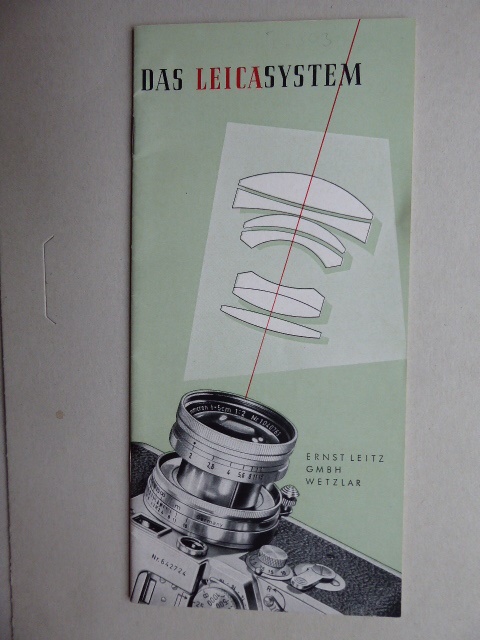
1954réf. 72803Wetzlar. (September 1954). 23 Seiten. Mit zahlreichen Abbildungen. Mehrfarbiger Druck. Farbig ill. OBrosch. 21x10 cm
1913réf. 1104172Braunschweig, Fr. Vieweg u. Sohn, 1913. 14, 384 S. m. 33 Textabb. u. 1 Falttaf. (Die Wissenschaft. Slg v. Einzeldarst. a. d. Gebieten d. Naturwiss. u. d. Technik 49). OLwd (Kanten bestoßen, St. a. T.).
1875réf. TECH1710München, Rudolph Oldenbourg 1875. Kl.8°. XII, 324 S. Mit 132 Holzstichen im Text. OKart. m. schwarzgedr. Deckeltit. Rücken und Fälze mit Papierstreifen verstärkt, Einbd. angestaubt, Spiegel m. Klebespuren, erstes u. letztes Blatt gebräunt.
réf. 145042Wiesbaden. (Ohne Jahr). Farbig illustrierte u. als Aufsteller ausgestanzte, Originalschachtel mit gefülltem Inhalt an farbigen Miniatur-Ferngläsern im Format ca. 2,2x2,7 cm jeweils mit einem Schlüsselanhänger. Schachtelformat 12x19x2,4 cm
18908vo, 19.3cm. Pp. viii,77, 1 fold. pl., 13 figs. in text, 1 stereogram on thin cardboard in rear pocket, notes & refs., index. Orig. cloth. Some light spotting to binding, contents very good. - Rare.
1907réf. 143932Leipzig, B. G. Teubner 1907. 70, (4) Seiten und 19 lose Tafeln in Umschlag. Original-Leinwand-Einband in guter Ehraltung. (Zwei Tafeln in der Mitte durchgeschnitten, jedoch komplett). 18x13 cm
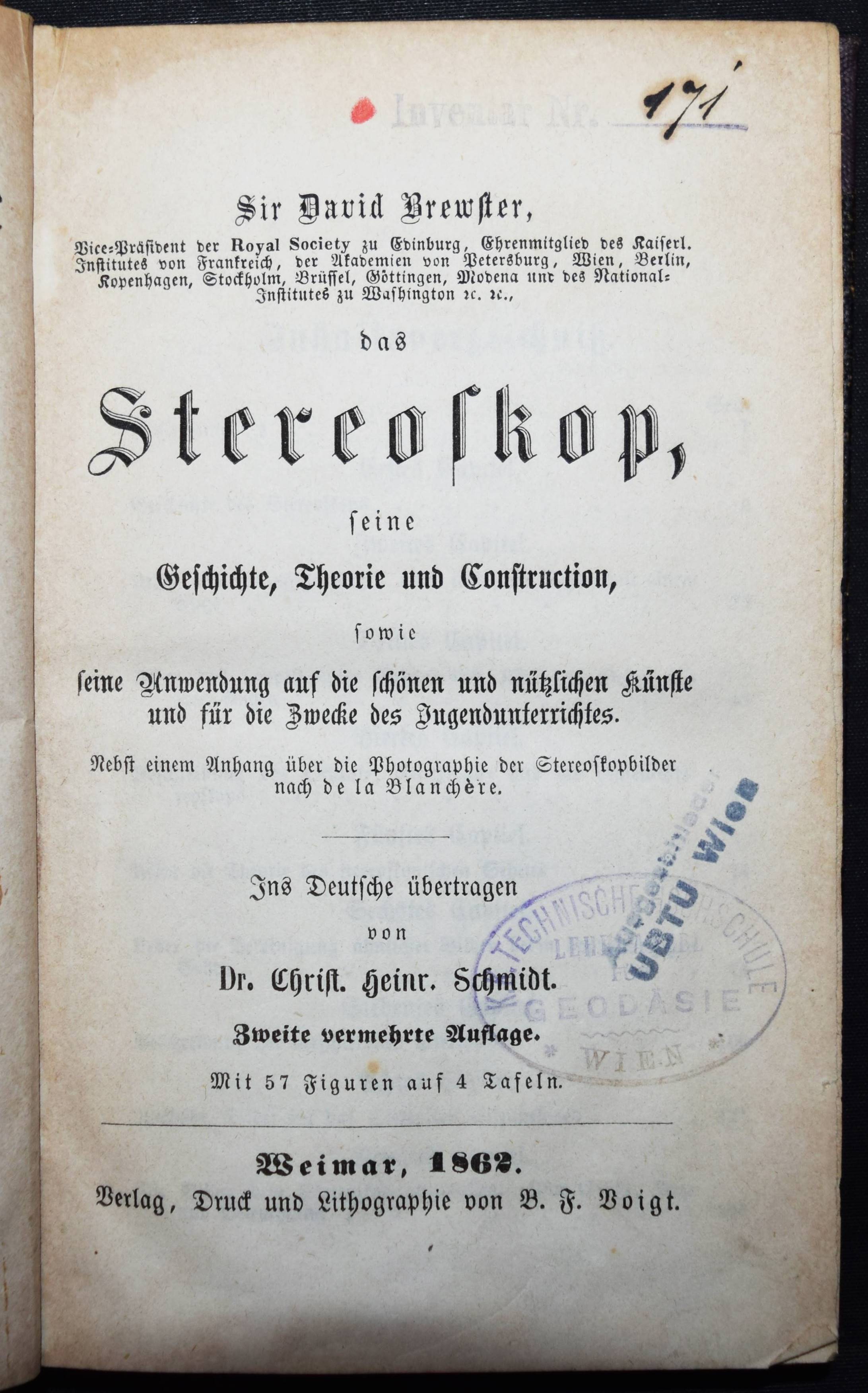
1862réf. 106385BBWeimar, B. F. Voigt, 1862. 8°. XII, 320 S. mit 57 Abb. auf 4 gefalt. lithogr. Tafeln. OHln. mit goldgepr. Rückentitel u. Linienvergoldung. [5 Warenabbildungen] 2., verm. Aufl. (Neuer Schauplatz der Künste und Handwerke, Band 35).
1950réf. 146468Couverture souple. Broché. 128 pages.
1950réf. 146469Couverture souple. Broché. 128 pages.
1611"Marca tipografica frontespizio e numerosi diagrammi xilografici nel testo. 4 p.l., 78 pp., 1 carta di errata. Piccolo 4to, pergamena coeva. Venezia: T. Baglionus, 1611. Frontespizio con un piccolo restauro. Prima edizione di questa rara e importante opera nella storia dell'ottica e del telescopio; ha avuto una grande influenza sulle teorie ottiche di Newton ed è di grande interesse galileiano. De radiis visus et lucis si occupa di lenti, telescopi e arcobaleno. De Dominis sapeva come la luce si rifrangeva nel suo passaggio da un mezzo all'altro. Dopo l'invenzione del telescopio De Dominis ha aggiunto la sua spiegazione teorica al suo lavoro. La sua spiegazione non fu del tutto soddisfacente, tuttavia, perché la sua conoscenza della legge di rifrazione era incompleta. De Dominis descrive in modo particolareggiato l'effetto sull'angolo di vista di una lente di maggiore curvatura o di maggiore distanza tra la lente e l'oggetto che si sta osservando. Con la stessa accuratezza ha esaminato le combinazioni di lenti, in particolare la combinazione di un oggetto di vetro convesso e di un oculare concavo. Questo lavoro ha portato alla sua scoperta delle condizioni in cui è possibile l'ingrandimento di un'immagine. ""- DSB, IV, p. 158. Nella prefazione, Giovanni Bartoli, che fu ambasciatore della Toscana a Venezia e uno dei primi sostenitori delle scoperte di Galileo, descrive il cannocchiale di nuova invenzione (attribuendo la sua invenzione a Galileo) e le scoperte rese possibili da questo strumento. De Dominis fornisce anche un resoconto del cannocchiale (pp. 34-43) e suggerisce addirittura i tiranti, entrati in uso molto più tardi . Questo libro contiene anche la famosa teoria dell'arcobaleno di De Dominis che influenzò molto Newton. Nel 1704, Newton scrisse nel suo Optics: ""Questa rifrazione è stata recentemente scoperta e spiegata più completamente dal famoso Arcivescovo Antonius de Dominis di Spalato, nel suo libro De Radiis Visus et Lucis, pubblicato dall'amico Bartolus a Venezia, nell'anno 1611, e scritto sopra 20 anni prima. Perché vi insegna come l'arco interno è realizzato da gocce di pioggia rotonde da due rifrazioni della luce solare. ""Per una discussione approfondita sulla spiegazione dell'arcobaleno di De Dominis, vedere Boyer, The Rainbow (pp. 187-92 & passim ), che lo definisce ""superiore a qualsiasi altro pubblicato nell'intervallo di tre secoli dal 1311 al 1611"". Newton possedeva una copia del presente libro che ora si trova al Trinity College di Cambridge (vedi Harrison, The Library of Isaac Newton, 535). De Dominis (1560-1626), gesuita dalmata, tenne conferenze di matematica, logica e filosofia a Verona, Padova e Brescia. In seguito fu nominato arcivescovo di Spalato (Spalato). La sua fede nell'unità di tutti i cristiani chiese e la pace tra le nazioni lo portarono a fuggire in Inghilterra. Poco dopo il suo ritorno a Roma, fu imprigionato dall'Inquisizione. Morì in una prigione e dopo la sua morte fu riconosciuto colpevole di eresia e il suo corpo fu bruciato. Goethe scrisse di De Dominis che ""ha scoperto lo spettro solare mentre diceva messa"" Cinti 33. Poggendorff, I, 589-90. Riccardi, I, 417-18– ""importantissimo libro"". Printer’s mark on title page & numerous woodcut diagrams in the text. 4 p.l., 78 pp., 1 leaf of errata. Small 4to, contemporary calf. Venice: T. Baglionus, 1611. Title page with a small restoration. First edition of this rare and important work in the early history of optics and the telescope; it had a major influence on the optical theories of Newton and is of great Galilean interest. De radiis visus et lucis deals with lenses, telescopes, and the rainbow. De Dominis knew how light was refracted in its passage from one medium to another. After the invention of the telescope Dominis added its theoretical explanation to his work. His explanation was not entirely satisfactory, however, because his knowledge of the law of refraction was incomplete. De Dominis describes in particular detail the effect on the angle of sight of a lens of greater curvature or of a greater distance between the lens and the object being viewed. With the same thoroughness he examined lens combinations, in particular the combination of a convex object glass and a concave eyepiece. This work led to his discovery of the conditions under which the magnification of an image is possible.""–D.S.B., IV, p. 158.In the Preface, Giovanni Bartoli, who was Tuscan Ambassador at Venice and an early advocate of Galileo’s discoveries, describes the newly invented telescope (attributing its invention to Galileo) and the discoveries made possible by this instrument. De Dominis also provides an account of the telescope (pp. 34-43) and even suggests draw-tubes, which came into use much later. This book also contains De Dominis’ famous theory of the rainbow which greatly influenced Newton. In 1704, Newton wrote in his Optics: ""This Refraction was of late more fully discover’d and explain’d by the famous Antonius de Dominis, Archbishop of Spalato, in his book De Radiis Visus et Lucis, published by his friend Bartolus at Venice, in the Year 1611, and written above 20 Years before. For he teaches there how the interior Bow is made in round Drops of Rain by two Refractions of the Sun light."". For a thorough discussion of De Dominis explanation of the rainbow, see Boyer, The Rainbow (pp. 187-92 & passim), who calls it ""superior to any other published in the interval of three centuries from 1311 to 1611."" Newton owned a copy of the present book which is now at the Trinity College, Cambridge (see Harrison, The Library of Isaac Newton, 535). De Dominis (1560-1626), a Dalmatian Jesuit, lectured on mathematics, logic, and philosophy at Verona, Padua, and Brescia. He was later appointed archbishop of Split (Spalato). His belief in the unity of all Christian churches and peace among nations caused him to flee to England. Soon after his return to Rome, he was imprisoned by the Inquisition. He died in a dungeon and after his death he was found guilty of heresy and his body was burned. Goethe wrote of De Dominis that ""he discovered the solar spectrum while celebrating Mass"" Cinti 33. Poggendorff, I, 589-90. Riccardi, I, 417-18–""importantissimo libro"" "
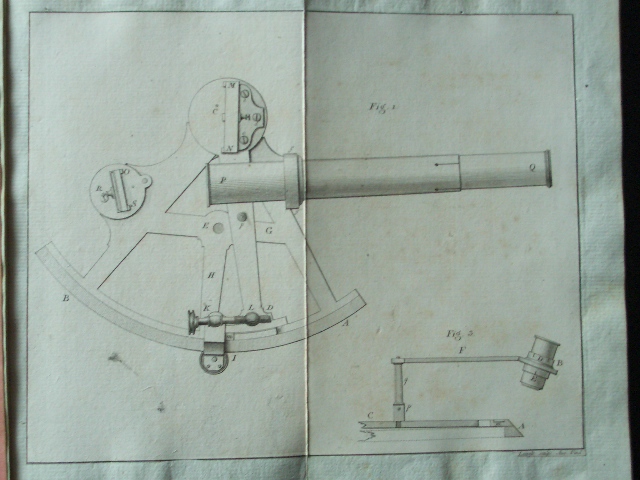
1794réf. 1798) Instrument für den Ingenieur. Mit 4 gefalt. Kupfertafeln von [Balthasar Friedrich] Leizelt. Stuttgart, gedrukt bei Chr. Fr. Cotta, 1794. Kl.-4to. (22,5 x 18,3 cm). 3 Bll., 18 S. Schlichter Pappband d. Zt.
1781réf. 27130A Paris, à la Librairie économique / chez Magimel, 1800. Un vol. au format in-4 (270 x 212 mm) de 2 ff. n.fol. et 90 planches gravées. Reliure de l'époque de demi-basane marbrée brune, dos lisse orné de doubles filets verticaux dorés, doubles filets dorés, roulettes dorées, large décor fleuronné doré, semis de cercles dorés, pièces de titre de maroquin cerise et marine, titre doré, palette dorée en tête et queue, tranches jaunes.
réf. 15998Bruxelles, Librairie Classique et Mathématique, Alex De Mat, 1838. 19 x 28, 2 volumes, impressions sur 2 colonnes, 584 pp. + 620 pp., 58 planches au total (parachutes et ballons dirigeables, instruments scientifiques, astronomie, mécanique et machinerie, géométrie, etc.), reliure dos cuir, très bon état (rousseurs quasi
réf. 26225aafWien, L.W. Seidel (für K.K. Kriegsschule), 1878, in-4° et in-4° oblong, XVI + 426 S. / 22 Tafeln davon 20 lithogr. Tafeln mit zahlr. gestoch. Fig. (Tafel 1 mit Stempel und staubfleckig), 1 Lichtdrucktafel, und 1 Karte in photolithogr. Farbendruck, im Mitte gefalten, einige Stempel, Original-Broschüre, fleckig, Stempel und Etikette / broschiert, Titeletikette uaf Umschlag vorne, Umschlag etwas beschädigt.
1960réf. X109089Bonn, 1960 67pp., 21cm., softcover, text in German, Doctoral dissertation (Inaugural-Dissertation zur Erlangung der Doktorwürde der Philosophischen Fakultät der Rheinischen Friedrich-Wilhelms-Universität zu Bonn), stamp at verso of title page, text is clean and bright, good condition, X109089
1906réf. 1103732Braunschweig, Fr. Vieweg u. Sohn, 1906. 9, (1), 160 S. m. 73 Abb. im Text. (Die Wissenschaft. Slg naturwiss. u. mathem. Monographien 17). Hlwd (Rücken verblichen, Einb beschabt, St. a. T.).
196067pp., 21cm., softcover, text in German, Doctoral dissertation (Inaugural-Dissertation zur Erlangung der Doktorwürde der Philosophischen Fakultät der Rheinischen Friedrich-Wilhelms-Universität zu Bonn), stamp at verso of title page, text is clean and bright, good condition, X109089
1928réf. 1228497Jena, G. Fischer, 1928. Gr.-8vo. 1 Porträt, 14, 146 S. m. einigen Abb. u. Tabellen (Gesammelte Abhandlungen 4/1 = Unveröffentliche Schriften wissenschaftlich-technischen Inhalts 1). Goldgepr. OLwdbd.
1931réf. 105031Düsseldorf. 5. Auflage November. 1931. 11, (1) Seiten. Mit zahlr. Abbildungen (Ohne Firmeneintrag). 21x14 cm
1879réf. 1109316Leipzig, Quandt u. Händel, 1879. 23, (1), 221 S. m. 74 Fig. im Text. Hlwd (Rücken verblichen, Kanten bestoßen, St. a. T.).
1927réf. 20935Jena. Druckschrift: P 258. (1927). 16 Seiten. Mit 12 Abbildungen u. einer gefalteten Tafel. Originalbroschur. 21x15 cm
1911réf. 1227123Stuttgart, Enke, 1911. 12, 223, (9) S. m. 114 Textabb. (davon wenige farbig). Lwdbd (Kopf m. Klebespuren, Titelei m. mehreren Stemp. u. Sign.).
1951réf. 1192822Leipzig, 1951. 33, (1) S. (Fotografie des Typoskripts). Hlwdbd (mehrf. gest.).
1657In-4°, (10cc), 46pp, 1carta ripiegata; 38pp, 4 carte di tavola, due ripiegate; 55pp, due carte di tavv, 16pp, 12pp, una carta ripiegata; 56pp, una carta ripiegata; 16pp, una carta ripiegata. Prima edizione, buone condizioni, legatura in pergamena con titolo manoscritto al dorso. La prima prefazione è di Dilherr, la seconda dell’autore. Poggendorff, II, col. 1133; Houzeau & Lancaster. Astronomie (1964 ed.), 9322, NUC pre-1956, NT In-4° (10cc), 46pp, 1 folded table; 38pp, 4 tables, two folded; 55pp, two folded tables; (2), 16pp, 12pp, one folded table; 56pp, one folded table; 16pp, one folded table. First edition, good copy, contemporary vellum binding, manuscript title at the spine. The first preface is by Dilherr, the second by the author The initial foreword is by Dilherr, the second one by the author. Poggendorff, II, col. 1133; Houzeau & Lancaster. Astronomie (1964 ed.), 9322, NUC pre-1956, NT"