624 résultats
Broch?. 40 pages ron?ot?es. Annot?. 21x27 cm. Rousseurs.
grand in-8°, x-212 pages, illustrations et figures, broche, couverture illustree. Bel exemplaire. [MI-4]
réf. 609P., Doin, 1913, un volume in 8 relié en cartonnage éditeur, 263pp., figures dans le texte
1917réf. 25856Paris Delagrave 1917 Fort In-8 XXXI- 620 pp, Bibliothèque scientifique de l'ingénieur et du physicien. papier jauni mais bon exemplaire
réf. 1527SEDES , Paris 1954
réf. 6193notions nécessaires aux photographes amateurs étude de l’objectif application in 12 broché faux-titre,titre, VIII 132 pages 4 pages de catalogue 72 figures dans le texte Paris Gauthier Villars et fils imprimeurs libraires 1891, bibliothèque photographique.Bon exemplaire
1898réf. 181440Georges Carré et C Naud Paris ,Georges Carré et C Naud, 1898. Grand In-8 relié demi-toile noire à coins, titre doré en dos de 335 pages ornées de 201 figures Dioptrique oculaire, Fonction de la rétine, les mouvements oculaires et la vision binoculaire. Bel exemplaire, peu courant
réf. 141872aafParis, C. Hermant, s.d. (1965), gr. in-8vo, 225 p. + 1 p. vide + VI, brochure originale.
1954réf. 25031954 broché in-octavo tellière, dos et couverture blancs, illustrations in-texte, quelques passages du texte sont soulignés, 128 pages, 1954 Paris Presse Universitaires de France,
1979Paris, Puf 1979. In-12 broché de 127 pages. Collection que sais-je. Parfait état
réf. 14790Paris Bordas 1955 in 8 (24,5x15,5) 1 volume broché, 184 pages,(bibliothèque de la science moderne). 108 figures dans le texte. Avec la collaboration de M.-Y. Bernard (Agrégé de l'Université, Docteur ès Sciences, Professeur à l'E.N.S. de Saint-Cloud), et de A. Septier (Agrégé de l'Université, Docteur ès Sciences, chargé de recherches au C.N.R.S). Préface de Louis de Broglie. Grivet P. Professeur de radioélectrécité. Bon exemplaire
français S.l.s.n.s.d. (Panckoucke, vers 1789). Petit in-4 (19,8x25,3 cm) de 4 pp. + 18 pl. h.t.; broché en ffs. cousus), couverture muette avec au premier plat une vignette de titre sur papier (couverture postérieure). Ensemble de 18 planches gravées représentant 149 figures d'optique (appareils et schémas). En très bon état. Petits manques de papier au dos.
réf. 41415Bruxelles, De Boeck/Wesmael, 1988. 14 x 22, 170 pp., nombreux dessins, broché, bon état (couverture défraîchie).
réf. 43659Paris, Masson, 1954. 16 x 25, 906 pp., 723 figures, reliure d'édition pleine toile, bon état (couverture et dos défraîchis).
1950réf. 1307877Jena, etwa 1950). 48 S. m. zahlr. teils ganzseitigen Abbildungen. OKart.
1899réf. 1308240(Berlin), Reimer, (1899). Gr.-8vo. 19 S. (Sitzungsberichte der Königlich Preussischen Akademie der Wissenschaften 19/1899). OBroschur.
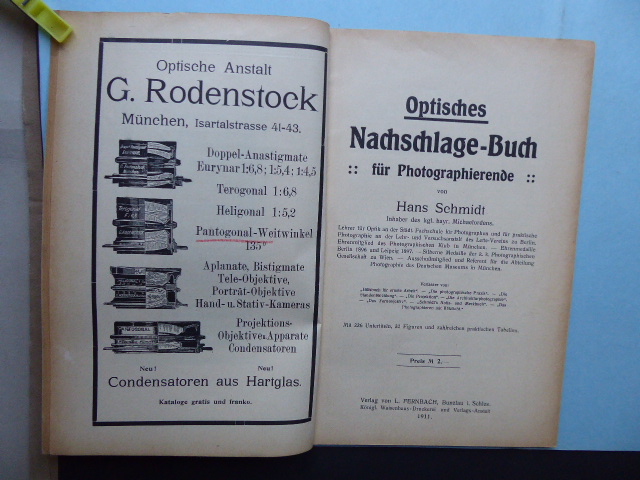
1911réf. 143956Bunzlau i. Schlesien. Verlag von L. Fernbach. 1911. VIII, 66, (4)Seiten. Originalbroschur. (Etwas randfleckig). 22x14,5 cm
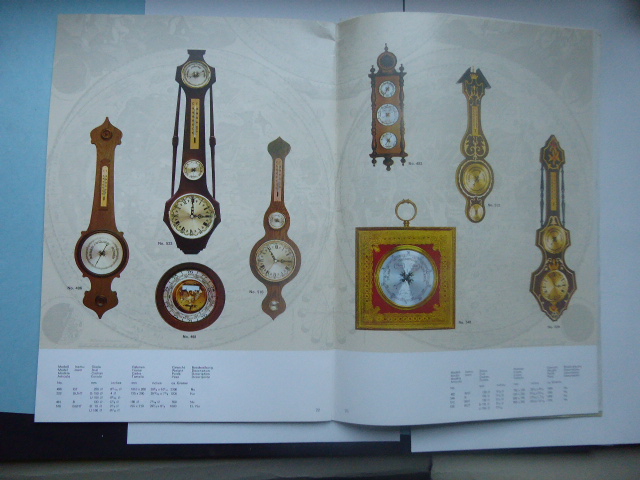
1974réf. 96111Weigheim i. Württemberg. 1974. 24 Seiten, eine Preisliste u. ein Anschreiben. Mit zahlreichen teils farbigen Abbildungen. Originalbroschur. 30x21 cm
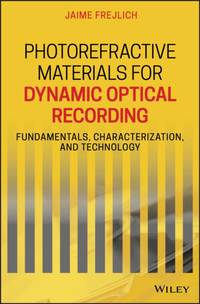
réf. 026079029X.Gpaperback. Good. Access codes and supplements are not guaranteed with used items. May be an ex-library book. paperback
réf. 7636Washington, War Department technical manual (TM9-1582), (19 janvier) 1945. In-8, broché.
1995réf. 28757Paris Cnrs Éditions 1995 Fort-in-8 561 pp, nombreuses illustrations en noir
2011réf. 136326Freiburg. Optik Nosch GmbH. & Co. KG. 2011. 220 Seiten. Mit zahlreichen teils farbigen u. teils faks. Abbildungen u. Dokumenten. Farbig illustrierter OKart.-Einband. 22x15 cm
1504réf. 5444Venice: Giovanni Battista Sessa June 1504. THIRD OR FOURTH EDITION of the two editions of 1504 priority has not been determined. THE FIRST TO BE EDITED BY LUCA GAURICO. Hardcover. Fine. Bound in modern vellum. Title with large woodcut showing the author in his study surrounded by books lecturing his students one of whom takes notes. Sessa's cat-and-mouse printer's device appears on the same leaf.The text is illustrated with 77 woodcut diagrams. A very fine copy crisp and bright. There is a very light stain on the title page a bit of soiling in the gutter of leaf A3 and a discreet paper repair to the fore-edge of the final leaf. "The 'Perspectiva communis' was the most widely used of all optical texts from the early fourteenth until the close of the sixteenth century and it remains today the best index of what was known to the scientific community in general on the subject" DSB. It was first printed in Milan around 1482 then in 1503 it was included in a collection by Thomas Bradwardine "Praeclarissimum mathematicarum opus"Valencia. This 1504 edition the first edited by Luca Gaurico can be considered the third although another edition of the pre-Gaurico version was also published in 1504 at Leipzig. A mathematician from Naples and teacher of Scaliger Gaurico who also edited the works of Archimedes and Ptolemy completely revised the text. "The work on which Pecham's fame has chiefly rested is the Perspectiva communis probably written between 1277 and 1279 during Pecham's professorship at the papal curia. In the first book Pecham discussed the propagation of light and color the anatomy and physiology of the eye the act of visual perception physical requirements for vision the psychology of vision and the errors of direct vision. In book II he discussed vision by reflected rays and presented a careful and sophisticated analysis of image formation by reflection. Book III was devoted to the phenomena of refraction the rainbow and the Milky Way. "The central feature of Pecham's optical system and the dominant theme of book I of the 'Perspectiva communis' is the theory of direct vision. Here as elsewhere Pecham endeavored to reconcile all the available authorities-Aristotle Euclid Augustine al-Kindi Ibn al-Haytham Ibn Rushd Grosseteste and Bacon. Following Ibn al-Haytham Pecham argued that the emission of visual rays from the observer's eye is neither necessary nor sufficient as an explanation of sight; the primary agent of sight is therefore the ray coming to the eye from a point on the visible object. But in an attempt to follow Aristotle al-Kindi and Grosseteste as well Pecham argued that visual rays do nevertheless exist and perform the important but not always necessary function of moderating the luminous rays from the visible object and making them "commensurate with the visual power." Thus Pecham like Bacon resolved the age-old debate between the emission and intromission theories of vision in favor of a twofold radiation although to be sure priority was given to rays issuing from the visible object. "The rays issuing from points on the visible object fall perpendicularly onto the cornea and penetrate without refraction to the sensitive ocular organ the glacial humor or crystalline lens; nonperpendicular rays are weakened by refraction and therefore can be largely ignored. Since only one perpendicular ray issues from each point of the visible object and the collection of such perpendicular rays maintains a fixed order between the object and the eye a one-to-one correspondence is established between points on the object and points on the glacial humor and unconfused perception of the visual field is thus achieved. Vision is not "completed" however in the glacial humor. There is a further propagation of the rays or species through the vitreous humor and optic nerve to the common nerve where species from the two eyes combine and eventually to the anterior part of the brain and the "place of interior judgment." "Pecham's optical system included significantly more than a theory of direct vision. He briefly discussed the doctrine of species; treated at length the propagation of rays; and developed a theory to explain how solar radiation when passing through noncircular apertures gives rise to circular images. He expressed the full law of reflection and applied it to image formation by plane spherical cylindrical and conical mirrors; in this analysis he revealed an implicit understanding of the nature of the focal point of a concave mirror. Although he did not possess a mathematical law of refraction he successfully applied the general qualitative principles of refraction to the images that result from refraction at plane and circular interfaces between transparent media of various densities. In his discussion of the rainbow Pecham again attempted to reconcile different theories. He argued that all three kinds of rays rectilinear reflected and refracted concur in the generation of the rainbow. "Pecham's 'Perspectiva communis' is still extant in more than sixty manuscripts and went through twelve printed editions including a translation into Italian between 1482 and 1665. It was used and cited by many medieval and Renaissance natural philosophers including Dominicus de Clavasio Henry of Langenstein Blasius of Parma Lorenzo Ghiberti Leonardo da Vinci Albert Brudzewski Francesco Maurolico Giambattista della Porta Girolamo Fabrici Johannes Kepler Willebroad Snellius and G. B. Riccioli. It was lectured upon in the late Middle Ages at the universities of Vienna Prague Paris Leipzig Cracow Würzburg Alcala and Salamanca."DSB. Giovanni Battista Sessa, June hardcover
1504réf. 5444Venice: Giovanni Battista Sessa June 1504. THIRD OR FOURTH EDITION of the two editions of 1504 priority has not been determined. THE FIRST TO BE EDITED BY LUCA GAURICO. Hardcover. Fine. Bound in modern vellum. Title with large woodcut showing the author in his study surrounded by books lecturing his students one of whom takes notes. Sessa's cat-and-mouse printer's device appears on the same leaf.The text is illustrated with 77 woodcut diagrams. A very fine copy crisp and bright. There is a very light stain on the title page a bit of soiling in the gutter of leaf A3 and a discreet paper repair to the fore-edge of the final leaf. "The 'Perspectiva communis' was the most widely used of all optical texts from the early fourteenth until the close of the sixteenth century and it remains today the best index of what was known to the scientific community in general on the subject" DSB. It was first printed in Milan around 1482 then in 1503 it was included in a collection by Thomas Bradwardine "Praeclarissimum mathematicarum opus"Valencia. This 1504 edition the first edited by Luca Gaurico can be considered the third although another edition of the pre-Gaurico version was also published in 1504 at Leipzig. A mathematician from Naples and teacher of Scaliger Gaurico who also edited the works of Archimedes and Ptolemy completely revised the text. "The work on which Pecham's fame has chiefly rested is the Perspectiva communis probably written between 1277 and 1279 during Pecham's professorship at the papal curia. In the first book Pecham discussed the propagation of light and color the anatomy and physiology of the eye the act of visual perception physical requirements for vision the psychology of vision and the errors of direct vision. In book II he discussed vision by reflected rays and presented a careful and sophisticated analysis of image formation by reflection. Book III was devoted to the phenomena of refraction the rainbow and the Milky Way. "The central feature of Pecham's optical system and the dominant theme of book I of the 'Perspectiva communis' is the theory of direct vision. Here as elsewhere Pecham endeavored to reconcile all the available authorities-Aristotle Euclid Augustine al-Kindi Ibn al-Haytham Ibn Rushd Grosseteste and Bacon. Following Ibn al-Haytham Pecham argued that the emission of visual rays from the observer's eye is neither necessary nor sufficient as an explanation of sight; the primary agent of sight is therefore the ray coming to the eye from a point on the visible object. But in an attempt to follow Aristotle al-Kindi and Grosseteste as well Pecham argued that visual rays do nevertheless exist and perform the important but not always necessary function of moderating the luminous rays from the visible object and making them "commensurate with the visual power." Thus Pecham like Bacon resolved the age-old debate between the emission and intromission theories of vision in favor of a twofold radiation although to be sure priority was given to rays issuing from the visible object. "The rays issuing from points on the visible object fall perpendicularly onto the cornea and penetrate without refraction to the sensitive ocular organ the glacial humor or crystalline lens; nonperpendicular rays are weakened by refraction and therefore can be largely ignored. Since only one perpendicular ray issues from each point of the visible object and the collection of such perpendicular rays maintains a fixed order between the object and the eye a one-to-one correspondence is established between points on the object and points on the glacial humor and unconfused perception of the visual field is thus achieved. Vision is not "completed" however in the glacial humor. There is a further propagation of the rays or species through the vitreous humor and optic nerve to the common nerve where species from the two eyes combine and eventually to the anterior part of the brain and the "place of interior judgment." "Pecham's optical system included significantly more than a theory of direct vision. He briefly discussed the doctrine of species; treated at length the propagation of rays; and developed a theory to explain how solar radiation when passing through noncircular apertures gives rise to circular images. He expressed the full law of reflection and applied it to image formation by plane spherical cylindrical and conical mirrors; in this analysis he revealed an implicit understanding of the nature of the focal point of a concave mirror. Although he did not possess a mathematical law of refraction he successfully applied the general qualitative principles of refraction to the images that result from refraction at plane and circular interfaces between transparent media of various densities. In his discussion of the rainbow Pecham again attempted to reconcile different theories. He argued that all three kinds of rays rectilinear reflected and refracted concur in the generation of the rainbow. "Pecham's 'Perspectiva communis' is still extant in more than sixty manuscripts and went through twelve printed editions including a translation into Italian between 1482 and 1665. It was used and cited by many medieval and Renaissance natural philosophers including Dominicus de Clavasio Henry of Langenstein Blasius of Parma Lorenzo Ghiberti Leonardo da Vinci Albert Brudzewski Francesco Maurolico Giambattista della Porta Girolamo Fabrici Johannes Kepler Willebroad Snellius and G. B. Riccioli. It was lectured upon in the late Middle Ages at the universities of Vienna Prague Paris Leipzig Cracow Würzburg Alcala and Salamanca."DSB. Giovanni Battista Sessa, June hardcover books
réf. ria9781119563778_inpHardback. New. New Book; Fast Shipping from UK; Not signed; Not First Edition; N/A hardcover