1780Folio. 2 pts. and addenda in 1 vol. XX, 464, (34) pp. With engr. title page, 1 engr. folding map and 15 engr. vignettes. Later marbled boards with contemporary handwritten spine label. First edition. Fundamental work on the entire mining industry in Bohemia and Moravia, reproducing numerous documents; a classic of mineralogy, technical history, and economic history. Peithner served as mining inspector in Prague. The fine, large-sized vignettes, engraved by Jacob Adam and J. E. Mansfeld, show mining scenes, coins, medals, allegories, and a small view of Prague. - A clean, wide-margined copy. Ferchl 399. Hoover 629. Humpert 3619. Koch 368. Kress 4964. Poggendorff II, 388. Wurzbach XV, 79ff.
17473 Bände. Titel, (12), 599, (9) SS. Titel, (12), 568, (8) SS. Titel, (12), 625 (recte: 624), (8) SS. Alle Titel in rot und schwarz gedruckt. Mit zus. 3 gest. Frontispizen und 49 mehrf. gefalt. Tafeln. Pergamentbände der Zeit mit goldgepr. Rückenschildchen. Dreiseitiger Rotschnitt. 8vo. Etwa vierte Ausgabe (EA 1721-29). - Enthält Untersuchungen zur Physik und Chemie mit Anleitungen zu zahlreichen Experimenten, letztere durch Kupfertafeln illustriert. "Wolff here describes in detail his simple, chiefly wooden instruments, with which he carried out his experiments" (Faber du F.). Der Leibniz-Schüler Wolff (1679-1754) gilt als "der bedeutendste Philosoph der deutschen Aufklärung" (DBE); "siebzig Jahre vor Kants berühmtem aufklärerischem Appell schrieb Wolff: 'Jeder sollte nach so hurtigem Gebrauch der Kräfte des Verstandes streben, als nur immer möglich ist'" (Metzler Phil. Lex.², 931). - Schönes, kaum gebräuntes Exemplar. Heinsius IV, 451. Vgl. Poggendorff I, 1355. Ackermann V, 1313. Faber du Faur II, 1577a.
ref. 25118Hardcover. 4to. 27.5cm printed in double column format several thousand illustrations plates diagrams drawing etc from engravings in contemporary half sheep double red and black leather labels gilt titles standard french marbled boards hinges cracked or shaken some spines chipped needs re-backing internally fine very rare cnds. hardcover
1902ref. 375732Building News London 1902. Hardcover. Good Condition. 37 volumes : 82 85 90-92 94-105 107-110 112-113 115-127 129. All in original period bindings. These are working copies and have minor wear and typical age related signs of use. They are not intended to be glamorous shelf bindings but useable working books for reference and research. Due to the complex and extensive nature of these substantial volumes it is not guaranteed that there are no missing plates or pages but they are priced appropriately to account for that uncertainty. These books have come in recent years from a private working collection and should be considered as ideal for that ongoing purpose. Given the weight it is very unlikely that overseas postage will be available on these volumes. UK delivery costs will be by arrangement our standard delivery price will not apply. Size: Folio Approx. A4 size. Category: Builder & Building News; Antiquarian & Rare; New Arrivals; Architectural Interest Complete Volumes. Building News hardcover
ref. Z1-T-032-02120Intl Specialized Book Services. Used - Good. Ships from UK in 48 hours or less usually same day. Your purchase helps support Sri Lankan Children's Charity 'The Rainbow Centre'. Ex-library so some stamps and wear but in good overall condition. 100% money back guarantee. We are a world class secondhand bookstore based in Hertfordshire United Kingdom and specialize in high quality textbooks across an enormous variety of subjects. We aim to provide a vast range of textbooks rare and collectible books at a great price. Our donations to The Rainbow Centre have helped provide an education and a safe haven to hundreds of children who live in appalling conditions. We provide a 100% money back guarantee and are dedicated to providing our customers with the highest standards of service in the bookselling industry. Intl Specialized Book Services unknown
ref. Z1-E-014-02427Amer Society of Civil Engineers. Used - Good. Ships from UK in 48 hours or less usually same day. Your purchase helps support Sri Lankan Children's Charity 'The Rainbow Centre'. Ex-library so some stamps and wear but in good overall condition. 100% money back guarantee. We are a world class secondhand bookstore based in Hertfordshire United Kingdom and specialize in high quality textbooks across an enormous variety of subjects. We aim to provide a vast range of textbooks rare and collectible books at a great price. Our donations to The Rainbow Centre have helped provide an education and a safe haven to hundreds of children who live in appalling conditions. We provide a 100% money back guarantee and are dedicated to providing our customers with the highest standards of service in the bookselling industry. Amer Society of Civil Engineers unknown
1768Large 4to. (2), 13, (1), 10 pp. With 85 engraved plates. Contemporary calf with giltstamped label to richly gilt spine. Leading edges gilt. Second edition of this principal work, first published in 1741. Dillenius is considered the founder of scientific investigation of cryptogams, especially mosses (cf. Hirsch/H. II, 271). "The beginning of bryology. The exact descriptions of the species, as well as the excellent illustrations, drawn and engraved by himself, made his 'historia muscorum' a standard work, not superseded for many years" (cf. NDB III, 718). - Binding slightly rubbed and bumped; small defect to spine. A good, wide-margined copy; the engravings printed in good impressions. With signature and heraldic bookplate of Otto Leiner. Nissen BBI 491. Stafleu/C. 1472. Henrey 641. DNB V, 984 ("his greatest work").
4to. (6), 36, (4) pp. With a folding table and a folding engraved map in hand colour, 147 cms in length. Modern marbled boards. First monograph about the just-completed Strömsholm Canal connecting Grangärde (in Dalarna, middle Sweden) with Strömsholm on Lake Mälaren, from where ships have easy access to Stockholm. Work on the 62-mile canal, intended to facilitate transport for the numerous steel works along the waterway, had begun in 1772: based on plans by Johan Ullström, a series of lakes were connected by short canals and a total of 25 locks. The fine map, nearly one and a half metres long, shows the entire stretch of the structure. Earlier the same year, the author Magnus Schenström (1775-1848) had published an eight-page Latin dissertation "De canalibus et catarractis in Svecia generatim, speciatim vero Strömsholmensibus", which he subsequently expanded into the present account of the canal. - Some slight marginal waterstaining, but a good, wide-margined copy. Rare; only four copies listed in OCLC (Baker Library-Harvard Business School; National Library of Sweden; Danish National Library; Staatsbib. Berlin). OCLC 186273921.
1662ref. d3372Cologne: Pauli Pricipus. Worn condition. Boards detached rubbed and scuffed. Occasional edge foxing and browning but content in overall good condition. 1662. First Latin Edition. Brown hardback leather cover. 350mm x 220mm 14" x 9". xi 53pp plates. 131 of 154 b/w plates. Lacking plates 15 31 32 43 44 46 49 63 64. 84 86 108 - 112 116 132 133 141 142 145 153. Text in Latin. . Pauli Pricipus hardcover
4to. (8), 237, (3) pp. Bound in contemporary 'carta rustica', faded manuscript title to spine. Rare first edition of this treatise on bread and bread-making, by the physician and naturalist Saverio Manetti (1723-85). The work deals with wheat, flour, different kind of bread (corn, rye, buckwheat and sweat bread, donuts, farinata, waffles, bread with raisins etc.), how to prepare and bake it, substitutes of bread and molds and worms that can grow on it. A separate section details the specifics of oriental bread - "Pane Etiopico, e Saracenico", and varieties "in grand' uso appresso l' Egitto" (pp. 148ff.). "This work precedes Parmentier's 'Parfait Boulanger' by 13 years" (Westbury). - Very lightly foxed, but a very good copy, uncut. With Lord Westbury's bookplate to front pastedown. Bitting 185 (1766 edition only, s.v. "Ginori"). Gamba 2328 (1768 ed. only). Re III, 103. Westbury 138-140.
Messing, vergoldet und graviert. Oktogonalform mit zentral eingelassener, verglaster Kompassdose. Aufstellbarer Schattenwerfer mit Stellzeiger für Polhöhen. Auf der Unterseite des Bodens Polhöhenangaben und Monogramm "L.T.M". 49 x 53 mm. Hübsche Taschensonnenuhr des Augsburger Instrumentenmachers L. T. Müller (1710-70), auf der Unterseite des Deckels sind die Polhöhen von 9 Städten eingraviert, darunter Lissabon, Venedig, Wien, München und Krakau. Tadellos erhalten mit intakter Stundenskala und Gradbogen. Vgl. Syndram, Wissenschaftliche Instrumente und Sonnenuhren, Kataloge der Kunstgewerbesammlung Stiftung Huelsmann Bd. 1, Nrn. 182/183.
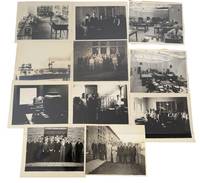
1930ref. 232561930. Stanford University Military Engineering Archive Documenting the First Army Ordnance Reserve Gauging Program ca. 1930. Stanford University photo archive documenting the emergence of interwar military-industrial technical education ordnance gauging instruction and precision engineering research on campus during the early development of Stanford's engineering and applied science programs. Rather than depicting science classrooms in a general sense these photographs specifically document the technical culture surrounding Army ordnance training instrumentation systems machine calibration and laboratory-based engineering instruction that linked universities to the expanding infrastructure of American military preparedness between World War I and World War II. Taken together the archive captures Stanford at the moment when higher education increasingly merged scientific research industrial precision manufacturing and military technical training into a unified research model that later shaped the wartime and Cold War defense university system. Photo archive of 11 large silver gelatin photographs each approximately 8" x 10" Stanford University California dating from 1930 into the 1950s; two later views mounted to decorative yellow board. Several photographs depict laboratory interiors filled with precision instrumentation gauging apparatus optical and mechanical measuring devices machine-tool equipment calibration benches microscopes drafting stations and technical worktables arranged for instruction and inspection work. One especially important close-up photograph shows a large precision gauging or rotational calibration apparatus associated with ordnance measurement and machine tolerance testing. Surrounding the device are machined cylindrical components threaded fittings gauge rings and polished metal parts likely used in dimensional inspection bore alignment concentricity testing or interchangeable manufacturing instruction. Another darkened workshop view depicts what appears to be a heavy precision lathe or gauging bench fitted with a mounted cylindrical test component equipment consistent with ordnance inspection and military engineering instruction during the interwar period. Additional photographs show groups of students and instructors posed around technical apparatus inside instrumentation laboratories while later mounted photographs document more formalized postwar engineering office and drafting environments associated with large-scale technical administration and research organization. Most important is a detailed handwritten verso inscription reading: "Equipment used Feb 1930 Ordnance School at Stanford University. This was first time a course in gauging was given in any Army Ordnance Reserve Unit permanent facilities excepted. Instructor; Lieut Merrill S. Hingo. Photo; Lieut Howard Story Taylor." The inscription firmly identifies the archive as documentation of early Army ordnance reserve technical instruction conducted at Stanford and specifically ties the machinery to military gauging education. In the 1920s-30s "gauging" referred not merely to ordinary measurement but to the specialized science of precision dimensional inspection used in artillery manufacture weapons-part standardization shell tolerances bore measurement interchangeable machining systems and industrial calibration. Such instruction formed a critical component of modern military-industrial production where even minor deviations in machining tolerances could affect artillery accuracy chamber pressure shell seating or mechanical reliability. Several outdoor group portraits further reinforce the military context. One large group stands beneath a doorway marked "Military Science and Tactics" while another includes Colonel Donald C. Cubbison a career U.S. Army officer and West Point graduate who served as professor of military science and tactics at Stanford from 1930 to 1935 before later attaining the rank of major general during World War II. His appearance situates the archive directly within Stanford's interwar military training system and links the photographs to broader national efforts to train technically educated reserve officers in engineering ordnance artillery science and industrial preparedness. The archive also reflects Stanford's broader transformation into a modern research university centered on applied science and engineering. During the interwar years Stanford's scientific departments expanded laboratory instruction instrumentation programs and research-based technical education under faculty including Robert E. Swain John P. Mitchell William H. Sloan and George S. Parks. Parks in particular became associated with analytical chemistry and geochemical laboratory science disciplines heavily dependent upon precision instrumentation and calibrated measurement systems. The engineering and laboratory culture documented here overlaps with contemporary developments in industrial metrology applied physics materials testing optical measurement and machine-tool inspection that increasingly tied university research to industrial production and military logistics. What makes the archive especially significant is the way it documents the transitional infrastructure between traditional university instruction and the emerging defense-oriented research university model. These photographs preserve not simply classrooms but the physical systems of technical education itself: calibration benches inspection machinery gauging apparatus optical instruments drafting rooms and laboratory spaces where students and reserve officers were trained in the precision engineering practices underlying twentieth-century industrial warfare and mass manufacturing. In doing so the archive visually traces the early foundations of the university-based defense engineering culture that would later expand dramatically during World War II and the Cold War throughout California research institutions and the broader military-industrial complex. Photographs are sharp and highly detailed with clear views of equipment and interiors; handwritten identifications remain legible. The two mounted 1950s photographs have several large tears without image loss with lighter handling wear elsewhere. Overall good condition. unknown
1930ref. 232561930. Stanford University Military Engineering Archive Documenting the First Army Ordnance Reserve Gauging Program ca. 1930. Stanford University photo archive documenting the emergence of interwar military-industrial technical education ordnance gauging instruction and precision engineering research on campus during the early development of Stanford's engineering and applied science programs. Rather than depicting science classrooms in a general sense these photographs specifically document the technical culture surrounding Army ordnance training instrumentation systems machine calibration and laboratory-based engineering instruction that linked universities to the expanding infrastructure of American military preparedness between World War I and World War II. Taken together the archive captures Stanford at the moment when higher education increasingly merged scientific research industrial precision manufacturing and military technical training into a unified research model that later shaped the wartime and Cold War defense university system. Photo archive of 11 large silver gelatin photographs each approximately 8" x 10" Stanford University California dating from 1930 into the 1950s; two later views mounted to decorative yellow board. Several photographs depict laboratory interiors filled with precision instrumentation gauging apparatus optical and mechanical measuring devices machine-tool equipment calibration benches microscopes drafting stations and technical worktables arranged for instruction and inspection work. One especially important close-up photograph shows a large precision gauging or rotational calibration apparatus associated with ordnance measurement and machine tolerance testing. Surrounding the device are machined cylindrical components threaded fittings gauge rings and polished metal parts likely used in dimensional inspection bore alignment concentricity testing or interchangeable manufacturing instruction. Another darkened workshop view depicts what appears to be a heavy precision lathe or gauging bench fitted with a mounted cylindrical test component equipment consistent with ordnance inspection and military engineering instruction during the interwar period. Additional photographs show groups of students and instructors posed around technical apparatus inside instrumentation laboratories while later mounted photographs document more formalized postwar engineering office and drafting environments associated with large-scale technical administration and research organization. Most important is a detailed handwritten verso inscription reading: "Equipment used Feb 1930 Ordnance School at Stanford University. This was first time a course in gauging was given in any Army Ordnance Reserve Unit permanent facilities excepted. Instructor; Lieut Merrill S. Hingo. Photo; Lieut Howard Story Taylor." The inscription firmly identifies the archive as documentation of early Army ordnance reserve technical instruction conducted at Stanford and specifically ties the machinery to military gauging education. In the 1920s-30s "gauging" referred not merely to ordinary measurement but to the specialized science of precision dimensional inspection used in artillery manufacture weapons-part standardization shell tolerances bore measurement interchangeable machining systems and industrial calibration. Such instruction formed a critical component of modern military-industrial production where even minor deviations in machining tolerances could affect artillery accuracy chamber pressure shell seating or mechanical reliability. Several outdoor group portraits further reinforce the military context. One large group stands beneath a doorway marked "Military Science and Tactics" while another includes Colonel Donald C. Cubbison a career U.S. Army officer and West Point graduate who served as professor of military science and tactics at Stanford from 1930 to 1935 before later attaining the rank of major general during World War II. His appearance situates the archive directly within Stanford's interwar military training system and links the photographs to broader national efforts to train technically educated reserve officers in engineering ordnance artillery science and industrial preparedness. The archive also reflects Stanford's broader transformation into a modern research university centered on applied science and engineering. During the interwar years Stanford's scientific departments expanded laboratory instruction instrumentation programs and research-based technical education under faculty including Robert E. Swain John P. Mitchell William H. Sloan and George S. Parks. Parks in particular became associated with analytical chemistry and geochemical laboratory science disciplines heavily dependent upon precision instrumentation and calibrated measurement systems. The engineering and laboratory culture documented here overlaps with contemporary developments in industrial metrology applied physics materials testing optical measurement and machine-tool inspection that increasingly tied university research to industrial production and military logistics. What makes the archive especially significant is the way it documents the transitional infrastructure between traditional university instruction and the emerging defense-oriented research university model. These photographs preserve not simply classrooms but the physical systems of technical education itself: calibration benches inspection machinery gauging apparatus optical instruments drafting rooms and laboratory spaces where students and reserve officers were trained in the precision engineering practices underlying twentieth-century industrial warfare and mass manufacturing. In doing so the archive visually traces the early foundations of the university-based defense engineering culture that would later expand dramatically during World War II and the Cold War throughout California research institutions and the broader military-industrial complex. Photographs are sharp and highly detailed with clear views of equipment and interiors; handwritten identifications remain legible. The two mounted 1950s photographs have several large tears without image loss with lighter handling wear elsewhere. Overall good condition. unknown books
(6), 110 pp. With engr. frontispiece (M. Rein sc.). Modern marbled boards. 8vo. First edition in book form (parts had been published in 1720 in the periodical "Berlinische und Cölnische ordinaire Post-Zeitung"): descriptions of lamps capable of burning for prolonged periods without having to be refueled, invented by the Saxonian court mechanic Andreas Gärtner (1654-1727). Gärtner, a cabinet maker and mechanic, had learned his trade over twelve years travelling throughout Germany and Italy (Venice, Bologna, and Rome). By 1686 he was royal cabinet maker to the Dresden court, and later also royal mechanic. Delighting in complicated machanical models and devices, he soon became known as the "Saxon Archimedes". Unfortunately, most of his works perished in a fire at the Wackerbarth Palace in 1728. Gärtner's famous world clock (c. 1700), boasting 365 dials, has survived and still draws crowds at the Dresden Zwinger. The frontispiece shows some of his newly-invented lamps. - Rare; KVK locates 4 copies in Germany (Erlangen, Augsburg, and Munich); OCLC locates no copies in the U.S.; not in COPAC. - Insignificant browning. A very good, clean copy. Thieme/Becker XIII, 37ff.
1787Large 8vo. (4), 314 pp. With figural woodcut vignette on title-page, 1 printed and 6 engraved folding plates of tables. Contemporary marbled calf with giltstamped title to gilt spine. Leading edges gilt. Edges in red. First edition of one of the most important works in the history of modern chemistry. "To persuade a new generation of chemists to join their ranks and to complete what Lavoisier had envisaged since 1773 - a revolution in chemistry - these men brought out a collaborative work, the 'Méthode [...]'. Originally suggested by Guyton de Morveau to eliminate the confused synonymy of chemistry, and prefaced by a memoir of Lavoisier, it emerged as a complete break with the past" (DSB VIII, 80). The result of this collaboration by de Morveau, Lavoisier, Berthollet, de Fourcroy, Laplace, and Monge is the system presented within the present work, which was to form the basis for the nomenclature still used today, the language of modern chemistry. "The work lists 55 known elements in a series of tables, introducing many new terms which have remained in standard use" (Norman Cat., 604). - Spine-ends damaged; lower corner of front cover bumped. Slight worming to front hinge (small defect at top end). Some browning and finger-smudging inside. First engraved plate water-stained. Front pastedown with contemp. French bookseller's label of the Viennese bookseller Jean-Baptiste Mangot (cf. Öhlberger, p. 203 and 290). Duveen 340. Duveen/Klickstein 126. Honeyman 1936. Norman 1291. DSB VIII, 87.
17404to. (8), XLVIII, 362, (14) pp. With 22 folding engraved plates, title vignette, and 19 engraved text vignettes. Contemporary vellum with double fillets, blindstamped centrepiece, and ms. title to spine. All edges sprinkled in red. First edition of the Parisian astronomer's work about the application of Newton's Laws to astronomy. The plates mostly depict astronomical and mathematical diagrams. The attractive text vignettes by Charles Nicolas Cochin le jeune (1715-90) are an early example of his book decorations. - Fine copy with ms. note of ownership by "Ed. Declercq, Prof." and bookplate "Dr. Hautrive père". - Important work, recently edited on microfilm in the "Landmarks of science" series. Poggendorff I, 840.
1929Folio. 3 vols. 9, (3), 295, (1) pp. 9, (1), 296-546 pp. 16, 547-902 pp. With 364 colored lithogr. ornithological plates and numerous text illustrations. Conmtemp. half calf with title to gilt spine; faux raised bands colored black and raised with gilt fillets, enclosing the image of a bird). All edges marbled; marbled endpapers. A magnificent publication and the standard work on Scandinavian ornithology. Originally published between 1828 and 1838 in 105 installments. In addition to the original 184 plates, the present second edition contains reproductions of further drawings by the Wright brothers newly discovered in the Kungl. Vetenskaps-Akademien Stockholm and in the Helsingfors University Library. - "[D]ie Bilder schwedischer Vögel der Brüder von Wright [sind] so vorzüglich [...], daß man sie noch ein Jahrhundert später einer Neuausgabe für wert gehalten hat, wobei noch fast die gleiche Anzahl bisher unveröffentlichter Tafeln ans Licht gekommen ist" (Nissen, p. 54f.). - A fine, appealingly bound copy. Nissen, Vogelb. 1026. Anker 544. Wood 637.
4to. (6), 372 pp. Engraved additional pictorial title with letterpress explanatory leaf, 3 hand-coloured engraved plates. Contemporary tree calf, spine gilt, marbled edges. First edition of this rare monograph on snakes. Text printed intwo columns throughout in Dutch and French. The fine plates, drawn from nature by W. Veltman and engraved by J. C. Philips, show an unidentified snake, a viper, and a slow-worm. A printed explanation is provided opposite the engraved title. - Johannes van Lier was a politician, lawyer, tax collector and Deputy of Drenthe. He wrote several treatises on a wide variety of subjects including history, archaeology and natural history. - Marginal adhesion mark to L4 and M1, very faint dampstaining to some gatherings. Extremities lightly rubbed, head- and tailcaps more heavily, spine label slightly defective. Nissen ZVB 2509.
17294to. (6), 161, (21) pp. With 58 figures on 10 (counting 1 as frontispiece) engraved plates, mostly folding. Contemporary half calf with label to gilt spine. Second edition of the work first published in Frankfurt in 1719 under a slightly different title and the pseudonym of "Gregorius Anglus Sallwigt". Important for the history of Rosicrucianism, "the mystical content of which is very much unclear" (Kopp). An enlarged version, entitled "Opus Mago-Cabbalisticum et Theosophicum [...]", was published in 1735 under the name of the author (who had died in 1727) and was reprinted in 1760 and 1784. Compared with later copies, the present one is not only more beautifully printed, but also has larger plates and is generally executed with greater accuracy. "The ten folding plates are of absorbing interest to the Rosecrucian turn of mind. Goethe studied this book intensively" (Hoover). Details about Welling (1652-1727), according to Hoover "a man of great learning but very superstitious", the various editions of his works and their content are provided by Frick, Die Erleuchteten, pp. 54, 491ff. and 426ff.: "At the beginning of the eighties of the 18th century, Welling's Opus Mago-Cabbalisticum became the most important text and instruction book of the Order of the Gold- and Rosicrucians [...] The fourth chapter of the first part, 'De mundo archetypo', was transferred almost verbatim into the instruction documents of the first Degree of the Order". - The fine engravings depict geometrical figures and cabbalistic symbols, among them the "Systema Magicum Universi". Slightly browned and insignificant spotting; occasional underlinings and pencil marginalia, otherwise a good copy. Ferguson II, 317. Duveen 526. Neu 4323. Ferchl 466. Mellon 150 (note). Kopp II, 240. Cf. Hoover 872.
8vo. (10), 143, (9) pp. With fine woodcut frontispiece showing saw and pruning knife, 1 engraved folding plate, and 30 woodcut text illustrations. Contemporary half calf and speckled boards, spine richly gilt with gilt lettered label. The first western book on the cultivation of dwarf trees, or "bonsai". Georg Liegelsteiner was court gardener to the Archbishop of Salzburg in Austria, Count Franz Anton Harrach. His book on dwarf trees, although now largely forgotten and overlooked in botanical and horticultural literature, proved extraordinarily successful in its day, achieving six editions including the original edition of 1705. Liegelsteiner "writes about dwarfing trees so that they look like a very beautiful big tree, but only much smaller. He understands tree physiology like only a small minority of bonsai enthusiasts today. He explains in detail how to shorten roots and transplant trees often, how to shorten branches, how to correct a one-sided tree. He explains how to cut back a tree to a stump, let the new shoots grow, cut them back at strategic points, let the new shoots grown again and cut them back. It is exactly the 'Chinese' clip-and-grow technique. He makes drawings which explain the development of a dwarf tree in a way that could not be improved" (Walter Pall, Dwarf Trees of George Liegelsteiner, in: Bonsai Magazine 3 [2000]). The edition offered here is the final one, published after the death of its author, with a very interesting new preface which attempts to sketch a history of dwarf trees in Europe. It suggests that the art of growing Bonsai trees came to Versailles in the late 17th century. One of the Versailles gardeners, Grottendorf, settled in Berlin and experimented more on it. Eventually he was appointed head gardener to the wealthy merchant and Councillor Georg Bose's garden, the "Kleinbosischer Garten", in Leipzig. Liegelsteiner received advice from Grottendorf about the art of growing dwarf trees. - OCLC locates the 2 copies in US: Berkeley and National Agriculture Library; also: Berkeley (1703 ed.); Delaware, Agricult. Library, and Berkeley (1716); Berkeley and Cincinnati Museum Centre (1725)]; COPAC locates only British Library (1702 ed.) and Kew Gardens (1702 ed., their 1716 ed. 'is lost at binders' ). A very good copy. Not in Dochnahl, Hunt, Lindley Lib., Nissen, Plesch, Pritzel, Oak Sprink Sylva.
8vo. 16 pp. Original printed wrappers, bound within modern boards. With the author's three-line-autograph inscription to his friend Friedrich Schwandner, with whom he had studied at Tübingen and formed an illicit students' union, the "Corps Guestphalia", for which reason the two had been arrested in 1837. Both works, "Über die Torricellische Leere" and "Über Auslösung", were separately published in 1875 and 1876 within the "Beilage des Staatsanzeigers für Württemberg". Eisert 29.
1650Large 4to. 2 parts in one volume. (8), XXXIX, (1), 307, (1) pp. (4), 309-633, (3) pp. With woodcut vignette to both title pages, several woodcut illustrations in the text, and printer's device on last leaf. Fine contemporary French éventail leather binding. Wants ties. Second, posthumous edition. Previously, Montebruni (1597-1644) had published his "Ephemerides" for the years 1640-45 and 1645-60. "D'apres les tables de Lansberg, pour le méridien de Bologne. Dans la part I de la publication, il y a un catalogue d'étoiles, réduites à 1630" (Houzeau/L.). - Edges, corners and spine-ends professionally restored. Sumptuous giltstamped éventail-style binding: double borders of a narrow zig-zagging design and a wider rosette-and-flower-design within floral braces and double fillets enclose a large central compartment, the corners of which are occupied by round-headed pointillé fans emanating from tendril corner stamps. The same éventail stamps form an elaborate central rosette with tendril stamps at top and bottom ends. The empty space in between in filled in by intricate tendril and dentelle blindstamping. The various elements of the design are starkly set off by empty quarter-inch fillet borders enclosing the corner éventails with quadrants and the central rosette with a lozenge; the tendril infilling is structured by the same blank borders forming a cross, thus dividing the cover into four richly tooled, mirroring quarters. The spine is framed by the same zigzag and floral borders as the covers, enclosing a narrow blank border and a finely tooled dentelle and semi-rosette design echoing the cover infilling. - Title page bears 1772 ms. note of ownership by the Capuchin monk Giovanni da Cento, who introduced the volume to his monastery's library in Cento (Emilia-Romagna). Later in the library of the Swedish collector Thore Virgin (1886-1957) with his repeated signature (dated Stockholm, 16 May 1914) and his bookplate (dated 1911) and collection stamp ("Bibliotheca Qvarnforsiana"). Additional bookplate of Rolf Wistrand. Riccardi II, 180, 2. Houzeau/Lancaster 15161. OCLC 68956764. Lalande 211 ("1640").
4to. 2 vols. (out of 10). XVI, 222 pp. IX, (1), 256 pp. With 2 hand-coloured, engraved title pages and 225 hand-coloured, engraved plates (some folding), numbered 1-222, with a/b numbers for 114, 172, 198). Contemporary half calf with giltstamped green spine labels. Marbled endpapers. All edges sprinkled in red. The first two volumes of this rare work of decorative plates showing flowers and other plants, including fruits. Contains the first 225 of a total of 1090 engravings published until 1820. The Viennese physician Vietz, who combined artistic talent with a penchant for botany, began publication of this monumental ten-volume work in 1800; only the first three volumes were edited by him personally. The Natural History Museum, London, described its own copy thus: "Today, the work appears to be of extreme rarity, not being held in any other of the United Kingdom's national or public library collections. Only three copies have been found in North American libraries, of which two are certainly fragile and in need of conservation. One copy is in the Austrian National Library" (Great Flower Books [1990], p. 147). - Clean and well-preserved throughout. Nissen, BBI 2062. Stafleu/Cowan 16.153. Pritzel 9764. Wurzbach 50, 282f.
1886ref. 127543Paris, Challamel 1886 In-8 23 x 13,5 cm. Reliure demi-chagrin rouge, dos à nerfs, couverture conservée, VIII-84 pp., 1 panorama en couleurs 80 x 30 cm repliée in fine, table des matières. Joint la 1re épreuve corrigée par A. Garçon. Nombreux documents joints lettres de remerciement diverses, cartes de visite, coupures de presse dont 3 lettres autographes de Ferdinand de Lesseps et 2 de Victor de Lesseps.
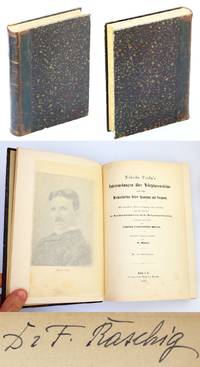
1895ref. 356j2779Deutsches Reich: Halle a.S. Very Good No dust jacket as issued. First German Edition. Hardcover. "This book essentially reproduces all those important publications which Tesla himself made in American electrical engineering journals up to about the middle of 1893 concerning his inventions and investigations. Furthermore since Mr. Tesla himself reviewed those sections of this book that report on his previously unpublished work before printing the present work may be considered an authentic account of his work." - translated from Translator's Preface. "Nikola Tesla 1856-1943 was a Serbian-American inventor and electrical engineer who revolutionized modern power technology. Renowned for creating the alternating current AC system Tesla developed motors transformers and the Tesla coil laying the foundation for modern electric grids radio technology and wireless communication." - Google AI. First German edition. Translated from the 1893 first U.S. edition. x 2 508 p. Index. 313 Black and white diagrams and photos. Prior owner's name Dr. F. Raschig handwritten atop front free endpaper and faintly atop page 508 otherwise tight clean and unmarked with moderate wear to the original dark marbled boards bound in contemporary half-leather. "Dr. Friedrich Fritz August Raschig 1863-1928 was a German chemist and politician who patented a number of important chemical processes and developed improvements to distillation. The chemical company he founded in 1891 operates to this day as Raschig GmbH." - Wikipedia. A well-preserved example of this profoundly important and historic work from an impressive provenance. 23.7 x 16.9 cm; Sm 4to . 1895. Halle a.S. hardcover