428 résultats
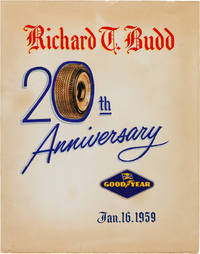
1959réf. 56719Almanza Las Piñas Rizal The Philippines. 1959. A Vivid Example of American Economic Colonialism in the Mid-20th Century A unique and large format presentation typescript documenting the facilities services and employees of the Philippine branch of the Goodyear Tire & Rubber Company in 1959 illustrated with almost 200 photographs produced for the twentieth anniversary of the tire plant's manager Richard T. Budd. The photographic scrapbook constitutes an extensive visual record of the facilities and operations of the Goodyear Tire factory in Las Piñas Rizal Philippines and provides an interesting peek into American foreign business practices in the mid-20th century. The album is highlighted by more than 100 large likely professional views of the factory exterior and interior following the tire-making process from raw material through to finished product with many of the images showing Filipino laborers at work. The album also contains a series of eight views of a January 1957 labor dispute. The images are accompanied by detailed typed captions explaining the tire-making process the strike and more. One such annotation reads: "On January 14 1957 the factory tasted its first strike when barrio residents set up a picket allegedly in protest of the alleged unfair hiring procedure of the company. Pickets gathered at the front of the gate while bus loads of employees wait outside for a chance to cross the picket line." The smaller photographs further depict the factory's employees and document health care facilities blood drives a free Christmas lunch company picnics and gatherings awards ceremonies and much more. Several pictures record Budd's contribution as a leader with the local Boy Scout Troop 60 comprised mostly of young Filipino boys. One page containing several photographs documents Goodyear management's donation to a local school; the caption reads: "Aware of its responsibility to the community Management goes to the much neglected barrio school and donates a swing and a slide for school children at play. This page contains the pictures of that donation." Additionally laid-in is a handmade folio greeting card commemorating Budd's twentieth anniversary of employment with a nicely hand-executed title cover featuring a photographic cut-out of a tire filling in the "0" of "20th" a large caricature of Budd in his scouting uniform and includes numerous ink inscriptions from fellow employees likely executives. There are also three additional loose folio sized cards bearing hundreds of ink signatures from the factory workers. Goodyear operated the plant at Las Piñas from 1956 until 2009 in close proximity to the island's robust rubber plantations. The album stands as important extensive and detailed primary source documentation of the international operations labor outsourcing and outreach efforts of an American auto-industry giant in the Asian Pacific during the last years of Eisenhower and immediately preceding U.S. involvement in Vietnam and serves as an important source for the "Americanizing" methods employed by U.S. companies after World War II when newly-opened markets allowed for American corporate expansion around the globe. Large folio. Original blue paper-covered boards brad-bound hand-painted titles on front cover reading: "GOODYEAR TIRE & RUBBER CO. OF THE PHILIPPINES LTD. ALMANZA LAS PIÑAS RIZAL." Moderate wear soiling and creasing to boards. Produced on acidic mid-century paper with most leaves chipped or with closed edge tears one leaf detached a couple partially detached. Photographs in generally very nice condition with easily-readable typed annotations. Overall very good. hardcover
réf. 20603A Paris, chez Cuchet, 1783, 1784, à Montpellier, de l'imprimerie de Jean Martel, 1784, A Aéropolis, sur la place des Nues, chez Zéphirolin le jeune, imprimeur-libraire & relieur de sa majesté Aiglonne, et se trouve à Paris chez les marchands de feuilles volantes, l'an de la Lune... (1783). plein veau raciné, dos orné, au chiffre "P", pièces de titres et tomaisons maroquinés, tranches, contre-plats et gardes teintés (vieux bleu), petites éraflures sur les plats, coins frottés, sans gravité. 2 volumes in-8 de XL-299-(7) pages, 1 tableau dépliant, 9 planches gravées en taille-douce, dont 1 en frontispice dessinée par Charles de Lorimier et gravée par Nicolas de Launay, autres graveurs: Pierre Gabriel Berthault et François Noël Sellier, représentant les diverses machines qui ont été construites jusqu'à ce jour, particulièrement celle de Versailles, & celle dans laquelle des hommes ont été enlevés jusqu'à la hauteur de 324 pieds, &c. &c. à la suite: second volume de (2)-366 pages + 1 feuillet d'errata, 5 planches en taille-douce dont 1 en frontispice, dessinée par Charles de Lorimier et gravée par Nicolas de Launay ainsi que les 2 suivantes, les 2 autres sont gravées par François Noël Sellier. A la suite: 82 pages et in-fine: 16 pages + 1 gravure dépliante., bandeaux dont 1 gravé sur bois par Jean-Michel Papillon, culs de lampe, 1 cahier débroché.
1936réf. 84243Akron OH: Goodyear Tire & Rubber Company 1936. Presumed one of several promotional fabric mementos produced for select distribution. Piece of Fabric. Fair. This is a piece of the Fabric used in Explorer II. This flight was sponsored by National Geographic Society NGS and U.S. Army Air Corps. Format is approximately 6.25 inches by 3.25 inches. It has printing on both sides. One side has an illustration of Explorer II ascending over text that reads EXPLORER II 1935 stratosphere Flight Balloon Capt. Albert W. Stevens Flight Commander Capt. Orval A. Anderson U. S. Army Air Corps. Take-off from Black Hills of South Dakota. The other side states This is a Piece of the Fabric Used in EXPLORER II 1935 Stratsophere Flight Balloon Largest Balloon Ever Built sponsored by National Geographic Society and U.S. Army Air Corps courtesy of Goodyear Tire & Rubber Company. The balloon used for the Explorer II expedition was cut up into strips and distributed as commemorative bookmarks among the NGS members who supported the mission. It is common for one or both sides of the bookmark to be discolored as the result of the chemical reaction between sunlight and the rubber coating on the cotton fabric used to construct the balloon. The Goodyear Tire & Rubber Company was founded in 1898 by Frank Seiberling and based in Akron Ohio. The company was named after American Charles Goodyear inventor of vulcanized rubber. The Goodyear tires became popular because they were easily detachable and required little maintenance. Goodyear had been manufacturing airships and balloons since the early 1900s. NOTE: THIS IS DIFFERENT FROM THE NGS ISSUED BOOKMARK!!! This is more of a souvenir than a bookmark in form and format. Explorer II was a manned U.S. high-altitude balloon that was launched on November 11 1935 and reached a record altitude of 72395 ft. Launched at 8:00 am from the Stratobowl in South Dakota the helium balloon carried a two-man crew consisting of U. S. Army Air Corps Captains Albert W. Stevens and Orvil A. Anderson inside a sealed spherical cabin. The crew landed safely near White Lake South Dakota at 4:13 pm and both were acclaimed as national heroes. Scientific instruments carried on the gondola returned useful information about the stratosphere. The mission was funded by the membership of the National Geographic Society. In January 1934 the National Geographic Society NGS and the U. S. Army Air Corps decided to collaborate on a program to build and launch a manned balloon to the then record altitude of 15 mi. This vehicle would be capable of carrying a crew of three in an airtight capsule along with a laboratory of instruments. The hydrogen balloon named Explorer was completed by July at a cost of around $60000. The balloon was launched from a canyon in the Black Hills of South Dakota on July 28 1934 and reached a near-record altitude of 60613 ft before tears in the fabric led the crew to begin reducing their altitude. A rupture in the balloon resulted in a precipitous descent followed by a spark that caused the hydrogen to ignite and destroy what was left of the balloon leaving the capsule to plummet toward the ground at terminal velocity. The crew just managed to escape using their parachutes. In 1935 the NGS and Army Air Corps decided to make another attempt. Once inflated the balloon stood 316 ft tall. The gondola was kept anchored to the earth by a team of more than 100 soldiers holding cables. The Explorer II reached a peak altitude of 72395 ft at 12:30 pm and remained there for 80 minutes. This set a new world altitude record and one that would last for nearly two decades. The crew became the first humans to witness the curvature of the Earth. Their photography showed the potential of high-altitude reconnaissance balloons. Explorer II included communications equipment and constant radio contact was maintained throughout the flight with the signal being broadcast across the U.S. and in Europe. The onboard instruments collected data on cosmic rays the ozone distribution and electrical conductivity of the atmosphere at different altitudes the atmospheric composition of the stratosphere and the luminosity of the Sun Moon and Earth. The success of the mission was much celebrated in the press and the aeronauts were invited to an audience with U.S. President Franklin D. Roosevelt. They became national heroes and both men were presented with the Hubbard Medal of the National Geographic Society by General John J. Pershing. The Air Corps awarded them the Mackay Trophy for the most meritorious flight of the year. Both men were also awarded the Distinguished Flying Cross for each of the Explorer flights. The EXPLORER balloon required approximately 2.5 acres of cotton fabric. EXPLORER II was larger. The National Geographic Society produced over a million EXPLORER II bookmarks from the balloons fabric. The number produced by the Goodyear Company could not readily be determined but was likely a comparative handful. Goodyear Tire & Rubber Company unknown