608 Ergebnisse
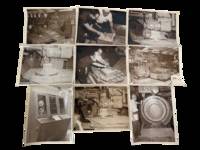
1960Best.-Nr. 233821960. Industrial factory photograph archive documenting large scale machining systems automated tooling equipment and precision manufacturing processes during the height of postwar American industrial expansion circa 1960s. Several scenes feature Sundstrand branded machinery associated with the Sundstrand Corporation a major Rockford Illinois manufacturer of machine tools aerospace components and industrial automation systems during the Cold War industrial economy. By the 1960s American factories increasingly relied on massive numerically controlled machining equipment capable of producing aircraft parts turbine components and heavy industrial hardware with levels of precision unattainable in earlier manually operated machine shops. These photographs record the physical scale of that transition capturing the integration of computerized or semi automated production systems into factory environments that formed the backbone of aerospace defense transportation and heavy manufacturing industries during the period. Photo archive of 9 Large Silver Gelatin photographs each 8" x 10" circa 1960s. Interior factory scenes show enormous industrial machining centers occupying tiled production floors beneath overhead lighting and exposed structural systems. Multiple photographs depict large circular indexing tables rotary cutting assemblies suspended tooling heads and enclosed control units bearing visible "Sundstrand" identification. Engineers and machinists wearing shop coats and protective glasses appear adjusting tooling mechanisms calibrating machine components and servicing cutting assemblies surrounded by heavy cables hydraulic systems and banks of industrial controls. Several machines are shown actively engaged in metal cutting operations with curled metal shavings accumulating beneath rotating tooling heads and across surrounding platforms. One scene captures technicians removing or fitting a large machined component beneath a circular cutting apparatus while another documents reel based electronic control equipment integrated into the production system reflecting the growing use of automated process control in industrial manufacturing during the decade. The 1960s marked a decisive transformation in American manufacturing as industries shifted from conventional machining toward automated and numerically controlled production methods capable of supporting aerospace engineering military procurement automotive manufacturing and mass industrial output. Companies such as Sundstrand played a central role in supplying the specialized tooling and machine systems that allowed factories to machine increasingly complex metal components at industrial scale. Some curling scattered edge and surface wear as well as foxing to margins; images remain sharp with strong detail. Overall in good condition. The photographs preserve direct visual evidence of the machinery labor practices and production environments that defined late midcentury industrialization before many such facilities were modernized outsourced or dismantled during later waves of deindustrialization. unknown books
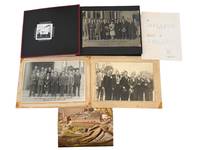
1940Best.-Nr. 233861940. Marathon Paper Mills and later American Can Company industrial safety archive documenting workplace medicine accident prevention campaigns first-aid training and factory safety administration in Menasha Wisconsin from the 1940s-60s. The album records how Midwestern paper and graphic arts manufacturers attempted to reduce industrial injuries during a period when paper mills and printing plants remained physically hazardous workplaces filled with heavy rollers cutting machinery chemical exposure steam systems and high-speed industrial presses. During the postwar decades American manufacturers increasingly institutionalized safety committees plant nursing departments and employee first-aid instruction in response to rising workers' compensation costs union pressure and national workplace safety campaigns promoted by organizations such as the National Safety Council. Marathon Paper Mills was acquired by American Can Company in 1957 placing the Menasha Graphic Arts plant within one of the nation's largest packaging and industrial printing corporations. Photo and scrapbook archive of over 100 pieces with approximately 75 black-and-white photographs including twelve 8 x 10 inch prints with typed programs corporate memoranda newspaper clippings conference photographs official correspondence and safety-related ephemera Menasha Wisconsin 1940-1969. Group portraits identify attendees at the Fox River Valley and Lakeshore Safety Conferences of 1940 1941 and 1942. Numerous mounted photographs depict factory nurses treating workers administering oxygen equipment conducting examinations teaching first-aid procedures inspecting washrooms and sanitary facilities and leading emergency-response instruction for plant employees. Workers stand beside industrial presses and mechanical equipment while captions stress housekeeping sanitation accident reporting and machine safety. Several pages preserve newspaper coverage celebrating "one million safe man hours" and "three consecutive years of safe working without a disabling injury" alongside a 1969 letter signed by Wisconsin Governor Warren P. Knowles congratulating the American Can Graphic Arts Plant on its safety record. A 1953 letter from the National Safety Council thanks Marathon Corporation for photographs displayed at the Industrial Nursing Section exhibit during the National Safety Congress in Chicago directly tying the album to nationally circulated industrial safety programming. The album preserves a narrower glimpse into ground level industrial plants with the emergence of workplace medicine and safety management as formal corporate systems. The main photographs focus on the Marathon First Aid Department where nurses supervisors and workers collaborated in organized training programs intended to reduce accidents and standardize emergency response inside hazardous production environments. Captions repeatedly emphasize sanitation inspections accident prevention emergency transport and employee instruction demonstrating how industrial safety became both a managerial program and a public relations tool during the postwar era. Photographs mounted with corner tabs throughout; scrapbook pages retain mounted newspaper clippings letters and typed documentation; light toning occasional adhesive discoloration and minor edge wear present. Overall in very good condition. unknown books
Best.-Nr. 172893NAKAZAWA DYEING FACTORY. Ouchi. Emperor's Palace. 80 silk colour samples mounted on 5 cardboard sheets. 8vo 240 x 140 mm publisher's tied cloth. Kyoto: Nakazawa n.d. An elegant collection of colour samples. hardcover books
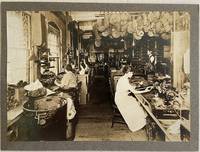
1900Best.-Nr. 178581900. Women at Work Albumen photo of women at work in a small factory. Photograph measures 7.75" x 5.5" inches and is on gray photographer's board measuring 8.5" x 6.5" inches. Circa 1900s. Albumen print. Women sitting at long wooden tables in small manufacturing shop. Palm-sized rings hang in loops from the ceiling and can be seen scattered throughout the photo. One woman in a long white dress holds length of material looking it over while another sitting behind her and across and wooden aisle looks away from the camera toward her desktop. Two other women can be seen seated behind her further back into the shop. A man in shirt and vest appears to be observing the women at work while another man at the back of the shop appears to be using some sort of pressing device. It's unclear what's being manufactured but the details of materials and workplace layout give rich details to take in. The women would have been part of a growing female workforce utilized to support production in the midst of industrialization. Overall very good condition. unknown books
1920Best.-Nr. 173461920. 1920s vintage sepia photograph of around 50 women at work in a textile factory. The photographer's board is 10" x 8" inches and image is 8.25" x 5" inches. The women are seated in long rows and armed with sewing machines and seem to be turning bundles of cloth into garments. Spools of thread hang down from a center rail in the middle of the table to be fed into the sewing machines. Some of the cloth appears to be polka-dotted similar to the dresses that several women pictured appear to be wearing. The factory is consisted almost entirely of women - there is one man in a waistcoat walking around accompanied by an older woman. The working women seem to be of varying ages from their early 20s into their 50s. Textile manufacturing was unique at the time for its overwhelmingly female labor force. Sepia toned very good condition with great detail. unknown books
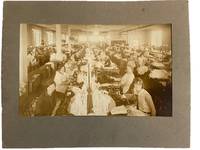
1910Best.-Nr. 175641910. Original photograph of female cigar factory workers Circa 1910. Sepia toned. 9.5" x 7.5" inches. Mounted on original gray board. This remarkable photo shows an all female workforce at a cigar factory in the 1910s. The women assemble bundles of cigars that are stacked into pyramid-like shapes. The cigars are being hand-rolledat their work stations. There are about 100 women pictured at work in the factory in this turn of the century photograph. A large and clear photo in very good condition. unknown books
1866Best.-Nr. 231951Philadelphia: T. B. Peterson & Brothers 1866. Soft Cover. Good binding. No pencil or ink markings in text. Text is clean. Plum color paper covers with dark lettering. Bottom spine is chipped with paper missing. Moderate to heavy edgewear to covers. Good binding. T. B. Peterson & Brothers unknown books
1975Best.-Nr. 37163Leningrad: Petersburg Tapestry Factory 1975. First edition. Hardcover. g to vg. Small folio. 269 1pp. Original illustrated cloth with red lettering on spine. Book housed in its illustrated paper covered slipcase. A well-illustrated survey of the output of the Imperial Tapestry Factory from 1716 until its closing in 1859. This work is profusely illustrated throughout with 187 striking color photographic reproductions of splendid Russian tapestries. Moderate rubbing along edges of slipcase. Minor soiling on spine. Text in Russian English French and German. Slipcase in overall good binding in good interior in very good condition. Petersburg Tapestry Factory hardcover books
1873Best.-Nr. 161015Manchester England: Excelsior Printing Works 1873. 45p 5.25 x.8.5 inches disbound with five small holes at spine faint vertical crease else very good condition. reaction by regional textile manufacturers on Mundella's speech regarding his proposed amendment to previous Factories Acts. Anthony John Mundella 1825-1897 was Liberal M.P. for Sheffield from 1868 to 1885 and for the Brightside division of the Borough from November 1885 to his death in 1897. His principal political interests were in the promotion of arbitration in labour disputes and the provision of education in particular technical education. He introduced the Factory Act of 1874 which established a ten-hours day for women and. children in textile factories. Excelsior Printing Works unknown books
1916Best.-Nr. 73762Hartford: the State 1916. 99p. wraps 5.75x9 inches wraps lightly toned along edges ex library front wrap beginning to separate. the State unknown books
1934Best.-Nr. 33126Allegan: Baker Furniture Factory 1934. Hardcover. Good. Hardcover. 112pp index. Binding shaken but hinges firm prelims foxed pages tanned else a good copy in publisher's cloth backed boards that have some dampstaining to the edges and superficial loss to the spine. Baker Furniture Factory hardcover books
1893Best.-Nr. 32205Columbis: Eclectic Publishing Company 1893. Paperback. Very good. Paperback. 121pp. Wraps tanned and rubbed split to bottom front joint with some tiny loss else very good. Eclectic Publishing Company paperback books
Best.-Nr. B196626-1Tønder 2001. 68 2pp. Prof. illus. Sm. 4to. Wraps. Parallel texts in Danish and German. Tønder, 2001. paperback books
19714to., First Edition, with 16 fine coloured plates and very numerous monochrome photographs (many full-page) in the text; cloth, gilt back, a very good, clean copy in unclipped dustwrapper. A standard reference.
19908vo., First Edition, with numerous photographs throughout; blue cloth, gilt back, a near fine copy in unclipped dustwrapper.
19498vo., First Edition, with frontispiece, numerous photographs and illustrations in the text, and pictorial endpapers in blue; blue cloth, upper board and backstrip blocked and lettered in gilt, a very good, bright, clean copy in unclipped dustwrapper.
1972Mm 110x170 Volume di pp. 238, brossura cucita, in buono stato. SPEDIZIONE IN 24 ORE DALLA CONFERMA DELL'ORDINE.
1987Mm 170x240 Collana: Espasa Arte, n° 4. Brossura editoriale con bandelle, 320 pagine, 138 tavole in bianco e nero e a colori. Lievi tracce d'uso al piatto posteriore, per il resto in buonissimo stato. Testo in spagnolo - spanish text. SPEDIZIONE IN 24 ORE DALLA CONFERMA DELL'ORDINE.
2012Mm 240x290 Catalogo Mostra. Volume rilegato in tela con sovraccoperta, 280 pagine profusamente illustrate in nero e a colori nel testo in lingua tedesca ed inglese - english-german texts. Copia eccellente, spedizione in 24 ore dalla conferma dell'ordine.
1920Clermont Ferrand vers 1920. In-8 oblong, couverture illustrée. Dos scotché, manque en coins de la couverture, déchirure sans manque. Nombreuses photos.
1996In-4 (cm. 30.20), cartonato editoriale, sovracoperta editoriale illustrata, custodia, pp. 76, (4), con illustrazioni a colori nel testo. In ottimo stato (nice copy).
1984P., Centre Georges Pompidou, 1984. In-8 carré, broché, 120 pp. avec des illustrations en couleurs et en noir et blanc. Bon état. Exposition du 8 février au 23 avril 1984.
1980Solingen, sans date (environ 1980). In-4 broché, une centaine de pages avec les épées, sabres et dagues de la fabrique.
PARIS, Ed. l'Harmattan - 1994 - In-8 - Broché - Couverture illustrée - Planches de photographies NB HT - Carte - 195 pages - Très bon exemplaire Autre exemplaire très propre : 20 euros Envoi de l'auteur : "A Mme Seznec, cette chronique des sardinières. Bien cordialement."
PARIS, Etablissements WALLACH Frères - Sans date (1920) - In-4 - Cartonnage éditeur - taché aux premières pages & sur la tranche - très importante iconographie - 881 pages