Richard K. GuyLivre Rare Book
101 results
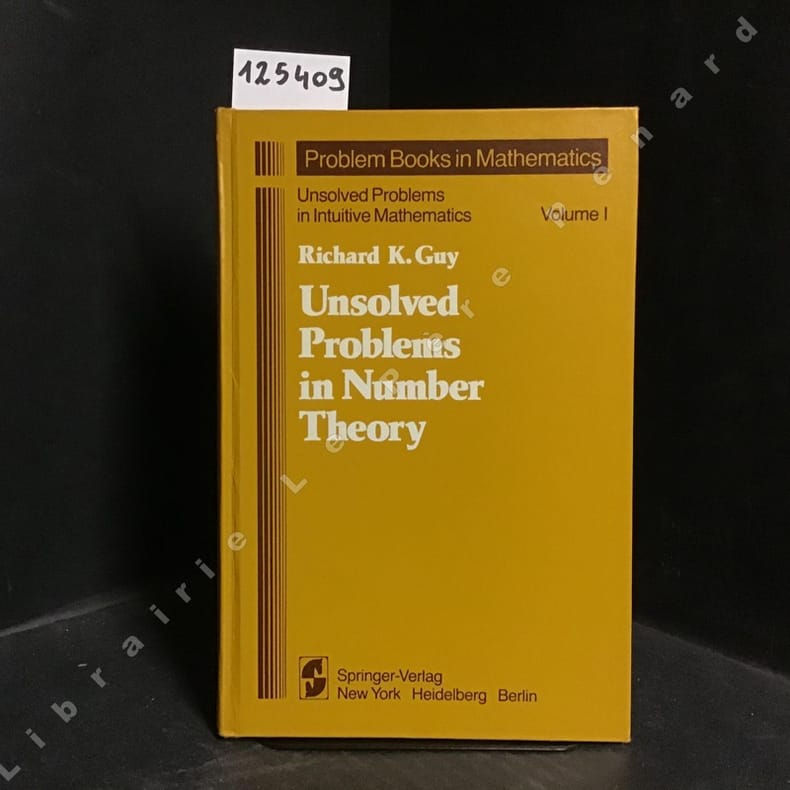
1981ref. 1254091981 Springer-Verlag New York / Berlin / Heidelberg - 1981 - In-8 relié - 161 pages - Illustré de 17 figures en N&B dans le texte
1971ref. 60569New York (u.a.), Springer (Lecture Notes in Mathematics Bd. 230), 1971. VI, 158 S. (25 cm) Broschierte Ausgabe
1779ref. 46989Paris Ph.-D. Pierres 1779. 4to. Nice recent vellum titlelabel with gilt lettering on spine. 4XXVIII471 pp. Wide-margined clean and fine. First edition of Bezout's main work - a fundamental contribution to algebraic geometry - in which he prooved the so called ´Bezout's theorem. The theorem was essentially stated by Isaac Newton in his proof of lemma 28 of volume 1 of his Principia where he claims that two curves have a number of intersection points given by the product of their degrees.Bézout's theorem is a statement in algebraic geometry concerning the number of common points or intersection points of two plane algebraic curves. The theorem claims that the number of common points of two such curves X and Y is equal to the product of their degrees. The work stimulated many investigations in the modern theory of elimination including Cauchy’s refinements of elimination procedure and Sylvester’s work on resultants and inertia forms. Bezout’s theorem is crucial to the study of the intersection of manifolds in algebraic geometry."It was not until 1779 that Bezout published his Théorie des équations algébriques his major work on elimination theory. Its best-known achievement is the statement and proof of Bezout’s theorem: "The degree of the final equation resulting from any number of complete equations in the same number of unknowns and of any degrees is equal to the product of the degrees of the equations." Bezout following Euler defined a complete polynomial as one that contains each possible combination of the unknowns whose degree is no more than the degree of the polynomial. Bezout also computed that the degree of the resultant equation is less than the product of the degrees for various systems of incomplete equations. Here we shall consider only the complete case.The proof makes one marvel at the ingenuity of Bezout who like Euler not only could manipulate formulas but also had the ability to choose those manipulations that would be fruitful. He was compelled to justify his nth-order results by a naive "induction" from the observed truth of the statements for 1 2 3 ···. Also numbered subscripts had not yet come into use and the notations available were clumsy."DSB. hardcover
Mm 165x255 Volume nella sua brossura originale, (12)-x-530 pagine molte delle quali ancora intonse. Piccole abrasioni alla testa e al piede del dorso, peraltro il libro è in buone-ottime condizioni nelle sue legature ben salde. Spedizione in 24 ore dalla conferma dell'ordine.
1779ref. 46989Paris, Ph.-D. Pierres, 1779. 4to. Nice recent vellum, titlelabel with gilt lettering on spine. (4),XXVIII,471 pp. Wide-margined, clean and fine.
1931ref. EC10-717Leipzig, Akademische Verlagsanstalt, 1931 / 1930 / 1933. original wrappers, large 8 vo, A) 2 leaves, 404 and 62 pages, [G?del p. [173]-198], B) [183]-404 and 52 pages, 2 leaves, [G?del 349-360], C) 235-470 and 41 pages, 2 leaves, [G?del 433-443], wrappers with librarystamps TU WIEN Ausgeschieden, (=Cancelled Ex-Library copies)
1931ref. BA9-1017Leipzig, Akademische Verlagsanstalt, 1931 / 1930 / 1933. original wrappers, large 8 vo, A) 2 leaves, 404 and 62 pages, [G?del p. [173]-198], B) [183]-404 and 52 pages, 2 leaves, [G?del 349-360], C) 235-470 and 41 pages, 2 leaves, [G?del 433-443], wrappers with librarystamps TU WIEN Ausgeschieden, (=Cancelled Ex-Library copies)
1951ref. 010194McGraw-Hill Book Company, New York Toronto London 1951. 1st Edition Leinen Gut
1992ref. 61066New York, Dover (Dover Books on Advanced Mathematics), 1992. X, 307 S. Broschierte Ausgabe
Mm 145x220 Volume rilegato in tela con titolo oro al dorso, viii-136 pagine di testo in lingua inglese - english text. Buona copia, spedizione in 24 ore dalla conferma dell'ordine.
1988ref. 62209New York, Springer (Lecture Notes in Mathematics, 1358), 1988. V, 308 S. (24 cm) Broschierte Ausgabe
1965ref. 60484Braunschweig, Vieweg, 1965. X, 108 S. Broschierte Ausgabe
1969ref. ABE-151680096580252 PAGES-20,2 CM X 21 CM-EN COUVERTURE: ALEXIS ET MARIE TREMBLAY DANS LE REGNE DU JOUR-LIBRE COURS: MORVAN LEBESQUE, 6P, 2 PHOTOS-LES ANARCHISTES OU LA BANDE A BONNOT, PHILIPPE FOURASTIE, 10P, 5 PHOTOS, BRUNO CREMER, JACQUES BREL, ANNIE GIRARDOT-LE REGNE DU JOUR, PIERRE PERRAULT, 14P, 5 PHOTOS-AFFRONTEMENTS CRITIQUES: THEOREME, PASOLINI, 1P, PHOTO-CHRONIQUE D'ANNA-MAGDALENA BACH, JEAN-MARIE STRAUB, 1P, PHOTO-PROCES-VERBAL: ROGER LOUIS, 6P, 6 PHOTOS-(DE0917)
1907ref. 48911Paris Gauthier-Villars 1907. 4to. No wrappers. In: "Comptes Rendus Hebdomadaires des Séances de L'Academie des Sciences" Tome 144 No 11 No. 19 and No. 21. Pp. 593- 664 pp. 1009- 1080. pp. 1137- 1192.3 entire issues offered.Reesz' paper: pp. 615-619. Fischer's paper: pp. 1022-1024 a. 1148-51. Nos 19 a. 21 with some small tears to outher margins. paper fragile. Sewing loose. First apperance of two fundamental papers - Riesz setting forth the theorem and Fischer proving it - the mathematics of which later made it clear that there is an equivalence between matrix mechanics Heisenberg and wave mechanics Schrödinger in quantum physics.The Riesz-Fischer theorem of 1907 concerning the equivalence of the Hilbert space of sequences of convergent sums of squares with the space of functions of summable squares formed the mathematical basis for demonstrating the equivalence of matrix mechanics and wave mechanics. unknown
1900ref. 51494Paris Gauthier-Villars 1900. 4to. No wrappers. In: "Comptes Rendus Hebdomadaires des Séances de L'Academie des Sciences" Tome 131 No 24. Pp. 975- 1017. Entire issue offered. Fejér's here spelled Téjer ! paper: pp. 984-987. Clean and fine. First printing of this importent paper in which Féjer states the "Summation Theorem" that bears his name."Fejér’s main works deal with harmonic analysis. His classic theorem on C 1 summability of trigonometric Fourier series 1900 not only gave a new direction to the theory of orthogonal expansions but also through significant applications became a starting point for the modern general theory of divergent series and singular integrals. Through a Tauberian theorem of G. H. Hardy’s the convergence theory of Fourier series was considerably affected by Fejér’s theorem as well; it is closely connected with Weierstrass’ approximation theorems and with the more advanced theory of power series and harmonics potential theory and makes possible a number of analogues for related series such as Laplace series."DSB. unknown
1770ref. 41596Berlin Haude et Spener 1770. 4to. No wrappers as issued in "Mémoires de l'Academie Royale des Sciences et Belles-Lettres" Tome V pp. 203-221 1 plate and pp. 222-288 1 engraved plate. Both papers first edition. The first paper is Euler's discussion of "Cramers Paradox" and it contains his inventions of 2 kinds of curves "Cusps of first kind" or keratoid cusp and "Cups of second kind" or ramphoid cusp. - Enestroem E 169.The second paper contains Euler's famous proof of "The fundamental Theorem of Algebra". - Enestroem E 170. unknown
1873ref. 38036Paris: Gauthier-Villars 1873. 4to. 282x225mm. Entire volume 1628 pp. offered here in original blank wrappers unopened. An exceptionally fine copy. 4 parts First edition of Hermite's epoch-making memoir in which he proved the transcendence of e and thus initiated a new era in number theory. A decade later Lindemann used the method of Hermite's work to establish the transcendence of pi. unknown
1873ref. 47891Paris: Gauthier-Villars 1873. 4to. No wrappers. In: "Comptes Rendus Hebdomadaires des Seances de l'Academie des Sciences" Vol 77 Nos 1 2 4 a. 5 4 entire issues offered. Hermite's paper: pp.18-24; 74-79; 226-233; 285-293. With halftitle and titlepage to vol. 77. First apperance of Hermite's epoch-making memoir in which he proved the transcendence of e and thus initiated a new era in number theory. A decade later Lindemann used the method of Hermite's work to establish the transcendence of pi. Parkinson "Breakthroughs" 1873 M. unknown
1770ref. 41596(Berlin, Haude et Spener, 1770). 4to. No wrappers, as issued in ""Mémoires de l'Academie Royale des Sciences et Belles-Lettres"", Tome V, pp. 203-221, 1 plate and pp. 222-288, 1 engraved plate.
1900ref. 51494(Paris, Gauthier-Villars), 1900. 4to. No wrappers. In: ""Comptes Rendus Hebdomadaires des Séances de L'Academie des Sciences"", Tome 131, No 24. Pp. (975-) 1017. (Entire issue offered). Fejér's (here spelled Téjer !) paper: pp. 984-987. Clean and fine.
1873ref. 47891Paris: Gauthier-Villars, 1873. 4to. No wrappers. In: ""Comptes Rendus Hebdomadaires des Seances de l'Academie des Sciences"", Vol 77, Nos 1, 2, 4 a. 5 (4 entire issues offered). Hermite's paper: pp.18-24" 74-79 226-233" 285-293). With halftitle and titlepage to vol. 77.
1907ref. 48911(Paris, Gauthier-Villars), 1907. 4to. No wrappers. In: ""Comptes Rendus Hebdomadaires des Séances de L'Academie des Sciences"", Tome 144, No 11, No. 19 and No. 21. Pp. (593-) 664 + pp. (1009-) 1080. + pp. (1137-) 1192.(3 entire issues offered).Reesz' paper: pp. 615-619. Fischer's paper: pp. 1022-1024 a. 1148-51. Nos 19 a. 21 with some small tears to outher margins. paper fragile. Sewing loose.
1873ref. 38036Paris: Gauthier-Villars, 1873. 4to. (282x225mm). Entire volume (1628 pp.) offered here in original blank wrappers, unopened. An exceptionally fine copy. 4 parts
In 4, pp. 23 + (1b). Intonso. Br. ed.
1780ref. 44931Paris Moutard Panckoucke 1780. 4to. Extract from "Mémoires fe Mathematique et de Physique Présentés à l'Academie des Sciences par divers Savans" Tome IX. Pp. 593-624 and 2 folded engraved plates. Clean and fine. First appearance of an importent papwer in the history of analytic geometry."In this article Tinseau gave an interesting generalization of the Pythagorean theorem for space of three dimensions: the square of the area of a plane surface is equal to the sum of the squares of the projection of this surface upon three mutually perpendicular coordinate planes.To Tinseau it appears that the use of the word "conoid" in the modern sense is due."Boyer "History of Analytic Geometry p. 207."Two of the three memoirs that constitute Tinseau’s oeuvre deal with topics in the theory of surfaces and curves of double curvature: planes tangent to a surface contact curves of circumscribed cones or cylinders various surfaces attached to a space curve the determination of the osculatory plane at a point of a space curve problems of quadrature and cubature involving ruled surfaces the study of the properties of certain special ruled surfaces particularly conoids and various results in the analytic geometry of space. In these two papers the equation of the tangent plane at a point of a surface was first worked out in detail the equation had been known since Parent methods of descriptive geometry were used in determining the perpendicular common to two straight lines in space and the Pythagorean theorem was generalized to space the square of a plane area is equal to the sum of the squares of the projections of this area on mutually perpendicular planes. DSB. Although Tinseau published very little his papers are of great interest as additions to Monge’s earliest works. Indeed Tinseau appears to have been Monge’s first disciple. unknown