4,149 results
1740ref. 30786A La Haye: Chez Jean Van Duren 1740. 1st editon. Period full mottled-calf binding with dark maroon title label to spine. Marbled paper eps. Joint leather beginning to split though joints held solidly by cords. Wear at spine ends & tips. Worming to right margin of 18 leaves. Period pos in top margin of general t.p. Withal a solid VG copy. 195 9 pp. General & Vol III title pages with both printed in red & black. Frontispiece engraving. Engraved t.p. vignette. 17 fold-out copperplate engravings at rear. 8vo: 2 A - M8 N6. Volume 3 of De Villeneuve's set albeit one that textually stands alone. Chez Jean Van Duren hardcover books
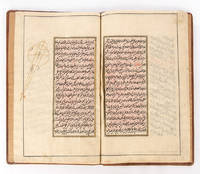
ref. 114244India Jumadi 1284 AH 1867 AD. . Single volume illuminated manuscript on thin polished Indian laid paper text-block sprinkled in red and pink in Farsi Persian manuscript on paper black ink on paper 34 leaves 268 x 160 mm; 16 lines bold nasta'liq verging on shekasteh text-block ruled in gilt numerous diagrams in the text and adorning the margins most of these in gold some contemporary annotations to margins a few spots to preliminary leaves gilt ruling to text-block oxidised and caused closed tears in come instances mostly to inner ruling close to gutter some margins repaired; contemporary red sheep over pasteboards covers ruled in blind with central stamped motifs also in blind rebacked and edges repaired new endpapers and pastedowns covers rubbed. An attractive treatise on geometry and astronomy likely copied in India for a certain Alim al-Din Hussayn bin Abd'Allah al-Ansari in 1867 AD. The work includes many diagrams in the text showing various geometrical shapes diagrams of stars and planets and diagrams of various eclipses and spheres in orbit. India, Jumadi 1284 AH (1867 AD). hardcover
ref. BN168813Klett-Cotta. Die natürliche Geometrie des Kindes Hardcover Die natürliche Geometrie des Kindes Hardcover Die natürliche Geometrie des Kindes Hardcover Klett-Cotta hardcover
ref. BN376165Lehrmittelverlag des Kantons Zürich. Geometrie: Kommentar 7. Schuljahr Peter Willi Geometrie: Kommentar 7. Schuljahr Peter Willi Geometrie: Kommentar 7. Schuljahr Peter Willi Lehrmittelverlag des Kantons Zürich unknown
ref. BN374764Lehrmittelverlag des Kantons Zürich. Geometrie Mittelstufe Kopiervorlagen: 4. bis 6. Schuljahr Hohl Walter; Lauffer Felix and Schnellmann Thomas Geometrie Mittelstufe Kopiervorlagen: 4. bis 6. Schuljahr Hohl Walter; Lauffer Felix and Schnellmann Thomas Geometrie Mittelstufe Kopiervorlagen: 4. bis 6. Schuljahr Hohl Walter; Lauffer Felix and Schnellmann Thomas Lehrmittelverlag des Kantons Zürich unknown
1998ref. BN573870CRC Press 1998. 1998. Rings Hopf Algebras and Brauer Groups Lecture Notes in Pure & Applied Mathematics Band 197 Rings Hopf Algebras and Brauer Groups Lecture Notes in Pure & Applied Mathematics Band 197 Verschoren A. Stefaan Caenepeel f Week on Algebra and Algebraic Geometry University of Antwerp and the a. o. CRC Press unknown
2002ref. BN629393American Mathematical Society 2002. 2002. Complex Manifolds and Hyperbolic Geometry: II Iberoamerican Congress on Geometry January 4-9 2001 Cimat Guanajuato Mexico Contemporary Mathematics Complex Manifolds and Hyperbolic Geometry: II Iberoamerican Congress on Geometry January 4-9 2001 Cimat Guanajuato Mexico Contemporary Mathematics Harvey William Sevin Recillas-Pishmish and Mexico Iberoamerican Congress on Geometry 2001 Guanajuato American Mathematical Society unknown
1834ref. 41598Berlin G. Reimer 1834. 4to. No wrappers. In "Journal für die reine und angewandte Mathematik. Hrsg. von A.L. Crelle" Bd. 12 Heft 1 IV88 pp. the whole issueHeft 1 offered with titlepage to volume 12. Jacobi's paper: pp. 1-69. a. 1 engraved plate. First edition of a main paper dealing with n-dimensional geometry."Of the papers devoted to n-fold integrals Jacobi's 1834 paper "De binis quibuslibit." is of crucial importence in this connection the theory of algebraic forms of variables. Here besides the problem of computing multiple integrals an importent problem of the theory of algebraic forms is solved." Andrei Nik. Kolmogorov. unknown
1829ref. 41605Berlin G. Reimer 1829. 4to. No wrappers. Extracted from "Journal für die reine und angewandte Mathematik. Hrsg. von A.L. Crelle" Bd. 4. - Plücker's paper pp. 349-370 First edition of a major paper in the arithmetization of geometry introducing the so-called triangular coordinates. "In 1829 Plücker contributed to Crelle's Journal the paper offered here with a revolutionary point of view that broke completely with the old Cartesian view of coordinates as line segments. The equation of a straight line in homogenous coordinates has the form ax by ct=0.Plücker saw that one could modify the usual language and call abc the homogenous coordinates of a line.Plücker had discovered the immidiate analytic counterpart of the geometric principle of duality about which Gergonne and Poncelet had quarreled; it now became clear that the justification that pure geometry had sought in vain was here supplied by the algebraic point of view." Boyer History of Mathematics. unknown
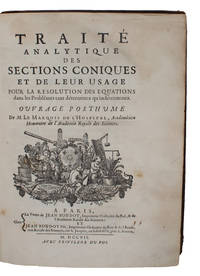
1707ref. 48217Paris Jean Boudot et Jean Boudet fils 1707. 4to. Contemporary full calf. A bit of cracking to front hinges so that cords are seen but cover not loosening. Spine with 6 raised bands richly gilt compartments. Wear to top of spine. Two small old paperlabels one to upper compartment one to frontcover. Covers slightly rubbed. 44595 pp. Large woodcut vignette on titlepage 2 other vignettes one engraved one in woodcut. 32 folded engraved plates and one smaller folded plate Fig. A. An old owners stamp on flyleaf. Internally clean and fine. A few tiny brownspots. Wide-margined and printed on good paper. Scarce first edition of l'Hôspital's second book - his second successfull textbook - the manuscript of which was left completed at his death in 1704. His first book "Analyse des infiniment petits pour l’intelligence des lignes courbes" 1696 was the first textbook of the differential calculus and his name lives on in the name of the rule for finding the limiting value of a fraction whose numerator and denominator tend to zero. His mathyematical teacher was Jean Bernoulli.The year in which Newton published the anti-Cartesian "Arithmeticus" there appeared in France a conspicuously successfull textbook on Cartesian geometry along the lines of that of Guisnée. This was the "Traité Analytique des Sections Coniques". a book which contains less original material than that of Guisnée but which is more extensive and closer to the modern manner of treatment. The work had been intended for publication at the time the authors famous calculus textbook appeared in 1696 but l'Hospital's illness apparently led to delay and it appeared posthumously in 1707. It is Cartesian in emphasis and although it consists of but one volume follows generally the tripartite plan of Lahire and Ozanam: first an algebraic quasi-analytic treatment of the Conic Sections along the lines of Apollonian theory; then an analytic study of the loci and finally a long section on the customary construction by conics of the roots of cubic and quartic polynominal equations. LHospital sometimes used two axes and seems to have recognized the interchangeability of these but he betrays some hesitation. In general L'Hospital like Descartes was more interested in analytic geometry as a measure of ecpressing loci algebraivcally than as a method of deriving the properties of a curve from its equation." Carl B. Boyer "History of Analytic geometry" pp. 150-154. hardcover
1727ref. 45242London T. Bowles 1727. Small 8vo. Contemp. full calf raised bands blindtooled covers Cambridge-binding. Wear to spine ends and spine. Hinges weakening but still holding. Titlepage in red/black. 21956 pp. and 80 full page engraved illustrations. Some soiling and browning mainly marginal last 10 engravings with a faint dapmstain. The charming plates are engraved by Leclerc. Scarce English edition the third of Leclerc's charming and very popular treatise on elementary practical geometry and perspective.Sebastien Leclerc 1637-1714 was originally an engraver who studied physics and geometry in relation to perspective theory a field of which he became famous. In 1672 he was appointed to "l'Academie de Peinture" as professor in perspective. He was also engraver to Louis XIV and was appointed professor at "l'Ecole des Gobelins". hardcover
1785ref. 44970Paris Moutard 1785. 4to. Extracted from "Mémoires fe Mathematique et de Physique Présentés à l'Academie des Sciences par divers Savans" Tome X. Pp. 511-550 a. 2 folded engraved plates. Clean and fine. First appearance of this importent paper by the "greatest geometer of the century" in which he solves some main problems in coordinate geometry especially he introduced the "distant formula" for three dimensions years before it was used by Lagrange. He laid the foundation of a completely new branch of mathematics known as descriptive geometry. The paper was delivered already in 1771 but not published until 1785. "His first important original work was "Memoire sur les développées les rayons de courbure et différents genres d inflexions des courbes á double courbure" He published an extract from it in June 1769 in the Journal encycyclop´matiques and in October 1770 he finished a more complete version that he read before the Academie des Sciences in August 1771; the latter however was not published until 1785 Mémoires de mathématiques et de physique présentés á ’Academic par divers scavanns. By then some of the most important ideas in the memoir no longer seemed so original because Monge had employed them in other works published in the intervening years. Nevertheless this memoir is of exceptional interest for it presents most of the new conceptions that Monge developed in his later works as well as his very personal method of exposition which combined pure geometry analytic geometry and infinitesimal calculus."DSB. unknown
1859ref. 42296London Richard Taylor and William Francis 1859. 4to. No wrappers as extracted from "Philosophical Transactions" Vol. 149 - Part I. Pp. 61-90. Clean and fine. First appearance of this pathbreaking paper in which Cayley unites 'Metrical Geometry' and 'Projectice Geometry' by introducing "imaginary" elements to metrical properties."The fundamental notions in metrical geometry are the distance between two points and the angle between two lines. Replacing the concept of distance by another also involving "imaginary" elements Cayley provided the means for unifying Euclideangeometry and the common non-Euclidean gemoetries into one comprehensive theory."Bell in "Men of Mathematics".In non-Euclidean geometry prepared the way for Klein's splendid discovery that the geometry of Euclid and the non-Euclidean geometries of Lobatchewsky and Riemann are all threee merely different aspects of a more general kind of geometry which includes them as special cases.Dealing with the relations between metrical and projective geometry Klein remarks In "Entwicklung der Mathematik" Teil I p. 148: "Vor allem kommt für uns sein Cayley's berühmtes 'A Sixth Memoir upon Quantics" im betrachtt. Quantioc heisst soviwel "Form" d.h. homogenes Polynom von zwei drei oder mehr Variablen wonach man binäre tertiäre usw. Formen unterscheidet." unknown
1873ref. 53254London and New York Macmillan and Co. 1873. 4to. Orig. full brown cloth gilt spine pictorial gilt frontcover. Near mint condition. Small embossed stamp at upper corner of title-page David Dunlop ObservatoRy Library. In: "Nature a weekly illustrated Journal of Science." Volume VIII May 1873 to October 1873. XII562 pp. Entire volume offered. Riemann's paper: pp. 14-17 a. 36-37. Internally clean and fine no traces of use. First English translation of this milestone work on the foundations of geometry. It "is one of the key work from which derives the modern study of differential geometry and especially the study of manifolds of dimension greater than two. It was to prove central to the overthrow of Euclidean geometry as the source of geometrical ideas and to Einstein's general theory of relativity after 1915." Grattan-Guiness "Landmark Writings in Western Mathematics 1640-1940.It is a translation of Riemann's famous Habilitationsvortrag held in 1854 in secondary literature it is often misidentified as his Habilitationsschift but that was concerned with Fourier series and was delivered the year before. Riemann begins his lecture with a remark about a certain darkness that lies at the foundation of geometry. This darkness obscures the relations between that which geometry assumes i.e. the notion of space and the first principles of constructions in space. In Riemann's oponion one must take another approach towards this problem than the usual axiomatic method used ever since Euclid. The approach taken by Riemann is to a large extent guided by Gauss's work on the intrinsic geometry of surfaces; 'Disquisitiones generales circa superficies curvas' 1828. In this work Gauss showed that the curvature of a surface can be determined without reference to the ambient Euclidean space in which it lies i.e. that the curvature is an intrinsic property of the surface. Based on this Gauss showed several fundamental theorems about figures on the surface by referring only to the surface itself i.e. indicating that the surface itself is a space with its own geometry independent of the geometry of the ambient Euclidean space. Riemann argues that the true objects and properties of geometry are those which can be studied within the space itself and he defines a general n-dimensional space in a similar manner to the parametric representation of a surface. Riemann believed that we know space only locally he therefore bases his study of the geometry of such a general space or manifold as they are known today on the infinitesimal methods of calculus. This choice is a crucial departure from the classical axiomatic methods used by Euclid Lobachevsky and Bolyai. The notion of distance or metric on a manifold is a generalization of the usual Euclidean distance formula in n-dimensions. Particular choices of space and metric reveal both the hyperbolic geometries of Lobachevsky and Bolyai and elliptic or Riemannian geometry. Riemann's approach to geometry is of paramount importance this work "did more to change our ideas about geometry and physical space than any work on the subject since Euclid's Elements." Landmark Writings in Western Mathematics p.507. "The importance of this treatise is not confined to pure mathematics. Without it Einstein would not have been able to develop his general theory of relativity." Printing and the Mind of Man p.177. hardcover
1770ref. 31785Berlin Haude & Spener 1770. 4to. No wrappers as issued in "Mémoires de l'Academie Royale des Sciences et Belles Lettres" tome XXIV pp. 327-354 and 1 engraved plates. First edition. Lambert's work on non-Euclidean geometry is among the most important in the field. Carl Boyer writes "No one else came so close to the truth without actually discovering non-Euclidean geomtry." History of Mathematics pp. 504. Lambert wrote his famous book 'Theorie der Parallellinien' in 1766 but it was not published until 1786 nearly a decade after his death. Lambert originally set out to prove Euclid's parallel postulate in a similar way to that which Saccheri had used in his 'Euclides Vindicatus' but in contrast he did not interpret the consequences of non-Euclidean geometry as absurd. The offered paper 'Observations Trigonometriques' is the only work by Lambert on non-Euclidean geometry which was published during his life-time. Here he made the important discovery of the duality between spherical and hyperbolic geometry i.e. that hyperbolic trigonometries can be deduced from spherical trigonometries by using imaginary angles and consequently he introduced the hyperbolic functions for the first time. By illustrating this duality Lambert gave strong evidence of the consistency of non-Euclidean geometries. See Kline's Mathematical Thought from Ancient to Modern Times pp. 404 & 868. unknown
1709ref. 45238Paris Jean Boudot 1709 a. 1711. 4to. Without wrappers. Extracted from "Mémoires de l'Academie des Sciences. Année 1708" and Annèe 1709. Pp. 339-365 a. 1 folded engraved plate pp. 320-350 a. 1 folded engraved plate. First printing of two importent papers in the further development of Cartesian analytical geometry."The irrepressible Michel lRolle.in the Memoires of the Academie des Sciences for 1708-1709 the papers offered raised doubts about the correctness of the Cartesian graphical solution of equations as he had about the validity of the calculus of L'Hospital. He pointed out that to solve fx= 0 one arbitrarily chooses a curve gxy = 0 and on combining it with fx = 0 one obtains new curves hxy = 0 the intersection of which with gxy = 0 furnish the solution of fx = 0; and he realized that in this way extraneous solutions may be introduced. Imaginary branches further comp0licated the problem and although Rolle sawthe difficulties he was unable to solve them."Boyer "History of Analytical Geometry" p. 155. unknown
2011ref. BN28357Springer 2011. 2011. Hardcover. 246 x 168 x 2 cm. Vectorworks® ist das meist genutzte CAD-Programm für Apple und eines der führenden für Windows. Mit dem Buch lernen Architekten Innenarchitekten Bühnen- und Szenenbildner sowie Studierende das Programm noch besser kennen. Zu Beginn werden Leser in Programmoberfläche Werkzeuge Strukturhilfen Standardzeichentechniken und -translationsoperationen eingeführt wobei die 3D- und 2D-Werkzeuge anhand eines Beispielprojekts vorgestellt werden. Am Ende steht ein komplettes 3D-Modell des Bauwerks einschließlich davon abgeleiteter Pläne. Programmoberfläche · Blattrand und Raster ausblenden · Fangeinstellungen · Automatische Sicherung · Handbuch Quickstart · Arbeitsumgebungen · Tastenkürzel · Rasterbilder importieren · Klassen anlegen · Ebene bearbeiten · Navigation Klassen/Ebenen · Zeichnen per Koordinateneingabe · 2D zu 3D · 3D-Werkzeug Boden/Decke · Bauteildefinition · Boden/Decke bearbeiten · 3D-Werkzeug Wand · Wände verbinden · Wände bearbeiten · Partielle Höhenanpassung von Wänden · Wandverbindungen bearbeiten · Grundrissdarstellung steuern · Fenster und Türen als 2D/3D-Symbole anlegen · Arbeitsebenen als Konstruktionshilfe · 2D/3D-Symbole bearbeiten · Symbole im Modell einsetzen · Klassenstruktur von Symbolen · Symbolverwaltung in der Zubehörpalette · Ebenen als Geschosse · Ebenenübergreifende Modellansicht · 3D-Befehl Dachfläche anlegen · Wände an Dach anpassen · Dachfläche bearbeiten und ergänzen · Wandnische anlegen · Gekrümmte Bauteile als NURBS-Flächen modellieren · Kurvenflächen verbinden · Wendeltreppe mit dem Treppen-Werkzeug erstellen · Treppenobjekt 2D-editieren · Treppenobjekt im Modell einsetzen · Gesicherte Darstellungen · Layoutebene anlegen · Ansichtsbereiche · Ansichten Schnitt und Grundrisse aus 3D-Modell erzeugen · Zeichnungen 2D-editieren · Schraffuren und Verläufe anlegen · Bemaßungen anlegen und editieren · Kombination Liniendarstellung/Renderworks · Kamera festlegen · Kamerasteuerung aus dem Layout · Szenenbeleuchtung mit Umgebungslicht und anderen Lichtquellen · HDRI-Beleuchtung · Indirekte Beleuchtung · Vorgabe-Materialien · Shader- und Bitmapbasierte Texturen selbst erstellen · Materialzuweisung und Texturprojektion · Renderzeit-Optimierung · Spiegelung mit Rasterbildobjekten- Autor: Horst Sondermann ist Architekt und Professor an der Architekturfakultät der HFT Stuttgart. Er studierte an der TU Berlin und unterrichtet seit 1994 Darstellende Geometrie und Architekturdarstellung. Zur Architekturvisualisierung hat er bereits die Bücher Licht Schatten Raum · Architekturvisualisierung mit Cinema 4D® Cinema 4D®·Tipps und Tricks für die Architekturvisualisierung sowie Photoshop® in der Architekturgrafik im Springer-Verlag veröffentlicht. Vectorworks® ist das meist genutzte CAD-Programm für Apple und eines der führenden für Windows. Mit dem Buch lernen Architekten Innenarchitekten Bühnen- und Szenenbildner sowie Studierende das Programm noch besser kennen. Zu Beginn werden Leser in Programmoberfläche Werkzeuge Strukturhilfen Standardzeichentechniken und -translationsoperationen eingeführt wobei die 3D- und 2D-Werkzeuge anhand eines Beispielprojekts vorgestellt werden. Am Ende steht ein komplettes 3D-Modell des Bauwerks einschließlich davon abgeleiteter Pläne. Programmoberfläche · Blattrand und Raster ausblenden · Fangeinstellungen · Automatische Sicherung · Handbuch Quickstart · Arbeitsumgebungen · Tastenkürzel · Rasterbilder importieren · Klassen anlegen · Ebene bearbeiten · Navigation Klassen/Ebenen · Zeichnen per Koordinateneingabe · 2D zu 3D · 3D-Werkzeug Boden/Decke · Bauteildefinition · Boden/Decke bearbeiten · 3D-Werkzeug Wand · Wände verbinden · Wände bearbeiten · Partielle Höhenanpassung von Wänden · Wandverbindungen bearbeiten · Grundrissdarstellung steuern · Fenster und Türen als 2D/3D-Symbole anlegen · Arbeitsebenen als Konstruktionshilfe · 2D/3D-Symbole bearbeiten · Symbole im Modell einsetzen · Klassenstruktur von Symbolen · Symbolverwaltung in der Zubehörpalette · Ebenen als Geschosse · Ebenenübergreifende Modellansicht · 3D-Befehl Dachfläche anlegen · Wände an Dach anpassen · Dachfläche bearbeiten und ergänzen · Wandnische anlegen · Gekrümmte Bauteile als NURBS-Flächen modellieren · Kurvenflächen verbinden · Wendeltreppe mit dem Treppen-Werkzeug erstellen · Treppenobjekt 2D-editieren · Treppenobjekt im Modell einsetzen · Gesicherte Darstellungen · Layoutebene anlegen · Ansichtsbereiche · Ansichten Schnitt und Grundrisse aus 3D-Modell erzeugen · Zeichnungen 2D-editieren · Schraffuren und Verläufe anlegen · Bemaßungen anlegen und editieren · Kombination Liniendarstellung/Renderworks · Kamera festlegen · Kamerasteuerung aus dem Layout · Szenenbeleuchtung mit Umgebungslicht und anderen Lichtquellen · HDRI-Beleuchtung · Indirekte Beleuchtung · Vorgabe-Materialien · Shader- und Bitmapbasierte Texturen selbst erstellen · Materialzuweisung und Texturprojektion · Renderzeit-Optimierung · Spiegelung mit Rasterbildobjekten- Autor: Horst Sondermann ist Architekt und Professor an der Architekturfakultät der HFT Stuttgart. Er studierte an der TU Berlin und unterrichtet seit 1994 Darstellende Geometrie und Architekturdarstellung. Zur Architekturvisualisierung hat er bereits die Bücher Licht Schatten Raum · Architekturvisualisierung mit Cinema 4D® Cinema 4D®·Tipps und Tricks für die Architekturvisualisierung sowie Photoshop® in der Architekturgrafik im Springer-Verlag veröffentlicht. Springer hardcover
ref. 1568810466.GVHStape. Good. Access codes and supplements are not guaranteed with used items. May be an ex-library book. unknown
ref. 0821811932.Ghardcover. Good. Access codes and supplements are not guaranteed with used items. May be an ex-library book. hardcover