4.116 Ergebnisse
1993Hardcover in very good condition. Pages are clean, text and illustrations are clear. TH Used
1993Hardcover. Boards are unmarked, pages are clean, and the text is clear. TH Used
1981Usual stamps and markings, library sheet to inner front cover. Page edges are slightly agetoned, pages are clean and tight. Ex Library
1923No dust jacket. Hardcover. Acceptable condition. One or two minor bumps on rear board. Spine is faded and has a few minor scores and marks. Spine ends are worn, bumped and nicked. Minor wear on leading corners. Binding is visible at a few points. Contents are clear. AF Used
Best.-Nr. 53811431-nnew. unknown
1994Best.-Nr. ABE-447641932zThe Office 1994. Staple-Bound Softcover. Very Good. Title: Terrorism and Drug Trafficking: Threats and Roles of Explosives and Narcotics Detection Technology GAO/NSIAD/RCED-96-76BR. Text very good clean 36 pp.; slight corner wear numbers marked on top front left corner/embossed library stamp bottom front cover quite minor outer wear. The Office paperback
Best.-Nr. B9781013532054Hardback. New. hardcover
Best.-Nr. B9781014190680Paperback / softback. New. paperback
Best.-Nr. 45861469-nnew. unknown
Best.-Nr. A9780371994443Paperback / softback. New. paperback
Best.-Nr. A9780461990782Paperback / softback. New. paperback
Best.-Nr. 1331966809.Gpaperback. Good. Access codes and supplements are not guaranteed with used items. May be an ex-library book. paperback
Best.-Nr. 133013625X.Gpaperback. Good. Access codes and supplements are not guaranteed with used items. May be an ex-library book. paperback
1962Ex Library hardcover (no jacket) in good condition. 56pp. The edges, leading corners and spine are rather worn. A few marks on the boards and page block. Labels on the spine foot and front pastedown. Label, stamp and pen on copyright page. Stamps at a few further points. The FEP has been removed, making the binding a little weak on the opening page; the rest of the pages are sound and clean; all content is clear. Translated by D.E. Brown. English translation editor: Ian N. Sneddon. Popular Lectures in Mathematics, Volume 8. CM Used
2013Paperback (reprint of the 1980 edition) in excellent condition, with just one or two instances of very minor shelfwear on covers. Pages are clean and sound; all text is clear. TS Used
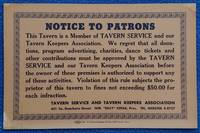
1950Best.-Nr. 5035062Chicago: Tavern Service and Tavern Keepers Assoc 1950. Original. Soft cover. Very Good. Original circa 1950 notice poster for tavern patrons posted in Chicago taverns and printed/published by the Tavern Keepers Association. The Service was headquartered at 431 So. Dearborn St. and the prefix of the telephone number WEBSTER 9-0727 is noted in the Digital Research Library of Illinois History Journal. Size 7: x 10 3/4". Decorated border. Dark blue printing. Printed by E. Schoenenberger & Son. Small stain lower left corner and slight loss of color at the corners; else vg condition on thick card stock. Tavern Service and Tavern Keepers Assoc unknown
2008Best.-Nr. SHEL1646New Castle & London: Oak Knoll Press & British Library 2008. 1st Edition. Hardcover. Fine/As New. 1st printing. 4to cloth. 159pp. Fine and descriptive Illustrations. Bibliography. Index. Fine like new in dj. A useful and attractive reference book for collectors. Oak Knoll Press & British Library hardcover
1967Hardcover in very good condition. Pages are clean, and text and illustraions are clear. TH Used
1996Hardcover without jacket in excellent condition. Pages are clean and sound; all text is clear. TS Used
2011Paperback. Good condition. Front cover dog-eared at lower corner, affecting first few pages. Marks to first few pages at lower corners. Shelf marked to back cover and page block face is marked. Pages and text fine. RB Used
1956Best.-Nr. 025605Howell North Books 1956. First Edition . Cloth. Near Fine/Near Fine. Bright & unopened. Maps in back pocket. Covers looking fresh with shiney gilting. Faint line of fading at lower front and upper spine. Price-clipped jacket very nice and crisp with just a touch of shelfwear. Inner side of jacket has mild foxing. Howell North Books hardcover
1977Best.-Nr. 016079Sioux Falls SD: American Pop Corn Company 1977. Soft cover. Near Fine. The First Family of American Pop Corn. Stapled booklet of 48 pp. with stiff card covers. Printed on thick ivory paper and full of vintage pop corn product photos & stories and personalities of the Jolly Time Pop Corn company. Includes 4 recipes of Smith family favorites. A clean crisp copy. Covers have some very light soiling mainly on rear. American Pop Corn Company paperback
1999Best.-Nr. 91332Washington DC: United States General Accounting Office 1999. Presumed First Edition First Printing. Wraps. Very good. 28 pages. Footnotes. This is a "Report to the Chairman Subcommittee on Defense Committee on Appropriations House of Representatives". Satellite control systems are used to ensure that satellites reach their planned orbits and perform their intended missions while in orbit. There are two types of satellite control operations-platform control and payload control. Platform controls involves monitoring the health and status and managing the operations of a satellite's physical structure sometimes called the bus. Payload controls involves monitoring the health and status and managing the operations of a satellite's mission equipment. Specific satellite control functions consist of 1 locating satellites and receiving and processing data from them 2 following satellites' motion over time and 3 transmitting signals to satellites. These three functions are called telemetry tracking and commanding and are performed by a network of ground command and control centers ground antennas and communication capabilities between the centers antennas and satellites. There are two types of satellite control networks-common and dedicated. DOD operates two common networks that provide primary or backup control for communications environmental monitoring navigation and intelligence satellites. Examples include the Defense Satellite Communications System Defense Meteorological Satellite Program and Global Positioning System. DOD also operates several dedicated networks that control missile warning communications and intelligence missions. DOD has made minimal progress in integrating and improving its satellite control capabilities in accordance with 1996 national space policy. In 1992 DOD identified a need for an integrated satellite control system to achieve standardization and interoperability across military services and individual satellite programs. In 1995 the Air Force which controls most of DOD's satellites characterized its satellite control capabilities as aging inefficient and costly to operate. The Air Force initiated an effort to standardize these capabilities and achieve full implementation in 2003-a first step toward an integrated and interoperable DOD capability. Air Force officials chose to proceed with a conceptual design over operational alternatives. However in 1997 the Air Force terminated this effort because of schedule delays resulting from software development problems and the additional amount of software that needed to be written. Air Force Space Command representatives are now recommending that the use of the Air Force's existing satellite control capabilities be extended to 2005 to provide time to acquire an improved capability. Until then the Air Force will be unable to reduce approximately $400 million it spends annually to operate maintain sustain and modernize satellite control capabilities. The Navy's satellite control capabilities are not as old inefficient or costly to operate as the Air Force's capabilities. Although the Navy upgraded its capabilities in the early 1990s another upgrade is planned because the company that provided the existing capabilities no longer provides software support services. DOD has taken limited action to foster integrated and interoperable satellite control for all government space activities since it was directed to do so by the 1996 national space policy. Prior studies recommended that a high-level interagency management group be established to oversee implementation of integrated systems across agency lines. Although DOD established a senior steering group in 1998 to address national security space management and integration issues government space agencies continue to plan for satellite control capabilities on an independent basis rather than coordinate and integrate their efforts on an interagency basis. Considering the long-standing need to replace the Air Force's aging and costly satellite control capabilities and the Navy's more recent plan to upgrade its capabilities DOD has an opportunity to revitalize its effort to achieve integrated satellite control by acquiring a standardized capability. A resumed search for such a capability is appropriate because it would also provide an opportunity to review Air Force satellite control decisions for future space-based infrared and communication satellite programs that are currently in development. Commercial off-the-shelf products that could perform core functions for controlling satellites are available and several studies have advocated the use of such products. In making a selection among alternatives DOD could reduce acquisition risk by employing best commercial practices-a key element of DOD's acquisition reform initiatives. Commercial firms place a premium on demonstrated performance before making critical decisions rather than on predicted performance as was the case with the Air Force's 1995 selection. We are recommending that the Secretary of Defense take actions to revitalize efforts to 1 integrate and improve DOD's satellite control capabilities using commercial products and practices and 2 foster integration and interoperability of satellite control among government space activities. United States General Accounting Office paperback
1994Best.-Nr. 91327Washington DC: United States General Accounting Office 1994. Presumed First Edition First Printing. Wraps. Very good. 31 1 pages. Footnotes. Figure. Table. This is a "Report to Congressional Requesters". The space shuttle is the only U.S. launch system capable of carrying people to and from space. It has operated for over 10 years and is likely to be used well into the next century. As the shuttle ages the National Aeronautics and Space Administration NASA will be faced with increased need to update and replace various components due to obsolescence or to enhance safety. At Congress; request GAO reviewed the shuttle program lo determine 1 the assumptions NASA has made regarding the length of time the current shuttle fleet will be in operation and 2 NASA'S processes and criteria for selecting needed safety and obsolescence upgrades. NASA has not made explicit assumptions about how long the current shuttle fleet will remain in operation. However based on its budget projections and approach to defining a new launch system the current fleet cannot be replaced for at least another 12 to 15 years. NASA'S projections of its likely budgets through fiscal year 1999 will not support simultaneous development of the space station and a new launch vehicle. NASA has a process for identifying and assessing needed upgrades. However NASA does not use life-cycle cost as a criterion for evaluating potential safety upgrades and it does not always consider alternatives when selecting an approach to implementing an improvement. Without life-cycle cost estimates NASA cannot determine whether an upgrade project is affordable within the context of the program and the agency's overall budget and out-year plans. Therefore it is possible that inappropriate program decisions on upgrades may be made. NASA managers do not have a precise basis for estimating life-cycle costs for decision purposes because of uncertainty about how Iong the current fleet will remain in operation. Since the shuttle fleet must operate for at least another 12 to 15 years it would seem logical that NASA officials could use that time period as a minimum basis for estimating life-cycle costs. NASA'S approach to funding the Safety and Obsolescence Upgrade program may increase programmatic risks. The program manager believes that funding is adequate to develop upgrade projects that have already been approved. However recent budgets have not included funds for early design studies of other potential upgrades or to cover unforeseen contingencies. Not conducting early design studies to establish the feasibility of a potential upgrade could mean that projects are not started when they are needed or projects are initiated before they are adequately defined. Also the lack of contingency funds means that if approved projects encounter unexpected problems the projects may have to be stretched out and costs may increase. This situation raises questions as to whether the decision to start two new projects in fiscal year 1995 adequately reflect budget constraints and inherent technical and cost risks. In commenting on a draft of this report NASA said that it agreed in principle with our recommendations. The agency stated however that some safety upgrades are made without a full life-cycle cost analysis because of the emphasis on safety. Safety is NASAS highest priority and relative cost is a lesser consideration. We agree that NASA must heavily weigh safety considerations in such decisions. We believe however that prudent management requires an estimate of total costs to ensure that NASA managers understand the full implications of their decisions and that the projects are affordable within the context of NASA'S total budget and future plans. United States General Accounting Office paperback