2462 risultati
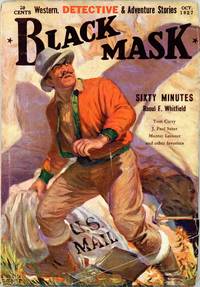
1927rif. 36856New York: Pro-Distributors Publishing Company Inc. 1927. Text paper darkened with some minor loss to upper right corner edge wear to yapp with tiny tears and creases creasing to lower right corner mild wear to spine ends a very good copy. 36856. Octavo single issue cover by Fred Craft pictorial wrappers. Pulp magazine. Fiction by Raoul Whitfield Murray Leinster Marion Scott and others. Reference: Cook Mystery Detective and Espionage Magazine pp. 62-68. Pro-Distributors Publishing Company, Inc. unknown
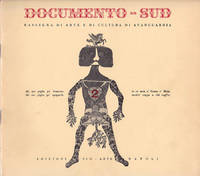
1959rif. 1476Numero 2 Oblong quarto unpaginated 32 pages illustrated throughout. Stiff illustrated wrappers. Front cover illustration by Guido Biasi. - First edition. Texts by: Persico Baj Lebel Andriani Crispolti Barletta Castellano Jaguer and Biasi illustrations by: Luca Galdo Palumbo Trubbiani Pollock Alfano Baj Brauner R. d'Haese Lebel Reuterswärd Dubuffet Verga Gruppo '58 Barisani C. del Pozzo Massey Fergola Biasi L. Del Pezzo Viscardi Freda di Bello Persico Jaguer and Colucci. Front cover by Guido Biasi with a rearranged excerpt from the Neapolitan song Lily Kangy by Capurro and Gambardella – "chi me piglia pe' francese/ chi mi piglia pe' spagnola/ io so nata o' Conte e' Mola/ mett'a' coppa a chi vogl'io" "Some take me for French / some take me for Spanish / I was born in Conte e' Mola / I'll put on top whoever I want" Numero 6 Oblong quarto unpaginated 32 pages illustrated throughout. Stiff illustrated wrappers. Front cover illustration after drawing by Gustave Moreau. - First edition. Texts by D'Angelo's: Un centenario dell'Indipendenza; Delire des ombres; Delire des ombres; Toniato Andriani von Holten Martini Benayoun Jaguer Persico Thiercelin; Biasi: Apologia dell'interrogazione; Llinas Leonard Castellano Havrenne Petersen and Walter Fedler: Realismo socialista nella Repubblica Democratica Tedesca. Illustrations by Mesens Fergola Andriani Boucher Max Ernst Lucio Del Pezzo; Persico Toyen Petersen Baj Vielfaure Lacomblez Picabia Biasi Pabi Castellano Fahlström Sant'elia Russo Dova and di Bello. The central double page is dedicated to Franz Picabia featuring a reproduction of one of his works and nine quotations from other authors who wrote about him Apollinaire Breton Estienne Fricker De Massot Olga Picabia Seuphor Tapié. 'The merit of Documento Sud and its creators undoubtedly lies in their contribution to the development of Italian visual poetry their attempt to build a new interplay between image and word a connection between drawing and writing poetry and collage always guided by an unconventional use of forms and freedom in the figurative repertoire "disobeying any logical criterion" to use the words of Mario Persico." Marina Borrelli Edizioni Sud Arte
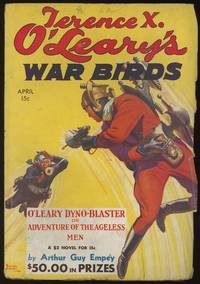
1935rif. 32688New York: Dell Publishing Co. Inc. 1935. Tanning to text paper cover with mild wear to yapp edges with several closed tears penciled notation to upper front cover small damp stain to upper rear cover a nearly fine copy. 32688. Octavo single issue cover by Rudolph Belarski pictorial wrappers. Pulp magazine. Second of three SF themed issues written by Arthur Guy Empey. Reference: Tymn and Ashley eds Science Fiction Fantasy and Weird Fiction Magazines pp. 659-60. Dell Publishing Co., Inc. unknown
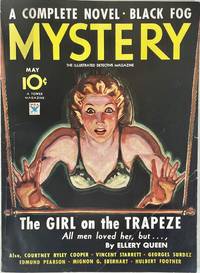
1934rif. 28769Chicago IL: Tower Magazines Inc. 1934. Crease to lower right cover several tiny edge tears small tear at upper left front corner at spine a very good to nearly fine copy. 28769. Large octavo single issue pictorial wrappers. Fiction by Ellery Queen Vincent Starrett Mignon G. Eberhart Hulbert Footner and others. A large format densely illustrated bedsheet-sized pulp. "The fiction emphasized the woman's point of view was often narrated by a woman and featured as many feminine as masculine detectives. In the rear of the magazine flowered all the usual departments of a more conventional woman's publication . That this magazine would publish much fiction of interest seems improbable. But without effort it contrived to be superb. ILLUSTRATED DETECTIVE selected outstanding writers who had made their mark in the 1920s and mingled these with rising writers of the 1930s. Over the years the magazine would publish work by top names in the mystery field including Ellery Queen Stuart Palmer Sax Rohmer Arnold Kummer Hulbert Footner Vincent Starrett and H. Bedford-Jones. The fiction was polished often strongly compressed and good enough for a large amount of it to appear later between book covers. The magazine appeared monthly for almost six years sixty-nine issues at ten cents a copy. After three years the title was changed to THE MYSTERY MAGAZINE . Covers were tasteful bright and uneventful relying heavily on the faces of self-confident women. Inside was an astonishing amount of material: eight to ten pieces of fiction four or more crime-fact articles and up to ten continuing departments about half of these slanted directly toward women. When the magazine was at its peak in the early 1930s it offered material carefully calculated to appeal to most tastes and both sexes . MYSTERY was as meticulously planned as an orchestral score. Its careful variations played upon every shade of reader interest. It was consciously polished self-consciously feminine. A curious pared sound rang in its fiction as if the stories had been edited with a chain saw but the prose flashed with a bright nickel glitter. Slick the magazine may have been and often over illustrated but it was also considerably interesting and for years excellent." - Cook Mystery Detective and Espionage Magazines pp. 287-90. Tower Magazines, Inc. unknown
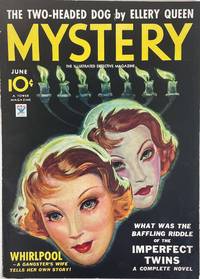
1934rif. 28770Chicago IL: Tower Magazines Inc. 1934. Edge rubs to spine mild wear at the head of the spine panel a nearly fine copy. 28770. Large octavo single issue pictorial wrappers. Fiction by Ellery Queen Francis Beeding Stuart Palmer and others. A large format densely illustrated bedsheet-sized pulp. "The fiction emphasized the woman's point of view was often narrated by a woman and featured as many feminine as masculine detectives. In the rear of the magazine flowered all the usual departments of a more conventional woman's publication . That this magazine would publish much fiction of interest seems improbable. But without effort it contrived to be superb. ILLUSTRATED DETECTIVE selected outstanding writers who had made their mark in the 1920s and mingled these with rising writers of the 1930s. Over the years the magazine would publish work by top names in the mystery field including Ellery Queen Stuart Palmer Sax Rohmer Arnold Kummer Hulbert Footner Vincent Starrett and H. Bedford-Jones. The fiction was polished often strongly compressed and good enough for a large amount of it to appear later between book covers. The magazine appeared monthly for almost six years sixty-nine issues at ten cents a copy. After three years the title was changed to THE MYSTERY MAGAZINE . Covers were tasteful bright and uneventful relying heavily on the faces of self-confident women. Inside was an astonishing amount of material: eight to ten pieces of fiction four or more crime-fact articles and up to ten continuing departments about half of these slanted directly toward women. When the magazine was at its peak in the early 1930s it offered material carefully calculated to appeal to most tastes and both sexes . MYSTERY was as meticulously planned as an orchestral score. Its careful variations played upon every shade of reader interest. It was consciously polished self-consciously feminine. A curious pared sound rang in its fiction as if the stories had been edited with a chain saw but the prose flashed with a bright nickel glitter. Slick the magazine may have been and often over illustrated but it was also considerably interesting and for years excellent." - Cook Mystery Detective and Espionage Magazines pp. 287-90. Tower Magazines, Inc. unknown
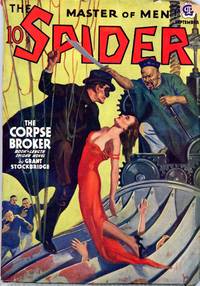
1939rif. 34784Chicago: Popular Publications Inc. 1939. Mild tanning to text paper mild edge wear several tiny tears to upper edge with small chip to right corner several light creases a nearly fine copy. 34784. Octavo single issue cover by John Howitt pictorial wrappers. Pulp magazine. "The Corpse Broker" with Wayne Rogers writing as "Grant Stockbridge." The character was established to be a direct competitor to Street and Smith's Shadow magazine. After Doc Savage and The Shadow this was the most popular hero character. The Spider character was considered one of the most brutal and violent of the pulp era. Reference: Cook Mystery Detective and Espionage Magazines pp. 521-527. Tymm and Ashley Science Fiction Fantasy and Weird Fiction Magazines pp. 602-604. Popular Publications, Inc. unknown
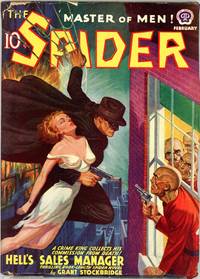
1940rif. 34789Chicago: Popular Publications Inc. 1940. Mild tanning to text paper mild edge wear with several tiny tears shallow small chip to upper left front edge a very good to nearly fine copy. 34789. Octavo single issue cover by Rafael DeSoto pictorial wrappers. Pulp magazine. "Hell's Sales Manager" with Norvell Page writing as "Grant Stockbridge." The character was established to be a direct competitor to Street and Smith's Shadow magazine. After Doc Savage and The Shadow this was the most popular hero character. The Spider character was considered one of the most brutal and violent of the pulp era. Reference: Cook Mystery Detective and Espionage Magazines pp. 521-527. Tymm and Ashley Science Fiction Fantasy and Weird Fiction Magazines pp. 602-604. Popular Publications, Inc. unknown
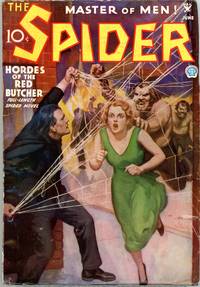
1935rif. 34731Chicago: Popular Publications Inc. 1935. Mild tanning to text paper mild edge wear with small tear to right edge slight trimming color fade at head of spine a nearly fine copy. 34731. Octavo single issue cover by John Howitt pictorial wrappers. Pulp magazine. "Hordes of the Red Butcher" with Norvell Page writing as "Grant Stockbridge." The character was established to be a direct competitor to Street and Smith's Shadow magazine. After Doc Savage and The Shadow this was the most popular hero character. The Spider character was considered one of the most brutal and violent of the pulp era. Reference: Cook Mystery Detective and Espionage Magazines pp. 521-527. Tymm and Ashley Science Fiction Fantasy and Weird Fiction Magazines pp. 602-604. Popular Publications, Inc. unknown
rif. 22152Without date or place. 1p 12mo. On the recto of the first leaf of a bifolium the rest being blank. In good condition lightly aged with a hole on a blank part of the paper at the foot of the first leaf. Neatly written and signed 'C. Cavour'. Cavour begins by taking up an offer by the unnamed recipient by asking him to convey a letter to his rival Massimo Taparelli Marquess of Azeglio 1798-1866 Prime Minister of Sardinia. He hopes that on the recipient's return from London he will employ his pen ' con quell'efficacia che le e propria' in the service of the cause of unification of Italy by writing in the most powerful 'organo de' pubblicita' which has ever existed The Times. He ends with good wishes for the journey. The letter reads: 'Preg. Sig. Approfittando della gentile Sua profferta le mando que' compriegata una lettera pel Marchesa d'Azeglio. Spero che al tuo ritorno da Londra la penna per patrocinare con quell'efficacia che le e propria la causa dell'unificazione d'Italia nel piu potente organo de' pubblicita che abbia mai esistito Le auguro bouon viaggio e le gli atti della distinta mia Stima.' Without date or place. unknown
1803rif. 2108483Paris: Crapelet / chez Maradan 1803. XXXII, 405, (1); (4), 419, (1) Seiten. Mit einer gefalteten Tafel. 8° (19,5 x 13,5 cm). Pappbände der Zeit mit Marmorpapierbezug, goldgeprägtem Titelschild auf den Rücken und gelbgefärbten Schnitten. [Hardcover / fest gebunden].
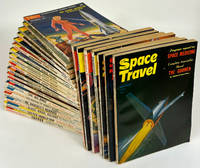
1954rif. 31550Evanston IL: Greenleaf Publishing Company 1954-1958. A nearly fine to fine set. 31550. Small octavo 26 issues pictorial wrappers. Digest magazine. This magazine initial started out with fiction leaning toward the humorous with a note of 'spice' as evidenced by the titillating covers by Harold McCauley over the first seven issues. In the fall of 1956 the magazine moved to more conventional stories. In the waning days of the magazine the editor tried to move to a more serious image with the age of Sputnik and changed the title to Space Travel in which the magazine lasted only three more issues. Authors included Robert Bloch Edmond Hamiltion some pseudonymous Steven Marlowe under pseudonym Robert Silverberg some pseudonymous Randall Garrett A. Bertram Chandler Margeret St. Clair Harlan Ellison and others. Reference: Tymm and Ashley Science Fiction Fantasy and Weird Fiction Magazines pp. 347-350. Greenleaf Publishing Company unknown
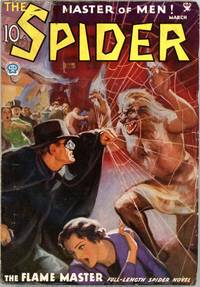
1935rif. 34728Chicago: Popular Publications Inc. 1935. Mild tanning to text paper mild edge wear with some trims small separation at lower left edge a nearly fine copy. 34728. Octavo single issue cover by John Howitt pictorial wrappers. Pulp magazine. "The Flame Master" with Norvell Page writing as "Grant Stockbridge." The character was established to be a direct competitor to Street and Smith's Shadow magazine. After Doc Savage and The Shadow this was the most popular hero character. The Spider character was considered one of the most brutal and violent of the pulp era. Reference: Cook Mystery Detective and Espionage Magazines pp. 521-527. Tymm and Ashley Science Fiction Fantasy and Weird Fiction Magazines pp. 602-604. Popular Publications, Inc. unknown
rif. 018954[Positivisme] Richard Congreve (1818-1899), philosophe anglais, figure de proue du positivisme en Angleterre, à l'origine du schisme en 1878. L.A.S. en français + enveloppe, Wandsworth Londres, 18 Homère 81 [15 février 1869], 4p in-12. Au docteur Jean-François Robinet (1825-1899), médecin d'Auguste Comte et important positiviste français. « Cher et digne ami, Je vous expédie : 1° La lettre Lonchampt. L'accroissement du subside est toujours quelque chose, quoique faible. 2° La pièce que vous me demandez - la protestation. Quant à la lettre de M. Foucart, j'y réfléchirai. Il y en a si peu de nous qui pensent s'engager dans un degré quelconque pour l'avenir. Nous vivons tous presque dans l'incertitude - sur des fonds qui peuvent à tout moment, telle est la vie commerciale, disparaître, en partie du moins. Faites ce que vous pouvez à moins d'être propriétaire ou rentier dans les fonds publics. Là, l'existence est toujours fixée sur un volcan. Mais trouverez-vous les moyens de fonder un journal ? J'aurais préféré quelque chose dans le genre des publications de la rue de Poitiers si je ne me trompe pas de nom, des petites brochures à vils prix, toutes les quinzaines pour un an. Je ne saurais juger votre situation. Evidemment elle est des plus pénibles et des plus anxieuses. Mais il faut se souvenir que si on y avait mis de la bonne volonté, on aurait pu déjà avoir pris connaissance de la doctrine et en avoir tiré les renseignements nécessaires. Je ne pourrais donc que vous souhaiter et de coeur tout le succès possible dans quoi que ce soit que vous entreprendrez. Et si j'avais les moyens pécuniaires, je vous serais utile mais là, quoique mon avis reste toujours le même, nous seront forcément les spectateurs pendant quelques temps encore, nous efforçant toujours d'augmenter le milieu. Je vous quitte. Vous serez peu satisfait mais croyez toujours à ma bonne volonté - sympathie - affection. Richard Congreve ». Joseph Lonchampt (1825-1890), ami de Georges Audiffrent (1832-1909) qui l'initiera à la doctrine positiviste. Lonchampt est un des exécuteurs testamentaires d'Auguste Comte. Jean-Baptiste Foucart (1823-1898) est un avocat et poète. Il est aussi un des exécuteurs testamentaires. Les lettres entre positivistes sont rares. [443]
rif. 018955[Positivisme] Richard Congreve (1818-1899), philosophe anglais, figure de proue du positivisme en Angleterre, à l'origine du schisme en 1878. L.A.S. en français + enveloppe, Wandsworth Londres, 8 Homère 81 [5 février 1869], 2p in-8 & 2p in-12. Au docteur Jean-François Robinet (1825-1899), médecin d'Auguste Comte et important positiviste français. « Cher et digne ami, Pardon du délai en vous remettant le certificat. Il a tenu à la difficulté de trouver immédiatement un témoin compétent. Les conclusions de votre ennemi - dois-je les rendre ou non ? Je les ai provisoirement expédiées à M. Hutton. Je regrette extrêmement l'impasse où pour le moment vous êtes quant au procès de Danton. Et le tableau ne se vend-il pas ? Vous ne me répondez pas à propos de M. Bridges. Certainement nous assisterons aux crises prochaines en spectateur. Tâchons d'exercer une influence modificatrice. Au-delà, il n'est guère rien à espérer mais celle-là nous pouvons l'avoir, nous l'avons même. Pour la Revue Occidentale, je suis toujours contre. Entre les difficultés pécuniaires, il y a la difficulté insurmontable de l'insuffisant nombre des écrivains avec un monde d'une demi-douzaine ou une douzaine au plus, comment faire face à une Revue. Et si vous augmentez votre monde, il y a presque certitude d'assez graves différence d'opinion qui feraient un mauvais effet. Je suis d'avis que la décision de M. Comte est encore pleinement motivée par l'état actuel des affaires et que nous risquerions beaucoup à nous y lancer et que en tout cas, nous perdrions l'avantage qui nous revient de notre abstention complète à l'égard de pareils moyens de propagande. Il serait mieux selon moi que M. [Pierre] Laffitte n'hésitât pas mais se prononçât dans ce sens. A vous et aux vôtres tout ce qu'il y a d'affectueux de notre part. Richard Congreve ». On joint un petit billet (les 2p in-12, daté lundi) : « Vendredi je n'ai pas trouvé l'homme d'affaires que je cherchais. Samedi je me présentai à un de nos juges de première instance. Il n'a pas voulu donner de certification, me recommandant d'aller chez un inspecteur de police. Lui aussi a refusé à moins d'une autorisation de la part du chef de l'administration. Je vous dis cela pour vous montrer qu'il n'a pas tenu à moi que je sois si en retard. Enfin, j'ai résolu de m'en tenir à ce qui serait en tout cas chez nous une attestation formellement légale, espérant que ce qui satisfait à notre loi sera valable en France aussi ». Henry Dix Hutton (1824-1907) est un avocat irlandais. Il sera exécuteur testamentaire d'Auguste Comte. John Henry Bridges (1832-1906) est un médecin anglais, lui aussi exécuteur testamentaire. Les lettres entre positivistes sont rares. [443]
rif. 018968[Positivisme] Richard Congreve (1818-1899), philosophe anglais, figure de proue du positivisme en Angleterre, à l'origine du schisme en 1878. L.A.S. en français, Londres, 28 Shakespeare 96 [6 octobre 1884], 3p Œ in-8. Au docteur Jean-François Robinet (1825-1899), médecin d'Auguste Comte et important positiviste français. « Mon cher Monsieur Robinet, Je regrette votre décision mais comme je crois vous l'avoir dit d'avance, sans en être froissé ! Les lettres Dubuisson ont été imprimées il y a environ deux ans et je me suis décidé enfin à les lui envoyer afin de ne rien cacher. L'impression n'implique aucune publicité. Je ne saurais accepter votre observation que vos lettres fussent écrites sur ma demande pour Madame Congreve. Sauf pour l'entrevue de la rue Madeleine. Elle n'intervient pas dans nos débats d'autrefois. Je vous accorde la pleine autorisation de publier tout ce que vous avez de moi. Je ne vois pas d'incompatibilité où vous la voyez. Il est impossible de faire en sorte que les traces de l'ancien désagrément disparaissent. Mais je pensais que nous pussions jusqu'à un certain degré donner libre cours aux sentiments d'affection personnelle qui nous unissaient et qui nous unissent toujours, je le sens à travers votre [mot illisible]. Il n'entrait pas dans mon projet de reprendre aucune communication relative à notre action respective, si nous pouvions toujours nous parler de la foi que nous partageons. Du reste les débats se rouvrent sans moi et ils nous mèneront loin. Les MM[membres] du Brésil et du Chili ne paraissent pas disposés à accepter le silence. Quoiqu'il en soit, je resterai toujours lié à vous subjectivement par mon passé et actuellement par l'affection que je vous conserve. Tant de souvenirs nous rattachent. Adieu donc. La vie s'en va. Courage toutefois. La grande cause avance. Et nos tristesses ne sont que pour peu de chose. Je n'ajoute qu'un mot. Si vous aviez connaissance de tout ce qui s'est passé ici, vous comprendriez mieux ma manière d'agit. Encore une fois adieu. Richard Congreve ». Paul Dubuisson (1847-1908), médecin, est le gendre du docteur Robinet. On notera que pour le paragraphe mentionnant sa femme, Robinet note en marge « menteur ». Les lettres entre positivistes sont rares. [445]
rif. 018969[Positivisme] Richard Congreve (1818-1899), philosophe anglais, figure de proue du positivisme en Angleterre, à l'origine du schisme en 1878. L.A.S. en français, 24 Frédéric 89 [28 novembre 1877], 3p in-8. Au docteur Jean-François Robinet (1825-1899), médecin d'Auguste Comte et important positiviste français. « Cher et digne ami, Je dois être court - car je suis pressé - à la veille d'un petit voyage. Votre note rectificative m'avait soulagé - mais interprétée de la manière que l'interprète votre lettre d'hier, je me sens moins à mon aise car enfin la confidence tendait à me brouiller avec Sémérie. Pour les autres confidences, soyez rassuré. Elles n'ont fait aucun mal - pas même accentué mon action - car il suffisent largement des jugements non confidentiels que vous portiez sur M. Laffitte. et si vous n'en aviez pas parlé du tout, pensez-vous que ma longue familiarité - mon attention non interrompue à toute sa gestion ne m'auraient pas suffisamment délaissé sur son compte. Aussi ne vous blâmez pas. Et ce passage de la lettre de Sémérie. Je vous ai déjà dit comment je le jugeais. Nous avons discuté lui et moi cette question. Nous différons quant au degré. Nous somme d'accord sur le principe. Nous sommes au clair l'un avec l'autre. Selon moi vous interprétez beaucoup trop sérieusement une phrase qui ne tire pas à conséquence et qui me parait [mot illisible] nullement avec sa conduite générale. La phrase, comment dirais-je, nous disions, donne dans la rhétorique. Et vous vous emportez trop contre son auteur. Reprenons le cale. Rappelez-vous que c'est de 1872 que date ma séparation définitive avec la direction de Paris - qui dans une grave difficulté m'a planté là sans vouloir prendre aucune responsabilité, sans même pendant des mois répondre à mes lettres. Cela m'a suffi comme expérience. Et je comprends à l'heure qu'il est cette faiblesse, pour ne pas dire [mot illisible] de M. Laffitte. Il s'appuie sur certains de ceux qui normalement sont groupés autour de moi et il n'a pas voulu se compromettre ni avec moi, ni avec eux. Je vous engage à méditer l'alinéa indiqué et de me dire catégoriquement si vous ne croyez pas que j'ai raison à un certain degré. Mais je le répète. Reprenons le calme, nos luttes intérieures passeront et même, admettant qu'elles fussent plus graves, que nous pussions, comme j'ai prévenu mon auditoire il y a deux ans, qu'il était assez probable que sous peu nous le serons, dispersés et toute concorde rompue, soyez sûr que nous marcherions toujours. Je me sens plein de confiance, quoique bien peiné par l'action de mes coreligionnaires ici. Et sur le point peut-être de voir disparaître toute union autour de moi. En dehors d'un très minime groupe. Tâchons de refaire l'oeuvre. Mais il s'agit de voir les choses avec sang froid, tant que le jugement est invoqué. Je crois cependant avec peine et sympathie votre agitation. Puisse-t-elle finir bientôt. A vous toujours. Richard Congreve. Je ne tarderai pas à vous rendre ma lettre. Je l'ai déjà commentée ». Eugène Sémérie (1832-1884) était un médecin, positiviste, proche du docteur Robinet. Les lettres entre positivistes sont rares. [446]
Xilografie misure: mm 315 x 415 (foglio oblungo) Scultore, ceramista e incisore italiano. Dopo un anno di studi accademici partì alla volta di Torino per continuare la formazione presso lo scultore Leonardo Bistolfi. Inizialmente affiancò la poetica simbolista del maestro per poi distaccarsene ed entrare nel movimento Novecento. Questo movimento nacque a Milano nel 1922 intorno alla figura di Margherita Sarfatti per volontà di sette artisti i quali, pur venendo da esperienze diverse, desideravano un ritorno all'ordine, superando correnti come il cubismo e il futurismo mediante uno sguardo all'antichità classica. Questo ritorno all'ordine e alla semplicità delle forme è visibile nelle xilografie di Boccolari il quale assorbì la tecnica grazie allo studio sulle xilografie di Adolfo De Carolis. Le sue prime xilografie, di Boccolari, risalgono al 1913 e ad oggi se ne contano circa duecento. Boccolari fu anche un assiduo collaboratore de L'Eroica di Ettore Cozzani e dei Classici del ridere, le celebri edizioni di Angelo Fortunato Formiggini. Le dieci tavole xilografiche fanno parte di un album, intitolato Dall'Alto ispirato all'esempio dell'artista xilografo svizzero Felix Vallotton (Losanna 1865 - Neuilly-sur-Seine1925). L'album è composto da brossura editoriale legata da nastrino e illustrata con xilografia in rosso incisa dall'autore, 31 pagine e dieci illustrazioni protette da veline con numero e titolo. con prefazione di Francesco Sapori. Seconda edizione con due tavole aggiunte rispetto alla prima edizione del 1922. Questi fogli mostrano scene di vita quotidiana, rappresentate attraverso un punto di vista rialzato, come da un moderno drone. L'artista confessa, come scritto nella prefazione di Francesco Sapori, di non voler esprimere nulla di grande o di profondo ma di far corrispondere il contenuto delle stampe ai titoli. Le scene, giocate sul contrasto chiaroscurale, rappresentano la vita di tutti i giorni in chiave teatrale; alcune racchiudono il tema della provincialità altre quello della morte e sono trattate con semplicità nella forma ma con una particolare attenzione per i dettagli. Ottimo stato di conservazione.
rif. 38874Wien [Vienne] Ant. Berka s.d. [premier tiers du XIXe siècle] 8 x 9,5 cm environ en feuille, à tirette, légèrement jauni
MASCELLANI NORMA Bologna 1909 - 2009. Pittrice figurativa ed esperta in arte incisoria fu allieva di Protti, Pizzirani, Morandi e Romagnoli. , , Grande litografia in colore con lumiera e mazzo di fiori. Misura cm 55 x 41,5 alla figura più ampi margini (totale 72 x 60), numerata dall'A. 87/99, firma in basso a destra. Bella e molto raffinata nei delicati colori pastello Buono (Good) .
1926VENTURI ADOLFO Il Correggio. Vienna-Asburgo-Roma, Filser-Alberto Stock 1926, In folio grande (circa 48,5 cm la carta), pp. 609; magnifica leg. in piena pelle bordeaux della ditta Gingler di Roma, con fregi a secco e in oro ai piatti, dorso a cinque nervi con fregi e titoli ai comparti, dentelles all'unghiatura e taglio sup. dorato; astuccio in carta bordeaux. Ediz. tedesca con testo tradotto da W. R. Deusch, es. 233 di 310; contiene 194 grandi tav. in fototipia, curate da Alinari e precedute da veline parlanti (poche mancanti) Buono (Good) .
1788rif. 8866[sans lieu], [sans nom], 1788. In-8 de [2]-310 pages, demi-basane brune, coins en parchemin, dos lisse orné de filets dorés, un mors fendu, coupes un poil frottées.
1927rif. 2111902160201275Nagoya Communications Bureau 1927. Soft Cover. Fine. Volume: 1 Nagoya Communications Bureau paperback
In 8, pp. (XXXII) 354, cart. , 13 tavv. piu' vv. rip. di cui 3 non pertinenti, finalini inc. f.t. RARISSIMA PRIMA EDIZIONE dell'astronomo, matematico e ingegnere idraulico trapanese. Etichetta di coll. Minime fioriture. Ottimo (5746/ GEOMETRIA PIANA - GEOMETRIA EUCLIDEA - TRAPANI - FIRENZE - ASTRONOMIA)
1885rif. 21843Milano, Fratelli Dumolard Editori, 1885. In-4 de VIII-271-[1] pages, couvertures illustrées conservées, demi-maroquin rouge à coins.
1952rif. 27771Philosophical Library NY 1952 HBDJ 1952 1ST EDITION VG/VG DJ light rub wear & tiny chips extremities DJ Protected clear Mylar BROWN CLOTH titled in black on spoine cvr & light top edge chips a terrific downpour drove us for shelter intoa small coffee house inside of which we had never been before we ordered coffee sat down hoping the ran would abate to a drizzle. Presently the proprietor brought us on a Tray 2 cups of Turkish coffee we were both srck by the way he walked as 1 walking barefooted on chips of glass. He said dont you know Pitted Face . 1st Edition. Hardcover. Very Good/Very Good. Philosophical Library NY hardcover