MICHELOT. BRÉMOND.-Livre Rare Book

2 956 résultats
réf. ORD-19732Marseille. Brémond. (1727 - 1732). In-4 oblong (218 x 178 mm) dos vélin ivoire à 5 nerfs, titre manuscrit, plats marbrés, reliure de l'époque un peu râpée et épidermée, contient un titre gravé et 37 planches allant du Plan de la Baye et Rades de Cadix et des Environs au Plan du Port de Trapano et des Isles Favouillane. Fortes rousseurs notamment sur le titre et la première planche, planches suivantes lgt brunies dans les marges mais souvent restées très blanches. Neuf d'entr'elles habilement rehaussées de couleurs. Première feuille de garde rajoutée. Armoiries de E. Gerald Agnew au dos du titre. Assez bon exemplaire bien complet.
1849Very Good Turkish, Ottoman (1500-1928) In contemporary fine black 1/3 leather bdg. Decorated gilt to spine. Roy. 8vo. (23 x 16 cm). In Ottoman script (Old Turkish with Arabic letters). 112 p. Extremely rare first edition of this Nabi's first-hand account of Mecca, Medina and the Hejaz during his pilgrimage in the late 17th century. This is the most celebrated literary pilgrimage narrative written in Ottoman Turkish. Nabi (1642-1712) was one of the prominent Ottoman poets and is considered a foremost exponent of the didactic trend (hikem-i tarz) in Ottoman Turkish literature. Nabi, whose given name was Yusuf, was born in Urfa (then known as Ruha) in 1052/1642. In 1082/1671 he took part in the Ottoman military campaign in Poland, in the retinue of Müsahib Pasha, (1640-1686). Having spent thirteen years in Istanbul, Nabi desired to go on a pilgrimage to Mecca. He was personally ready to undertake a journey to the Hijaz and to set down an eloquent account of his journey, the experience of his lifetime. Accordingly, having achieved a position of good standing with his patrons, Müsahib Mustafa Pasha and Mehmed IV, Nabi revived his longstanding desire to perform the hajj. In 1089/1678, at around 37 years of age, he set out in a small private caravan from Istanbul, passing through Konya, Urfa, Damascus, Jerusalem and Cairo, where he joined the main Egyptian pilgrimage caravan. The work, which is one of the most successful examples of Ottoman insa (artistic prose), includes historical, sociological, geographical and autobiographical information. In his preliminary remarks, Nabi indicates that he had received governmental help for his journey. He relates that he first obtained leave for the hajj from his patron Musahib Mustafa Pasha, and then submitted a qasida to Mehmed IV, describing the sacred places. The sultan provided Nabi a letter of recommendation addressed to Abdurrahman Pasha (d. 1691), governor of Egypt, ordering him to enable Nabi to make a comfortable journey. Nabi traveled in a small private caravan, since the caravan extended its route to Nabi's homeland, Urfa, and spent about fifty days there. It appears that he generally followed the usual route of the pilgrimage caravan from Istanbul to Damascus, passing through Scutari, Kartal, Gebze, Hersek, Iznik, Eskisehir, Seyitgazi, Aksehir, Ilgin, Ladik, Konia, Eregli, Adana, Misis bridge, Payas, Antioche, Aleppo (with a long detour to Urfa (Edessa) and back to Aleppo via Aintab), Hama, Hims and the Kuteyfe strait. He was fascinated with the splendid architecture of the buildings, the bazaars and the mosques built side by side by Kurdish and Circassian rulers and the Nile when he arrived in Cairo. Nabi gives a general description of the city of Cairo, the Nile, the two reservoirs of the city, parklands, the Ahram hills and the immediate neighborhood of the city. In Mecca, Nabi visited the sacred sites enthusiastically and performed the hajj on 77 January 1679. He gives a moving account of his experience as a pious emotional pilgrim. It appears that Nabi stayed in Mecca for more than twenty days. Immediately after 1 Muharrem 1090/12 February 1679, he set out for Medina, presumably in the Damascus caravan. While in Medina, Nabi served at the tomb of the Prophet by lighting the candles since his name was on the honorary list of attendants who were determined by the central government to serve the sanctuaries in Mecca and Medina. Nabi regards these services as a testimony to the legitimacy of Ottoman rule. He summarizes his journey of return from Medina to Damascus and to Istanbul in a few general words. Özege 21267.; Not in OCLC.
1931Very Good Arabic Original brown half leather bindings in Egyptian style, raised six bands to spine, title gilt on the second, volume nos on fourth, and alphabetical with the historical content of the volumes on sixth compartments and "Mahmoud Al-Tawawî" name. Minor foxing on some pages. Overall a very good set. Roy. 8vo. (24 x 17 cm). In Arabic. 14 books are complete set in 7 volumes. Extremely rare first printed edition of the most comprehensive and complete corpus on Baghdad city, which includes Al-Baghdadi's first-hand account of the collection of hadiths, biographies, and his travels in the 11th century Baghdad in traditional "al-râwî" style. Al-Baghdadi is known as a Muslim traveler in the pursuit of knowledge who compiled hadiths and traveled to many Islamic cities. He was born on the 24th ?jumada II, 392 (1002) at Darzidjan, a large village on the west bank of the Tigris below Baghdad. The son of a khatib [i.e. preacher], he began his studies very early and spent his youth traveling in search of ?adith. In this way, he visited Basra, Nishapur, I?fahân, Hamadân, and Damascus. Finally settling in Baghdâd, he held the office of a kha?îb and this was the origin of the name al-Khatîb al-Bag_dadi. After completing his education, he spent more than twenty years of his time writing "Tarikh Baghdad". He finished his corpus in 444 AH [1052-53]. He was a fellow student of Rîsürrüesâ Ibn al-Muslima who was the vizier of the Abbasid caliph Kâim-Biemrillâh. The vizier took Khatib, whom he appreciated in the science of hadith, under his patronage. The Abbasid caliph, therefore, ordered Khatib to be given permission to take hadith lessons from him. Khatib started to narrate hadiths from "Tarikh Baghdad" to his students here in his house near the Nizâmiya Madrasa, on the other hand, he started to read the books for which he had permission to narrate from many teachers, also write the books he planned. Several years after, the Turkish commander Besasiri (?-1060), who was a supporter of the Fatimid Caliph Mustansir-Billâh, entered Baghdad with the encouragement of the Fatimid caliph, deposed the caliph, and killed Ibn al-Muslima. Some members of the Hanbali sect, who had a grudge against Khatib because of what they wrote against some Hanbalis in Tarikh Baghdad, started to disturb him by taking the opportunity to kill the vizier. Therefore, he had to flee to Damascus. In his masterpiece, Khatibi, in addition to his account and descriptions of the city during his time in Baghdad, 7831 figures of people in total who lived or came in Baghdad before 450 (1058), statesmen such as caliphs, viziers, commanders, poets, judges, and other professions. This is an alphabetical work giving information about biographies of these figures, but it starts with the name "Muhammad" referring to the Muslim prophet. The first volume is about the establishment of Baghdad in the pre-Islamic period, its conquest by the Muslims, and its history. This masterpiece of him, published in fourteen volumes, is the most comprehensive corpus written on Baghdad in the Islamic world including the city's topography, history, et alli. Brockelmann, GAL, I, 401; Suppl., I, 563.; H. Gibb, "Islamic Biographical Literature".; F. Rosenthal, A History of Muslim Historiography, Leiden 1968, p. 14, 43. Only one set in OCLC in BnF (Bibliothèque nationale de France): 1198963531.
1855COMPLETE SIX VOLUME SET BOUND IN THREE. RARE elaborate and vast series of detailed lithograph prints of Egypt and the Near East by the eminent Scottish painter David Roberts (1796-1864), which he produced from sketches he had made during long tours of the region (1838-1840). These and his large oil paintings of similar subjects made him a prominent Orientalist painter, and he was elected as a Royal Academician in 1841. [ALL VOLUMES]: 300x220mm. Unpaginated. Half-leather gilt Hardcover with gilt ribbed spine. Text block edges gilt. Marbled endpaper. Cover and spine rubbed and slightly scratched. Cover slightly stained. Cover corners bumped and worn. Cover edges slightly bumped. Spine edges and hinges rubbed. Whitepages and few other pages age-stained. Some pages and plates slightly age-stained (otherwise the plates are in very good condition). Pages slightly yellowing. [VOLS.I-II]: Cover corner and spine upper edge peeling. [VOLS.III-IV]: Two bump-marks on spine rear hinge. [VOLS.III-IV & V-VI]: Front cover somewhat lumpy. [SUMMARY]: This extremely rare precious set of classic 19th-century Orientalist lithographs by the foremost artist in this genre is good condition. PLEASE NOTE: This item is overweight. We may ask for extra shipping costs.
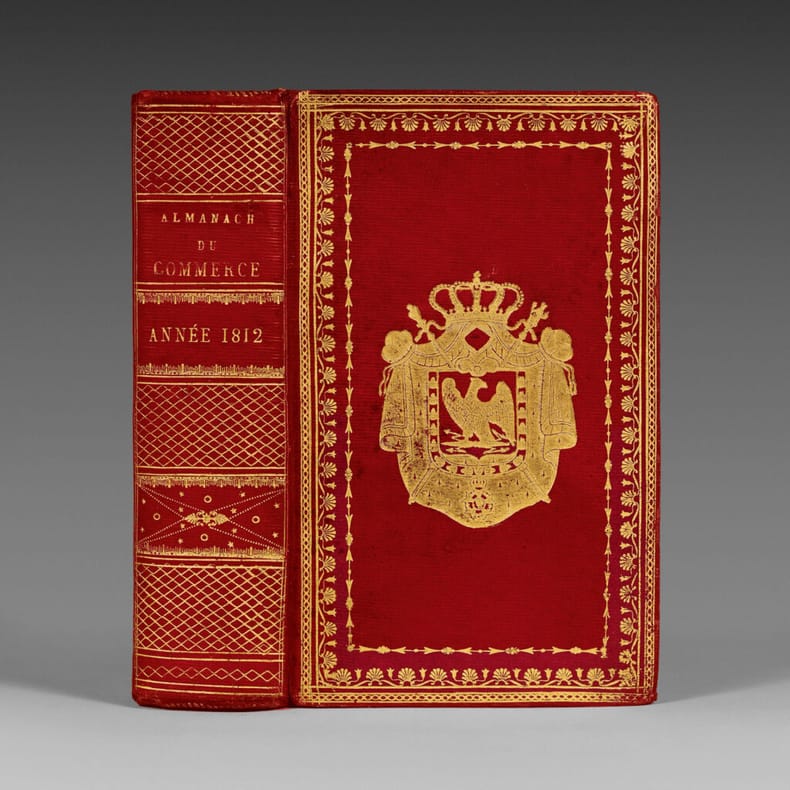
réf. LCS-18198L’Almanach du Commerce pour l’année 1812 relié en maroquin rouge de l’époque aux armes de l’Empereur Napoléon Ier. Paris, chez J. de la Tynna, Propriétaire-Rédacteur, rue J. J. Rousseau, n° 20. In-8 de 1039 pp. Plein maroquin rouge, encadrement de filets et roulette dorés autour des plats, armoiries de l’Empereur Napoléon Ier au centre des plats, dos lisse richement orné, coupes décorées, doublures et gardes de tabis bleu, tranches dorées. Reliure armoriée de l’époque. 211 x 129 mm.