18 063 résultats
1780Paris, Moutard, Panckoucke, 1780. 4to. Extract from ""Mémoires fe Mathematique et de Physique, Présentés à l'Academie des Sciences par divers Savans"", Tome IX. With titlepage to vol. IX. Pp. (2), (167-) 264 and 4 folded engraved plates. The memoir has also its own titlepage. Fine and clean. Wide-margined.
1821London, John Murray, (1821), 1822, 1823. Wirhout wrappers as extracted from ""The Quarterly Journal of Science and the Arts. (The Royal Institution of Great Britain)"", vol. XII a. XV. Half-title and title-page to vol. XII, pp. 74-96 a. pp. 416-421 and 1 engraved plate (showing Faraday's apparatus for illustrating electromagnetic rotation). Title-page to vol. XV. Pp. 288-292. The plate slightly brownspotted.
1878Copenhague, K. Schønberg, 1878. 8vo. Uncut and unopened in the original printed, illustrated wrappers. A very fine copy of this delicate publication. 72 pp. Many text-illustrations throughout.
1679Paris, Thomas Jolly, 1679. Small8vo. (15x9 cm.). Contemp. full sprinckled calf., raisedbands, richly gilt spine. Top of spine a bit worn. Edges of covers gilt. (12),86,(1) pp. Last page ""Extrait du Privilege du Roy"". 34 fine full-page engravings (25 copper-engraved a. 9 in woodcut). A paperflw at foot of titlepage neathly repaired, no loss of paper or letters. Internally clean and fine, printed on thick, good paper.
1864London, Taylor and Francis, 1864. 4to. Extracted and rebound in recent green plain wrappers. In ""Transactions of the Cambridge Philosophical Society, vol. 10"" Title-page of vol. 10 withbound. A fine copy. Pp. (2), (27)-83, (1).
1842Heidelberg, C.F. Winter, 1842. Bound in a nice later hcalf. Raised bands, titlelabel with gilt lettering. In: ""Annalen der Chemie und Pharmacie. herausgegeben von Friedrich Wóhler und Justus Liebig"", Vol. 42. (6),356 pp. Mayer's paper: pp. 233-240. Volume 42 is offered bound together with vol. 41. (8),376 pp. a. 1 folded plate. (This volume contains importent cehemical papers by Kolbe, Cahours, Kopp, Wöhler, Laurent and Liebig (the first printing of Liebig's famous work on animal physiology and pathology)
1913London, 1913 & 1914. 8vo. 2 volumes, uniformly bound with the original wrappers in recent full blue cloth. In ""The London, Edinburgh and Dublin Philosophical Magazine"", Sixth Series, Vol. 26, no. 156, December 1913 & vol. 27, no. 160, April 1914. Lower part of index (pp. 1059-1064) in vol 26 with horisontal repair to lower part, affecting last three line (but legible). A fine and clean set. Moseley's papers: pp. 703-13" pp. 1024-1034. [Entire issues: pp. 937-1064 " pp. 541-756].
1926Leipzig, J.A. Barth, 1926. 8vo. All five paper bound separately in blank blue wrappers. Extracted from In ""Annalen der Physik. Hrsg. von W. Wien und M. Planck., Vierte Folge, Bde. 79-81.""Entire issue 4, 6, 8, 13 and 18 offered. A fine and clean set. [Schrödinger's papers:] Pp. 361-376" Pp. 489-527 " Pp. 734-756 (Bd. 79). Pp. 438-490 (Bd. 60). Pp. 109-131 (Bd. 81).
1820Leipzig, Johann Ambrosius Barth, 1820. Contemporary half calf. Raised bands, gilt spine. Spine slightly rubbed. ""Annalen der Physik. Hrsg. von Ludwig Wilhelm Gilbert"", Bd. 66. Small stamps on verso of title-pages (2) and verso of plates. (12), 426 pp., 1 folded table a. 3 engraved plates. The entire volume offered. Oersted's paper: pp. 295-304. Internally clean and fine.
1820Paris, Crochard, 1820. Contemp. hcalf., raised bands, gilt spine with gilt ettering. Stamps to verso of titlepage and to verso of plates. In ""Annales"". In ""Annales de Chimie et de Physique, Par MM. Gay-Lussac et Arago"" Tome XIV pp. 417-25. Entire volume offered: 448 pp. and 3 folded engraved plates. Fine and clean, printed on good paper.
1879Paris, Aux Bureau du Journal, 1879-88. 4to. Bound in 29 uniform contemp. hcalf. Spines gilt and with gilt lettering.Top of spine on 3 vols. with wear. A nick to spine on 2 vols. 4 vols. with some wear to spines. A few vols. slightly rubbed. Internally fine. More than 14000 pp. Profusely illustrated with fine woodcuts in the text. The work is known for its fine executed illustrations of machinary and apparatus.
1548[fisica- Torrentino] (cm.22,5) legatura recente in piena pergamena antica restaurata, sguardie antiche rimontate. -pp.197, pp3nn. Con avviso al lettore ed errata in fine. Magnifico carattere rotondo, molti passaggi in greco. Edizione originale di un veramente importante trattato, pseudo-aristotelico sui colori attribuito anche a Theoprastus e a Strato Lampsacenus, spesso confuso dai bibliografi con l'altra opera "de coloribus oculorum". Il filosofo napoletano Porzio (1497-1554) fu dottore in medicina e come il suo contemporaneo Pomponazzi tenne lezione all'università di Pisa. Si dedicò alla traduzione di molti saggi sull'argomento scritti da Aristotele, passò poi a meditazioni sulla natura dell'uomo, sul meterialismo e negò l'immortalità sotto ogni forma. Esemplare molto bello, nitidissimo e marginoso. Solo vecchia integrazione all'angolo interno del frontis e alcuni tarli ben restaurati all'angolo di poche carte interne, quasi invisibili. * Moreni (Torrentino) p.25; * Crans "bibliogr. of Aristotle" 108.139; * Wellcome I 5217; * Hoffmann I 289; * Bm.Stc. 54; * Adams P 1958.[f30] Libro
1820réf. 41350Paris, Crochard, 1820. 8vo. Without wrappers, as extracted from ""Annales de Chimie et de Physique"", Volume 15, pp. 59-76 and pp.170-218. Five engraved plates accompanying the memoires showing the experimental equipments. Half-title and title-page to volume 15 present.
1825réf. 43749Paris, Crochard, 1825. 8vo. 2 contemporary half calfs w. richly gilt spines. Light wear at top of spines. Minor scratches to upper compartments of spines. Small stamps on verso of title-pages and verso of plates. In: ""Annales de Chimie et de Physique, Par MM. Gay-Lussac et Arago."", tome 29 a. 30. - 448 pp. and 3 folded engraved plates + 448 pp. and 2 folded engraved plates. (The entire volumes offered). Ampère's papers: pp. 381-404 (tome 29) + Suite pp. 29-41 (tome 30) + ""Lettre à Gerhardi"": pp. 373-381 (tome 29). Clean and fine throughout.
1780réf. 44921Paris, Moutard, Panckoucke, 1780. 4to. Extract from ""Mémoires fe Mathematique et de Physique, Présentés à l'Academie des Sciences par divers Savans"", Tome IX. With titlepage to vol. IX. Pp. (2), (167-) 264 and 4 folded engraved plates. The memoir has also its own titlepage. Fine and clean. Wide-margined.
1821réf. 43731London, John Murray, (1821), 1822, 1823. Wirhout wrappers as extracted from ""The Quarterly Journal of Science and the Arts. (The Royal Institution of Great Britain)"", vol. XII a. XV. Half-title and title-page to vol. XII, pp. 74-96 a. pp. 416-421 and 1 engraved plate (showing Faraday's apparatus for illustrating electromagnetic rotation). Title-page to vol. XV. Pp. 288-292. The plate slightly brownspotted.
1842réf. 46883Heidelberg, C.F. Winter, 1842. Bound in a nice later hcalf. Raised bands, titlelabel with gilt lettering. In: ""Annalen der Chemie und Pharmacie. herausgegeben von Friedrich Wóhler und Justus Liebig"", Vol. 42. (6),356 pp. Mayer's paper: pp. 233-240. Volume 42 is offered bound together with vol. 41. (8),376 pp. a. 1 folded plate. (This volume contains importent cehemical papers by Kolbe, Cahours, Kopp, Wöhler, Laurent and Liebig (the first printing of Liebig's famous work on animal physiology and pathology)
1926réf. 57200Leipzig, J.A. Barth, 1926. 8vo. All five paper bound separately in blank blue wrappers. Extracted from In ""Annalen der Physik. Hrsg. von W. Wien und M. Planck., Vierte Folge, Bde. 79-81.""Entire issue 4, 6, 8, 13 and 18 offered. A fine and clean set. [Schrödinger's papers:] Pp. 361-376" Pp. 489-527" Pp. 734-756 (Bd. 79). Pp. 438-490 (Bd. 60). Pp. 109-131 (Bd. 81).
1820réf. 43416Leipzig, Johann Ambrosius Barth, 1820. Contemporary half calf. Raised bands, gilt spine. Spine slightly rubbed. ""Annalen der Physik. Hrsg. von Ludwig Wilhelm Gilbert"", Bd. 66. Small stamps on verso of title-pages (2) and verso of plates. (12), 426 pp., 1 folded table a. 3 engraved plates. The entire volume offered. Oersted's paper: pp. 295-304. Internally clean and fine.
1879réf. 43501Paris, Aux Bureau du Journal, 1879-88. 4to. Bound in 29 uniform contemp. hcalf. Spines gilt and with gilt lettering.Top of spine on 3 vols. with wear. A nick to spine on 2 vols. 4 vols. with some wear to spines. A few vols. slightly rubbed. Internally fine. More than 14000 pp. Profusely illustrated with fine woodcuts in the text. The work is known for its fine executed illustrations of machinary and apparatus.
17612 Volumi in folio piccolo (mm270x210) pp. XII, 335, (1), e 10 tavole ripiegate f.t; pp. (4), 376, e 10tavole ripiegate f.t; belle ed uniformi legature in piena pelle bazzana, titolo oro su tassello e fregi al dorso a 4 nervi. Frontespizi stampati in rosso e nero con vignetta incisa da Giuseppe Patrini e disegnata da Benigno Bossi. Rara edizione originale adorna di 20 tavole ripiegate f.t incise in rame raffiguranti figure geometriche. Fondamentale opera del Belgrado che insieme al Grandi, Manfredi e Riccati, nella prima metà del secolo, aveva portato in Italia i metodi infinitesimali di Newton e di Leibniz, ridestando l'interesse per la geometria e per l'analisi. Per applicare l'analisi alla fisica si richiedono tre condizioni: definire le quantità delle masse, dei volumi e delle densità. L'opera tratta di: problemi di idraulica, statica, astronomia, ottica, balistica, "centrobaryca", fisica dei gas, architettura, meteorologia, igrometria, "de motu uniformi, et accelerato", "de pendulis", "de corporum collisione", "de cohaerentia corporum", acustica, nautica, geografia, "gnomonica", forze centripete e centrifughe, comunicazione dei moti, resistenza dei corpi, analisi infinitesimale. Esemplare in perfetto stato di conservazione, marginoso impresso su carta forte. . .
1737in-4 (mm.215x155), pp. (1), XI, 300, (2), 1 cb, belliss. leg. m. pelle rossa coeva con tass., fregi e tit. oro al d., piatti in carta dec. "remondiniana". Belliss. antip. inc. in rame da Marco Pitteri su dis. di G.B. Piazzetta raffigurante una dama e un cavaliere. Testat. e final. xilogr. L'A., (Venezia 1712 - Pisa 1764) attraverso le teorie del Newton, espone le famose ipotesi sulla natura della luce e dei colori. Questa è l'opera che per prima diede celebrità all'A.: in forma di dialoghi con la Marchesa di E.... (Emilie du Chatelet), al fine di convertirla dalle opinioni cartesiane alle verità di Newton, vero continuatore della scienza galileiana. L'ultimo dialogo riguarda la forza gravitazionale. L'Algarotti affiancò nei sui studi di fisica newtoniana, in particolare di ottica, la famosa scienziata italiana Laura Bassi ricordata anche come la prima donna laureata presso l'Università di Bologna nel 1732. La semplificazione del linguaggio scientifico, non pedantesca e appositamente voluta dall'Algarotti, gli produsse le critiche di altri colleghi ma di fatto quest'opera risponde al bisogno del tempo e testimonia la volontà degli ambienti femminili di accedere a quei settori del sapere che per anni erano stati di esclusività degli scienziati uomini. L'opera ebbe comunque un grandissimo successo e fu presto tradotta e diffusa in tutta Europa. Prima rariss. ediz. da non confondere con quella pirata del medesimo anno che però reca XII pagine numerate romane di prefazione anzichè XI, e la tav. in antip. reincisa da G. Filosi. Morazzoni 212. Biancardi Francese, p.23. Parenti, Falsi luoghi, p. 148. Sconosciuta a Riccardi. Freschiss. esempl. a larghi margini. [047]
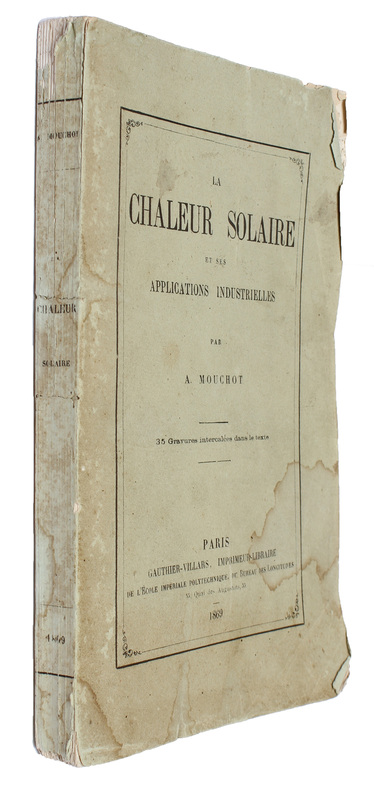
1869Paris, 1869. 8vo. Uncut in the original printed wrappers. Wrappers frayed at edges, a bit soiled, and with some stains. A bit of brownspotting. Last leaves with a, mostly marginal, damp stain. First few leaves a bit frayed at edges. VII, (1), 238 pp. Illustrated.
1869réf. 49338Paris, 1869. 8vo. Uncut in the original printed wrappers. Wrappers frayed at edges, a bit soiled, and with some stains. A bit of brownspotting. Last leaves with a, mostly marginal, damp stain. First few leaves a bit frayed at edges. VII, (1), 238 pp. Illustrated.
1913réf. 032015London: Macmillan And Co 1913. First English Language Edition 1st Printing. Hardcover. Very Good. Xiv 1 219 Pp 4 Pp Ads At Rear. Blue Cloth Gilt And Blindstamped. Seven Line Inscription And Signature Of Zeeman Dated In December 1924 To Alfred Lande. Light Rubbing At Corners And Front Spine Edge Gilt All Present But Not Brilliant Very Faint Dampstaining In Upper Right Third Of Front Cover And Small Area In Upper Corner Of Rear Cover But No Trace On Contents; Otherwise Clean No Fading To Cloth. From Wikipedia: Alfred Landé 1888 -1976 Was A German-American Physicist Known For His Contributions To Quantum Theory. In 1913 Landé Was Sent By Arnold Sommerfeld His Thesis Advisor At The University Of Munich To Be A Special Assistant For Physics To David Hilbert At The University Of Göttingen To Replace Paul Peter Ewald Whom Sommerfeld Had Sent To The Same Position In 1912. Landé Obtained His Doctorate Under Sommerfeld At The University Of Munich Two Weeks Prior To The Start Of The First World War. He Joined The Red Cross And Served For Two Years On The Eastern Front Before Being Invited By Max Born To Join Him At The Artillery Testing Commission One Of The Few Scientific Sections Of The Army. Apart From Their Work On Artillery Location By Sound Ranging They Began To Examine The Cohesive Forces And Compressibility Of Crystals. This Work Led To The Unexpected Result That The Electron Trajectories In Atoms Were Not At All Like Planetary Orbits Which At The Time Was The Usual Understanding Of The Electron In An Atom. Landé Studied Atomic Structure Intensively For The Next Seven Years. In 1916 Sommerfeld Had Begun To Apply The New Atomic Theory To Form A General Quantization Rule. In 1919 Landé Unexpectedly Turned To Spectroscopy Even Though The Continuation Of The Study Of The Spatial Orientation Of The Atoms Was The Most Pressing Problem Of The Time. He Turned To The Problem Of Atoms With Several Electrons In Particular To The Simplest Case The Spectrum Of Helium. The Spectrum Showed Non-Combining Single And Double Actually Triplet As It Turned Out Later Terms So That It Seemed As If Helium Was Made Of Two Different Substances Which Is Explained Today As The Result Of Electron Spin. Landé's Work Contained Several New Important Ideas Including The Rule Of Vector Addition Of Two Quantum-Mechanical Angular Momenta J1 And J2. His Findings And Postulates Were Later Confirmed By Quantum Theory. Landé's Frankfurt Investigations December 1920 Until April 1921 Ended With The Discovery Of The Well-Known Landé G-Formula And An Explanation For The Anomalous Zeeman Effect. The Landé G-Factor Is Now Defined Through Mj The Magnetic Quantum Number. In 1923 Landé Stated The Landé Interval Rule A Rule Dealing With The Relation Between An Electron's Spin And Orbit. Landé Was A Forerunner In A Phase Of New Interpretation Of Quantum Theory From Which Concrete Physical Statements About Experimentally Verifiable Facts Can Be Made. This Happened After The First Phase Of The Interpretation Of The Theory With Well-Known Discussions Between Niels Bohr Werner Heisenberg And Wolfgang Pauli Who Favoured The Copenhagen Interpretation Opposed In Varying Degrees By Erwin Schrödinger Louis De Broglie And Most Notably Albert Einstein. After 1950 And For The Rest Of His Life Landé Turned Energetically Against The Copenhagen Interpretation Of Quantum Theory Requiring As Did Einstein An Objectively Real Description Of Physical Processes. This Change Was Driven By Landé's Perception That Wave-Particle Duality Was An Unnecessary Misrepresentation Of Quantum Processes That He Explained By Developing A New Unitary Particle Formulation Without Dualistic Reference To Waves. Landé Based His New Formulation Upon Non-Quantal Principles Of Symmetry And Invariance With Duane's Rule For Quantisation Of Momentum Exchange With Space-Periodic Structures And Leibniz's Principle Of Cause-Effect Continuity To Explain The Intrinsically Probabilistic Nature Of Quantum Processes. His Interpretation Is Considered A Minority Interpretation. Macmillan And Co hardcover