20.368 Ergebnisse
1927Best.-Nr. 47023London, Harrison And Sons, Ltd., 1927. Royal8vo. Contemp. full cloth. A small stamp on verso of titlepage. In: ""Proceedings of the Royal Society of London"", Series A, Vol. 114. VI,IX,748 pp. (entire volume offered). Dirac's papers: pp. 243-265 a. pp. 710-728. Clean and fine.
1960Best.-Nr. 59846(London), 1960. Folio. Loose leaves in original cloth portfolio and slipcase. Gilt lettering to spine. Mimeographed typescript, printed on one side only. Ca. 400 unnumbered leaves.
1834Best.-Nr. 42246(London, Richard Taylor, 1834). 4to. No wrappers as extracted from ""Philosophical Transactions"" 1834 - Part I. Pp. 77-122. Fine and clean.
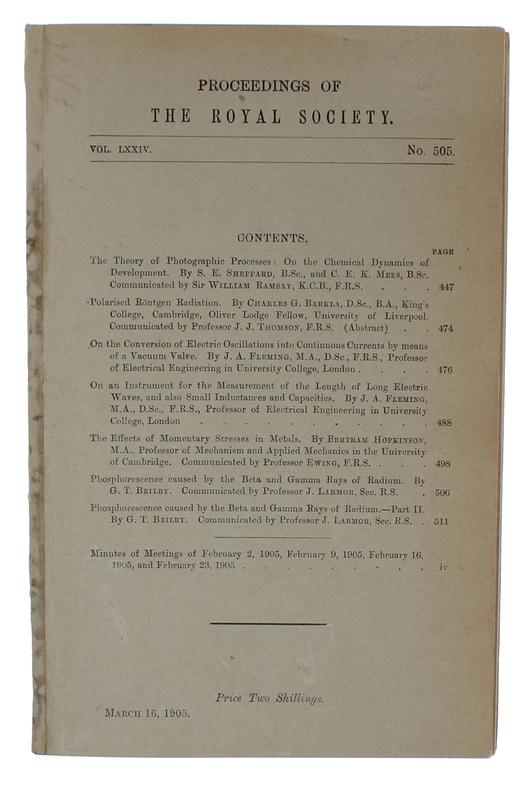
1905Best.-Nr. 59850London, Harrison and Sons, 1905. 8vo. In the original printed wrappers. In ""Proceedings of the Royal Society of London"", vol. 74, No. 505. With new paper back-strip (presumably after having been extracted from a binding). Ex-libris (""Alan. A. C. Swinton"") pasted on to verso of title-page. Internally fine and clean. Pp. 476-487"" pp. 488-498. [Entire volume: Pp. (2), 447-518].
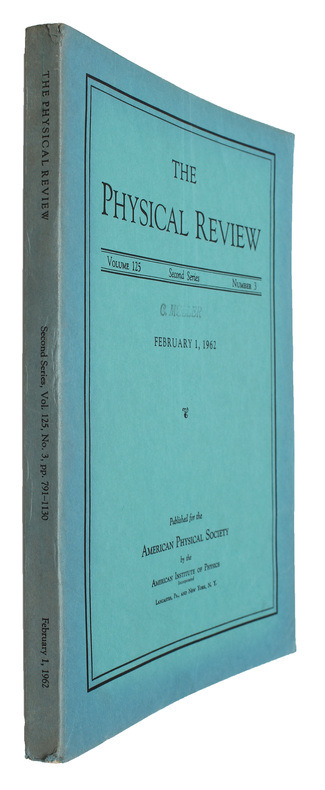
1962Best.-Nr. 49652Lancaster, PA and New York, American Institute of Physics, 1962. Royal8vo. In the original blue printed wrappers. In ""The Physical Review"", vol. 125, second series, Number 3, February 1, 1962. With previous owner's small stamp (Danish physicist C. Møller) to front wrapper. Light wear to extremities, otherwise a fine and clean copy. Pp. 1067-1084.
1902Best.-Nr. 52166[Leipzig, Hirzel, 1902]. Royal8vo, [275 x 195 mm]. Without wrappers, as issued. Offprint from ""Physikalische Zeitschrift"", 3. Jahrgang, No. 10. Pp. 210-214. With ""Ueberreicht vom Verfasser"" printed in top right corner of first leaf. Small blue gummed labels (from the library of Becquerel) pasted to top of first leaf. First leaf with brownspotting in inner margin. Traces after having been folded hjorizontally, otherwise fine.
1732Best.-Nr. 46579Paris, L'Imprimerie Royale, 1732. 4to. Without wrappers. Extracted from ""Mémoires de l'Academie des Sciences. Année 1730"". Pp. 452-507 a. 1 folded engraved plate. With titlepage to Année 1730/1732. Titlepage with small tears to margins. Clean and fine.
1744Best.-Nr. 51381Leipzig, Breitkop, 1744. (+) Leipzig, Breitkop, 1745. (+) Halle, Hemmerde, 1745. 8vo. Bound in one contemp. hcalf. raised bands. A paperlabel pasted on top of spine. Stamps on the first title-page. An old name erased from title-page leaving a small hole, no loss of letters. (32),168 pp. - (28),164 pp. and 7 (numb. I-VII, the first 3 belongs to the first work, 4 to the second) folded engraved plates, referring to both works !) - 62 pp. a. 1 engraved plate. Internally clean, printed on good paper.
1896Best.-Nr. 46978London, Macmillan & Co, 1896-97. Royal8vo. Bound in contemporary half calf with gilt lettering to spine. In ""Nature"", Vol. 55, November 1896 - April 1897. Bookplates to front free end-papers and library stamp to title page. Minor wear to extremities, otherwise very fine and clean. P. 347. [Entire volume: XL, 624 pp.].
1800Best.-Nr. 14061Paris, Libr. Économique, An VIII (1800). 4to. 3 fine cont. hcalf, richly gilt backs. Coloured title-and tomelabels. Very slight fraying at top of spines. XII,506-(4),491 pp. and platevolume with 90 fine engraved plates. Printed on good paper.
1727Best.-Nr. 47078Halle im Magdeburgischen, Rengerischen Buchhandlung, 1727-29. 8vo. Bound in 3 contemp. full vellum. One corner a bit bumped. Backcover on vol. 2 with a small loss of vellum at front edge. 3 engraved frontispieces. Titlepages printed in red/black. (14),599,(9)(14),568,(8)(14),624,(8) pp. and 49 folded engraved plates with many figs each (17 + 14 + 18). One plate in vol. 2 with a minor loss in upper right corner, affecting 1 figure. On foot of forst titlepage a stamp (Greve Scheel). Internally fine.
Best.-Nr. SONG0198526784Used: Good unknown
Best.-Nr. DADAX0471051578New unknown
Settecentina, Eclaircissemens sur l'Analyse des Infiniment Petits par M. Varignon Chez Rollin, Paris 1725, cm 24x18, pp. [8]-118-[2] con qualche capolettera e fregio incisi in b/n, più 6 belle tavv. inc. in b/n e rip. al termine del testo, le quali contengono in totale 40 figure (vedi foto), gradevole legatura d'epoca in piena pergamena muta, tagli colorati a spruzzo. Rarissima prima edizione del 1725, completa delle sei tavole in b/n. Testo in francese. Condizioni di conservazione Esemplare in buone condizioni con tracce d'uso e leggeri segni del tempo, alcune leggere bruniture, alla coperta alcune piccole marginali macchiette e qualche lieve alone. Un paio di minuscoli poco visibili forellini (vecchi danni da insetto) che interessano la totalità dell'esemplare ma che non comportano perdite di testo. Interni buoni, marginosi, ben conservati, angolo superiore destro delle tavv. 3-6 con una leggera gora che non interessa o non compromette le immagini (vedi foto). Rarissima prima edizione del 1725 di questo importante testo sul calcolo infinitesimale. L’autore fu tra i primi in Francia a comprendere l’importanza dell’analisi infinitesimale. Testo importante sia per il tema trattato che per la storia della matematica. Opera completa delle sei tavole in b/n. Testo in francese. SETT221.L21422 N
Settecentina, Gli elementi teorico - pratici delle matematiche pure del padre Odoardo Gherli domenicano professore di Teologia Dogmatica nell'Università di Modena resi pubblici da Domenico Pollera tomi I - VII - opera completa in sette tomi Nella Stamperia di Giovanni Montanari - Presso la Soc. Tipografica, Modena 1770-1777, cm 27,5x20,5, pp. XXIV-358, più 1 tavv. in b/n rip. al termine del testo (tomo I), pp. XIV-448, con 5 tavv. in b/n rip. fuori t. (tomo II), pp. XII-312-114 (tavole dei logaritmi, dei seni, dei coseni), più 10 tavv. in b/n rip. al termine del testo (tomo III), pp. XII-404 più 15 tavv. inc. in b/n rip. al termine del testo (vol. IV), pp. [8]-380 più 4 tavv. inc. in b/n rip. al termine del testo (vol. V), pp. VIII-392 più 4 tavv. inc. in b/n rip. al termine del testo (vol. VI), pp. XL-440, più 3 tavv. inc. in b/n rip. al termine del testo (vol. VII), pregevole legatura d'epoca in mezza pelle con itolo e fregi floreali impressi in oro al dorso (titolo e numerazione del tomo entro tassello), piatti marmorizzati, tagli rossi. Opera completa in 7 tomi, molto rara. Condizioni di conservazione Tomi tutti complessivamente ben conservati con tracce d'uso e leggeri segni del tempo, coperte con alcune leggere abrasioni e mancanze per lo più marginali, dorsi con pochi minuscoli forellini (vecchi danni da insetto), dorso del tomo I e cuffie dei tomi II, III e VI con piccole mancanze. Interni buoni con leggero foxing, alcune pagine con leggera / lieve ombra di gora, le quali non compromettono la lettura del testo. Per maggiori dettagli vedi foto. Opera matematica molto rara, completa in 7 tomi. SETT132.L22391 N
1967Best.-Nr. 178468Cambridge, The University Press, 1938-1967. 3 OBr. Rest sind Bibliotheksbde. m. Rsign. u. St. a. mehr. S. Bibl.-Tekt. a. Vorsatz u. Innendeckel. Einbde. bestoßen. Bindg. teilw. gelockert. Es fehlen: Vol. 78/5 (S. 785-1082).
Best.-Nr. 713P., Jombert, 1775, 2 volumes in 8 reliés en plein veau marbré, dos ornés de fers dorés, étiquettes rouges, tranches rouges (reliures de l'époque), (quelques rousseurs, 2 coins légèrement émoussés), T.1 : (1), 37pp., 396pp., T.2 : (1), 444pp., 16 planches dépliantes numérotées 1 à 9 et 1 à 7
1671Cm. 20,5, pp. (12) 76. Con vari fregi xilografici nel testo (di cui due a piena pagina) ed una tavola f.t. con 10 figure incise in rame. Bella legatura coeva in piena pergamena semifloscia con decorazioni e fregi in oro. Un ininfluente tarletto marginale, peraltro esemplare genuino e ben conservato, stampato su carta forte. Prima ed unica edizione di quest'operetta di Geminiano Montanari (Modena 1633 - Padua 1687) nata da una disputa con Donato Rossetti, seguace di Galilei, il quale aveva pubblicato uno scritto sullo stesso soggetto poco tempo prima. Montanari fu parte del gruppo di scienziati emiliani che si distinsero nel Seicento, assieme a Cassini e Malpighi. Il libro è scritto in forma di due epistole indirizzate al Granduca di Toscana ed al patrizio veneto Girolamo Savorgnano. La seconda lettera contiene anche le considerazioni del Redi. Cfr, Riccardi I/2, 171-172: "Raro" e Piantanida (1588): "Raro opuscolo".
1784Best.-Nr. 21819Paris Gueffier 1784 -in-8 plein-veau 2 volumes, reliure plein veau havane raçiné in-octavo (binding full calfskin in-8) (20,6 x 13,2 cm), Reliure d'Epoque, dos à nerfs (spine with raised bands), décoration or et à froid (gilt and blind stamping decoration), titre et tomaison frappés or (gilt title and volume numbering), pièce de titre et de tomaison sur fond bordeaux avec filet "or" et filet perlé "or" en encadrement, roulette "or" en place des nerfs avec un filet à froid de part et d'autre des nerfs avec legers manques de dorure, entre nerfs à fleuron "or" dans un encadrement à filet "or" et filet perlé "or" avec rinceaux "or" aux angles, roulette "or" en tête et en pied, dos légèrement frotté, plats ornés d'un filet à froid en encadrement, filet "or" sur les coupes avec manques de dorure, toutes tranches lisses rouges, orné de 25 planches dépliantes hors-texte gravées sur bois en noir par Borgnet in-fine du Tome I + 28 planches dépliantes hors-texte gravées sur bois en noir par Borgnet in-fine du Tome II , restauration ancienne aux mors haut et bas du tome II, (XVI + 396 + [25] p. de planches dépliantes) + (474 + [2] + XXVIII p. de planches dépliantes) pages Avec approbation, & privilége du Roi, 1784 A Paris, chez Gueffier, imprimeur, rue de la Harpe Editeur,
Best.-Nr. 8078P., Pissot, 1725, un volume in 4 relié en plein veau moucheté, dos orné de fers dorés, tranches rouges (reliure de l'époque), (coiffes légèrement usées), (8), 128pp., 5 PLANCHES DEPLIANTES
1969Best.-Nr. PH-341Boulder CO.: Golem Press 1969. Classic highly-acclaimed treatise on the Wiener-Hopf technique as applied to waveguides antennas and electromagnetic wave propagation. Weinstein was the first to generalize the Wiener-Hopf method for application to open-ended waveguides and related problems. Part I contains topics covering the diffraction of electromagnetic and acoustic waves at the open end of plane-parallel and circular waveguides including the author's rigorous solutions. Part II contains topics covering a wide variety of diffraction and propagation problems such as axial resonators; noncontacting plungers; corrugated structures; gratings; diaphrams in waveguides; finitely conducting structures; surface waves; shore refraction; sheath helixes; radiation; etc. 411 pgs. Illustrated. This edition has been Corrected and Updated by the author with respect to the original Russian edition published in 1966. Dustjacket price-clipped on lower front flap; very minimal rubbing to edges; in mylar. Very minimal shelfwear to text; upper corners slightly bumped. Scarce. First English Edition. Hard Cover. Fine/Fine. 8vo - over 7¾" - 9¾" tall. Golem Press Hardcover
Best.-Nr. 059841Joseph Henry Laboratories Princeton Unibversity 1975. 1st Edition . Soft cover. Fine. I 538-605 Pp. Offprint In Card Covers With Cutout Front Cover Black Binding. Near Fine Slight Aging To Covers. Inscribed By Wheeler To Adolf Grunebaum. Per Wikipedia Adolf Grünbaum 1923 - 2018 Was A German-American Philosopher Of Science And A Critic Of Both Psychoanalysis And Karl Popper's Philosophy Of Science. He Was The First Andrew Mellon Professor Of Philosophy At The University Of Pittsburgh From 1960 Until His Death And Also Served As Co-Chairman Of Its Center For Philosophy Of Science From 1978 Research Professor Of Psychiatry From 1979 And Primary Research Professor In The Department Of History And Philosophy Of Science From 2006. His Works Include Philosophical Problems Of Space And Time 1963 The Foundations Of Psychoanalysis 1984 And Validation In The Clinical Theory Of Psychoanalysis 1993. Joseph Henry Laboratories, Princeton Unibversity paperback
1998Best.-Nr. 056212New York: W. W. Norton & Company 1998. 1st Edition 1st Printing. Hardcover. Near Fine/Fine. 380 Pp. Black Boards Gilt. First Printing Indicated. Signed By John Archibald Wheeler. Near Fine No Wear But Foxing Along Top Edge And Fore Edge Of Page Block In Fine Dust Jacket "Signed Copy" Sticker On Front Panel Priced $27.95. W. W. Norton & Company hardcover
1998Best.-Nr. 046940New York: W. W. Norton & Company 1998. 1st Edition 1st Printing. Hardcover. Fine/Fine. 380 Pp. Black Boards Gilt. First Printing Indicated. Inscribed On The Half Title Page By John Archibald Wheeler. Fine In Fine Dust Jacket Priced $27.95. W. W. Norton & Company hardcover
1950Best.-Nr. 046939American Physical Society / American Institute Of Physics 1950. 1st Edition . Hardcover. Near Fine. 422 Pp. Annual Volume 1950 Bound With Green Morocco Spine And Tips No Wrapers. Patterned Boards Speckled Edges Gilt Title On Spine. Near Fine No Wear Immaculate Gilt Brilliant "Hauptbucherel" Stamp And Circular Ownership Stamp In Ludwigshafen On Title Page Vertical Crease On Title Page Else Fine. Chien-Shiung Wu Chinese: ; 1912 - 1997 Was A Chinese-American Particle And Experimental Physicist Who Made Significant Contributions In The Field Of Nuclear And Particle Physics. Wu Worked On The Manhattan Project Where She Helped Develop The Process For Separating Uranium Into Uranium-235 And Uranium-238 Isotopes By Gaseous Diffusion. She Is Best Known For Conducting The Wu Experiment Which Proved That Parity Is Not Conserved. This Discovery Resulted In Her Colleagues Tsung-Dao Lee And Chen-Ning Yang Winning The 1957 Nobel Prize In Physics While Wu Herself Was Awarded The Inaugural Wolf Prize In Physics In 1978. Her Expertise In Experimental Physics Evoked Comparisons To Marie Curie. Her Nicknames Include The "First Lady Of Physics" The "Chinese Madame Curie" And The "Queen Of Nuclear Research". In September 1944 Wu Was Contacted By The Manhattan District Engineer Colonel Kenneth Nichols. Wu Was Frustrated With Her Lack Of Professorships And Volunteered To Help Out In The Project. The Newly Commissioned B Reactor The First Practical Nuclear Reactor Ever Built Which Was Located At The Hanford Site Had Run Into An Unexpected Problem Starting Up And Shutting Down At Regular Intervals. John Archibald Wheeler And Partner Enrico Fermi Suspected That A Fission Product Xe-135 With A Half-Life Of 9.4 Hours Was The Culprit And Might Be A Neutron Poison Or Absorber. Segrè Then Remembered The 1940 Phd Thesis That Wu Had Done For Him At Berkeley On The Radioactive Isotopes Of Xe And Told Fermi To "Ask Ms. Wu". After Fermi Contacted Wu Segrè Visited Her Dorm Room Together With Nichols And Collected The Typewritten Draft Prepared For The Physical Review. The Suspicions Of Fermi And Wheeler Came True Wu's Paper Unknowingly Verified That Xe-135 Was Indeed The Culprit For The B Reactor; It Turned Out To Have An Unexpectedly Large Neutron Absorption Cross-Section. Wu Also Used Her Findings In Radioactive Uranium Separation To Build The Standard Model For Producing Enriched Uranium To Fuel The Atomic Bombs At The Oak Ridge Tennessee Facility As Well As Build Innovative Geiger Counters. Wu Like Most Involved Physicists In Their Later Years Distanced Herself From The Manhattan Project Due To Its Destructive Outcome And Recommended To The Taiwanese President Chiang Kai-Shek In 1962 To Never Build Nuclear Weapons. In November 1949 Wu Experimented With The Conclusions Of Einstein's Epr Thought Experiment Which Called Quantum Entanglement "Spooky Action At A Distance". Wu Managed To Be The First To Establish The Phenomenon And Validity Of Entanglement Using Photons Through Observing Angular Correlation. Specifically The Experiment Carried Out By Wu Was The First Important Confirmation Of Quantum Results Relevant To A Pair Of Entangled Photons As Applicable To The Einstein-Podolsky-Rosen Epr Paradox. In Her Post-War Research Wu Continued To Investigate Beta Decay. In 1949 Wu Completely Established Fermi's Theory And Showed How Beta Decay Worked Especially In Creating Electrons Neutrinos And Positrons.At Columbia Wu Knew The Chinese-Born Theoretical Physicist Tsung-Dao Lee Personally. In The Mid-1950S Lee And Another Chinese Theoretical Physicist Chen Ning Yang Grew To Question A Hypothetical Law Of Elementary Particle Physics The "Law Of Conservation Of Parity". The Discovery Of Parity Violation Was A Major Contribution To Particle Physics And The Development Of The Standard Model. The Discovery Actually Set The Stage For The Development Of The Model As The Model Relied On The Idea Of Symmetry Of Particles And Forces And How Particles Can Sometimes Break That Symmetry. See The Much Longer Wikipedia Article. American Physical Society / American Institute Of Physics hardcover