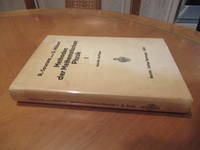
Torretti, RobertoBiblio.com

20.368 Ergebnisse
1983Best.-Nr. 056635U.S.A.: Pergamon Press 1984 1983. 1st Edition 2nd Printing. Hardcover. Fine/No Jacket. Xi 395 Pp. Green Cloth Stamped In White And Grey. First Edition Second Printing 1984. Technical Discussion With Philosophical Viewpoint. Excellent Bibliography At End. Fine No Wear. Pergamon Press (1984) hardcover
1941Best.-Nr. 055998Cambridge: Harvard University Press 1941. First Edition 1st Printing. Hardcover. Near Fine/Very Good DJ. 238 Pp.Red Cloth Gilt. First Printing 1941 Date On Title Page. A Near Fine Book. No Marks In Book. Dj Aged / Browned Price $2.75 Slight Soiling A Few Minute Losses At Edges. Per Wikipedia Philipp Frank 1884 -1966 Was An Austrian-American Physicist Mathematician And Philosopher Of The Early-To-Mid 20Th Century. He Was A Logical Positivist And A Member Of The Vienna Circle. He Was Influenced By Mach And Was One Of The Machists Criticised By Lenin In Materialism And Empirio-Criticism. He Studied Physics At The University Of Vienna And Graduated In 1907 With A Thesis In Theoretical Physics Under The Supervision Of Ludwig Boltzmann. He Joined The Faculty There In 1910. Albert Einstein Recommended Him As His Successor For A Professorship At The German Charles-Ferdinand University Of Prague A Position Which He Held From 1912 Until 1938. Doctoral Students Included Reinhold Furth And Peter Bergmann. In 1938 He Was Invited By Harvard University To America As A Visiting Lecturer On Quantum Theory And The Philosophy Of Modern Physics. The Germans Having Invaded Czechoslovakia As He Was About To Begin His Scheduled Lecture Tour Frank A Jew Never Returned To His Position At Prague. And Instead Became A Lecturer On Physics And Mathematics At Harvard From That Year Until His Retirement In 1954. In 1947 He Founded The Institute For The Unity Of Science As Part Of The American Academy Of Arts And Sciences Aaas. This Arose After Howard Mumford Jones Then President Of The Aaas Had Issued A Call To Overcome The Fractionalization Of Knowledge Which He Felt The Aaas Well Suited To Address. The Institute Held Regular Meetings Attracting A Broad Range Of Participants. Quine Regarded The Organisation As A "Vienna Circle In Exile". Politically Frank Was A Socialist. Astronomer Halton Arp Described Frank's Philosophy Of Science Class At Harvard As Being His Favorite Elective.His Younger Brother Josef Frank Was A Noted Architect And Designer. Harvard University Press hardcover
1931Best.-Nr. 056296Berlin : Verlag Von Julius Springer 1931. 1st Edition 2nd Printing. Hardcover. Near Fine/Near Fine. 469 Pp. Second Printing 1931 18 Pp Longer And With A New Second Preface By Courant. Yellow Cloth. Ownership Signature Of Computer Security Pioneer Donald . Woodbridge On Front Pastedown. Near Fine In Near Fine Dust Jacket Verlag Von Julius Springer hardcover
1966Best.-Nr. 054516Reading Massachusetts: Addison-Wesley Publishing 1966. 1st Edition 4th Printing. Soft cover. Very Good/No Dust Jacket. 11 1/4" Tall. Profusely Illustrated with Black and White Charts Graphs Diagrams and Equations. Fourth Printing July 1966. Soft Cover 1" Thick Thicker Than Hardcover!. Interior Clean And Unmarked. Covers Bright And Clean. Wear And Light Reading Creases To Spine Panel. Addison-Wesley Publishing paperback
1936Best.-Nr. 054954London Uk: G. Bell And Sons 1936. 1st Edition 1st Printing. Hardcover. Near Fine/Good. Viii 451 Pp. Blue Cloth Gilt. First Printing. Lightly Used Near Fine Gilt Brilliant Tiny Former Owner's Name. Dust Jacket Priced 18S. Net WearBrowning Small Losses At Corners No Loss Of Lettering. G. Bell And Sons hardcover
1948Best.-Nr. 053939New York: The Macmillan Company 1948. First American Edition 1st Printing. Hardcover. Very Good/Good. X 364 Pp. Black Cloth Gilt. First American Printing Stated. Lightly Used Former Owner's Name. Dj With Wear Price Clipped And New $4.00 Price Stamped At Top Of Front Flap Browning Small Losses At Corners. Per Wikipedia Sir James Hopwood Jeans Om Frs 1877 - 1946 Was An English Physicist Mathematician And An Astronomer. He Served As A Secretary Of The Royal Society From 1919 To 1929 And Was The President Of The Royal Astronomical Society From 1925 To 1927 And Won Its Gold Medal.Jeans Was Elected Fellow Of Trinity College In October 1901 And Taught At Cambridge But Went To Princeton University In 1904 As A Professor Of Applied Mathematics. He Returned To Cambridge In 1910. From 1923 To 1944 He Was Associated With Caltech's Mount Wilson Observatory. He Made Important Contributions In Many Areas Of Physics Including Quantum Theory The Theory Of Radiation And Stellar Evolution. Jeans Along With Arthur Eddington Is A Founder Of British Cosmology. His Scientific Reputation Is Grounded In The Monographs The Dynamical Theory Of Gases 1904 Theoretical Mechanics 1906 And Mathematical Theory Of Electricity And Magnetism 1908. After Retiring In 1929 He Wrote A Number Of Books For The Lay Public. One Of Jeans's Major Discoveries Named The Jeans Length Is A Critical Radius Of An Interstellar Cloud In Space. It Depends On The Temperature And Density Of The Cloud And The Mass Of The Particles Composing The Cloud. A Cloud That Is Smaller Than Its Jeans Length Will Not Have Sufficient Gravity To Overcome The Repulsive Gas Pressure Forces And Condense To Form A Star Whereas A Cloud That Is Larger Than Its Jeans Length Will Collapse. Jeans Came Up With Another Version Of This Equation Called The Jeans Mass Or The Jeans Instability That Solves For The Critical Mass A Cloud Must Attain Before Being Able To Collapse. Jeans Also Helped To Discover The Rayleigh-Jeans Law Which Relates The Energy Density Of Black-Body Radiation To The Temperature Of The Emission Source. Jeans Is Also Credited With Calculating The Rate Of Atmospheric Escape From A Planet Due To Kinetic Energy Of The Gas Molecules A Process Known As Jeans Escape. The Macmillan Company hardcover
1980Best.-Nr. 049261U.S.A.: Pepperdine University Press 1980. 1st Edition 1st Printing. Hardcover. Fine/Very Good. 173 Pp. Blue Cloth. First Printing 1980. Near Fine Light Usage No Marks. Dust Jacket Priced $10.95 Light Wear Short Tear Near Top Of Spine Panel. Pepperdine University Press hardcover
Best.-Nr. DADAX3642775683New unknown
Best.-Nr. SONG019835939XUsed: Good unknown
Best.-Nr. DADAX0750312432New unknown
Best.-Nr. DADAX0750325593New unknown
Best.-Nr. DADAX0768407850New unknown
Best.-Nr. SONG0199683093Used: Good unknown
Best.-Nr. SONG0323566685Used: Good unknown
Best.-Nr. DADAX0750324147New unknown
Best.-Nr. DADAX3319291297New unknown
Best.-Nr. DADAX364243763XNew unknown
Best.-Nr. DADAX0750317361New unknown
Best.-Nr. DADAX0750321938New unknown
Best.-Nr. DADAX0307985954New unknown
1970Best.-Nr. 050205New York: Academic Press 1970. First Edition 1st Printing. Hardcover. Very Good/Very Good DJ. Xiii 111 Pp. Tan Cloth Printed In Black. First Printing. Dust Jacket 1/16" Shorter Than Book As On All Copies. Book And Dj Were Slightly Damp With A Little Irregular Waviness But No Dampstaining. Dj With Light Wear At Corners. Academic Press hardcover
Best.-Nr. SONG3030613720Used: Good unknown
Best.-Nr. DADAX0750310596New unknown
1956Best.-Nr. 050956New York: Scientific American Inc. 1956. First Edition . Soft cover. Very Good. Photographs And Drawings. 156 Pp. Light Wear. Scientific American, Inc. paperback
Best.-Nr. DADAX0750321229New unknown