18 070 résultats
1820réf. 46029Paris Crochard 1820. No wrappers. In "Annales". In "Annales de Chimie et de Physique Par MM. Gay-Lussac et Arago" Tome XIV Juin issue pp. 113-222. Entire issue offered with halftitlepage to vol. 14. Savart's paper: pp. 113-172 and 3 folded engraved plates. Plates with some scattered brownspots. First printing of a pioneer paper on the acoustics of the violin and on the construction of the Trapezoidal Fiddle."In his earliest work Savart gave the first explanation of the function of certain parts of the violin. To learn how vibrations are transmitted from the strings to the rest of the instrument he induced vibrations in a free wood plate by passing a vibrating string over a bridge at its center; he also used Chladni’s sand-pattern technique to observe the resulting nodal lines. Savart showed that the bridge transmits the string’s vibrations; that the plate can be made to vibrate at any frequency; and that the corresponding mode is a modification of an unforced mode. He demonstrated that the sound post also serves to transmit vibrations and he explained that it therefore should not be placed under a nodal line. Thinking that symmetry and regularity would produce the best tone Savart built a trapezoidal violin with rectangular sound holes. When the instrument was played before a committee that included Biot the Composer Cherubini and other members of the Academy of Sciences and the Académie des Beaux-Arts its tone was judged as extremely clear and even but somewhat subdued."DSB.The issue also contains Eilhard Mitscherlich' famous paper in the first French version "Sur la Relation qui existe entre la forme cristalline et les proportions chimiques" pp. 172-190. unknown
1957réf. 50909Lancaster American Physical Society 1957. Lex8vo. In the original printed orange wrappers. In "Reviews of Modern Physics" Volume 29 April No. 2 1957. Entire issue offered. Lacking backtrip and stamp to front wrapper Langley Aeronautical Laboratory. Otherwise a fine a copy. Feynman Pp. 205-212. Entire issue: Pp. 159-254. First printing of the Reviews of Modern Physics issue entirely dedicated to the International Congress on Theoretical Physics held in Seattle Washington 1957. The congress turned out to be exceptionally important in the field of superconductivity and Feynman here presented his only paper on the subject even though he spend most of the 1950ies on precisely this. Feynman's work on the subject led directly to Bardeen's focus on the subject which eventually resulted on Bardenn Leon Cooper and John Robert Schrieffer published their famous BCS-theory paper in 1957:"John Bardeen already well-known for his work leading to the discovery of the transistor turned his full attention to superconductivity in 1951 having realized that the isotope effect identified the interaction between electrons that must be responsible for the phenomenon. The basic idea would be a Fermi-degenerate gas of nearly free electrons with a weakly attractive interaction by way of the lattice phonons. Solving that problem - for example finding the ground state of such a system - proved to be a difficult task. There was also the threat of powerful competition. Richard Feynman one of the masters of quantum electrodynamics could not help but notice the similarity between that problem and this one. By 1955 by then at the University of Illinois at Urbana Bardeen decided that reinforcements were needed. He called up C. N. Yang at the Institute for Advanced Study at Princeton to ask for a postdoc versed in the kind of field theory one uses in quantum electrodynamics. Yang recommended Leon Cooper. At about the same time one of Bardeen's graduate students J. Robert Schrieffer decided to work on superconductivity. The team was assembled. In the cramped quarters of the University of Illinois physics department Bardeen and Cooper had to share an office a hardship that did not prove to be an obstacle to progress. The team worked furiously in early 1957 driven in part by the feeling that Feynman was hot on the trail using powerful new techniques they knew little about. However it was not Feynman but Bardeen Cooper and Schrieffer who produced the microscopic theory" Goodstein Richard Feynman and the History of Superconductivity. unknown
1867réf. 43456London Taylor and Francis 1867. 4to. No wrappers as extracted from "Philosophical Transactions" Vol. 157 - Part I. Titlepage to volume 155 and pp. 49-88. Titlepage with minor light browning at corners. Internally clean. A small stamp on verso of titlepage. First appearance of this seminal paper in its full version from "Transactions" representing the announcement of Maxwell's final "Theory of Gases" and introduces the "Maxwell Distribution" in its final form a statistical means of describing aspects of the kinetic theory of gases a theory together with his electromagnetic theory are considered to be SOME OF THE GREATEST ADVANCES IN PHYSICS OF ALL TIMES. Everett considers this paper 1868 to be Maxwell's greatest single paper. Maxwell's discoveries laid the foundations of special relativity and quantum mechanics.One of Maxwell's major investigations was on the kinetic theory of gases. Originating with Daniel Bernoulli this theory was advanced by the successive labours of John Herapath John James Waterston James Joule and particularly Rudolf Clausius to such an extent as to put its general accuracy beyond a doubt; but it received enormous development from Maxwell who in this field appeared as an experimenter on the laws of gaseous friction as well as a mathematician.In 1866 he formulated statistically independently of Ludwig Boltzmann the Maxwell-Boltzmann kinetic theory of gases. His formula called the Maxwell distribution gives the fraction of gas molecules moving at a specified velocity at any given temperature. In the kinetic theory temperatures and heat involve only molecular movement. This approach generalized the previously established laws of thermodynamics and explained existing observations and experiments in a better way than had been achieved previously. Maxwell's work on thermodynamics led him to devise the Gedankenexperiment thought experiment that came to be known as Maxwell's demon. unknown
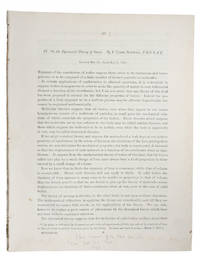
1952réf. 49100Edinburgh Nelson and Sons 1952-53. 8vo. Contemp. hcloth. Tome-and titlelabels with gilt lettering. In: "The British Journal for the Philosophy of Science" Vol. III May 1952 to February 1953. XIV394 pp. Entire volume offered. Stamps to foot of titlepage and a few other pages. Schrödinger's papers: pp. 109-123 a. 233-242. Clean and fine. First printing of these importent papers on the philosophy of Quantum physics. "If we have to go on with these damned quantum jumps then I'm sorry that I ever got involved." E.Schrodinger."In it he contrasts the smooth evolution of the Schrodinger wavefunction with the erratic behaviour of the picture by which the wavefunction is usually supplemented or 'interpreted' in the minds of most physicists. He objects in particular to the notion of 'stationary states' and above all to 'quantum jumping' between those states. He regards these concepts as hangovers from the old Bohr quantum theory of 1913 and entirely unmotivated by anything in the mathematics of the new theory of 1926. J.S. Bell. hardcover
1932réf. 53414Berlin Springer 1932. 8vo. Orig. full yellow cloth. with orig. printed dustjacket. Jacket with a few minor small tears. Small stamp on titlepage and jacket with previous owners name: Niels Arley 1911-94 collaborated with Niels Bohr professor at Inst. of Theoretical Physics Univ. of Copenhagen. 82622 pp. With many annotations in small pencil by Niels Arley throughout. First edition. In the early years of quantum mechanics several distinct formulations were developed; Heisenberg's matrix mechanics Schrödinger's wave mechanics and Dirac's more general transformation theory. However these theories lacked strict mathematical rigor only much later through Schwartz's theory of distributions did Dirac's theory achieve this. Quantum mechanics is one of the fields of science which was fortunate to attract the attention of a mathematician of von Neumann's character. Von Neumann showed in a paper published 1927 how generalized infinite-dimensional Euclidean spaces function spaces and linear operators provide the proper mathematical framework for quantum mechanics. Von Neumann was strongly influenced by Hilbert's program of axiomatizing the fields of science. The axiomatic approach which von Neumann takes in his theory has ever since dominated modern physics and functional analysis and it was von Neumann who coined the term 'Hilbert space'. Von Neumann's work in this field culminated in this monograph which in addition to the earlier paper includes his important considerations inspired by Bohr and Heisenberg regarding the problem of measurement in particular von Neumann's disproof of hidden variables. hardcover
1939réf. 7933Paris1939. Orig.full cloth. XX247 pp. - First edition with contributions by N.Bohr L.de Broglie O.Klein H.A.Kramers L.Brillouin A.S.Eddington E.A.Milne a.others hardcover
1897réf. 43860Leipzig Johann Ambrosius Barth 1897. No wrappers. In: "Annalen der Physik und Chemie Neue Folge" Bd. 61 No 7. Titlepager to vol. 61. Pp. 417-640 a. 1 folded plate. Entire issue offered. Kaufmann's paper: pp. 544-552 textillustrations. A stamp to upper corner of titlepage. Clean and fine. First printing of this landmark paper in particle physics in which Kaufmann found that the cathode are negatively charged particles that certain properties of the cathode rays are independent of the nature of the gas that they traverse and determining the ratio e/m. charge/mass"To define the 'birth of an era' is perhaps best left for parlor games. Let me write of the BIRTH OF PARTICLE PHYSICS nevertheless define it to take place in April 1897 and appoint Kaufmann and Thomson as keepers of the gate. Their respective experimental arrangements.are of comparable quality their experimental results equally good."Pais "Inward Bound" p. 84."In 1897 three physicists Weichert Kaufmann and Thomson in independent experiments found that cathode rays are indeed negatively charged particles having the peculiar property that the ratio of the mass and the charge of these particles is in the order of 1000 times smaller than for the lightest ion the ion of the hydrogen. The term 'electron' which had previously been used to denote the 'elementary charge' was soon adopted as the name of the new particle. The electron was the first of the later so-called 'elementary particles' to be discovered." Siegmund Brandt "The Harvest of a Century" No. 4 p.16 ff. unknown
1939réf. 38592Paris 1939. Royal8vo. Orig. full cloth with dustjacket. XXI247 pp. With original contributions by Niels Bohr The causality problems in atomic physics L. de Broglie Links between the quantum theory and relativity O. Klein On the theory of charged fields L. Brillouin Individuality of elementary particles. A.S. Eddington Cosmological application of the theory of quanta E.A. Milne A possible mode of approach to nuclear dynamics. hardcover
1896réf. 43069Leipzig Johann Ambrosius Barth 1896. 8vo. Contemporary half cloth with gilt title to spine. Band 58 of "Annalen der Physik und Chemie". Library stamp to verso of title-page. Light wear to edges and capitals and a damp-stain to the lower part of the last three leaves. Otherwise a clean and well preserved copy. The entire volume offered. Pp. 662-669. Entire volume: VIII 776 pp. 6 folded plates. First edition of Wilhelm Wien's highly influential paper on the phenomenon of radiation also known as Wien's displacement law. Wien followed Ludwig Boltzmann's approach when incorporating electrodynamics and thermodynamics in investigating radiation and its characteristics. "He argued that if a system reaches the same temperature by the increase of temperature or by the adiabatic compression of the volume containing heat radiation it should yield the same energy distribution. Considering also the Doppler effect of the radiation Wien arrived at an expression for energy distribution that states that the product of temperature and the wave length is a constant". Mathew Chandrankunnel Philosophy of physics 2000 4 p.Wien's empirical observations functioned as a starting point for Max Planck who wanted prove the theoretical foundation for Wien's wishing thus to justify the entropy law. Today Wien's approximation is also known as Wien-Planck law.This phenomenon was coined "Wien's displacement law" because the energy density curve is displaced correspondingly to the temperature; it implies that the hotter an object is the shorter the wavelength at which it will release most of its radiation. Wien's description of radiation awarded him the Nobel Prize in Physics in 1911. Wien's constant is today used in a wide range of different aspects of physics e.g. cosmic microwave background and the determination of how much energy is emitted from a light bulb. Magie "A Source Book in Physics". Pp. 597-600.Other papers of interest contained in the present volume:KOHLRAUSCH F. Ueber Widerstandsmessungen von Electrolyten mit Wechselströmen durch das Dynamometer. Pp. 514-516.BOLTZMANN L. Zur Energetik. Pp. 595-598.RYDBERG J. J. Die Neuen Grundstoffe des Cleveïtgases. Pp. 674-679.WIEN W. Ueber die auf einer schweren Flüssigkeit möglichen Wellen von sehr Höhe. Pp. 729-735.Etc. hardcover
2007réf. SONG073540450XBrand: American Institute of Physics 2007-10-25. 2008. paperback. Used: Good. 8.25x1.25x11.00. Buy with confidence. Excellent Customer Service & Return policy. Brand: American Institute of Physics paperback
2005réf. SONG0124759882Academic Press 2005-10-26. 1. hardcover. Used: Good. 6.44x1.17x9.30. Buy with confidence. Excellent Customer Service & Return policy. Academic Press hardcover
réf. SONG1563963140Institute of Physics Publishing GB 0000-00-00. 1st ed. 1995. hardcover. Used: Good. 10.16x6.97x7.01. Buy with confidence. Excellent Customer Service & Return policy. Institute of Physics Publishing (GB) hardcover
2007réf. SONG9812706224World Scientific Publishing Company 2007-05-01. hardcover. Used: Good. 6.84x0.90x9.77. Buy with confidence. Excellent Customer Service & Return policy. World Scientific Publishing Company hardcover
réf. ria9780323832922_inpPaperback / softback. New. New Book; Fast Shipping from UK; Not signed; Not First Edition; N/A paperback
1991réf. 07122Luxembourg: Commission of the European Communities 1991. LUX Presumed 1st edition No markings slight rubbing to upper corner of head of spine and tiny nick to bottom edge of front cover otherwise Very Good; no dust jacket as published. Hardcover paginated by sections about 250pp graphs and diagrams. Scattering Path geometry Attenuation; Effect of the spatial structure of precipitation; Rain height distribution; Z-R relations; Gaseous absorption during precipitation; Hydrometeor scatter; Cancellation networks; Site-shielding Models; Cost 210 clear-air networks; Hydrometeor scatter facilities of COST 210; Testable versions Co-ordination propagation models. 2.7 JM HOQ 103/a4. 1st. Hardcover. Very Good/No Dust Jacket as Published. 8vo - over 7¾" - 9¾". Commission of the European Communities Hardcover
réf. 9810214162.Ghardcover. Good. Access codes and supplements are not guaranteed with used items. May be an ex-library book. hardcover
2008réf. DADAX1436651832Kessinger Publishing 2008-06-02. Reprint Edition. hardcover. New. 6.00x0.94x9.00. Buy with confidence. Excellent Customer Service & Return policy. Kessinger Publishing hardcover
2006réf. DADAX9812568832World Scientific Publishing Company 2006-10-09. 1. paperback. New. 6.08x0.76x9.02. Buy with confidence. Excellent Customer Service & Return policy. World Scientific Publishing Company paperback
1975réf. DADAX0854981195CRC Press 1975-01-01. 1. hardcover. New. 6.51x1.00x9.38. Buy with confidence. Excellent Customer Service & Return policy. CRC Press hardcover
2003réf. DADAX9810218931World Scientific Publishing Company 2003-01-01. paperback. New. 5.91x0.75x8.47. Buy with confidence. Excellent Customer Service & Return policy. World Scientific Publishing Company paperback
2006réf. SONG0444521461Elsevier 2006-04-17. 1. hardcover. Used: Good. 6.20x0.67x9.12. Buy with confidence. Excellent Customer Service & Return policy. Elsevier hardcover
2006réf. SONG9812568832World Scientific Publishing Company 2006-10-09. 1. paperback. Used: Good. 6.08x0.76x9.02. Buy with confidence. Excellent Customer Service & Return policy. World Scientific Publishing Company paperback
réf. DADAX0274590360Wentworth Press 2018-08-02. hardcover. New. 6.14x0.81x9.21. Buy with confidence. Excellent Customer Service & Return policy. Wentworth Press hardcover