Fliedner, CAntiquariat.de
FLOREZ POSADA, Juan.MareMagnum
ESTUDIO ANALITICO DEL RESALTO SUPERFICIAL.
191025x17. 7p. Algo deteriorado. Ilstr.

Libreria Fernandez Javier · Spanien10,00 €
19.802 Ergebnisse
1880Best.-Nr. 11107Braunschweig: Vieweg 1880. Mit 118 Textholzstichen. XV, 191 S. Neuerer HLeinenbd. 22x14 cm.
191025x17. 7p. Algo deteriorado. Ilstr.
190925x17. 9p. Algo deteriorado. Iltr.
1909In 8 (cm 16 x 24,5), pp. VIII + 480. Legatura coeva in mezza pelle. Seconda edizione della traduzione italiana dell'opera di Floriano Cajori, History of Mathematical Notation, pubblicata in prima traduzione italiana sempre da Zanichelli l'anno prima, nel 1908. L'opera presenta tre appendici sull'Accademia del Cimento, sui fisici e sui matematici italiani rivedute da Angelo Battelli. Floriano Cajori fu professore di fisica nell'Universita' del Colorado ed e' noto soprattutto come storico della sua materia.
Best.-Nr. 2119Berlin, Springer, 1957; 3 volumes in 8 reliés en pleine toile éditeur (cachets de bibliothèque), T 1 : 6pp., 553pp., T.2 : 7pp., 580pp., T.3 : 7pp., 626pp.
Best.-Nr. 2120Berlin, Springer, 1957, un volume in 8 relié en pleine toile éditeur, (cachets de bibliothèque), 6pp., 556pp.
Best.-Nr. 66525aafLondon, Isaac Pitman & Sons, 1948, lg. in-8vo, IX + 245 p. + plates / XIV + 273 p. + plates, orig. cloth.
Best.-Nr. SONG069118254XUsed: Good unknown
Best.-Nr. DADAX069118254XNew unknown
1956Best.-Nr. 46102Gäottingen, Vandenhoeck & Ruprecht, 1956. Orig. full cloth. 202 pp., textfigs. Clean and fine.
1956Gäottingen, Vandenhoeck & Ruprecht, 1956. Orig. full cloth. 202 pp., textfigs. Clean and fine.
1931Milano, 1931, estratto in-4° pp. 12 con fig. - !! ATTENZIONE !!: Con il termine estratto (o stralcio) intendiamo riferirci ad un fascicolo contenente un articolo, completo in se, sia che esso sia stato stampato a parte utilizzando la stessa composizione sia che provenga direttamente da una rivista. Le pagine sono indicate come "da/a", ad esempio: 229/231 significa che il testo è composto da tre pagine. Quando la rivista di provenienza non viene indicata é perché ci è sconosciuta. - !! ATTENTION !!: : NOT A BOOK : “extract” or “excerpt” means simply a few pages, original nonetheless, printed in a magazine. Pages are indicated as in "from” “to", for example: 229/231 means the text comprises three pages (229, 230 and 231). If the magazine that contained the pages is not mentioned, it is because it is unknown to us.
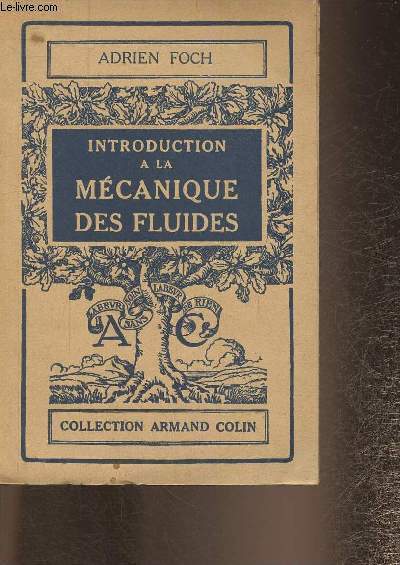
1934Best.-Nr. RO60055171Armand Colin. 1934. In-16. Broché. Etat d'usage, Couv. légèrement passée, Manque en coiffe de tête, Intérieur acceptable. 210 pages. Illustré de nombreuses figures en noir et blanc dans le texte. Petite annotation sur le 1er plat. 2e plat légèrement taché.. . . . Classification Dewey : 530-Physique
1934Best.-Nr. R200113833Armand Colin. 1934. In-12. Cartonné. Bon état, Couv. convenable, Dos satisfaisant, Quelques rousseurs. 208 pages. 67 figures en noir et blanc, dans le texte.. . . . Classification Dewey : 530-Physique
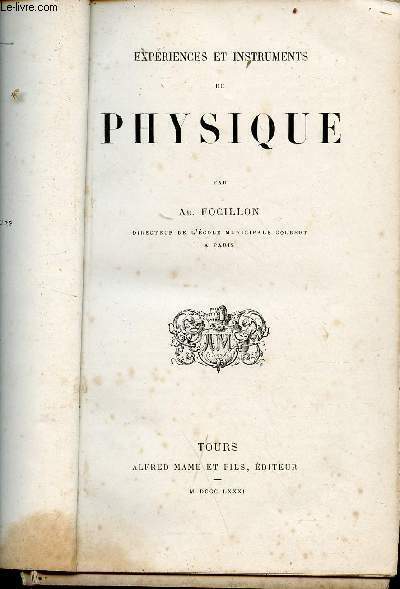
1881Best.-Nr. R160214730Alfred Mame et Fils. 1881. In-8. Relié. Etat passable, Coins frottés, Dos frotté, Quelques rousseurs. 215 pages - quelques illustrations en noir et blanc dans le texte - ouvrage désolidarisé des plats - quelques pages désolirarisées. . . . Classification Dewey : 530-Physique
1945Best.-Nr. RO30329428Armand Colin. 1945. In-12. Broché. Etat passable, Couv. légèrement passée, Dos satisfaisant, Papier jauni. 200 pages. Quelques schémas en noir et blanc, dans le texte.. . . . Classification Dewey : 530-Physique
2014br. Gli argomenti trattati in questo libro sono quelli tradizionali di Meccanica e Termodinamica insegnati nei corsi di Fisica delle Scuole di Scienze, Ingegneria ed Architettura. Tali argomenti vengono trattati tenendo conto delle più attuali conoscenze della Fisica e dei più recenti risultati sperimentali, tra quelli di rilievo per un corso di carattere generale. Uno degli aspetti più importanti della Fisica, che ne condiziona e ne qualifica l'insegnamento, è la capacità di far acquisire il metodo di indagine scientifica della realtà. Tale aspetto è molto curato nel libro, anche attraverso una mirata distribuzione degli argomenti di ciascun capitolo su tre livelli: un corpo centrale fondamentale, una parte dedicata agli approfondimenti ed una terza riservata ai complementi. Tutti i capitoli contengono numerosi esempi svolti (più di 300, in totale) dettagliatamente discussi e risolti. In questa nuova edizione, inoltre, al termine di ogni capitolo sono stati inseriti problemi da svolgere (oltre 300), per i quali sono forniti la formula risolutiva finale ed il risultato numerico.
2003brossura La nuova edizione della prima parte dell'opera di Fisica Generale per l'Università di Focardi, Massa e Uguzzoni viene presentata al pubblico suddivisa in due distinti volumi per andare incontro alle esigenze didattiche introdotte dalla recente riforma universitaria. Questo primo volume rappresenta un testo di base per lo studio della meccanica nei corsi di laurea di Scienze e di Ingegneria mentre il secondo volume, che uscirà nei prossimi mesi, sarà dedicato alla meccanica dei fluidi e alla termodinamica. Il testo mantiene l'apprezzata struttura della precedente edizione, particolarmente efficace dal punto di vista didattico e di presentazione degli argomenti. I contenuti sono organizzati a più livelli: ogni capitolo comprende una parte istituzionale, corredata da due sezioni di Approfondimenti e Complementi; nei primi, alcuni degli argomenti già esposti nella parte generale vengono trattati a un livello più approfondito; nei secondi vengono presentati argomenti più specialistici, che allargano il campo dando una visione più ampia della materia. Inoltre, numerosi esempi inseriti nel corso del testo offrono la possibilità di entrare nel merito delle dimostrazioni delle leggi fisiche enunciate ed esercizi a diversi gradi di difficoltà consentono di mettere alla prova la qualità dell'apprendimento. A ogni livello, la trattazione poggia sempre su fondamenta formali rigorose, che presuppongono una buona conoscenza dell'Analisi Matematica di base.
2010ill., br. In questo volume vengono trattate le oscillazioni, le onde elastiche, le onde elettromagnetiche nel vuoto e nella materia, l.ottica ondulatoria e l.ottica geometrica. Uno degli aspetti più importanti della Fisica è la capacità di far acquisire il metodo di indagine scientifica della realtà. Tale aspetto è molto curato nel libro, anche attraverso una mirata distribuzione degli argomenti di ciascun capitolo su tre livelli: un corpo centrale, una parte dedicata agli Approfondimenti e una terza riservata ai Complementi. Tutti i capitoli sono corredati di numerosi esempi: un banco di prova immediato per la verifica del livello di apprendimento raggiunto, l'occasione per una riflessione o, infine, un.indicazione sui possibili sviluppi. Nel corso di tutto il libro è costante l.impegno a mantenere almeno due riferimenti fondamentali: il fatto che la Fisica abbia la sua forza nella capacità di realizzare modelli fondati sulla realtà, e il suo carattere di scienza sperimentale, elementi che la rendono sorgente di innumerevoli applicazioni pratiche.
1970Best.-Nr. 607602Darmstadt, Steinkopff, 1970. M. 9 Tab. u. 30 Abb. VIII, 95 S. St. u. Sign. a. Tit.
1954Best.-Nr. 188914Berlin, Akad.-Vlg. 1954. 48 S. OBr. Umschlag lichtrandig u. angestaubt. (Berichte über die Verhandlungen der sächs. Akad. der Wiss. zu Leipzig Math.-naturwiss. Kl. 101/3).
Best.-Nr. SONG1936114755Used: Good unknown
1949Best.-Nr. 053568'S-Gravenhage / The Hague: Martinus Nijhoff 1949. 1st Edition . Soft cover. Near Fine. Diagrams. Offprint Pp 65-132. First Edition. Near Fine Aging Around Edges Of Covers. Adriaan Daniël Fokker 1887 -1972 Was A Dutch Physicist. He Worked In The Fields Of Special Relativity And Statistical Mechanics. Fokker Was Born In Buitenzorg Dutch East Indies Now Bogor Indonesia. He Was A Cousin Of The Aeronautical Engineer Anthony Fokker. Fokker Studied Mining Engineering At The Delft University Of Technology And Physics At The University Of Leiden With Hendrik Lorentz Where He Earned His Doctorate In 1913. He Continued His Studies With Albert Einstein Ernest Rutherford And William Bragg. In His 1913 Thesis He Derived The Fokker-Planck Equation Along With Max Planck. After His Military Service During World War I He Returned To Leiden As Lorentz' And Ehrenfest's Assistant. Fokker Became A Physics Teacher At The Gymnasium Of Delft After 1918 And Was Appointed In 1923 As The First Professor Of Applied Physics At The Technische Hoogeschool Delft Today Delft University Of Technology. In 1928 Fokker Succeeded Hendrik Lorentz As Director Of Research At Teylers Museum In Haarlem. Fokker Made Several Contributions To Special Relativity And Some Less Well-Known Contributions To General Relativity Particularly In The Area Of Geodetic Precession The Phenomena Of Precession Of A Freely Falling Gyroscope In A Gravitational Field.Fokker Began To Study Music Theory During The Second World War When The University Of Leiden Was Closed; Partly This Was Due To A Desire To Convince The Nazis He Would Be Of No Use To The War Effort And Partly It Was A Response To Reading The Work Of Christiaan Huygens On The 31 Equal Temperament. In 1938 Fokker - Along With Dirk Coster And Otto Hahn - Helped Jewish-Born Physicist Lise Meitner Escape From Austria To The Netherlands. "Fokker And Coster Both Knew That University Positions Were Virtually Unavailable For Foreigners. Laboratory Space Was Not A Problem However Either In Groningen Or Haarlem. 'Perhaps We Can Tap Colleagues For Regular Contributions' Coster Suggested. Fokker Set A Goal Of F.20000 Enough To Support Meitner For Five Years And Immediately Began Contacting Colleagues For Advice And Donations." They Were Unsuccessful In Obtaining Funding But Fokker Succeeded In Getting Official Permission For Meitner To Leave Although He Was Unable To Telegraph That To Her Due To Secrecy. She Escaped Barely In Time To Evade Arrest. The Year 1942 Consequently Marked A Turning Point In His Life; After Then He Wrote Many Pieces In 31-Equal Which Are Notable For Using The 7Th Harmonic As A Consonant Interval 31-Equal Has A Much Better Approximation Of The 7Th Harmonic Than The Ubiquitous 12-Equal. He Also Made Notable Contributions To Music Theory Such As The Fokker Periodicity Block. Martinus Nijhoff paperback
1942Best.-Nr. 040908'S-Gravenhage / The Hague: Martinus Nijhoff 1942. 1st Edition . Soft cover. Very Good. Diagrams And A Few Illustrations. Offprint In Blue Covers Stamped In Black Pp 449-506. Light Wear. Printed Name "Fokker" At Top Of Front Cover Probably One Of The Author's Own Copies But Last From The Library Of Dutch Physicist Jan Korringa. Adriaan Daniël Fokker 1887 -1972 Was A Dutch Physicist. He Worked In The Fields Of Special Relativity And Statistical Mechanics. Fokker Was Born In Buitenzorg Dutch East Indies Now Bogor Indonesia. He Was A Cousin Of The Aeronautical Engineer Anthony Fokker. Fokker Studied Mining Engineering At The Delft University Of Technology And Physics At The University Of Leiden With Hendrik Lorentz Where He Earned His Doctorate In 1913. He Continued His Studies With Albert Einstein Ernest Rutherford And William Bragg. In His 1913 Thesis He Derived The Fokker-Planck Equation Along With Max Planck. After His Military Service During World War I He Returned To Leiden As Lorentz' And Ehrenfest's Assistant. Fokker Became A Physics Teacher At The Gymnasium Of Delft After 1918 And Was Appointed In 1923 As The First Professor Of Applied Physics At The Technische Hoogeschool Delft Today Delft University Of Technology. In 1928 Fokker Succeeded Hendrik Lorentz As Director Of Research At Teylers Museum In Haarlem. Fokker Made Several Contributions To Special Relativity And Some Less Well-Known Contributions To General Relativity Particularly In The Area Of Geodetic Precession The Phenomena Of Precession Of A Freely Falling Gyroscope In A Gravitational Field.Fokker Began To Study Music Theory During The Second World War When The University Of Leiden Was Closed; Partly This Was Due To A Desire To Convince The Nazis He Would Be Of No Use To The War Effort And Partly It Was A Response To Reading The Work Of Christiaan Huygens On The 31 Equal Temperament. In 1938 Fokker - Along With Dirk Coster And Otto Hahn - Helped Jewish-Born Physicist Lise Meitner Escape From Austria To The Netherlands. "Fokker And Coster Both Knew That University Positions Were Virtually Unavailable For Foreigners. Laboratory Space Was Not A Problem However Either In Groningen Or Haarlem. 'Perhaps We Can Tap Colleagues For Regular Contributions' Coster Suggested. Fokker Set A Goal Of F.20000 Enough To Support Meitner For Five Years And Immediately Began Contacting Colleagues For Advice And Donations." They Were Unsuccessful In Obtaining Funding But Fokker Succeeded In Getting Official Permission For Meitner To Leave Although He Was Unable To Telegraph That To Her Due To Secrecy. She Escaped Barely In Time To Evade Arrest. The Year 1942 Consequently Marked A Turning Point In His Life; After Then He Wrote Many Pieces In 31-Equal Which Are Notable For Using The 7Th Harmonic As A Consonant Interval 31-Equal Has A Much Better Approximation Of The 7Th Harmonic Than The Ubiquitous 12-Equal. He Also Made Notable Contributions To Music Theory Such As The Fokker Periodicity Block. Martinus Nijhoff paperback
1939Best.-Nr. 032861'S-Gravenhage: Martinus Nijhoff 1939. First Separate Edition . Soft cover. Good. 96 Pp. Publisher's Brown Paper Covers Printed In Black. First Printing. Fokker Studied Mining Engineering At The Delft University Of Technology And Physics At The University Of Leiden With Hendrik Lorentz Where He Earned His Doctorate In 1913. He Continued His Studies With Albert Einstein Ernest Rutherford And William Bragg. In His 1913 Thesis He Derived The Fokker-Planck Equation Along With Max Planck. After His Military Service During World War I He Returned To Leiden As Lorentz' And Ehrenfest's Assistant. In 1928 Fokker Succeeded Hendrik Lorentz As Director Of Research At Teylers Museum In Haarlem. In 1938 He Helped Lise Meitner Escape The Nazi's. Quite Scarce Lectures Only 3 Institutional Holdings Shown In Worldcat. Slight Wear To Covers Which Are Browning At Edges But Paper Spine Is Completely Perished. A Few Pencil Notes By Student Jan Korringa Later A Physicist And Assistant To Kramers. Inscribed "Rey/Sept. '39" At Top Of Title Page Probably For H. A. Kramers. Martinus Nijhoff paperback