Fischer, Ernst PeterAntiquariat.de

2 557 résultats
1996réf. 90878Berlin, Springer 1996. XIV, 243 Seiten. Softcover/Paperback
1999réf. 61825Freiburg, Herder Verlag, 1999. "Originalausgabe, in der Reihe ""Herder Spektrum Meisterdenker"", 8°, 206 S., kartonierter Einband"
2003réf. x-0520215036Univ of California Pr 2003. Paperback. New. 1st edition. 491 pages. 9.75x7.00x1.00 inches. Univ of California Pr paperback
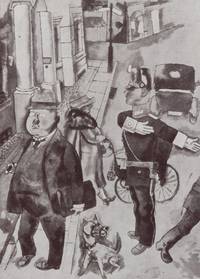
1926réf. 39022Berlin: Das Kunstarchiv Verlag 1926. First edition. Softcover. g. Quarto. 36pp. Original printed wrappers. Catalog published on the occasion of an exhibition of paintings and drawings by George Grosz held during the Spring of 1926 in Berlin at the Galerie Alfred Flechtheim. This catalog features 24 duo-tone and b/w photographic reproductions. Includes a poem by Gottfried Benn and four essay on the artist and his work by Carl Einstein Marc Neven Max Herrmann and Florent Fels. Some age-wear and moderate soiling on wrappers. Upper corners bumped thus slightly affecting pages throughout. Text in German gothic script with one of the four essays in French. Wrappers in overall good- to good interior in good to very good condition. Alfred Flechtheim 1878-1937 was a German art dealer art collector journalist and publisher. Flechtheim appeared in the art world shortly after 1900 with a collection of paintings by Vincent van Gogh and Paul Cézanne; French Avant garde early works of Pablo Picasso Georges Braque and André Derain; paintings of Wassily Kandinsky Maurice de Vlaminck Alexej von Jawlensky Gabriele Münter and the Rhein Expressionists Heinrich Campendonk August Macke Heinrich Nauen de and Paul Adolf Seehaus de. Flechtheim opened his first gallery in Düsseldorf in 1913 followed by galleries in Berlin Frankfurt Cologne and Vienna. Flechtheim served in the German Army during World War I but not at the front. His art business collapsed during the war but he re-opened in Düsseldorf in 1919. In 1921 he founded "Der Querschnitt" the Cross Section a cultural magazine. Legendary glamorous parties in Flechtheim's gallery overflowed with the glitterati of the new Berlin: movie stars titans of finance prizefighters and artists of every stripe. As Hitler rose to power in the late 1920s and early 1930s Flechtheim became a bête noire because of the art he espoused and championed. In 1933 Sturmabteilung men broke up an auction of Flechtheim's paintings. The Nazis aryanized Flechtheim's gallery as they would many other Jewish businesses and turned it over to Flechtheim's business manager Alex Vömel. After the war former party member Vömel said he didn't even remember who Flechtheim was. The Nazis seized and sold off Flechtheim's private collection as well as the contents of his gallery. Emigration and Death Six months after the Nazis came to power in 1933 Flechtheim penniless fled to Paris and tried to find work with his former business partner Daniel-Henry Kahnweiler. Flechtheim subsequently organized exhibits in London of the paintings of exiled German artists. In London Flechtheim slipped on a patch of ice was taken to a hospital punctured his leg on a rusty nail in his hospital bed developed septicemia leading to amputation of his leg and died. Das Kunstarchiv Verlag unknown
1926réf. 39022Berlin: Das Kunstarchiv Verlag 1926. First edition. Softcover. g. Quarto. 36pp. Original printed wrappers. Catalog published on the occasion of an exhibition of paintings and drawings by George Grosz held during the Spring of 1926 in Berlin at the Galerie Alfred Flechtheim. This catalog features 24 duo-tone and b/w photographic reproductions. Includes a poem by Gottfried Benn and four essay on the artist and his work by Carl Einstein Marc Neven Max Herrmann and Florent Fels. Some age-wear and moderate soiling on wrappers. Upper corners bumped thus slightly affecting pages throughout. Text in German gothic script with one of the four essays in French. Wrappers in overall good- to good interior in good to very good condition. Alfred Flechtheim 1878-1937 was a German art dealer art collector journalist and publisher. Flechtheim appeared in the art world shortly after 1900 with a collection of paintings by Vincent van Gogh and Paul Cézanne; French Avant garde early works of Pablo Picasso Georges Braque and André Derain; paintings of Wassily Kandinsky Maurice de Vlaminck Alexej von Jawlensky Gabriele Münter and the Rhein Expressionists Heinrich Campendonk August Macke Heinrich Nauen de and Paul Adolf Seehaus de. Flechtheim opened his first gallery in Düsseldorf in 1913 followed by galleries in Berlin Frankfurt Cologne and Vienna. Flechtheim served in the German Army during World War I but not at the front. His art business collapsed during the war but he re-opened in Düsseldorf in 1919. In 1921 he founded "Der Querschnitt" the Cross Section a cultural magazine. Legendary glamorous parties in Flechtheim's gallery overflowed with the glitterati of the new Berlin: movie stars titans of finance prizefighters and artists of every stripe. As Hitler rose to power in the late 1920s and early 1930s Flechtheim became a bête noire because of the art he espoused and championed. In 1933 Sturmabteilung men broke up an auction of Flechtheim's paintings. The Nazis aryanized Flechtheim's gallery as they would many other Jewish businesses and turned it over to Flechtheim's business manager Alex Vömel. After the war former party member Vömel said he didn't even remember who Flechtheim was. The Nazis seized and sold off Flechtheim's private collection as well as the contents of his gallery. Emigration and Death Six months after the Nazis came to power in 1933 Flechtheim penniless fled to Paris and tried to find work with his former business partner Daniel-Henry Kahnweiler. Flechtheim subsequently organized exhibits in London of the paintings of exiled German artists. In London Flechtheim slipped on a patch of ice was taken to a hospital punctured his leg on a rusty nail in his hospital bed developed septicemia leading to amputation of his leg and died. Das Kunstarchiv Verlag unknown books
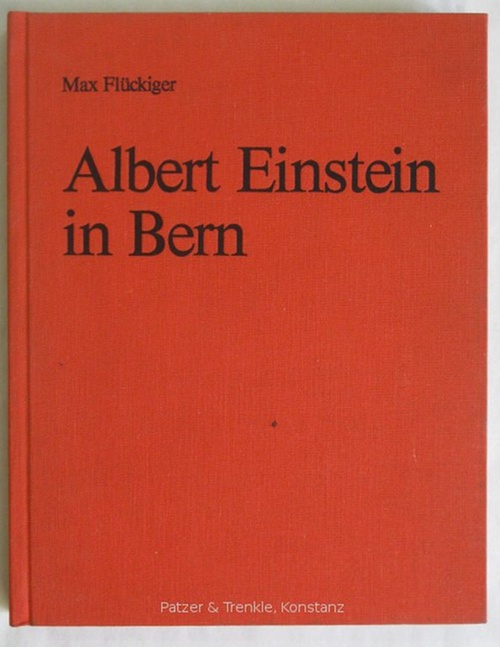
1974réf. 133172Bern: Haupt. 1974.
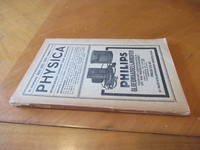
1925réf. 032126Physica / Nederlaandsch Tijdscrift Voor Natuurkunde 1925. 1st Edition 1st Printing. Soft cover. Very Good. Double Issue Nov-Dec 1925. Einstein Article Is In German. Einstein Temporarily Abandons The Search For A Unified Theory. Original Grey Card Covers Printed In Black Small "Lorentz" Printed On Label On Spine. Lightly Used Some Loss Of Paper On Spine Corner Crease On Front Cover Beginning To Split. Physica / Nederlaandsch Tijdscrift Voor Natuurkunde paperback
1961in cofanetto
1961(Il mosaico del pensiero). 16°, pp.207 (1), t. cart. edit., astuccio edit. (Lineamenti della teoria della relatività e pensiero filosofico; Il principio di relatività nella meccanica classica;Relatività particolare; Cenno sulle geometrie non euclidee; Teoria della relatività generale e sintesi successive; Nuove vedute geometriche di Weyl e Eddington; Interpretazioni unitarie dei fenomeni naturali).
1914réf. 1199Braunschweig: Friedr. Vieweg & Sohn 1914. 1st Edition. FIRST EDITION FULL VOLUME OF THE FRANCK-HERTZ EXPERIMENT: THE FIRST ELECTRICAL MEASUREMENT TO CLEARLY SHOW THE QUANTUM NATURE OF ATOMS - PROOF OF THE QUANTIZED MODEL OF THE BOHR ATOM & OF PLANCK'S QUANTUM THEORY. Note that this volume includes both the first and second Franck-Hertz experiment. In the first they demonstrate that atoms can only absorb and be excited by specific amounts of energy; in the second experiment performed the same year they demonstrate that the frequency of the light emitted following the collision of electrons with mercury atoms corresponds precisely with the energy lost by the electrons in the collision. Franck and Hertz received the Nobel Prize for this work specifically "for their discovery of the laws governing the impact of an electron upon an atom" Nobel Prize Committee. Of equal import this volume also contains a paper by Einstein in which he uses the light quantum hypothesis to give new derivations of Planck's radiation law and Nernst's third law of thermodynamics. His "proofs introduced the quantum hypothesis" Calaprice The Einstein Almanac 40. In 1914 James Franck and Gustav Hertz were working together in the Physics Institute of Berlin and were "particularly interested in ionization i.e. in the process in which an electron is removed from an atom" The Harvest of a Century" p. 102-103. The experiment they devised now known commonly as the Franck-Hertz experiment is "a vivid illustration of the quantization of energy" that relied on methodology so simple "that it is now carried out regularly by undergraduates. They accelerated electrons through a low-pressure gas of mercury. When the electrons' energy reach the energy of a stationary state of mercury they gave up a quantum of energy to the mercury resulting in a stepwise shape to the curve of current through the apparatus. This demonstrated that atoms could absorb energy only in discrete amounts" Peacock The Quantum Revolution 40. "Franck and Hertz had not only shown for the first time that electrons lose their kinetic energy to mercury atoms in energy quanta but also that these energy quanta are equal to the energy of the light emitted by the same atoms if interpreted with Einstein's light-quantum hypothesis.This was the first experimental determination of Planck's constant not using blackbody radiation" Brandt 103. CONDITION & DETAILS: Braunschweig: Friedr. Vieweg & Sohn. 8vo. Unobtrusive stamp on front paste down and title page. In-text figures throughout. Tightly bound in leather over marbled paper boards; gilt-lettered and tooled at the slightly faded and spotted spine which looks worse in the image due to the bright light than it does to the eye. Unusually beautiful marbled paper edges. Bright and very clean throughout. Near fine. Friedr. Vieweg & Sohn hardcover
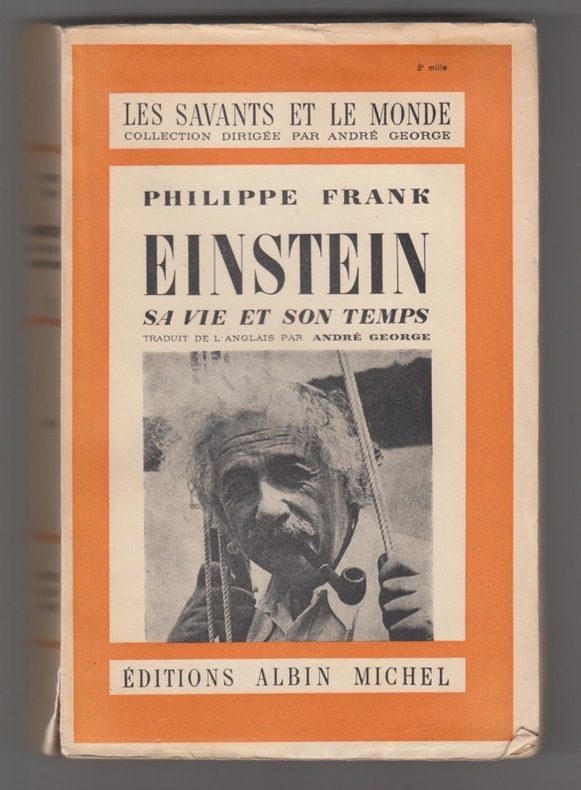
réf. 5925P., A.Michel, 1950, un volume in 8, broché, couverture imprimée, 435pp.
1950réf. 27614Editions Albin Michel, coll. “Les savants et le monde” 1950 In-8 broché 20,5 cm sur 13. 435 pages. Très bon état d’occasion.
1950réf. 10252Paris Albin Michel 1950 Petit In-8 435 pp, traduit de l'anglais par André George, VIII reproductions photographiques en noir hors-texte.
réf. 12463Albin Michel, Paris, 1950. Un volume in-12 broché de 440 pages. Traduit de l'anglais. Photos hors-texte. Collection "Les savants et le Monde". bon état.
1950Albin Michel 1950, In-8 broché, 429 pages. Bon état.
1950réf. 99939034Albin Michel Albin Michel 1950, In-8 broché, 429 pages. Bon état.
1953réf. 200315New York, Knopf, 1953. M. 16 Taf. XXVII, 298, XII S. OLwd.
in-8°, 435 p., broche, couverture illustree Bel exemplaire. [CA28-2][SC-4vf][TX-15]
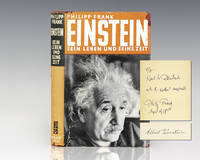
1949réf. 133215Munchen: Paul List Verlag 1949. First German edition of this classic work by Frank a famed contemporary of Einstein. Octavo original cloth. Signed by Albert Einstein on the slip to the title page and inscribed by the author on the front free endpaper "To Karl W. Deutsch with the author's compliments Philipp Frank August 10 1950." Philipp Frank was a physicist mathematician and also a philosopher during the first half of the 20th century. He was a logical-positivist and a member of the Vienna Circle. He was influenced by Mach and was one of the Machists criticised by Lenin in Materialism and Empirio-criticism. He studied physics at the University of Vienna and graduated in 1907 with a thesis in theoretical physics under the supervision of Ludwig Boltzmann. Albert Einstein recommended him as his successor for a professorship at the German Charles-Ferdinand University of Prague a position which he held from 1912 until 1938. Very good in a good dust jacket. Much has been written about Albert Einstein technical and biographical but very little remains as valuable as this unique hybrid of a book written by Einstein's colleague and contemporary. Both rich in personal insights and grounded in a deep knowledge of twentieth-century science Phillip Frank's biography anchors the reader with a lucid overview of physics and draws an intimate portrait of the Nobel Prize–winner. Paul List Verlag hardcover
1979réf. 8467San Francisco, W.H. Freeman, 1979. An Introduction to Einstein's Theory XVIII, 172 S. (23,5 cm) Broschur / Fadenheftung
2009réf. 239953Payot 2009 332 pages in8. 2009. Broché. 332 pages. exemplaire service de presse
1979Hier et Demain 1979, grand In-8 broché, 333 pages + index des noms et des sujets traités + illustrations. Cachet de bibliothéque. Trés bon état.
1979réf. 99925571Hier et Demain 1979 Hier et Demain 1979, grand In-8 broché, 333 pages + index des noms et des sujets traités + illustrations. Cachet de bibliothéque. Trés bon état.
1971réf. 72758Braunschweig: Vieweg (uni-text), 1971. M.I.T. Einführungskurs Physik. Lehrbuch für Lehrbuch für Studenten aller naturwissenschaftlichen und technischen Fachrichtungen ab 3. Semester 287 S. (23 cm) Broschierte Ausgabe
réf. 9782401113404Hatier parascolaire