2 557 résultats
réf. 12591171-nnew. unknown
1924réf. 25388London:: Methuen 1924. Second edition revised and enlarged. publisher's cloth in dust jacket. . Very good or better in a jacket with an L-shaped closed split at the bottom of the jacket spine a label had been removed from the bottom of the spine which has skinned a few of the letters in the imprint; also there is some splitting along folds. An uncommon book in jacket. . 8vo. With a Preface by Albert Einstein. Methuen, hardcover
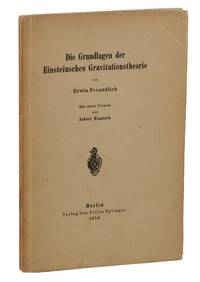
1916réf. 140945574Berlin: Verlag von Julius Springer 1916. First edition. First edition. 64 pp. Bound in publisher's wraps. Very Good with slightly toned wraps tiny stain to back wrap slightly bumped corners bookplate on verso of front wrap. An early German language work on Einstein's theory of gravitation with a foreword by the man himself. Freundlich's first book. Verlag von Julius Springer unknown books
1922réf. 34667Berlin Julius Springer 1922-24. 8vo. In: "Zeitschrift für Physik" Vol. 10 pp. 377 ff.Vol.11 pp.326 vol.16 pp.228 vol.21 pp.326-332. The entire four volumes offered here. Contemporary half cloth bindings. Two landmark papers in the history of cosmology: All first editions. In 'Über die Krümmung des Raumes' Friedman derived the non-stationary solutions to Einstein's field equations. Einstein quickly responded in a short comment 'Bemerkung' in which he expressed his suspicion of such a model of the Universe and apparently pointed out an error in Friedman's calculations. However Friedman now wrote a letter to Einstein in which he enclosed his full calculations. Shortly after this Einstein submitted a short notice Notiz in which he admitted that he himself had performed a calculation error and that Friedman's solutions which shed new light on the matter were valid. Friedman's expanding universe model was corroborated by Edwin Hubble's red-shift observations in 1929. In 'Über die Möglichkeit einer Welt mit konstanter negativer Krümmung des Raumes' Friedman derived the Friedman-equations and demonstrated that he had command of all three Friedman-models describing positive zero and negative curvature respectively nearly a decade before the independent discoveries of the same models by Lemaître Robertson and Walker. hardcover
1922réf. 49429Berlin Julius Springer 1922-24. 8vo. 4 contemporary half cloth binding: two in uniform half green cloth and two en uniform grey/blue half cloth. In "Zeitschrift für Physik" Bd. 10 11 16 & 21. Entire volumes offered. All volumes with stamp to title page and front free end paper otherwise a fine and clean set. Friedmann: Bd. 10: Pp. 377-386; Bd. 21: P.p. 326-332. Einstein: Bd. 11:P. 326; Bd. 16: P. 228. First printing of these four landmark paper in which Friedman "introduced into cosmology two concepts of revolutionary importance the age og the world and the creation of the world" Kragh Cosmology and Controversy. "In his paper of 1922 Friedmann offered a complete analysis of the solutions of Einstein's cosmological field equations that went beyond the earlier solutions of Einstein and de Sitter as it also included nonstatic solutions. Friedmann did so clearly and explicitly: "The purpose of this note" he wrote "is firstly to show that the cylindrical Einsteinand spherical de Sitter worlds are special cases of more general assumptions and secondly to demonstrate the possibility of a world in which the curvature of space is independent of the three spatial coordinates but does on time".Ibid.In 'Über die Krümmung des Raumes' Friedman derived the non-stationary solutions to Einstein's field equations. Einstein quickly responded in a short comment 'Bemerkung' in which he expressed his suspicion of such a model of the Universe and apparently pointed out an error in Friedman's calculations. However Friedman now wrote a letter to Einstein in which he enclosed his full calculations. Shortly after this Einstein submitted a short notice Notiz in which he admitted that he himself had performed a calculation error and that Friedman's solutions which shed new light on the matter were valid. Friedman's expanding universe model was corroborated by Edwin Hubble's red-shift observations in 1929. In 'Über die Möglichkeit einer Welt mit konstanter negativer Krümmung des Raumes' Friedman derived the Friedman-equations and demonstrated that he had command of all three Friedman-models describing positive zero and negative curvature respectively nearly a decade before the independent discoveries of the same models by Lemaître Robertson and Walker. "Friedmann made a valuable contribution to Einstein's general theory of relativity. As always his interest was not limited simply to familiarizing himself with this new field of science but led to his own remarkable investigations. Friedmann's work on the theory of relativity dealt with one of its most difficult questions the cosmological problem. In his paper "Über die Krümmung des Raumes" 1922 he outlined the fundamental ideas of his cosmology: the supposition concerning the homogeneity of the distribution of matter in space and the consequent homogence of "world" time for which at any moment in time the metrics of space will be identical at all points and in all directions. This theory is especially important because it leads to a sufficiently correct explanation of the fundamental phenomenon known as the "red shift." This solution of the Einstein field equations obtained from the above propositions is the model for any homogeneous and isotropic cosmological theory. It is interesting to note that Einstein thought that the cosmological solution to the equations of a field had to be static and had to lead to a closed model of the universe. Friedmann discarded both conditions and arrived at an independent solution. Einstein welcomed Friedmann's results because they showed the dispensability of the ad hoc cosmological term Einstein had been forced to introduce into the basic field equation of general relativity". DSB. Weil 122 & 130. hardcover
1922réf. 792Berlin: Springer 1922. First Edition. Wrappers. Near fine. 2 vols. in German the first appearance of 2 distinct papers in 2 separate periodical issues September 13 and November 17. Both are complete in original wrappers. Near fine small pencil name on the Nov. cover. Seems to be surprisingly rare. RBH lists no auction sales of Friedmann's article title and date since 1975 and only one copy of it is listed by OCLC but copies of the bound annual Zeitschrift für Physik are regularly available and should not in this case be considered in any way equivalent to our set in publisher's wrappers. 1. Friedmann's pioneering paper the first to seriously apply general relativity to cosmology without the stabilizing cosmological constant theorizing and mathematically formularizing an expanding universe dragging cosmology into a branch of physics. In Zeitschrift für Physik Band 10 He 16 September 13 1922 pages 377-386 "Here we have for the first time the idea of an expanding universe originating in a singularity-a big-bang." -Helge Kragh Cosmology and Controversy page 24. 2. Einstein's critical remarks on Friedmann's paper that he retracted in 1923. In Zeitschrift für Physik Band 11 He 4/5 November 17 1922 page 326. Springer unknown books
Kleine Lesespuren am Umschlag aber keine Einträge o.ä.,, ein gutes und sauberes Exemplar. - "man brüllt seine Lieben zunächst einmal an" -- Schuljahre: auf dem Wege zum "Einspänner" -- Umwege eines "Wunderkinds" -- "Vagabund und Eigenbrödler". Student in Zürich -- "Gott schuf den Esel und gab ihm ein dickes Fell" -- Experte III. Klasse "viel zu denken" -- "Herr Doktor Einstein" und die Realität der Atome -- Die Lichtquanten "sehr revolutionär" -- Die Relativbewegung "mein Leben für sieben Jahre" -- Die Relativitätstheorie "eine Modifikation der Lehre von Raum und Zeit" -- "viel Würdigung". Facetten zum Auftritt des Jahrhundertgenies -- Experte II. Klasse "mit Arbeit arg überladen" -- Vom "Treppenwitz" zum Herrn Professor -- "man lernt viel dabei". Professor in Zürich -- Ordinarius in Prag, aber nicht lange -- Ein Mann fällt vom Dach: Auf dem Wege zur Allgemeinen Relativitätstheorie -- "ich weiß nicht, ob ich noch Eier legen kann". Von Zürich nach Berlin -- "im Narrenhaus". Als Pazifist in Preußen -- "die höchste Befriedigung meines Lebens". Die Vollendung der Allgemeinen Relativitätstheorie -- "ganz >oben<, aber allein". Kriegsjahre in Berlin -- "fiel aus wegen Revolution" -- "daß ich das habe erleben dürfen". Die Bestätigung der Lichtablenkung und der "plötzlich berühmte Dr. Einstein" -- "alles Zeitungsgeschrei". Relativität im Rampenlicht "in Honig geschrieben". Relativität, Philosophie und -- Erkenntniskritik -- "Reisender in Relativität" -- "meine stärkste menschliche Bindung". Judentum -- Zionismus und die Reise nach Amerika -- "so lange der Rummel anhält". Weite Reisen, viel Politik und ein wenig Physik -- Wie Einstein den Nobelpreis erhielt, dadurch Preuße wurde und es vorläufig auch blieb -- "Das marmorne Lächeln der unerbittlichen Natur". Die Suche nach der einheitlichen Feldtheorie -- "lieber Angestellter in einer Spielbank". Die Aporien der Quantentheorie -- "nicht der wahre Jakob". Kritik an der Quantenmechanik -- "nach meinem eigenen Gusto". Politik, Patente, Krankheit und ein "wundervolles Ei" -- "ich revanchiere mich dafür". Öffentliches und Diskretes aus dem Leben eines "Unverbundenen" -- Adieu Berlin: "da es hier für mich brenzlig wird" -- Exil als Befreiung: "Ich werde das Land meiner Geburt wohl nicht mehr sehen." -- Princeton: eine "Schicksalsinsel" -- "Wenn schon, denn schon." Physikalische Realität und ein Paradoxon, Relativität und vereinheitlichte Theorie -- Der Krieg, ein Brief und die Bombe -- Zwischen der Bombe und den Gleichungen: "aber die Gleichungen sind für die Ewigkeit" -- "eine alte Schuld" ISBN 351840489X
1994Volume in brossura in condizioni perfette. Raccolta di scritti del fisico tedesco. brossura
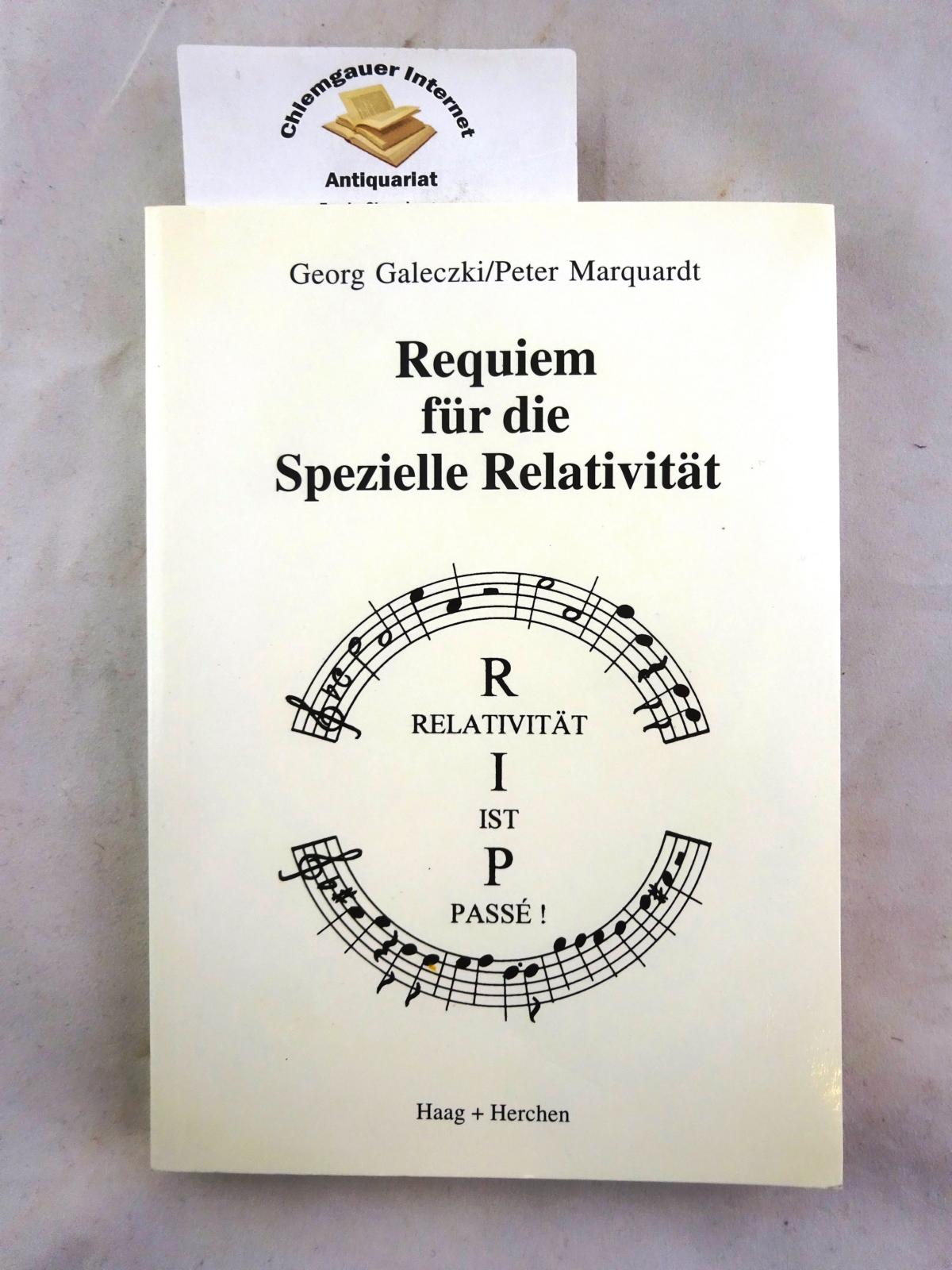
1997réf. 295591Frankfurt am Main : Haag und Herchen, 1997. 271 Seiten. Index ; 21 cm. Originalkarton.
2019ill., ril. È la formula più famosa di tutti i tempi. Ma quanti di noi sanno che cosa significa, esattamente? E perché è ancora importante per noi cent'anni dopo la sua esposizione? Il fisico di fama mondiale Christophe Galfard considera il significato reale dietro all'iconica sequenza di simboli di cui è composta la più nota equazione di Einstein. Nello stile accessibile ed evocativo che lo contraddistingue, Galfard dispiega in un racconto appassionato l'impatto di questa teoria sulla nostra visione della realtà, portandoci a una nuova comprensione della natura dello spazio e del tempo.
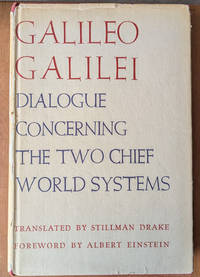
1968réf. 689Berkeley and Los Angeles: University of California Press 1968. Second Revised Edition Thus. Publisher's Blue Cloth Gilt Detailing. Near Fine/Very Good. A Near Fine Book in a Very Good or Better Dust Jacket Unclipped $15.00. Book is lightly shelf worn and sunned to extremities. Text block is a bit toned and soiled especially to top edge. Text is unmarked. Binding is tight and square. Dust Jacket is lightly shelf worn to extremities. Jacket is generally and variously toned from sunning. A few marks and scuffs present. Hardcover. Octavo. xxviii 5 6-496pp. . University of California Press unknown
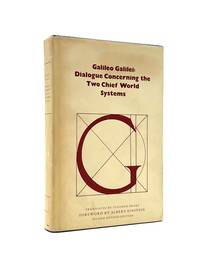
1953réf. 040592Berkeley and Los Angeles CA: University of California Press 1953. Book. Near Fine. Original Cloth. First Thus. 8vo - over 7¾" - 9¾" tall. Dark mauve cloth paper title label mounted on upper spine panel. Slight binding lean text block edges a bit toned by age. Dust jacket a bit toned along spine panel with 1" closed tear at head of front joint light shelf wear now in mylar. xxvii496 pp. Einstein's foreword in German with facing-page translation into English. University of California Press Hardcover
1953réf. 048358BERKELEY CA.: UNIVERSITY OF CALIFORNIA PRESS. SMALL CHIP TO THE DJ CLEAN UNMARKED COPY! . VG. Hardcover. First Edition. 1953. UNIVERSITY OF CALIFORNIA PRESS hardcover
1953réf. 019091University of California Press Berkeley / Los Angeles. First Printing. Clipped DJ in archival cover edge wear. . Fine. Hardcover. 1st Edition. 1953. University of California Press, Berkeley / Los Angeles hardcover
2013réf. 110056Folio Society 2013. Hardcover. New. 9x6x1. Brand new 2013 Folio Society hardcover in slipcase as issued. oversized and overweight.D25 Please email for photos. Folio Society hardcover
1953réf. biblio37528University of California Berkeley 1953. First Edition. XXVII496 pages. Fine Hardcover in VeryGood DJ. DarkRed cloth Bookplate with spine title. No Wear. Clean Unmarked throughout Excellent binding and hinges. The DJ got light edge wear. 9.5"x6.25"x1.6". be46009. University of California hardcover
2016br. Tra la fine dell'Ottocento e l'inizio del Novecento, i più importanti fisici del pianeta stanno cercando di trovare risposta ad alcune anomalie che riguardano la velocità della luce, la trasformazione e generazione della luce, l'esistenza dell'etere e delle molecole. Lo sforzo di scienziati come Hendrik Lorentz, Ludwig Boltzmann, Max Planck è orientato a ultimare la faticosa costruzione di una fisica che, di lì a pochi anni, sarà chiamata classica. Sono fisici maturi e preparati che dovranno affrontare la sfida di un giovane ribelle che non ebbe paura di criticare un apparato intellettuale formidabile che sembrava a un passo dal suo perfezionamento. Albert Einstein, considerato l'ultimo dei fisici classici, riesce a percepire le contraddizioni della scienza del suo tempo, ad affrontarle con semplicità, ma rifuggendo ogni soluzione che fosse parziale, particolare o di comodo. La sua ricerca, anche quando affronta problemi specifici come quello della luce, è animata da una visione unitaria del mondo fisico che lo collega direttamente a Galileo Galilei. In questo libro si racconta come, nell'arco di oltre vent'anni, Einstein e i suoi contemporanei abbiano trovato nel tema dell'interazione tra radiazione e materia la chiave che ha condotto alla fisica dei quanti.
In-8, broché, couverture imprimée (leg. défraichie), 16, (1) p. Edition originale de cette étude critique sur les travaux d'Einstein concernant la Relativité.
réf. 34297In-8, broché, couverture imprimée (leg. défraichie), 16, (1) p. Paris, Vuibert, 1923.
1969réf. 6297Zürich : Orell Füssli, 1969. 116 S. Pappband / gebundene Ausgabe
Gariboldi Leonardo (a cura di) Einstein. Dalla relatività alle onde gravitazionali. Corriere della Sera 2016.. Milano, Corriere della Sera italiano, in ottavo pp. 166 8915 Einstein. Dalla relatività alle onde gravitazionali. Corriere della Sera 2016. In-8. 166 pp. Brossura con alette. Ottimo.
1925réf. 10941Engelhorn, Stuttgart 1925. 64 S. Kart. Etwas angestaubt, gering stockfleckig. - Vorwort: "...daß die Einsteinsche Lehre (ganz zweifellos) gewisse Ideen aufweist, die einen Ewigkeitswert besitzen ... Aber nicht weniger zweifellos, daß manche Bestandteile nicht stichhaltig sind...
1930réf. 80796Paris: Calmann Lévy 1930. Fine. Calmann Lévy Paris 1930 22 x 27.50 cm broché First edition of this issue of the important journal dealing notably with archaeology fine arts and ethnography with Georges Bataille and Carl Einstein as principal editors. Very handsome copy. Contributions by Heinrich Ehl: ""L'heure de naissance de l'art européen occidental"" Georges Bataille ""La mutilation sacrificielle et l'oreille coupée de Vincent Van Gogh"" Michel Leiris: ""Le ""caput mortuum"" ou la femme de l'alchimiste"" Jean Bourdeillette: ""Franz Xaver Messerschmidt"" Zdenko Reich: ""Le massacre des porcs"" Carl Einstein: ""L'enfance néoloithique Hans Arp"" Jacques Prévert Maurice Leenhardt. Issue illustrated with photographs by Jacques-André Boiffard Calmann Lévy unknown
1930réf. 80796Calmann Lévy | Paris 1930 | 22 x 27.50 cm | broché
1930réf. 81582Calmann Lévy | Paris 1930 | 22 x 27.50 cm | broché