EINSTEIN, ALBERTBiblio.com

3.033 Ergebnisse
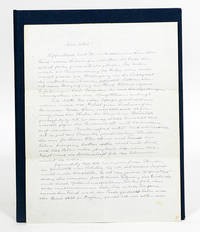
1930Best.-Nr. 2349np: np 1930. First edition. Fine. EINSTEIN ON THE CONCEPT OF PEACE: A POWERFUL AUTOGRAPH STATEMENT IN EXCEPTIONALLY LARGE FORMAT. Translated from the original German: "No person has the moral right to call himself a Christian or Jew so long as he is prepared to engage in systematic murder at the command of an authority or allow himself to be used in any way in the service of war or the preparation for it." Beginning in 1925 the World League for Peace Ligue mondiale pour la paix under the direction of its president Georges Dejean solicited statements on peace from prominent scientists writers artists political leaders and other public figures throughout the world sending them large 11.5x16.5 inch sheets for their submissions. The resulting collection of more than 1000 original manuscripts was assembled between 1925 and 1932. A selection was reproduced in facsimile in the limited-edition volume Pax Mundi: Livre d'or de la paix published in Geneva by Paxunis in 1932. This is Einstein's original manuscript contribution to the project. A highly unusual format with exceptionally large Einstein signature 2.25 in / 6 cm of an important Einstein statement consistent with his life-long dedication to pacifism. c.1925-1930. One large folio page 11.5 x 16.5 inches. In German. Fine condition. np unknown
1937Best.-Nr. 1984Princeton: np 1937. First Edition. Very Good. AN EXTRAORDINARY LETTER BY EINSTEIN TO HIS SON OFFERING LIFE ADVICE AND DISCUSSING FREUD SHAKESPEARE AND SCHILLER. Addressed to his son Eduard "Tetel" Einstein and signed "Papa" the letter written in ink on both sides of one sheet reads in full translated from the original German: Dear Tetel I hope by now you've received Freud's lectures from Vienna. I've read most of them myself in the past. They really made me admire the Author but they didn't convince me that his theories were correct. I must admit however that based on my personal experiences my conviction about those theories is weakening -- I feel now that he was onto something at least in regards to the main theses. I would have written to you sooner but work is keeping me very busy. Even though they say that the work of a single person will not have much of an impact in the big picture it does not diminish the passion in which we pursue our interests and that is a good thing. Although personal illusions may bring warmth and joy into one's life when young they don't last a lifetime. Life would be bleak if the work and the passion for discovery did not exist. In my free time I am currently reading Schiller's poems which I have neglected since my youth. They feel a bit pompous but at the same time they are enthralling in their choice of words and grammar. I am really happy that I picked them up again. I would have liked to send you another book on the top of the Freud but didn't know which one to send -- especially because I don't get a lot of German writings anymore. When I have some extra free time after finishing Schiller I really want to start reading Shakespeare everything from him I can get my hands on. If you like to read it too perhaps we could discuss it at some later time Albert is a real delight -- he has been traveling up and down the country for the past 6 weeks and will have seen and experienced many interesting things. I really hope he has followed my advice and kept a journal but I am not holding high hopes. When it comes to talking and writing he seems to be chronically constipated. With my warmest regards Papa Einstein's life advice underscoring one of his core beliefs: Einstein often stated that his main goal in life was the quest for truth no matter how difficult and painstaking the quest. He advises Eduard in this letter that it is the pursuit and the work in attaining the goal that brings satisfaction and sustains one throughout life even if "the work of a single person will not have much of an impact in the big picture". This he notes is critical to understand after the illusions of youth have succumbed to reality. Einstein Eduard and Freud: Eduard Einstein nicknamed "Tete" or "Tetel" born in 1910 was the second son of Albert and his first wife Mileva. From an early age he became enamored with the teachings of Freud even hanging a picture of famous psychiatrist on his bedroom wall. By the age of twenty he was diagnosed with schizophrenia and consequently was institutionalized several times throughout his life. Einstein's views of Freud's teachings were somewhat more nuanced than those of his son. Initially Einstein did not show much interest in Freud's theories and after their first meeting in 1927 Freud famously remarked "He understands as much about psychology as I do about physics." Over the years however Einstein began studying Freud's works. After corresponding with Freud somewhat regularly throughout the 1930s and even collaborating with him on a project sponsored by the League of Nations "Why War" 1932 Einstein began to move from a deep skepticism to - as indicated in this letter - a growing acceptance. By 1936 - just before this letter was written - Einstein sent birthday greetings to Freud acknowledging: "Until recently I could only apprehend the speculative power of your train of thought together with its enormous influence on the Weltanschauung of the present era without being in a position to form a definite opinion about the amount of truth it contains. Not long ago however I had the opportunity of hearing about a few instances not very important in themselves which in my judgment exclude any other interpretation than that provided by the theory of repression. I was delighted to come across them since it is always delightful when a great and beautiful conception proves to be consonant with reality." In this letter to Eduard Einstein admits to Eduard that he now believes Freud "was onto something at least in regards to the main theses." Einstein Shakespeare Schiller: Einstein's fondness for music is well-known but not as much has been recorded about his literary tastes. It is not surprising and has been previously documented that Einstein had a fondness for the great German poet Schiller but we can find no other references to Shakespeare by Einstein in any other letters or manuscripts. His words to Eduard "I really want to start reading Shakespeare everything from him I can get my hands on" imply that Einstein has recently "discovered" Shakespeare and is excited at the discovery. Note: Although the letter is not dated we can assume that it was written late November - December in 1937 when Einstein's son Albert was visiting the United States a trip he refers to in the letter. Princeton: November - December 1937. One 8.5x11 inch leaf written on both sides. In German. Usual folds otherwise fine. A LONG REMARKABLE AND REVEALING LETTER UNITING THE INTELLECTUAL GIANTS EINSTEIN FREUD AND SHAKESPEARE AND SHARING ONE OF HIS CORE BELIEFS WITH HIS SON. np unknown
1989Best.-Nr. Q-0517675773Random House Value Publishing 1989-01-13. Hardcover. New. New. In shrink wrap. Looks like an interesting title! Random House Value Publishing hardcover
Best.-Nr. 0870190032.Gpaperback. Good. Access codes and supplements are not guaranteed with used items. May be an ex-library book. paperback
Best.-Nr. 0993840140.Gpaperback. Good. Access codes and supplements are not guaranteed with used items. May be an ex-library book. paperback
Best.-Nr. 13884Frankfurt Insel Verlag 1963. 62 S. Pbd. Insel-Bücherei Nr. 801 unknown
Best.-Nr. EDZZ0740Berlin-Wilmersdorf Vlg. der Wochenschrift Die Aktion 1917. 99 S. 7 S. Verlagsanz. Mit 1 Portr. von Max Oppenheimer. = Aktions-Bücher der Aeternisten Bd. 5. Orig.-Pappband unt. Kapital mit 3 cm Fehlstelle. Raabe/Hannich-B. 65.1. Das Erstlingswerk Einsteins war zuvor 1912 erschienen als erste Buchpublikation der Aktion mit dem Untertitel ""Die Dilettanten des Wunders"". Berlin-Wilmersdorf, Vlg. der Wochenschrift Die Aktion 1917. unknown
Best.-Nr. a106117Braunschweig 1914 first edition. Vieweg. Vol XVI of Berichte der Deutschen Physikalishchen. Original binding. hardcover thick octavo. 3/4 darkbrown cloth with matching dark brown papercovered boards. Gilt spine lettering. Illustrations. 1072p. Among many other important papers this volume includes: EINSTEIN "Beitrage zur Quantentheorie " pp. 820-828 VG. no owner marks; light foxing on end papers; just very light cover wear; hinges not cracked. Clean solid excellent condition! Pictures available on request. . hardcover
Best.-Nr. a97179Braunschweig 1914 first edition. Vieweg. Vol XVI of Berichte der Deutschen Physikalishchen. hardcover very thick octavo. 3/4 dark brown cloth with brown/black marbled boards. Gilt spine lettering. Illustrations. 1072p. plus 414p. Halbonatliches Literaturverszeichnis. Includes: EINSTEIN landmark article pp. 820-828. Other article in same volume by A.Euken J. Franck G. Hertz andothers. Owner stamps on titlepage end of text and on end papers - no other marks. Very nice condition: Near Fine end papers slightly toned. Text Fine. . hardcover
1914Best.-Nr. 48163Braunschweig Vieweg & Sohn 1914. No wrappers. "Verhandlungen der Deutschen Physikalischen Gesellschaft im Jahre 1914. Hrsg. von Karl Scheel." 16. Jahrgang Nr. 16. Pp. 765- 834. Entire issue offered. With the general titlepage to 16. Jahrg. Titlepage stamped at foot. Einstein paper pp. 820-828. First edition. In this paper "Contributions to quantum theory" two considerations are given which are interrelated by a common goal inasmuch as it is attempted to derive two of the most importent achievementss of quantum theory viz. Planck's radiation law and Nernst's third law of thermodynamics in a new manner. The proofs do not involve Boltzmann's equation and are thus based enterely on macroscopic thermodynamics. They do introduce however the quantum hupothesis. Einstein points out that the alleged 'proofs' which try to derive the theorem of Nernst from the mere fact that the heat capacity of all substances goes to zero at absolute zero temterature are not genuine. Cornelius Lanczos.Weil No 67. unknown
1914Best.-Nr. 38840Braunschweig Vieweg & Sohn 1914. Later full cloth. A stamp to the general titlepage. IX1072;414 pp. textillustrations. "Verhandlungen der Deutschen Physikalischen Gesellschaft im Jahre 1914. Sechzehnter Jahrgang. Hrsg. von Karl Scheel." Einstein paper pp. 820-828. Internally clean and fine. The whole volume offered First edition. In this paper "Contributions to quantum theory" two considerations are given which are interrelated by a common goal inasmuch as it is attempted to derive two of the most importent achievementss of quantum theory viz. Planck's radiation law and Nernst's third law of thermodynamics in a new manner. The proofs do not involve Boltzmann's equation and are thus based enterely on macroscopic thermodynamics. They do introduce however the quantum hupothesis. Einstein points out that the alleged 'proofs' which try to derive the theorem of Nernst from the mere fact that the heat capacity of all substances goes to zero at absolute zero temterature are not genuine. Cornelius Lanczos.- Weil No 67. hardcover
1911Best.-Nr. 50315Leipzig: Johann Ambrosius Barth 1911. Einstein Albert 1879-1955. 1 Bemerkung zu dem Gesetz von Eötvös. In Annalen der Physik 34 1: 165-169 pp. 1910. Weil 38 Boni 35. 2 Eine beziehung zwischen dem elastischen Verhalten und der spezifischen Wärme bei festen Körpen mit einatomigem Molekül. In Annalen der Physik 34 1: 170-174 pp. 1910. Weil 39 Boni 36. 3 Bemerkungen zu den P. Hertzschen Arbeiten: "Über die mechanischen Grundlagen der Thermodynamik." In Annalen der Physik 34 1: 175-176 pp. 1910. Weil 40 Boni 37. 4 Bemerkung zu meiner Arbeit: "Eine Beziehung zwischen dem elastischen Verhalten . . ." In Annalen der Physik 34 3: p. 590. Weil 40. 5 Berichtigung zu meiner Arbeit: "Eine neue Bestimmung der Moleküldimensionen." In Annalen der Physik 34 3: p. 591. Weil 41. Leipzig: Johann Ambrosius Barth 1911. Whole volume: viii 1032 pp. 6 plates 5 folding 1 b/w/ silver photograph. Figs. Text-illust. 210 x 140 mm. Red cloth with gilt lettering on spine. First Edition. Pages are a little toned as are plates 5 and 6 otherwise Very Good. Approximate English translations of titles: 1 "Remarks on the law of Eötvös." 2 "A connection between the elastic conduct and the specific heat of solid bodies with monatomic molecule." 3 "Remarks on P. Hertz' work: 'On the mechanical foundations of thermodynamics.'" Eövtös' findings served as part of the basis of Albert Einstein's General Theory of Relativity in which the principle of equivalence acts as the keystone no. 1 above. "Einstein adds a comment on p.590 of the same journal no. 2 above. To supplement Sutherland's observation that infared eigenfrequencies of solid bodies possibly originate in the elastic vibrations of these bodies Einstein adds that electrically charged ions are the source of optical vibrations while the mututal motions of the entire molecule cause elastic vibrations." Calaprice Alice et al. An Einstein Encyclopedia. 2015. p. 291. Weil's Einstein Bibliography nos. 38 39 40 and 41. Boni's Einstein Checklist nos. 35 36 and 37. . Johann Ambrosius Barth unknown
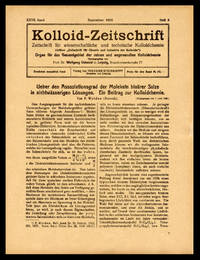
1920Best.-Nr. 14561920. 1st Edition. First edition in original wraps of Einstein's review of a paper by Nobel Prize winner Walter Rudolf Hess entitled Theory of the Viscosity of Heterogeneous Systems. CONDITION: The journal was published in three sections. All three are here all bright clean and in near fine condition. paperback
1923Best.-Nr. 433171923. Offprint from Sitzungsberichte der preussischen Akademie der Wissenschaften 1923. Single sheet pp. 76-77. 265 x 184 mm. A few marginal chips and tiny tears but very good. First edition offprint issue. The second of the four short papers Einstein published in 1923 on Eddington's program for a unified field theory. Weil Albert Einstein Bibliography 131n. unknown
1911Best.-Nr. 003225Leipzig: J. A. Barth 1911. title continued "Uber der mechanischen Grundlagen der Thermodynamik" pp. 175-76 and Bemerkung zu meiner Arbeit: "Eine Beziehung zxischen dem elastischen verhalten" p. 590 and Berichtigung zu meiner Arbeit: Enie neue Bestimmung der Molkuldimensionen" pp. 591-92. In Annalen der Physik Vierte Folge Band 34. Contemporary three-quarter cloth marbled boards. Short scratch in spine; small stain on rear cover; three nicks in outer edge of rear cover. First Edition. About Very Good. J. A. Barth hardcover
1912Best.-Nr. 003230Leipzig: J. A. Barth 1912. Contemporary three-quarter cloth marbled boards. First Edition. Very Good. J. A. Barth hardcover
1909Best.-Nr. 003223Leipzig: J. A. Barth 1909. Only the first paper is with J. Laub. Contemporary three-quarter cloth marbled boards. First Edition. Very Good. J. A. Barth hardcover
1911Best.-Nr. 38841Leipzig J.A. Barth 1911. Contemp. hcalf spine gilt. "Annalen der Physik. Vierte Folge. Band 34. Hrsg. von W.Wien und Max Planck." VIII1032 pp. 6 plates. Einstein papers: pp. 165-169; pp. 170-174; pp.; 175-176; p. 590; pp. 591-592. Fine and clean. The whole volume offered. First edition of all 5 papers. In "Relation between elastic behaviour and specific heat of solid bodies with monatomic molecules" Einstein comments Sutherlands importent paper in Philosophical Magazine from 1910. Sutherland made the importent remark that the infrared eigenfrequencies of solid bodies have their origin possibly in the elastic vibrations of these bodies. Einstein impressed by this remark adds that electrically charged ions are the sources of optical vibrations whreas elastic vibrations are caused by the mutual motion of the entire molecule. Hence he prefers to test the hypothesis of Sutherland by solid bodies which are composed of monatomic molecules."Lanczos. - Weil Nos 38 39 this with an asterix denoting major work40 1-2 and 41. unknown
1909Best.-Nr. 38830Berlin J.A. Barth 1909. Orig. printed wrappers. Frontwr. eith tears endwr. only partly preserbed. "Annalen der Physik. Vierte Folge. Band 28 Heft 2. Heft 2 in 15 parts pp.217-248. Einstein Paper: pp. 445-47. First edition. The authors claimed in "Elementare Theorie der Brownschen Bewegungen" that the boundary conditions for E D H B on the boundary surface between two different media remain the same whwther the bodies are at rest or in motion. This is in fact not tthe case. The correction is made here with the help of a method which was originally employed by H. Hertz. Lanzos. - Weil No 26. unknown
1907Best.-Nr. 29339Leipzig Barth 1907. 8vo. Extract from "Annalen der Physik IV23" pp.206-208. Some slight browning to leaves. First edition. Weil No. 18. unknown
1911Best.-Nr. 50604Leipzig J.A. Barth 1911. 8vo. In Contemporary half calf with gilt lettering to spine. In "Annalen der Physik. Vierte Folge. Band 34. Hrsg. von W.Wien und Max Planck.". The whole volume offered. A tear to lower part of spine and small stamp to title page otherwise fine. Einstein papers: pp. 165-169; pp. 170-174; pp.; 175-176; p. 590; pp. 591-592. Entire volume: VIII1032 pp. 6 plates. First edition of all 5 papers. In "Relation between elastic behaviour and specific heat of solid bodies with monatomic molecules" Einstein comments Sutherlands importent paper in Philosophical Magazine from 1910. Sutherland made the importent remark that the infrared eigenfrequencies of solid bodies have their origin possibly in the elastic vibrations of these bodies. Einstein impressed by this remark adds that electrically charged ions are the sources of optical vibrations whreas elastic vibrations are caused by the mutual motion of the entire molecule. Hence he prefers to test the hypothesis of Sutherland by solid bodies which are composed of monatomic molecules."Lanczos. - Weil Nos 38 39 this with an asterix denoting major work40 1-2 and 41. unknown
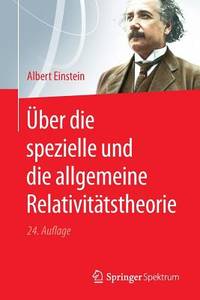
2012Best.-Nr. DADAX3642312780Springer 2012-09-14. 24. Aufl. 2009. Unver. paperback. New. 6.10x0.28x9.25. Buy with confidence. Excellent Customer Service & Return policy. Springer paperback
Best.-Nr. a97177Braunschweig 1909 first edition. Vieweg. Vol VII of Berichte der Deutschen Physikalishchen. Hardcover very thick octavo. 3/4 dark brown cloth with brown/black marbled boards. Gilt spine lettering. Illustrations. vii 749p. plus 450p. Halbonatliches Literaturverszeichnis. Includes: EINSTEIN "Ueber die entwichelung unserer Anschauunger ueber das Wesen und die Konstitution der Strahlung" p. 482-500; BORN "Ueber die Dynamik des Elektrons in der Kinematik des Relativitisprinzips"; HAHN und MEITNER "Eine Neue Methode zur Herstellung radioaktiver Zerfallsprodukte Thorium D"; SOMMERFELD "Ueber die Zusammensetzung der Geschwindigkeiten in der Raltivitheorie". No owner marks. Very nice condition: VG foxing on closed page ends; end papers slightly toned; hinges not cracked; binding secure. Text Fine and clean. Pictures available on request. . hardcover
1907Best.-Nr. 432971907. Einstein Albert 1879-1955. Berichtigung zu meiner Arbeit: "Die Plancksche Theorie der Strahlung etc." Offprint from Annalen der Physik 22 1907. Single sheet p. 800. Unbound as issued. 223 x 145 mm. Lower corner lightly creased but very good. First Edition Rare Offprint Issue. Einstein's important correction to his paper on specific heats "Die Plancksche Theorie der Strahlung und die Theorie der spezifischen Wärme" 1907; see Weil 15 which "made clear for the first time that quantum concepts have a far more general applicability" Pais p. 394. "Einstein initially believed that his oscillating lattice points in a three-dimensional crystal lattice were electrically charged ions. A few months later he published a correction to his paper in which he observed that this was an unnecessary assumption . . . Einstein's correction freed the quantum rules in passing one might say from any specific dependence on electromagnetism" Pais p. 396. Pais Subtle is the Lord pp. 394-396. Weil 15n. . unknown
1911Best.-Nr. 432921911. Einstein Albert 1879-1955. Berichtigung zu meiner Arbeit: "Eine neue Bestimmung der Moleküldimensionen." Offprint from Annalen der Physik 34 1911. 591-592pp. 224 x 146 mm. Original printed wrappers a little chipped splint in lower spine. Light toning but very good. First Edition Offprint Issue. Einstein's correction to his formula for the viscosity coefficient = 1 a key equation in his 1905 doctoral thesis in which he had presented a new theoretical method for determining molecular radii and Avogadro's number. In 1910 Jacques Bacelin a pupil of French physicist Jean-Baptiste Perrin obtained experimental results indicating a possible error in Einstein's formula. "That prompted Einstein after an unsuccessful attempt to find an error to ask his student and collaborator Ludwig Hopf to check his calculations and arguments . . . Hopf did find an error in the dissertation namely in the derivatives of some velocity components and obtained for a corrected coefficient 2.5 . . .In early 1911 Einstein submitted his correction for publication and recalculated Avogadro's number. He obtained a value of 6.56 x 10²³ per mole a value that is close to those derived from kinetic theory and Planck's black-body radiation theory" Duplantier pp. 216-217. Duplantier "Brownian motion 'diverse and undulating'" in Einstein 1905-2005: Poincaré Seminar 2005 pp. 201-293. Pais Subtle is the Lord p. 92. Weil Albert Einstein Bibliography 41. . unknown