1 804 résultats
2000réf. x-0312231024Palgrave Macmillan 2000. Hardcover. New. 253 pages. 9.00x5.75x1.00 inches. Palgrave Macmillan hardcover
2004réf. Q-0805854037Routledge 2004-07-15. Paperback. New. New. In shrink wrap. Looks like an interesting title! Routledge paperback
1993réf. Q-0691033226Princeton University Press 1993-09-20. Hardcover. New. In shrink wrap. Looks like an interesting title! Princeton University Press hardcover
réf. 400379-nnew. unknown
1925réf. 55651New York: Albert & Charles Boni 1925. First edition. Includes 22 letters by "Celebrated Intellectuals" many of whom were Nobel Prize recipients including Karl Capek Albert Einstein Selma Lagerlof Sinclair Lewis Maurice Maeterlinck Thomas Mann Romain Rolland Bertrand Russell Upton Sinclair H. G. Wells Rebecca West Izrael Zangwill et al. Published in the U.S. by Boni and the UK by The C. W. Daniel Company for the International Committee for Political Prisoners I.C.P.P. whose members who are listed opposite the title page included Jane Addams the first American woman to be awarded the Nobel Peace Prize Clarence Darrow Anna N. Davis Eugene Debbs W. E. B. DuBois Elizabeth Gurley Flynn Elisabeth Gilman et al. The I.C.P.P. was established in 1924 to agitate for the release of and raise funds for political prisoners around the world. "An impetus to the committee's formation was the imprisonment of Menshevists Social Revolutionaries Maximalists Anarchists and other dissenters in the U.S.S.R. Consequently the committee's first major effort was the publication of LETTERS FROM RUSSIAN PRISONS in 1925. This book profiled imprisoned revolutionaries and its criticism of the Soviet government generated controversy in leftist circles."-from the website of the New York Public Library. 8vo black pebble-cloth boards stamped in gilt and ruled on front in blind; top edge red; illustrated with photographs of original documents & letters; 317 pages. Spine gilt perished if it was ever there otherwise very good with contents fine and binding strong. Albert & Charles Boni unknown
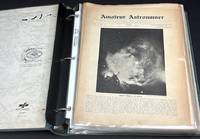
1936réf. H40351New York: Amateur Astronomers Association 1936. Very good. Old cloth 3-ring binder with acetate sheaths containing the issues. This started out as a 4 pp. periodical but expanded in later issues. In 1936 the journal merged with The Sky published by Hayden Planetarium which subsequently merged with The Telescope in 1941 to become Sky & Telescope which is still being published. Condition is mainly very good although the first three issues we have have some damage to fore-edges. The first issue has a supplementary sheet laid in "Professor Einstein Sends Greetings to the Amateur Astronomers Association" reprinting in facsimile the handwritten note with a printed translation and a facsimile of another note from Einstein. We have Vol. I nos. 1 & 2 April and May 1929; Vol. 2 nos. 1 September 1929 - 9 May-June 1930 -- the April 1930 issue has a cover story on the discovery of Pluto then considered the ninth planet. Pluto was first discovered on February 18 1930 by Clyde Tombaugh at the Lowell Observatory in Flagstaff Arizona.The discovery was announced on March 13 1930 in the Astronomical Journal.; Vol. III nos. 1 October-November 1930 - 7/8 May-June 1931; Vol. IV nos. 1 September-October 1931 - 8 Summer 1932; Vol. V nos. 1 September-October 1932 - 3 March 1933 -- these expanded to 6 pp. each; Vol. VI nos. 1 - 3 Winter & Spring 1933-1934 - Summer 1934 -- beginning with Vol. VI these are 16 pp. each; with the Spring issue cover story on Hayden Planetarium; Vol. VII nos. 1 Autumn 1934 - 3 Spring 1935; Vol. VIII nos. 1 Autumn 1935 - 3 Spring 1936. We don't know if we're missing any or not but it's a nice early run of this rare astronomical journal. Amateur Astronomers Association unknown
1931réf. 37423Berlin: Akad. Wiss 1931. Akad. Wiss unknown
1931réf. 37423Berlin: Akad. Wiss 1931. Akad. Wiss unknown books
1929réf. 235399Berlin : Max Hesses 1929. First Edition. Hardcover. Near fine copy in the original title-blocked pictorial cloth. Slightest suggestion only of dust-dulling to the spine bands and panel edges. Remains particularly well-preserved overall; tight bright clean and strong. Physical description; 2 vol ; 26 cm. Contents; vol 1 A-L -- vol 2 M-Z. Subjects; Music - Dictionaries. Berlin : Max Hesses hardcover
1925réf. H36806Brooklyn: Zionist Organization of America 1925. Wraps. Good. 12 x 8.5 inches pictorial softcover good or better with wear and tanning to covers slight 1/2" loss to spine head light chipping and loss to upper rear corner contents mainly very good and clean pp. 281-456 illustrated. Articles by Maurice Samuel Chaim Weizmann. Schmarya Levin Albert Einstein. Pierre Van Paassen. Chaim Nachman Bialik Achad Ha-am Harry Torcziner et al. including "The University Emerges" by Weizmann "Judaism Articulate" by Kaplan the founder of Reconstructive Judaism "The Mission of Our University" by Einstein Van Paassen on Balfour and much else. A terrific issue of this rare journal. Co-founded by Einstein and Weizmann Hebrew University first opened its doors in April 1925. Zionist Organization of America unknown
réf. 401539-nnew. unknown
réf. 400418-nnew. unknown
réf. 400418like new. unknown
réf. 5881923like new. unknown
réf. 400332like new. unknown
réf. 5881818like new. unknown
réf. 400938like new. unknown
réf. 400379like new. unknown
réf. 4224394like new. unknown
réf. 401434-nnew. unknown
réf. 401434like new. unknown
réf. 401539like new. unknown
2019réf. x-0691627533Princeton Univ Pr 2019. Paperback. New. reprint edition. 512 pages. 9.75x8.00x1.25 inches. Princeton Univ Pr paperback
1979réf. 202335New Jersey: Princeton University Press 1979. First Edition; First Printing. Hardcover. Near Fine in a Very Good price clipped dust jacket. Princeton University Press hardcover
1946réf. 858Lancaster: American Physical Society 1946. 1st Edition. FIRST EDITION IN ORIGINAL WRAPS OF SIGNIFICANT CORRECTIONS & ADDITIONS BY EINSTEIN & STRAUS TO AN IMPORTANT PAPER; AS WELL A PAPER BY CHANDRASEKHAR ON THE ORIGIN OF THE SOLAR SYSTEM. In 1945 Albert Einstein and Ernst G. Straus introduced their Swiss cheese model of the universe in a paper entitled "The Influence of the Expansion of Space on the Gravitation Fields Surrounding the Individual Stars". Weil 216. The following year they published "Corrections and Additional Remarks to Our Paper" the 1945 paper the paper offered here. In early 1945 Einstein returned to long held cosmological questions as he sought to try to understand whether the expansion of the universe caused the solar system to expand as well - or more specifically the influence of the expansion of space on the gravitational field in the neighborhood of a star. Working with Straus the two began studying the effect of inhomogeneities in an expanding model. "By the spring of 1945 Einstein and Straus had found a new type of possible universe using Einstein's equations. It described a universe which looked largely like one of the simple expanding universes of Friedmann and Lemaître containing material like galaxies which exerted no pressure. But it has spherical regions removed from it like bubbles in a Swiss cheese. Each empty hole then had a mass placed at its centre. The mass was equal in magnitude to what had been excavated to create the hole. This was a step towards a more realistic universe in which the matter was not smoothly spread with the same density everywhere but gathered up into lumps like galaxies which were spread about in empty space. Barrow The Book of Universes 106-107. ALSO INCLUDED: S. Chandrasekhar's "On a New Theory of Weizsäcker on the Origin of the Solar System". In 1945 C. F. v. Weizsäcker proposed a new theory of the origin of the solar system which appeared to merit consideration. Weizsäcker argued "that there would be turbulence in the solar nebula which would give rise to the formation of eddies having angular motion opposite to that of the rotation of the nebula" Abhyankar The Origin BASI 26 339. Weizsäcker's "principal idea was to regard the formation of a planetary system around a star as a possible last stage in the formation of the star itself" Chandrasekhar 1946 94. He believed that "the protoplanets were supposed to have formed at the sites of the ball bearing eddies and the merger of the protoplanets in the same orbit produced the known planets" Abhyankar 343. In the paper offered here the Indian American astrophysicist S. Chandrasekhar challenged Weizsäcker's theory and showed "that there will be a wide spectrum of turbulence with smaller eddies within the larger ones and there would be no regular pattern as suggested by Weizsäcker. Further the life time of the eddies will be too short for the formation of the planets" ibid. In other words Chandrasekhar's work "indicated that the regular pattern of vortices originally postulated by Weizsäcker could not occur but instead must be replaced by a range of eddy sizes" Brush A History of Modern Planetary Physics 14. Chandrasekhar's work led to the abandonment of Weizsäcker's theories. INCLUDED: Nobel Prize winner Percy Williams Bridgman's "Recent Work in the Field of High Pressures" pp. 1-94 an important review of work done in the field of high pressure physics between Bridgman's seminal 1930 work and 1946 the year he won the prize and R. Samuel's "The Dissociation Spectra of Covalent Polyatomic Molecules" pp. 103-148. CONDITION & DETAILS: Lancaster: American Physical Society. Complete issue in original wraps. 4to. 10.5 x 8 inches; 263 x 200mm. Very slight wear at the edges of the wraps and head and foot of the spine; small closed tear see images. Bright and clean throughout. Very good condition. American Physical Society paperback