Einstein, Albert,Biblio.com
1 813 résultats
réf. 400938like new. unknown
réf. 400379like new. unknown
réf. 4224394like new. unknown
réf. 401434-nnew. unknown
réf. 401434like new. unknown
réf. 401539like new. unknown
2019réf. x-0691627533Princeton Univ Pr 2019. Paperback. New. reprint edition. 512 pages. 9.75x8.00x1.25 inches. Princeton Univ Pr paperback
1979réf. 202335New Jersey: Princeton University Press 1979. First Edition; First Printing. Hardcover. Near Fine in a Very Good price clipped dust jacket. Princeton University Press hardcover
1946réf. 858Lancaster: American Physical Society 1946. 1st Edition. FIRST EDITION IN ORIGINAL WRAPS OF SIGNIFICANT CORRECTIONS & ADDITIONS BY EINSTEIN & STRAUS TO AN IMPORTANT PAPER; AS WELL A PAPER BY CHANDRASEKHAR ON THE ORIGIN OF THE SOLAR SYSTEM. In 1945 Albert Einstein and Ernst G. Straus introduced their Swiss cheese model of the universe in a paper entitled "The Influence of the Expansion of Space on the Gravitation Fields Surrounding the Individual Stars". Weil 216. The following year they published "Corrections and Additional Remarks to Our Paper" the 1945 paper the paper offered here. In early 1945 Einstein returned to long held cosmological questions as he sought to try to understand whether the expansion of the universe caused the solar system to expand as well - or more specifically the influence of the expansion of space on the gravitational field in the neighborhood of a star. Working with Straus the two began studying the effect of inhomogeneities in an expanding model. "By the spring of 1945 Einstein and Straus had found a new type of possible universe using Einstein's equations. It described a universe which looked largely like one of the simple expanding universes of Friedmann and Lemaître containing material like galaxies which exerted no pressure. But it has spherical regions removed from it like bubbles in a Swiss cheese. Each empty hole then had a mass placed at its centre. The mass was equal in magnitude to what had been excavated to create the hole. This was a step towards a more realistic universe in which the matter was not smoothly spread with the same density everywhere but gathered up into lumps like galaxies which were spread about in empty space. Barrow The Book of Universes 106-107. ALSO INCLUDED: S. Chandrasekhar's "On a New Theory of Weizsäcker on the Origin of the Solar System". In 1945 C. F. v. Weizsäcker proposed a new theory of the origin of the solar system which appeared to merit consideration. Weizsäcker argued "that there would be turbulence in the solar nebula which would give rise to the formation of eddies having angular motion opposite to that of the rotation of the nebula" Abhyankar The Origin BASI 26 339. Weizsäcker's "principal idea was to regard the formation of a planetary system around a star as a possible last stage in the formation of the star itself" Chandrasekhar 1946 94. He believed that "the protoplanets were supposed to have formed at the sites of the ball bearing eddies and the merger of the protoplanets in the same orbit produced the known planets" Abhyankar 343. In the paper offered here the Indian American astrophysicist S. Chandrasekhar challenged Weizsäcker's theory and showed "that there will be a wide spectrum of turbulence with smaller eddies within the larger ones and there would be no regular pattern as suggested by Weizsäcker. Further the life time of the eddies will be too short for the formation of the planets" ibid. In other words Chandrasekhar's work "indicated that the regular pattern of vortices originally postulated by Weizsäcker could not occur but instead must be replaced by a range of eddy sizes" Brush A History of Modern Planetary Physics 14. Chandrasekhar's work led to the abandonment of Weizsäcker's theories. INCLUDED: Nobel Prize winner Percy Williams Bridgman's "Recent Work in the Field of High Pressures" pp. 1-94 an important review of work done in the field of high pressure physics between Bridgman's seminal 1930 work and 1946 the year he won the prize and R. Samuel's "The Dissociation Spectra of Covalent Polyatomic Molecules" pp. 103-148. CONDITION & DETAILS: Lancaster: American Physical Society. Complete issue in original wraps. 4to. 10.5 x 8 inches; 263 x 200mm. Very slight wear at the edges of the wraps and head and foot of the spine; small closed tear see images. Bright and clean throughout. Very good condition. American Physical Society paperback
réf. 401078like new. unknown
réf. 41141Paris, Editions des Chroniques du Jour (coll. "XXe siècle"), 1934. In-4°, 140p. + XCVI planches. Broché, couverture illustrée rempliée.
réf. 20390606like new. unknown
2009réf. SONG0691141878Princeton University Press 2009-03-09. 1. hardcover. Used: Good. 7.75x1.75x10.00. Buy with confidence. Excellent Customer Service & Return policy. Princeton University Press hardcover
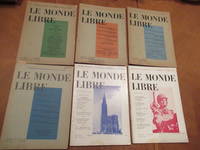
1944réf. 020487Montreal / London 1944 and 1945: Free World Inc 1944. First Editions . Printed Wrappers. Very Good. Drawings and Other Artwork. Six Issues. The French Language Edition Of "The Free World". No. 1 Has Chipping At Lower Corner Of Front Cover And Adjacent Pages Adjacent To Spine; Others Are Vg To Near Fine. Free World Inc unknown
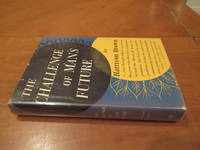
1954réf. 052515New York: Viking 1954. 1st Edition 1st Printing. Hardcover. Fine/Very Good Jacket. Xii 290 Pp. Turquoise Cloth Spine Gilt. First Printing Indicated. Fine No Marks Gilt Brilliant. Dust Jacket Priced $3.75 Slight Usage. Dust Jacket Blurbs By William O. Douglas Robert M. Hutchins Paul B. Sears Harold C. Urey Albert Einstein H. J. Muller; Brown Was An Outstanding Scientist Himself; But Few World Politicians Or Business Leaders 1946 To Present Ever Tried To Seriously Address These Issues Apparently Because They're Not There Primarily For The General Welfare. Harrison Scott Brown 1917 - 1986 Was An American Nuclear Chemist And Geochemist. He Was A Political Activist Who Lectured And Wrote On The Issues Of Arms Limitation Natural Resources And World Hunger. During World War Ii Brown Worked At The Manhattan Project's Metallurgical Laboratory And Clinton Engineer Works Where He Worked On Ways To Separate Plutonium From Uranium. The Techniques He Helped Develop Were Used At The Hanford Site To Produce The Plutonium Used In The Fat Man Bomb Dropped On Nagasaki. After The War He Lectured On The Dangers Of Nuclear Weapons. After The War He Worked At The University Of Chicago Where He Pioneered Nuclear Geochemistry. The Study Of Meteorites By Brown And His Students Led To The First Close Approximation Of The Age Of The Earth And The Solar System. In 1948 Brown Was Awarded The American Association For The Advancement Of Science Prize For His Work On Meteorites.Between 1951 And 1977 He Worked At The California Institute Of Technology Caltech Where He Contributed To Advances In Telescopic Instrumentation Jet Propulsion And Infrared Astronomy. While There He Attracted Several Former Colleagues And Highly Regarded Scientists To The Team. Together They Made Advancements In Telescopic Instrumentation Jet Propulsion Contributing To Nasa's Early Planetary Exploration Missions And Infrared Astronomy. In June 1954 He Was One Of Twenty Scientists Under The Age Of Forty Identified By Fortune Magazine As "Top Young Scientists In U. S. Universities And Industry". In The Early 1970S He Began Working More Directly On The Resource/Environment Issues That He Had Been Developing In His Books. In 1977 He Became Director Of The Newly Created Resource Systems Institute Of The East-West Center In Hawaii Where He Turned Full Time To Work On Understanding And Influencing The Interactions Of Energy Mineral And Food Systems In The Asia-Pacific Region Themes He Had Developed In His Books Since The 1950S. Viking hardcover
1938réf. 009528Leiden: A. W. Sijthoff's Uitgeversmaatschappij N. V. 1938. First Edition 1st Printing. Light Blue Cloth. Near Fine/Very Good Dust Jacket. 9 7/8" Tall. Drawings. Viii 222 Pp. Light Blue Cloth Stamped In Dark Blue. True First Edition Of "The Evolution Of Physics" Issued Just Prior To The English Translation. A Clean Unmarked Copy With Signs Of Removal Of A Single Bookplate On The Front Endpaper No Other Marks. Dust Jacket With Some Wear And Browning Also With A 1 3/8" X 1 5/8" V-Chip At Top Of Rear Panel Adjacent To The Spine Very Small Chips At Tips With A 1" X 1/8" Loss Along Top Of Front Flap Fold And A 1/2" Closed Tear At Top Of Rear Panel With A Few Small Chips And Very Short Closed Tears. A Nice Copy In The Nearly Complete And Scarce Jacket. A. W. Sijthoff's Uitgeversmaatschappij N. V. hardcover
1953réf. 035769Princeton: Princeton University Press 1953. 4th Edition 1st Printing. Hardcover. Near Fine/Very Good DJ. 165 Iii Pp. The Loose "Supplement To Appendix Ii" Laid In Loosely. Beige Cloth Lettered In Gilt. Book Very Good Lightly Used No Fraying Name Label And Owner's Signature On Front Pastedown Faint Ring Mark On Rear Cover. The First Printing Of This Edition With Einstein's 1953 Revisions To Appendix Ii First Published Here And A Further Addition In The Loose "Supplement To Appendix Ii" Which Is Laid In Loosely. Princeton University Press hardcover
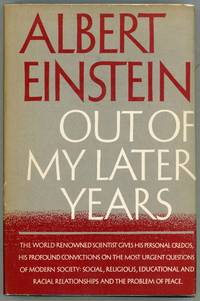
1950réf. 000010284New York: Philosophical Library 1950 1950. First edition. Hardcover. Near Fine/Near Fine. 8vo. 7 2 2 5-282 pp. Bound in navy cloth with a facsimile of Einstein's signature stamped in gold on the front board gold lettering on the spine. This is the variant with the grey and red jacket and Einstein's picture on the rear panel priority unknown with the price of $4.75 on the front jacket flap. Boni 515. A lovely copy of this collection of some of Einstein’s general essays on science and social issues. A Near Fine book with minor toning to the gutters; jacket is Near Fine with the spine panel and the edges of the flaps toned. Philosophical Library [1950] hardcover
réf. ria9780323796804_inpHardback. New. New Book; Fast Shipping from UK; Not signed; Not First Edition; N/A hardcover
1934réf. 948New York: Covici Friede Publishers 1934. First Edition Thus. Hardcover. Very Good. :: Originally published under the title "Mein Weltbild". :: Translated from the German by Alan Harris. :: A gathering of writings expressing Einstein's opinions on life ethics science society religion and politics. :: Bound in publisher's loden-green cloth title author and publisher stamped upon spine. Octavo 8 1/4 x 5 5/8 inches; 209 x 143 millimeters. 290 pages. Grade: Very Good. Corners rubbed worn at crown and foot shelf-wear and small stains. Silver stamping upon spine has mostly worn away. Pages age-toned. Light occasional margin pencil marks within. Covici Friede Publishers hardcover
réf. 10361210-6Taylor & Francis Group. Used - Very Good. Former library copy. Pages intact with possible writing/highlighting. Binding strong with minor wear. Dust jackets/supplements may not be included. Includes library markings. Stock photo provided. Product includes identifying sticker. Better World Books: Buy Books. Do Good. Taylor & Francis Group unknown
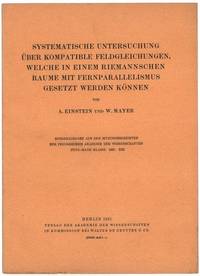
1931réf. 270891931. S.Ber. Akad. Wiss. Berl. 1931/13. - Berlin Verlag der Akademie der Wissenschaften 1931 8° 11 S. orig. Broschur. First Edition; the rare off-print from the "Sitzungsberichte". More and more frequently Einstein chose his assistants from mathematicians." One of the chief of them at that time was Professor Walter Mayer a small round individual who at first sight seemed crushed beneath the personality of Einstein. Einstein's family called him Mayerle and this Swabian diminutive suited him to perfection. But in Mayer's self-effacement there was more affection than respect. He gently contradicted Einstein interrupted him when necessary follwed up an argument and smiled a little mysteriously his head on one side as he watched the figures drawn up in front of him. "It is he who produced all my calculations; his skill is fantastic you know "Einstein used to say. In October 1933 Mayer followed Einstein in his American exile. -cf. Alicke Weil No.180; Schilpp-Shields No. 250; Alicke No. 149. unknown
réf. A9780691200736Hardback. New. hardcover
1949réf. 31509Evanston Ill: Library of Living Philosophers 1949 Book Date 1949. 1st Edition. No Binding. Clamshell As New/No Jacket. 1st Edition. No Binding. First Edition Clamshell Case. Albert Einstein. ALBERT EINSTEIN: PHILOSOPHER-SCIENTIST. Edited by Paul Arthur Schilpp. Evanston Ill.: Library of Living Philosophers 1949. First Trade Edition. Superb Custom Fitted Modern Collector's Clamshell Not A Book HAND-CRAFTED by our conservation team each case features a gilt stamped spine title piece & signature cut on the upper cover both on maroon leather. The clamshell case is finished in fine black cloth & black Nuba®. Nuba® is a fine supple & durable covering with a neutral ph that has the feel of velvety soft Italian Nubuck® leather. An excellent Collector's Custom Case for this uncommon Einstein. Other Einstein Cases are readily available. TBCL Web Site photo/link available for OVER 100 generally in-stock titles. Book definitely NOT included. Custom Craft available. Library of Living Philosophers, [1949, Book Date] unknown