Albert EINSTEIN; Walther MAYERBiblio.com
1,965 results
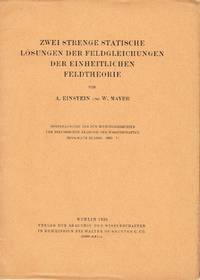
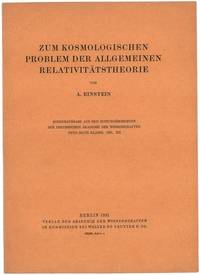
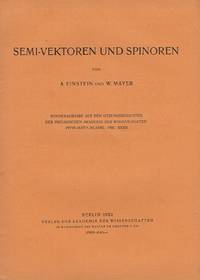
1933ref. 5746KBerlin: Verlag der Akademie der Wissenschaften in commission at Georg Reimer Reichsdruckerei 24th January 1933. Near Fine. Imperial 8vo 25 4: 18 2 cm. 31 1 pages. Letterpress on machine paper in original publisher’s brochure on orange stock with black title printing. First offprint in the original wrappers and new pagination of this rare seminal paper at the same time Einstein's last publication before having to leave Nazi-Germany. - Content: Present paper ist the last work by Einstein co-authored once again by Walther Mayer that was published in Weimar Germany Weil no. 187 was printed before. The offprint was distributed by the Prussian exactly a week before the Nazis came to power on January 30th 1933. Einstein and also Mayer would have to flee Germany due to their Jewish origins only a few months later. - Einstein's work on semivectors ""was stimulated by Ehrenfest's insistence on a better understanding of the relation between single-valued and double-valued representations of the Lorentz group . . . Einstein and Mayer went on to relate semivectors to the Dirac equation and to generalize the formalism to general relativity"" Pais Subtle is the Lord pp. 451-452. - Condition: Mint. - Reference: Alicke 152; Boni-Russ-L. 217; Schilpp-Shields 250; Weil 186 quotes the pagination of the first separate printing p. 522-550. Verlag der Akademie der Wissenschaften (in commission at Georg Reimer [Reichsdruckerei]) unknown
1930ref. 5742KBerlin: Verlag der Akademie der Wissenschaften in commission at Georg Reimer Reichsdruckerei 11th March 1930. Near Fine. Imperial 8vo 25 4: 18 2 cm. 13 1 pages. Letterpress on machine paper in original publisher’s brochure on orange stock with black title printing. First offprint in the original wrappers and new pagination of this late paper by Einstein about the Unified Field Theory written in collaboration with his assistant the Austrian mathematician Walther Mayer nicknamed „Einstein's calculator“. - Condition: Mint. - Reference: Alicke 144; Boni-Russ-L. 196; Schilpp-Shields 240; Weil 170 quotes the pagination of the first separate printing p. 110-120. Verlag der Akademie der Wissenschaften (in commission at Georg Reimer [Reichsdruckerei]) unknown
1965ref. 43963033780345Эйнштейн Ð. Собрание научных трудов: В 4 т. / Под ред. И. Е. Тамма Я. Ð. СмородинÑкого Б. Г. Кузнецова. Ð¡ÐµÑ€Ð¸Ñ "КлаÑÑики науки". — МоÑква: ИздательÑтво "Ðаука" 1965–1967. — Т. I: Работы по теории отноÑительноÑти 1905–1920. 1965. — 700 Ñ.; Т. II: Работы по теории отноÑительноÑти 1921–1955. 1966. — 878 Ñ.; Т. III: Работы по кинетичеÑкой теории теории Ð¸Ð·Ð»ÑƒÑ‡ÐµÐ½Ð¸Ñ и оÑновам квантовой механики 1901–1955. 1966. — 632 Ñ.; Т. IV: Статьи рецензии пиÑьма. ÐÐ²Ð¾Ð»ÑŽÑ†Ð¸Ñ физики. 1967. — 600 Ñ. Твёрдый издательÑкий переплёт в иллюÑтрированных Ñуперобложках чёрного цвета Ñ белым и оранжевым шрифтом. Увеличенный формат. СоÑтоÑние хорошее: Ñуперобложки Ñильно потёрты Ñ заломами значительными надрывами и утратами по краÑм и корешкам; переплёты Ñохранны блоки чиÑтые и крепкие. Einstein A. Collected Scientific Works: In 4 vols. / Edited by I. E. Tamm Ya. A. Smorodinsky B. G. Kuznetsov. Series "Classics of Science." — Moscow: "Nauka" Publishing House 1965–1967. — Vol. I: Works on the Theory of Relativity 1905–1920. 1965. — 700 pp.; Vol. II: Works on the Theory of Relativity 1921–1955. 1966. — 878 pp.; Vol. III: Works on the Kinetic Theory the Theory of Radiation and the Foundations of Quantum Mechanics 1901–1955. 1966. — 632 pp.; Vol. IV: Articles Reviews Letters. The Evolution of Physics. 1967. — 600 pp. Publisher's hardcover binding in illustrated black dust jackets with white and orange lettering. Enlarged format. Condition good: dust jackets heavily rubbed with creases substantial edge tears and losses along extremities and spine ends; bindings sound text blocks clean and tight. This four-volume set is the most authoritative Russian-language edition of Einstein's scientific writings and remains a landmark of Soviet academic publishing. Issued in the prestigious "Classics of Science" series of the USSR Academy of Sciences it was the first comprehensive collection of Einstein's papers anywhere in the world and is regarded by many specialists as the finest such gathering ever produced. The editorial board was extraordinary: Igor E. Tamm Nobel laureate in physics 1958 for the discovery of the Vavilov–Cherenkov effect; the distinguished theoretical physicist Yakov A. Smorodinsky; and the philosopher and historian of science Boris G. Kuznetsov Einstein's principal Soviet biographer. Volume I assembles the foundational relativity papers of 1905–1920 including "On the Electrodynamics of Moving Bodies" the mass–energy equivalence note and the genesis of the general theory; Volume II carries the relativity work through 1955 embracing cosmology gravitational waves and the unified field programme; Volume III collects the Brownian-motion papers the photoelectric and quantum-statistical writings and the celebrated polemical exchanges with Bohr; Volume IV gathers reviews letters autobiographical notes and the popular treatise "The Evolution of Physics" co-written with Leopold Infeld. Extensive scholarly commentary and bibliographies by leading Soviet physicists make this edition indispensable for the history of twentieth-century science. Nauka hardcover
1998ref. 0691048495_usedPrinceton University Press 1998-11-29. Hardcover. Like New. 10x8x1. Princeton University Press hardcover
ref. Q-0415409764Routledge. Hardcover. New. New. In shrink wrap. Looks like an interesting title! Routledge hardcover
1912ref. 50337Leipzig: Johann Ambrosius Barth 1912. Einstein Albert 1879-1955. Thermodynamische Begründung des photochemischen Äquivalentgesetzes. In Annalen der Physik 37 832-838 pp. Red cloth with gilt lettering on the spine. Whole volume: 1048 pp. 5 plates 4 folding 1 b/w silver photograph w/ small fold at foot. Figs. Text-illust. 210 x 130 mm. Very good copy. "A supplement published in vol. 38 1912: 881-884 See Book ID: 50338. Einstein presents a continuation of his earlier work on the interaction between light matter and on photochemical processes. It contrasts with earlier work in that it makes no use of the quantum hypothesis. He demonstrates how what he calls 'the law of photochemical equivalence' is deducible by purely thermodynamical arguments if one makes certain plausible assumptions. He wrote a supplement to the paper in five months later in the same journal." p. 291-2. Calaprice Kennefick & Shulmann. An Einstein Encyclopedia. 2015. Weil's Bibliography of Einstein's Papers no. 46. Boni's Bibliographical Checklist no. 42. . Johann Ambrosius Barth unknown
1902ref. 003204Leipzig: J. A. Barth 1902. In Annalen der Physik 4 Folge Band 8 pp. 798 - 814. First edition of Einstein's second published work. Contains papers by many other famous physicists: W. Wien P. Drude W. Voigt W. Nernst J. Stark and others. Former owner's ink stamp on frontfly and title page. First Edition. Later Red Cloth. Very Good. J. A. Barth Hardcover
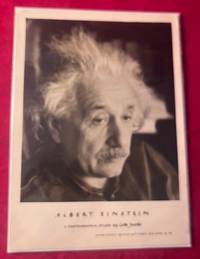
1938ref. 9498New Jersey: Jacobi Studio 1938. Very Good. 5 X 7 Inches. SCARCE original headshot of Albert Einstein by Lotte Jacobi circa 1938. This iconic photograph of Einstein features him wearing his leather coat inside his Princeton New Jersey home. Scarce cropped photograph of Einstein's face with Jacobi Studio text in lower border. "Albert Einstein: A Photographic Study By Lotte Jacobi - Jacobi Studio 46 West 52nd Street New York 19 NY." Lotte Jacobi took this photograph of the theoretical physicist Albert Einstein at his home in Princeton New Jersey at the time he was a professor at the university. Both Jewish the two had been family friends a decade earlier in Germany. Einstein had renounced his German citizenship for political reasons after leaving Nazi Germany in 1933 and Jacobi had been forced to emigrate to the United States from Nazi Germany after she too renounced her German citizenship in 1935. Jacobi and Einstein collaborated on the crafting of his media image in a series of late-1930s Princeton portraits commissioned by Life magazine. Einstein agreed to sit for the photo session only if Lotte Jacobi was assigned to photograph him. The image of Einstein in a leather jacket is unusual in that it catches him in a less-guarded less-constructed moment than the others and offers the viewer a glimpse of the world-famous theoretical physicist as an individual rather than as a stereotyped professor. Rubbing and light wear at corners. A SCARCE advertising piece from the Jacobi Studio. Jacobi Studio unknown
ref. 1745625-nnew. unknown
ref. 58378. Library copy with book-plate and stamp at the front cloth scuffed and discoloured with a touch of wear to the spine ends but despite its massive size the joints are firm and the contents clean. WEIL #54; BONI RUSS LAURENCE #55 - Einstein's famous exposition to the 85th. Vienna Congress. In the following discussion there are contributions from BORN JÄGER REISSNER RIECKE MIE HASENÖHRL. hardcover
1925ref. 14131925. 1st Edition. FIRST EDITION IN ORIGINAL PICTORIAL WRAPPERS. Near fine condition. "This paper is an early example of a series of papers - which continued until his death - in which he explored within the confines of general relativity possible pathways in the direction of a unified field theory. Here he discusses whether it is possible to explain why electrons and protons have equal charge but unequal masses. He notes that a more natural solution to the field equations would be particles of opposite sign and equal mass thus anticipating but for unrelated "Select Annotated Biography 114 p. 307. ALSO INCLUDED: Zeeman "Lorentz en de Hypothese der Licht-Quanta Bij de Voortplanting Van Licht" pp. 325-330 Lorentz was Zeeman's mentor. ALSO INCLUDED: Some of the issue is a memorial to Lorentz. CONDITION DETAILS: Complete issue. Very slight wear at the spine. Bright and clean inside and out. Near fine condition. unknown
ref. MA06D-02218Cambridge University Press. Collectible - Acceptable. London: Cambridge University Press 1938. Later issue. Sm 8vo hardcover. Light blue cloth with silver ornamentatation to front board and spine. 319pp. Illustrations. Fair book. No dust jacket. Spine faded. Boards slightly dampstained. Front endpage removed. Spine starting to crack at page 129. Bottom corner of page 253torn off. Bookseller's stamp on rear endpage. In polypropylene bag. Physics Relativity Quantum Theory Inquire if you need further information. Cambridge University Press hardcover
1955ref. 059673New York: Pantheon Books 1955. First Edition . Cloth. Near Fine/Near Fine. 86 Pp. Blue Cloth. First Edition. Book Near Fine Slight Rubbing At Corners. Dj Priced $4.50 Second State First State Is $4.00 With Tiny Chip At Center Of Bottom Edge Of Spine. Pantheon Books hardcover
1925ref. 032126Physica / Nederlaandsch Tijdscrift Voor Natuurkunde 1925. 1st Edition 1st Printing. Soft cover. Very Good. Double Issue Nov-Dec 1925. Einstein Article Is In German. Einstein Temporarily Abandons The Search For A Unified Theory. Original Grey Card Covers Printed In Black Small "Lorentz" Printed On Label On Spine. Lightly Used Some Loss Of Paper On Spine Corner Crease On Front Cover Beginning To Split. Physica / Nederlaandsch Tijdscrift Voor Natuurkunde paperback
1931ref. 289801931. S.Ber. Akad. Wiss. Berl. 1931/12. - Berlin Verlag der Akademie der Wissenschaften 1927 8°5 S. orig. Broschur. First Edition! A fine and fresh copy in the rare off-print form from the "Sitzungsbereichte." Interesting is to note in the publisher's ad on the last page of the back-cover that all the off-prints of Einstein's papers published by the Academy between 1914 and 1921 are marked out ofprint as early as 1931! Weil N0.179; Schilp-Shields No. 249 unknown
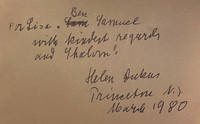
1979ref. 32820372FIRST EDITION. Presentation copy inscribed by Einstein's longtime assistant Helen Dukas: "For Lisa Ben Samuel with kindest regards and Shalom Helen Dukas Princeton N.J. March 1980." Helen Dukas became Einstein's secretary in 1928 and after his death in 1955 served as a trustee of his literary estate and archivist of his papers. This volume prints letters and documents selected by Dukas over the years to shed light on Einstein's character and personality. Original cloth and dust jacket. Some rubbing to jacket else very good. Princeton: University Press
1950ref. 6682New York: Philosophical Library 1950. First edition. Very Good in pretty good dust jacket. 21 cm; 279 pages portrait frontispiece. Turquoise cloth in plain cream-colored dust jacket. Dust jacket chipped at top of spine. Of the variant dust jackets and issues this is the one with the fewest number of titles advertised on the rear and the price of $4.75 on the inside flap. Philosophical Library hardcover
1925ref. 79Paris: Gauthier-Villars 1925. First French edition of Zur Elektrodynamik bewegter Korper On the Electrodynamics of Moving Bodies and 1st die Tragheit eines Korpers von seinem Energieinhalt abhangig Does the Inertia of a Body Depend on its Energy Content. Both 1905 treatises are "beyond compare and without precedent one of the greatest scientific achievements in content and one of the most brilliant in style" Gosling Albert Einstein. The first paper is "a landmark in the development of physics one of the two papers that laid out the theory of special relativity formulated a new conception of time. By assuming that the speed of light is the same to every observer moving at a constant velocity Einstein showed that space and time were not independent: spacetime was born. According to Hermann Weyl in 1918 this theory 'led to the discovery that time is associated as a fourth coordinate on an equal footing with the other three coordinates of space and that the scene of material events the world is therefore a four-dimensional metrical continuum.' It was a revolutionary piece of scientific work" Calaprice The Einstein Almanac 15. In the second work Einstein uses "the postulates of the special theory of relativity Einstein showed that energy radiated is equivalent to mass lost. For the first time he concluded that 'the mass of a body is a measure of its energy content'" ibid 16. CONDITION & DETAILS: Paris: Gauthier-Villars 1925. Small 8vo. 4 56 2 6 catalog. ILLUSTRATION: Frontispiece portrait of Einstein. EXTERIOR: Complete issue bound in original light brown stiff wraps. Some light surface dirt on the front wraps and a small area in the lower right where a piece of tape has been removed. Two barely visible repairs at the spine. Tightly bound. INTERIOR: Complete. Very small spot at the upper margin of page 3. Otherwise very good condition throughout. Gauthier-Villars paperback
1938ref. 055294New York: Simon and Schuster 1938. First Edition First Printing. Hardcover. Good/Good. A Good or slightly better copy 1938 owner's name in blue cloth lettered and decorated in gold in an edge-rubbed Good dust jacket with a damp-stain at the lower spine visible on the verso only and not the book. Mild cover wear clean/unmarked within. The first edition/first printing. Not ex-library. Simon and Schuster hardcover
1978ref. 74014Chicago Institute for Psychoanalysis 1978. paperback. very good condition with a bit of wear and a bit of fading around the spine. shipping via UPS Chicago Institute for Psychoanalysis paperback
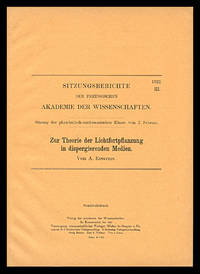
1922ref. 1648Berlin: Verlag der Akademie der Wissenschaften 1922. 1st Edition. FIRST EDITION COMMERCIAL OFFPRINT ISSUE OF EINSTEIN'S THEORY OF THE LIGHT PROPAGATION IN DISPERSIVE MEDIA. WEIL 120. "After 1917 Einstein firmly believed that light-quanta were here to stay thus it is not surprising that he would look for new ways in which the existence of photons might lead to observable deviation from the classical picture. In this he did not succeed. At one point in 1921 he thought he had found a new quantum criterion but it soon turned out to be a false lead as demonstrated in this paper" Schilpp-Shields 162. That paper - the one offered here - is Einstein's evidence that his 1921 efforts were incorrect. In it Einstein introduces a calculation on the topic and explains why his earlier proposed experiment had not been well considered because it could not predict a good choice between two theoretical alternatives" Calaprice Einstein Encyclopedia 98. CONDITION & DETAILS: Berlin: Koniglich Akademie der Wissenschaften. Commercial offprint from Sitzungsberichte der Koniglich preussischen Akademie der Wissenschaften III 1916 pp. 18-22. Octavo 252 x 179 mm. Original printed wrappers. Pristine inside and out. Fine. Verlag der Akademie der Wissenschaften unknown
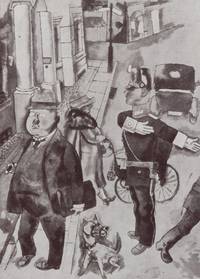
1926ref. 39022Berlin: Das Kunstarchiv Verlag 1926. First edition. Softcover. g. Quarto. 36pp. Original printed wrappers. Catalog published on the occasion of an exhibition of paintings and drawings by George Grosz held during the Spring of 1926 in Berlin at the Galerie Alfred Flechtheim. This catalog features 24 duo-tone and b/w photographic reproductions. Includes a poem by Gottfried Benn and four essay on the artist and his work by Carl Einstein Marc Neven Max Herrmann and Florent Fels. Some age-wear and moderate soiling on wrappers. Upper corners bumped thus slightly affecting pages throughout. Text in German gothic script with one of the four essays in French. Wrappers in overall good- to good interior in good to very good condition. Alfred Flechtheim 1878-1937 was a German art dealer art collector journalist and publisher. Flechtheim appeared in the art world shortly after 1900 with a collection of paintings by Vincent van Gogh and Paul Cézanne; French Avant garde early works of Pablo Picasso Georges Braque and André Derain; paintings of Wassily Kandinsky Maurice de Vlaminck Alexej von Jawlensky Gabriele Münter and the Rhein Expressionists Heinrich Campendonk August Macke Heinrich Nauen de and Paul Adolf Seehaus de. Flechtheim opened his first gallery in Düsseldorf in 1913 followed by galleries in Berlin Frankfurt Cologne and Vienna. Flechtheim served in the German Army during World War I but not at the front. His art business collapsed during the war but he re-opened in Düsseldorf in 1919. In 1921 he founded "Der Querschnitt" the Cross Section a cultural magazine. Legendary glamorous parties in Flechtheim's gallery overflowed with the glitterati of the new Berlin: movie stars titans of finance prizefighters and artists of every stripe. As Hitler rose to power in the late 1920s and early 1930s Flechtheim became a bête noire because of the art he espoused and championed. In 1933 Sturmabteilung men broke up an auction of Flechtheim's paintings. The Nazis aryanized Flechtheim's gallery as they would many other Jewish businesses and turned it over to Flechtheim's business manager Alex Vömel. After the war former party member Vömel said he didn't even remember who Flechtheim was. The Nazis seized and sold off Flechtheim's private collection as well as the contents of his gallery. Emigration and Death Six months after the Nazis came to power in 1933 Flechtheim penniless fled to Paris and tried to find work with his former business partner Daniel-Henry Kahnweiler. Flechtheim subsequently organized exhibits in London of the paintings of exiled German artists. In London Flechtheim slipped on a patch of ice was taken to a hospital punctured his leg on a rusty nail in his hospital bed developed septicemia leading to amputation of his leg and died. Das Kunstarchiv Verlag unknown
1924ref. 25388London:: Methuen 1924. Second edition revised and enlarged. publisher's cloth in dust jacket. . Very good or better in a jacket with an L-shaped closed split at the bottom of the jacket spine a label had been removed from the bottom of the spine which has skinned a few of the letters in the imprint; also there is some splitting along folds. An uncommon book in jacket. . 8vo. With a Preface by Albert Einstein. Methuen, hardcover
ref. 51-3457Leipzig: Klinghardt & Biermann 1922. Original pictorial boards tear along linen spine. 8vo. 16pp and unnumbered plates.Signed presentation copy "à mon cher Thadé Bloch . . . St. Tropez le 24 II 1923. Part of a collection from his friend Thadé Thódore Tadé Bloch. Leipzig: Klinghardt & Biermann, 1922 hardcover
1994ref. 331851Norwalk Connecticut: Easton Press 1994. First Edition; First Printing. Hardcover. Near Fine Leather Bound. Printed on archival paper with gilded edges. The endsheets are of moire fabric with a silk ribbon page marker. Smyth sewing and concealed muslin joints to ensure the highest quality binding. This book is in full leather with hubbed spines.; Collector's Edition. Easton Press hardcover