Albert EinsteinBiblio.com
1,909 results
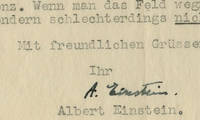
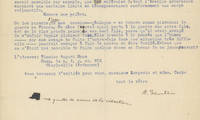
ref. 342445/11/19. A remarkable letter before his great fame referencing and shown to Marie Curie Einstein who helped free so many from the jaws of Nazism makes an impassioned plea for a World War I German POW in France who would escape but later die in the Holocaust In 1905 while a young patent clerk and physicist in Bern Switzerland Albert Einstein obtained his doctorate and published a paper that explained his newly developed Special Theory of Relativity. This unlocked many mysteries of the universe and introduced the world to the idea equating mass and the speed of light with energy which we know today as e=mc2. Einstein's insight and one element that distanced his work from that of Newton was to recognize that mc2 was the proper energy of mass the energy associated with that mass and was independent of its motion. Mass must be measured in this way as resting mass. This was a foundation of e=mc2. The breakdown of molecules therefore released energy. This energy is often used by cells to perform work such as powering movement. In the early years of the 20th century thanks to the development of mass spectrographs science had acquired the capacity to ""weigh"" atoms with extreme precision. Indeed Einstein provided the theoretical explanation for Brownian motion while French Chemist Perrin experimentally verified Einstein's theory solidifying the evidence for the existence of atoms. Scientists among them Perrin noted that when comparing the mass of a helium nuclei to that of the four elementary nuclei it was made of there was a slight discrepancy—one helium atom was slightly lighter than four hydrogen atoms; in other words the whole was smaller than the sum of the parts. Where did the missing mass go Einstein knew the answer: in accordance with his famous E=mc_ equation a tiny fraction of the mass had been transformed into a formidable quantity of energy. <img class=""alignnone wp-image-34256 size-post-window"" src=""https://cdn.raabcollection.com/wp-content/uploads/20250724151316/Einstein-Nov-1919-1-1600x709.jpg"" alt="""" width=""1600"" height=""709"" /> The French mathematician Paul Langevin understood the formidable source of energy that resulted from these ""transmutations."" But it was Jean Perrin a professor of physical chemistry in Paris who first proposed in 1919 that the fusion of hydrogen into helium was the energy source of the Sun and stars accounting for the billions of years of sunshine past and the billions of years to come. During this time radiation studies too were in their infancy. Marie Curie famously decided to do her thesis on radiation recently discovered in uranium by Henri Becquerel. She found that an ore containing uranium was far more radioactive than could be explained by its uranium content. This led her and her husband Pierre to the discovery of a new element that was 400 times more radioactive than uranium. In 1898 it was added to the Periodic Table as polonium named after Curie’s birth country. Then Curie discovered an even more radioactive element radium and through observation of radium made a fundamental discovery: Radiation wasn’t dependent on the organisation of atoms at the molecular level; something was happening inside the atom itself. The atom was not as scientists believed at the time inert indivisible or even solid. This discovery led to an overlapping one: At the time people did not know what powered the Sun. Many however thought it was Radium. Perrin was one of those who believed this. His hypothesis borrowing from E=MC2 was that radiation in the form of Radium was emanating from bodies like earth causing the breakdown of molecules on the Sun and that the breakdown was powering the Sun and other stars. In 1919 Perrin sent to Einstein his new publication proposing this theory. Einstein's response notes the breakdown of molecules and the released energy can likely be accomplished by other means than radiation. He uses the mathematical equation for the breakdown of one molecule into atoms. He references a first order reaction a chemical reaction where the rate of the reaction is directly proportional to the concentration of only one reactant. In simpler terms if you double the concentration of that reactant you double the reaction rate. A common example is radioactive decay. And he gives his best to the Madame Curie. Einstein had last met in Paris with Perrin Pierre Langevin Professor of Experimental Physics at the Collège de France and Curie then Professor of Physics at the Sorbonne on the occasion of Einstein’s lecture to the French Physical Society in late March 1913. They first met at the Solvay Congress in Brussels in autumn 1911. At the same time Einstein who helped so many Jews escape Germany during World War II had a distant cousin the geologist August Moos who had volunteered in the German infantry at the start of the First World War in 1914. After being taken prisoner in 1915 he made several attempts to escape which resulted in a sentence that prevented his release after the armistice of 1918. His mother asked for help from Einstein who turned to his friend Perrin as well as mathematician and statesman Paul Painlevé asking them to intercede. Moos was finally released in February 1920. He would work as an oil geologist in the interwar period before being tragically arrested due to his Jewish heritage under the Nazi regime. Moos would die in the Buchenwald concentration camp during World War II. Typed letter signed in French signed “A. Einstein"" November 5 1919 to Professor Jean Baptiste Perrin who would go on to win the Nobel Prize for Physics in 1926 for his work on the atomic structure of matter. ""Dear Perrin! I received your publications and thank you cordially. Your opinion of the primary importance of radiation for all chemical reactions still seems to me dubious even if it was certain which it is not that reactions of the type J_ - JJ added by hand are of the first order. It would be possible for example that J_ molecules whose internal energy exceeds a certain limit would decompose in accordance with radioactive bodies. ""One more prayer. One of the parents of one of my cousins—a geologist—is a prisoner of war in France. His widowed mother having lost her other son in the war is in the greatest pain for her only son since he had tried to flee several times. She shudders at the thought that the man—through his old efforts to flee in a very difficult situation—might try to flee again and be shot. Wouldn't it be possible to do something for this young scholar"" He goes on to give the address of August Moos held in Charleville Ardennes and concludes by offering his ""many friendships for you Mr. Langevin and Madame Curie."" Below he notes an ink spill draws an arrow and writes ""drop of editorial sweat from editing."" Perrin responded the very same day confirming that he believed rays from Earth were breaking down molecules in the sun and that he assumed the first order nature of the reaction. In other words he did not agree with Einstein that radiation was not breaking down molecules releasing energy and powering the sun. ""I do indeed believe that I2 Einstein used J but Perrin used I decomposes like radioactive bodies and I devoted a chapter of my work to this but precisely on the conviction that radioactive bodies like I2 are decomposed by light for radium ultra-short X rays emanating from the Earth at _ = 10–11 light which suddenly increases the internal energy. I read your letters to Mrs. Curie and to Langevin. They too send you their very best regards."" Perrin and In addition to this important family and political content Einstein comments on a theory that Perrin had developed in which all chemical transformations including radioactive decay are triggered by radiation calling it ""dubious."" Also significant is the date: one day before the official report of Eddington's expedition debuted before the Royal Society of London confirming Einstein's theory of general relativity. Widespread newspaper coverage of the results vaulted Einstein into immediate international fame. An altogether remarkable letter from one Nobel Prize winner to another shown to yet a third and using the chemical equation for the breakdown of molecules into atoms in his own hand. <img class=""alignnone wp-image-25018 size-post-window"" src=""https://cdn.raabcollection.com/wp-content/uploads/20231204144051/Folder-site-11-1600x1327.jpg"" alt="""" width=""1600"" height=""1327"" /> unknown
ref. 184029/9/54. The fullest summation we have seen by Einstein comparing relativity to Newtonian concepts of space and time Immanuel Kant took both Euclidean geometry and the Newtonian laws of motion to be synthetic a priori principles which from Kant’s point of view function as necessary presuppositions for applying our fundamental concepts of space time matter and motion to our sensible experience of the natural world meaning they are fixed necessary conditions. This idea rested on the absolute nature of space and time the work of Newton and the relationship between geometry and physics. In 1905 while a young patent clerk and physicist in Bern Switzerland Albert Einstein obtained his doctorate and published a paper that explained his newly developed Special Theory of Relativity. This unlocked many mysteries of the universe and introduced the world to ""e=mc2"" equating mass and the speed of light with energy. It established that time and space are not fixed and in fact change to maintain a constant speed of light regardless of the relative motions of sources and observers. Just 10 years later in 1915 Einstein published his General Theory of Relativity which described the universe as a four-dimensional continuum with time added as the fourth dimension where gravitational effects are explained by the warping of space-time. In this theory Einstein incorporated gravity as a geometric property of space-time. The impact of Einstein's work between 1905 and 1915 challenged many principles of physics that had been accepted for centuries. In 1921 he won the Nobel Prize for his work. Time Magazine named him the Person of the Century for the 20th century for his discoveries in relativity and space-time. Einstein is the most important scientist since Isaac Newton and probably the most famous in history. Space and time were considered relativistic more subjective and not the fixed a priori notions that had long permeated the mathematical and scientific worlds. Max Fischler was a California scientist who was interested in the implications of this distinction: were space and time now to be studied together in this context only or were the nature of space and the nature of time different In special relativity what appears simultaneous to one person might not to another - they are relative. You cannot separate space and time; they occur subjectively and semi-dependently but are not tied to the content of that space. With General Relativity space-time remains but matter warps it. It's a field like the sheet of a trampoline but reacts to matter. One needs all four dimensions of space-time and without them the others don't exist. You need matter for space. On September 5 1954 he wrote to Einstein: "".Can anything in your theory of Relativity be said to throw new light on the nature of space and time themselves Or must we rest satisfied with the purely new logical treatment of these conceptions In other words does the new view of space and time as space-time carry any new meaning ontologically beyond the purely mathematical and logical relationship between the two. Or to put it differently: When Minkowski in his famous words said 'Space by itself and time by itself must not sink into the mere shadows and only a kind of union of the two can preserve an independent existence' did he not attach some new real meaning to the 'spacetime' which the old independent notions of space and time could not convey If so in what does this new meaning consist."" Four days later Einstein replied in this letter: Typed letter signed in German on his personal blind embossed letterhead Princeton September 9 1954 to Max Fishler. ""The expression cited in the second paragraph only signifies the wish for logical clarity in the formal expressions. De facto the justification for concepts lies in their ability to comprehend the empirically given. ""In classical mechanics space and time were completed existences which had to be presupposed as real a priori in order to give meaning to the laws of motion. It was a reality in the same sense as the reality of matter; even governing the latter. In this sense Kant was entirely wrong. ""The case was the same as regards the Special Theory of Relativity only that an objective separation of space and time was abandoned in the sense that there could no longer be any objective simultaneity. Here too the four dimensional space is a reality independently of the physical content of space. ""Regarding the General Theory of Relativity however this is principally different. What we call ""space"" is here only an extension of a Field dimensionality hence no longer independent of the content of space. It is real in the same sense as matter but has no real existence independently of matter. When the field is taken away there does not remain any space but just nothing.” Letters of Einstein directly relating to relativity are increasingly uncommon and this is one of the finest such letters we have had. unknown
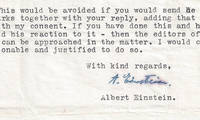
1702ref. 1536217/02/1953. In this letter from Einstein to David Bohm Einstein discusses the importance of connecting a key principle of the relatively new theory of quantum mechanics the “Born interpretation” to physical quantities that can be measured in the real world. To him it is essential that mathematical theories be connected to measurable quantities. In this letter Einstein’s uneasiness with quantum mechanics is apparent saying that validation of the seemingly random quantum mechanics “…can only be done on the basis of classical mechanics.” Without this validation quantum theory has essentially “no controllable meaning.” <img class=""alignnone wp-image-22637 size-post-window"" src=""https://cdn.raabcollection.com/wp-content/uploads/20231204163327/Einstein-born-2-e1639117238988-1600x656.jpg"" alt="""" width=""1600"" height=""656"" /> Max Born was a renowned physicist who was crucial for the development of quantum mechanics and also the Ph.D. supervisor of many important physicists including J. Robert Oppenheimer. Quantum mechanics describes the weird behavior of tiny subatomic particles. It’s also the guiding theory that led to critical technologies like nuclear power MRI machines and transistors in computers and phones. One of Born’s biggest contributions to quantum mechanics was the interpretation of the probability density which is a mathematical operation performed on the “psi-function” in Einstein’s words to predict the most probable physical quantities of a quantum particle. Einstein believed that probabilities only make sense if you can determine the values that they predict independently by measurement. This is easy to do in classical Newtonian mechanics the physics of big things in everyday life. But Einstein said we can’t measure it for something like a “bound electron” i.e. an electron in an atom. In order to interpret Born’s probability density function you need to connect the mathematics to real values. Einstein’s correspondence with Born on this subject is published and famous. To Einstein the universe is observable and measurable. When confronted with one of the principle tenets of Quantum Mechanics Einstein remarked now famously “Quantum mechanics is very imposing. But an inner voice tells me that it is not the real McCoy. The theory delivers a lot but hardly brings us closer to the secret of the Old One God. I for one am convinced that He does not throw dice.” This statement was made in one of those significant letters to Born. What he meant here is that rules of science cannot be random and in the rolling of dice we would have to accept unknown variables and therefore be unable to predict precisely via objective measurements. Therefore in Quantum Mechanics as in gambling an uncertainty of measurement exists. And to Einstein the universe is observable and measurable. He did not object to Quantum Mechanics per se; indeed he made notable contributions. But he eschewed any reliance on what was not observable and knowable. <img class=""alignnone wp-image-22634 size-post-window"" src=""https://cdn.raabcollection.com/wp-content/uploads/20231204163356/Einstein-born-5-e1639117103621-1600x616.jpg"" alt="""" width=""1600"" height=""616"" /> David Joseph Bohm was an American scientist who has been described as one of the most significant theoretical physicists of the 20th century and who contributed unorthodox ideas to quantum theory neuropsychology and the philosophy of mind. His first book Quantum Theory published in 1951 was well received by Einstein among others. But Bohm became dissatisfied with the orthodox interpretation of quantum theory he had written about in that book.Bohm’s aim was not to set out a deterministic mechanical viewpoint but to show that it was possible to attribute properties to an underlying reality in contrast to the conventional approach. He began to develop his own interpretation the De Broglie–Bohm theory also called the Pilot wave theory the predictions of which agreed perfectly with the non-deterministic quantum theory. He initially referred to his approach as a hidden variable theory. Bohm originally hoped that hidden variables could provide a local causal objective description that would resolve or eliminate many of the paradoxes of Quantum Mechanics the measurement problem and the collapse of the wavefunction. However Bell’s theorem complicates this hope as it demonstrates that there can be no local hidden variable theory that is compatible with the predictions of Quantum Mechanics. The Bohmian interpretation is causal but not local. Albert Einstein who had suggested that Bohm search for a realist alternative to the prevailing Copenhagen approach did not consider Bohm’s interpretation to be a satisfactory answer to the quantum question. The Copenhagen interpretation is an expression of the meaning of Quantum Mechanics that was largely devised in the years 1925 to 1927 by Niels Bohr and Werner Heisenberg. It remains one of the most commonly taught interpretations of Quantum Mechanics. According to the Copenhagen interpretation physical systems generally do not have definite properties prior to being measured and Quantum Mechanics can only predict the probabilities that measurements will produce certain results. The act of measurement affects the system causing the set of probabilities to reduce to only one of the possible values immediately after the measurement. In classical mechanics a particle has at every moment an exact position and an exact momentum. These values change deterministically as the particle moves according to Newton’s laws. Under the Copenhagen interpretation of Quantum Mechanics particles do not have exactly determined properties and when they are measured the result is randomly drawn from a probability distribution. The Schrödinger equation predicts what the probability distributions are but fundamentally cannot predict the exact result of each measurement. <img class=""alignnone wp-image-22633 size-post-window"" src=""https://cdn.raabcollection.com/wp-content/uploads/20231204163406/Einstein-born-e1639117155596-1600x360.jpg"" alt="""" width=""1600"" height=""360"" /> Typed letter signed on his blind embossed letterhead February 17 1953 Professor Bohm. “Dear Bohm: I thank you very much for the prompt reaction to my little article. I did of course not expect that you would agree with me. For scarcely anyone is inclined to abandon an enterprise in which le has invested a great deal of work. “I do not want to answer your letter in detail although it deserves it very much. Only a short remark concerning the interpretation of Born’s standpoint: “According to Born the physical meaning of the psi-function follows: it determines probabilities f.i. for the value of impulses. this makes sense only if the impulse is defined independently of the mathematical theory by some feasible measurement. This can only be done on the basis of classical mechanics. F.i. if one has calculated the impulse of a bound electron on the basis of a psi-function then this result has no controllable meaning. For there is no possibility to measure such a thing not even approximately. However if one has to do with a makro-object which is at least temporarily approximately free then one is able to determine experimentally at least approximately its impulsef.i. through two successive snapshots or through radar. If it is at all possible to attribute meaning to Born’s interpretation then the impulse the probability of which appears in the theory has to be put equal to the impulse thus measured. Classical approxi_mate measurement of the impulse is however in my example very well feasible without first removing the walls and then waiting some time. Born’s probability therefore has to be interpreted as relative to the impulse thus measured if this probability is to have any meaning at all. “The vanishing of position-probability for the nodes offers no difficulty though it is true that this fact excludes the interpretation of the process as a motion in the strict sense of the word. For the factual process will only approximately be describable as a motion as f.i. the action of a gas upon a small part of the wall is describable only approximately by the concept of pressure. “With regard to the publication of your remarks in the Born volume I have some scruples the reason for which you will readily understand. I have sent a copy of my article to you but not to de Broglie because this would have seemed to me somewhat pretentious. If therefore your answer would be published together with my remarks without de Broglie having had the possibility to do the same he might feel it as an unkindness from my side. “This would be avoided if you would send De Broglie my remarks together with your reply adding that you do this with my consent. If you have done this and have received his reaction to it – then the editors of the Born volume can be approached in the matter. I would consider it as reasonable and justified to do so.” <img class=""alignnone wp-image-22636 size-post-window"" src=""https://cdn.raabcollection.com/wp-content/uploads/20231204163341/Einstein-born-3-1-e1639117201589-1600x672.jpg"" alt="""" width=""1600"" height=""672"" /> This is a remarkably detailed scientific letter mentioning numerous significant physicists containing a hand-drawn symbol and directly relating to his important theories. It is also in a sense his defense of his own work including relativity. unknown
1943ref. 2376Princeton NJ: np 1943. First edition. nb. Fine. EINSTEIN OFFERS STRONG AND PRESCIENT WORDS OF ENCOURAGEMENT TO THE LEADER OF THE NAACP IN THE FIGHT AGAINST RACIAL SEGREGATION AND DISCRIMINATION IN THE UNITED STATES. Background: Einstein's fight against racial discrimination in the United States: The imperative "to protect the rights of the individual. was Einstein's most fundamental political tenet. Individualism and freedom were necessary for creative art and science to flourish. Personally politically and professionally he was repulsed by any restraints. "That is why he remained outspoken about racial discrimination in America. As a Jew who had grown up in Germany Einstein was acutely sensitive to such discrimination. 'The more I feel an American the more this situation pains me' he wrote in an essay called 'The Negro Question' for the January 1946 issue of Pageant magazine. 'I can escape the feeling of complicity in it only by speaking out.'" Isaacson Albert Einstein 505. Even more directly in his 1946 commencement speech to Lincoln University the first degree-granting Historically Black College and University HBCU in the United States Einstein strongly denounced segregation as "an American tradition which is uncritically handed down from one generation to the next" noting that "There is separation of colored people from white people in the United States. That separation is not a disease of colored people. It is a disease of white people. I do not intend to be quiet about it." This remarkable letter - from 1943 - is one of the earliest examples of his interest in condemning racism in the United States. The letter: Dated 22 September 1943 and handwritten on his embossed Mercer Street Princeton letterhead Einstein writes in English to Walter F. White the enormously influential African-American civil rights leader who led the NAACP from 1929-1955 praising him for his work and revealing his own awareness of and frustrations with racism and prejudice in America. The text reads in full: Dear Mr. White: I have been quite impressed by the address you delivered some years ago at a meeting of the Princeton Branch of the National Association for the Advancement of Colored People. I know how hard it is to awaken the conscience even of good-hearted and well-meaning people when deep rooted prejudices are in the way. It is a great work indeed which you are doing relentlessly for the betterment of the living conditions of our Colored fellow-citizens for justice and for the accomplishment of national unity of the American people. With sincere respect and kind wishes Yours Albert Einstein ------------- On April 28 1940 White was the keynote speaker at "an inter-racial meeting sponsored by the Princeton branch of the National Association for the Advancement of Colored People" where his topic was "What Happens to Democracy When It Encounters the Color Line." Princeton Herald April 26 1940. At the time Princeton did not admit African Americans and the community was debating the question of whether or not to end segregation at the university. Princeton in fact did not admit its first African-American student until the fall of 1947. Einstein - writing in 1943 - notes that he heard White speak "some years ago". Something clearly must have deeply impressed Einstein about White's speech for him to write this thoughtful letter to White over three years after the event. Note: In addition to its content this apparently unpublished letter is also remarkable for being one of the very few letters Einstein hand-wrote in English during this period as German was still very much his preferred tongue. Princeton: September 22 1943. One page on Einstein's embossed Mercer Street Princeton letterhead 7.25x10 in visible handsomely matted and framed with a photograph of Einstein. Fine condition. np unknown
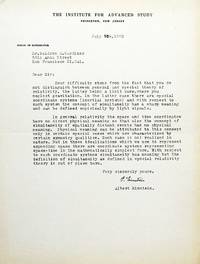
1952ref. 3091Princeton: np 1952. First edition. no binding. Very Good. EXTRAORDINARY EINSTEIN LETTER IN ENGLISH EXPLAINING SIMULTANEITY ONE OF THE CENTRAL TENETS OF RELATIVITY THEORY. Einstein's "1905 paper on special relativity is widely regarded as having destroyed the classical conceptions of absolute time and space along with absolute simultaneity and absolute length which had reigned in physics from the times of Galileo and Newton to the dawn of the twentieth century. The Special Theory teaches us that simultaneity is not as we supposed an absolute concept but is always relative to some inertial frame of reference. If we change the inertial frame of reference we change the events to be reckoned simultaneous." -Craig and Smith Einstein Relativity and Absolute Simultaneity The concept of simultaneity lies at the core of relativity theory. The very first sub-section of Einstein's legendary 1905 paper on Special Relativity is introduced by the title "Definition of Simultaneity" and "in the second paragraph of his 1905 relativity paper Einstein proved that simultaneity as defined in the first paragraph is a relative concept. This means as Einstein explained that 'we must not ascribe absolute meaning to the concept of simultaneity; instead two events that are simultaneous when observed from some particular coordinate system can no longer be considered simultaneous when observed from a system that is moving relative to that system.' In these words Einstein for the first time offered an explicit definition of what he means when he speaks of a relative concept. As we see it is a concept whose validity depends on the coordinate system chosen or in brief it is a frame-dependent concept. Simultaneity is no longer a binary relation depending also on the coordinate-frame involved. Furthermore Einstein's proof of the relativity of simultaneity in this paragraph is the first ever published rigorous proof of the relativity of a physical concept. The relativity of simultaneity became also the first major subject of dispute between proponents and opponents of the theory of relativity" Max Jammer Concepts of Simultaneity: From Antiquity to Einstein and Beyond. When Einstein expanded his relativity theory into his General Theory of 1916 the notion of simultaneity became less well-defined and more problematic and therefore much-debated. Einstein in the present letter is answering a question from Dr. Waldron Gardiner a physician apparently without any particular expertise in relativity theory about the concept of simultaneity in space the domain of general relativity. Dated July 10 1952 the letter reads in full: Dear Sir: "Your difficulty stems from the fact that you do not distinguish between general and special theory of relativity the latter being a limit case where you neglect gravitation. In the latter case there are special coordinate systems inertial systems and with respect to such system the concept of simultaneity has a sharp meaning and can be defined empirically by light signals. In general relativity the space and time coordinates have no direct physical meaning so that also the concept of simultaneity of spatially distant events has no physical meaning. Physical meaning can be attributed to this concept only in certain special cases which are characterized by certain symmetry qualities. Such case is not realized in nature. But in those idealizations which we use to represent expanding space there are coordinate systems representing space-time in the mathematically simplest form. With respect to such coordinate systems simultaneity has meaning but the definition of simultaneity as defined in special relativity theory is out of place here. Very sincerely yours SignedA. Einstein PrintedAlbert Einstein In short Einstein is explaining to Dr. Gardiner that since "space and time coordinates have no direct physical meaning" in cosmological terms i.e. there are no frames of reference that cover all of space his understanding of simultaneity in general relativity is flawed and based on the model of special relativity "a limit case" achieved only through a reductive and localized application of general relativity. Einstein concludes the letter with the provocative comment that in idealized systems representing expanding space simultaneity has meaning and in fact this "meaning" of simultaneity in general relativity has become a fertile area of exploration over the years see Jammer ibid. Note: A carbon of Dr. Gardiner's original letter to Einstein is included. Princeton: July 10 1952. One 8.5 x 11 inch page of Einstein's Institute for Advanced Study letterhead. Signed "A. Einstein" in ink. Date corrected from July 9th to July 10th. Usual but very light folds small spot of soiling at top left corner; a tiny bit of toning to extreme edges. Housed in custom presentation folder. LETTERS BY EINSTEIN DISCUSSING MAJOR ELEMENTS OF RELATIVITY PARTICULARLY IN ENGLISH ARE EXCEEDINGLY RARE. np unknown
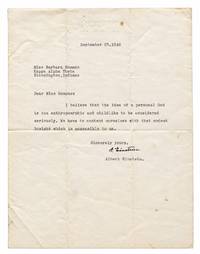
1948ref. 3094Princeton: np 1948. first edition. Very Good. ONE OF EINSTEIN'S MOST DIRECT STATEMENTS ON GOD: A POWERFUL AND CONCISE PRECURSOR TO HIS CELEBRATED "GOD LETTER". In the letter dated September 25 1948 and addressed to the Indiana University student Barbara Homans Einstein writes: "I believe that the idea of a personal God is too anthropomrphic sic and childlike to be considered seriously. We have to content ourselves with that modest insight which is accessible to us." The letter is a strikingly concentrated statement of Einstein's religious philosophy. In two sentences he rejects the notion of an anthropomorphic personal deity while setting against it a characteristically modest view of human knowledge: rather than claiming access to metaphysical certainty "we have to content ourselves" with the limited understanding available to us. That formulation places the letter squarely within one of the most important recurring themes of Einstein's later correspondence: his distinction between conventional belief in a personal God and his own sense of awe before the rational order of the universe. Six years later in his famous letter to the philosopher Eric Gutkind of 3 January 1954 Einstein would return to the same subject in far greater detail describing the word "God" as an expression of human weakness and rejecting traditional religious conceptions with exceptional directness. Christie's described the Gutkind letter as Einstein's most fully articulated statement of his religious and philosophical views; it sold in 2018 for $2892500 at Christie's. The present letter is remarkable because the essential position of the later "God Letter" is already present here in distilled form. The shared target is the anthropomorphic personal God: a conception Einstein repeatedly rejected while maintaining that a profound sense of wonder before the structure of nature could still be called religious. It is a direct statement of Einstein's mature religious philosophy anticipating the central argument of the 1954 "God Letter" by more than five years. Typed letter signed "A. Einstein" to Barbara Homans. Princeton 25 September 1948. One page 8 1/2 x 11 in typed on Einstein's Princeton stationery with embossed address at head; signed "A. Einstein" in ink. Folded for mailing with light toning and a few small stains. np unknown
1880ref. 24284A unique and important artifact of his childhood. ALBERT EINSTEIN. Ephemera. Set of Anker-Steinbaukasten children's building blocks by F. Ad. Richter & Cie. Rudolstadt Germany c.1880s. Approximately 160 composite quartz sand chalk and linseed oil blocks in red limestone and slate gray in various sizes and shapes together with three or more sets of building plans all contained in two wooden boxes with printed Anker-Steinbaukasten labels. Einstein spent his childhood building "complicated structures" with these Anker-Steinbaukasten blocks. Accepting his later theory that "Imagination is more important than knowledge" the toys that encouraged his imagination became building blocks for the most important scientific theories of the last millennium. His sister Maja Winteler-Einstein describing his childhood recalled that "The games he played … were very characteristic of Albert's capacities. These were mostly puzzles fretsaw work the erection of complicated structures with the well-known Anker building blocks and above all the construction of multi-storied card castles with which he filled his leisure." "Beitrag für sein Lebensbild" in The collected papers of Albert Einstein. ed. John Stachel. Volume 1: The early years. 1879-1902. Princeton University Press 1987 p.lix. Translated from German. Based on the work of German educator Friedrich Froebel who created the concept of kindergarten these composite stone blocks were a popular toy of the 1880s and 1890s. The blocks were designed to help develop childrens' tactile senses and manual dexterity and also to stimulate imagination creativity and three-dimensional perception. Fellow scientist J. Robert Oppenheimer as well as architects Frank Lloyd Wright and Walter Gropius are among the geniuses who are known to have played with Anker blocks. Provenance The set had passed by direct descent from Albert Einstein to the consignor from whom we acquired the blocks at Christie's London on July 13 2016. Condition A few blocks chipped and worn with original instructions and boxes worn soiled and defective. Albert Einstein 1879-1955 was a German-Swiss born theoretical physicist internationally recognized as one of the greatest physicists of all time. He enunciated the general theory of Relativity with law explaining the relationship between the speed of light and its consequence the equivalence of mass and energy E=MC2. For his work in theoretical physics—largely for his 1905 paper on photons and photo-electricity—Einstein was awarded the Nobel Prize for Physics announced in November 1922 retroactive for 1921. Working on a unified field theory he then attempted to explain gravitation and electromagnetism within one set of laws. With the expulsion of Jewish scholars from Germany after Hitler's rise to power Einstein joined the Institute for Advanced Study in Princeton New Jersey 1933 which became the most celebrated research center in the world. In 1939 he signed a letter written to President Franklin Roosevelt warning him of the possibility of Germany developing a nuclear bomb. He urged the U.S. to begin uranium research thus beginning the top secret "Manhattan Project." Later at Princeton he tried to develop a unified field theory and to refute the accepted interpretation of quantum physics both unsuccessfully. Einstein received U.S. citizenship in 1940.
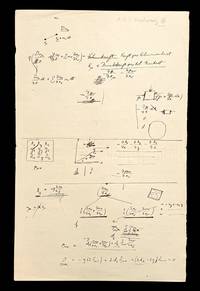
1912ref. 3056np: np 1912. first edition. custom box. Very Good. ON THE ROAD TO RELATIVITY: A four-panel working bifolium from Einstein's early post-Minkowski tensor phase. A remarkable working sheet showing Einstein making tensor formalism physically operational for continuum mechanics. Across three working zones the manuscript moves from a formal four-dimensional tensor transformation identity written in a distinct unidentified hand to Einstein's own derivations involving Volumenkraft Druckkraft stress force density diagrammatic testing and a heavily underlined mechanical equilibrium result. The folded rotated format gives the sheet the character of a compact notebook in miniature: formal tensor language brought into contact with physical terms local force relations diagrams and repeated calculation. The manuscript's all-lower-index notation explicit summations in Einstein's hand mixed coordinate idiom second-hand tensor identity and visible effort to make tensor language mechanically operational point most naturally to the 1912-1913 Zurich tensor period when Einstein was absorbing the post-Minkowski mathematics that General Relativity would require. Later revisitations cannot be entirely excluded but they explain the sheet less naturally. A rare survival documenting Einstein's working method on one of the foundational matter-side problems on the road to General Relativity. EINSTEIN ALBERT. Autograph scientific manuscript unsigned and undated most plausibly 1912-1913. A four-panel working bifolium 330 × 210 mm open from Einstein's early post-Minkowski tensor period retained among his private research papers and annotated by Helen Dukas: "A.E.'s Handwriting H.D." Provenance: Sotheby's New York 26 June 1998; Jagdish Mehra. PLEASE CLICK ON THE LINK BENEATH THE IMAGES FOR A PDF CONTAINING THE FULL DESCRIPTION. np unknown
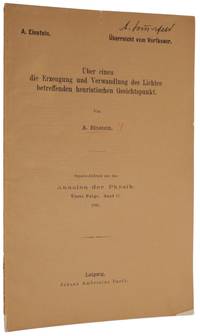
1905ref. 6412Leipzig: Johann Ambrosius Barth 1905. First edition. First edition rare author's presentation offprint 'Überreicht vom Verfasser' from the library of Arnold Sommerfeld - carrying his ink signature the red-pencil accession number '4' of his Einstein-offprint collection and his autograph pencil calculations on two pages - of the paper on light quanta and the photoelectric effect for which Einstein was awarded the 1921 Nobel Prize and the only one of his four annus mirabilis papers that he called sehr revolutionär. From Wien's radiation law he shows that the entropy of high-frequency radiation has the thermodynamic form of an ideal gas of independent quanta of energy hv and applies it to Stokes's rule photoionisation and the photoelectric effect. Sommerfeld's pencil decodes Einstein's β as h/k on p. 136 using the refined constants of Planck's 1906 Vorlesungen and on p. 146 computes Rβ/E the predicted slope h/e of the photoelectric line that Millikan would measure 1912-1916. Sommerfeld with Debye in 1913 argued the equation could be recovered without the light quantum; Compton's 1923 scattering results won him over. . Einstein's Nobel Prize Paper. First edition rare author's presentation offprint 'Überreicht vom Verfasser' from the library of Arnold Sommerfeld - carrying his ink signature the red-pencil accession number '4' of his Einstein-offprint collection beneath Einstein's printed name and his autograph pencil calculations in the margins of two crucial pages - of the paper on light quanta and the photoelectric effect for which Einstein was awarded the 1921 Nobel Prize in Physics. Of the four epochal papers Einstein produced during his annus mirabilis this is the only one he himself described as revolutionary and the one that most squarely broke with the nineteenth-century physics in which he had been trained. It is also the paper on which Thomas Kuhn built his argument that the origin of quantum theory belongs not to Planck in 1900 but to Einstein in 1905. Provenance: Arnold Sommerfeld 1868-1951 with his ink signature the red-pencil accession number '4' of his Einstein-offprint collection beneath Einstein's printed name on the front wrapper and his pencil calculations in the margins of pp. 136 and 146 with a pencilled mark on p. 145. Appointed to the chair of theoretical physics at Munich in 1906 the year after the present paper appeared he held it for more than three decades. Trained at Königsberg under Hurwitz and Lindemann he came to theoretical physics through mathematics and remained one of its greatest teachers. His Munich institute became the most important training ground in the discipline: Heisenberg Pauli Debye Bethe Ewald Landé Laporte and Morse were among his doctoral students and the institute's seminar room served as the workshop in which the old quantum theory took shape. Sommerfeld's own contributions to that theory - the quantisation of elliptical orbits the fine-structure formula the introduction of the fine-structure constant the systematics of selection rules and later the free-electron theory of metals - place him among the founders of modern atomic physics. His textbook Atombau und Spektrallinien first published in 1919 and repeatedly revised was for a generation the standard exposition of the subject. When the ageing professor was due to retire in 1936 in favour of Heisenberg the National Socialist authorities blocked the succession on the grounds that Sommerfeld and his nominee were insufficiently aligned with party science; the chair remained vacant until 1939 and passed in the end to a political appointment. Sommerfeld returned to his institute after the war and continued working until his death in a road accident in Munich in 1951. Max Born in his Royal Society obituary described him as combining classical clarity with the pioneering instinct. The red-pencil '4' on the front wrapper is one entry in a systematic accession numbering that runs in red chinagraph across Sommerfeld's collection of Einstein offprints. Thirteen numbered copies have so far been documented and their numbers are strictly chronological in the papers' publication dates: 4 on the present 1905 paper; 20 on the 1911 paper on gravitation and the propagation of light; 30 on the November 1915 'Zur allgemeinen Relativitätstheorie' with its Nachtrag; 33 and 34 on two duplicate copies of the 1916 'Hamiltonsches Prinzip' taking consecutive numbers; 36 on the 1917 'Kosmologische Betrachtungen'; and 40 44 45 46 47 48 and 49 on papers of 1923-1929 ending with the unified-field-theory series - the sequence resolved to the month even within a single year 44 on a January 1925 paper 45 on a July 1925 paper. The scheme is thus a running ledger of the collection in order of publication and the '4' identifies the present offprint as the fourth Einstein item in it implying just three earlier papers - necessarily drawn from Einstein's handful of Annalen papers of 1901-1904 - ahead of it. One of the documented copies also bears the pre-1918 stamp of Sommerfeld's Munich institute where his papers and library are recorded as having remained for decades after his death in 1951 consistent with the collection surviving intact long into the twentieth century. No published account of the Sommerfeld offprint collection exists; the reconstruction of the scheme rests on the documented copies themselves of which the present one is the earliest. Completed in Bern on 17 March 1905 and dispatched to Annalen der Physik the following day the paper was the first of Einstein's great 1905 contributions - the others being the doctoral dissertation on molecular dimensions the paper on Brownian motion and the two papers founding the special theory of relativity. Einstein was at the time a twenty-six-year-old technical expert third class at the Swiss Patent Office in Bern without academic affiliation without institutional laboratory with his doctorate not yet conferred and with a circle of scientific correspondents that ran to little more than his old Olympia Academy companions Conrad Habicht and Maurice Solovine. The regular correspondence with Planck Laue Stark Sommerfeld Wien and Lorentz that would bring him into the German-speaking academic world lay still in the future; his first surviving letter to Sommerfeld is dated 5 January 1908. The printed presentation formula on the wrapper marks the present copy as one of the small stock of author's offprints Einstein had in hand by the spring of 1905; how and when it reached Sommerfeld is not documented. Their acquaintance in fact opens over relativity rather than light quanta - the 1908 letter discusses the velocity of signals and the two men first met in person at the Salzburg Naturforscherversammlung of September 1909 - but the pencil annotations described below place the close study of this copy in precisely those years as Sommerfeld newly installed in the Munich chair of theoretical physics was turning himself and his school toward the quantum theory of radiation. Writing to Habicht in May 1905 Einstein sketched the four papers that were about to appear and reserved a particular adjective for this one alone. The first he explained concerned radiation and the energetic properties of light and was sehr revolutionär. The second determined the true sizes of atoms from the viscosity of dilute solutions. The third derived the irregular motion of small bodies suspended in a liquid from the molecular-kinetic theory of heat. The fourth still in draft would treat the electrodynamics of moving bodies and would alter as Einstein promised the theory of space and time. In that taxonomy only the light-quantum paper is singled out as revolutionary and Einstein's self-assessment has proved durable. Relativity consummated a line of nineteenth-century thought extending from Maxwell through Lorentz and Poincaré; the light-quantum hypothesis set itself against that entire line. The paper opens from a formal asymmetry that physicists had tolerated without remark. The state of a gas or any ponderable body is described by the positions and velocities of a finite if very large number of atoms and electrons so that the energy of such a body is a sum over a discrete basis. The state of an electromagnetic field by contrast is given by continuous functions in space so that in Maxwell's theory the energy of radiation is an integral over an infinite number of degrees of freedom. Einstein proposes that this asymmetry is not merely formal but physical - that radiation energy like matter may in certain circumstances behave as if it were concentrated into a finite number of localised packets. The wave theory he grants is magnificent where it applies but its predictions refer to time-averaged field values so that nothing in the experimental record rules out a granular structure on short timescales or at low densities of the radiation. The positive case for light quanta rests on a thermodynamic analogy that Einstein develops with remarkable economy. Using Wien's radiation law valid in the high-frequency tail of the black-body spectrum he writes down the entropy of monochromatic radiation of fixed frequency as a function of its volume. The resulting expression has exactly the form of the entropy of an ideal gas whose particle number equals the radiation energy divided by hv. In the Wien region in other words radiation behaves thermodynamically as a collection of independent energy quanta of magnitude hv. This simple audacious conclusion - that the entropy-volume relation of radiation is that of a gas of particles - is the paper's load-bearing result and it arrives without any appeal to detailed mechanical models of emission or absorption. From this thermodynamic footing Einstein advances to three predictions. Stokes's rule stating that fluorescent light has a lower frequency than the exciting light follows directly on the hypothesis that one absorbed quantum of energy hv can re-emit at most one quantum of no greater energy: the emitted frequency cannot exceed the absorbed frequency because the emitted quantum cannot exceed hv in energy. Photoionisation of gases by ultraviolet light follows from the condition that the ionisation energy of a molecule cannot be greater than the energy of the absorbed quantum. And the photoelectric effect in which metallic surfaces release electrons under illumination is reformulated into what became known as Einstein's photoelectric equation: the maximum kinetic energy of the ejected electron equals hv minus the work function of the metal. The linearity of electron energy in frequency and the independence of the slope from the material are predictions derived from the quantum hypothesis. It is on precisely these last two sections of the paper that the Sommerfeld copy speaks most directly. At the foot of p. 136 beside Einstein's statement of Planck's formula with the constants α = 6.10 × 10−56 and β = 4.866 × 10⁻¹¹ Sommerfeld has written in pencil β = h/κ = 6.548 × 10⁻²⁷ / 1.346 × 10⁻¹⁶ grad·sec. Einstein throughout his paper uses Planck's 1901 constants α and β without explicitly connecting them back to Planck's action quantum h and to what would later be called Boltzmann's constant k. Sommerfeld's pencil step reconstructs the bridge - Einstein's β is nothing other than the ratio h/k and 'grad·sec' is that ratio's correct unit - and the numbers he inserts identify the very book he was working from. The pair h = 6.548 × 10⁻²⁷ erg·sec and k = 1.346 × 10⁻¹⁶ erg/grad appears in exactly this form as equation 252 of Planck's Vorlesungen über die Theorie der Wärmestrahlung Leipzig 1906 p. 162 - Planck's own refinement of the rounder values of his 1901 paper - and so far as can be established nowhere else: Planck's second edition of 1913 revised the figure to 6.415 and the later determinations of Millikan 1916 and Birge 1919 differ again. Planck's 1906 text even cites Einstein's paper by page in the passage immediately preceding that equation. The annotation thus records a reader checking Einstein's constants against Planck's newest determination with the textbook open beside the offprint at some point between 1906 and about 1912 - the very years in which Sommerfeld entered the quantum theory of radiation. On p. 146 the second pencil annotation sits beside Einstein's derivation of the photoelectric equation ΠE = Rβv − P′ where E = 9.6 × 10³ is the charge of a gram-equivalent of a monovalent ion and Π is the stopping potential required to arrest the photoelectrons. Sommerfeld has written out Rβ/E = 8.31 × 107 · 4.866 × 10−11 / 9.6 × 10³ - that is the slope dΠ/dv of the stopping potential against frequency. Because Rβ = Rh/k = Nh and the Faraday E = Ne this ratio reduces algebraically to h/e. What Sommerfeld is pencilling in the margin is therefore the predicted slope of Einstein's photoelectric line - the very constant that Robert Andrews Millikan would spend the years 1912-1916 measuring and whose accurate determination by the straight-line fit of electron energy against frequency delivered in 1916 both the most stringent early confirmation of Einstein's equation and a precise new value of Planck's h. On p. 145 a small pencilled '2' and two double dashes in the outer margin bracket a single sentence of §8 - Einstein's caveat that it should not be excluded 'daß Elektronen die Energie von Lichtquanten nur teilweise aufnehmen' that electrons might take up the energy of light quanta only partially. That is precisely the loophole on which the semi-classical readings of the photoelectric equation would later be built Sommerfeld's own among them. That Sommerfeld should have traced those calculations on his own copy is more than incidental. In January 1910 he told Lorentz that he was 'old-fashioned enough to resist for now the light quanta in Einstein's conception' and through the 1910s he was himself among the physicists who argued that Einstein's photoelectric equation could be recovered on semi-classical non-Einsteinian grounds - that is that the equation stood while the light-quantum hypothesis from which Einstein had derived it need not be accepted. Planck Debye Lorentz and O. W. Richardson held variants of the same position; the fullest contemporaneous statement of this approach is Debye and Sommerfeld 'Theorie des lichtelektrischen Effektes vom Standpunkt des Wirkungsquantums' Annalen der Physik 346 1913 pp. 873-930. It would take the Compton experiments of 1922-1923 to change Sommerfeld's mind - at which point he declared with characteristic decisiveness that Compton's scattering results sounded the death knell of the classical wave theory of radiation a position he made public in the preface to the fourth edition of Atombau und Spektrallinien Vieweg 1924 pp. vii-viii where he wrote that he had clung to the wave theory as long as possible before being 'impelled to adopt more and more the position of the extreme light quantum theory'. The two pencil derivations on this copy then are the working-notes precursors to nearly twenty years of sustained theoretical engagement by one of the foremost teachers of modern physics with the very pages marked. The audacity of Einstein's argument was not lost on his contemporaries and neither was its precariousness. The light-quantum hypothesis demanded that a century of evidence for the wave theory - diffraction interference polarisation the entire edifice of physical optics - be folded into a picture in which radiation also travelled as discrete packets. Einstein himself acknowledged the strain and used the word heuristisch in his title to temper it. For nearly two decades after 1905 his contemporaries resisted the hypothesis even as they accepted the equation. When Planck Nernst Rubens and Warburg proposed Einstein for election to the Prussian Academy in 1913 they prefaced their glowing recommendation by asking that he not be held too severely to account for those of his speculations that had missed their mark - their example being precisely the hypothesis of light quanta. Millikan reporting the decisive experimental confirmation of Einstein's photoelectric equation in 1916 went out of his way to describe the underlying quantum hypothesis as untenable and reached instead for classical interpretations. Only with Compton's scattering experiments in 1923 did the physics community at large concede that light itself and not merely its interaction with matter demanded the quantum. The prehistory of the paper runs back to Einstein's undergraduate years. Mach's Wärmelehre which he read in Aarau or shortly thereafter devoted two chapters to thermal radiation and closed with an account of Kirchhoff's universal black-body law. H. F. Weber's physics course at the ETH in the winter of 1898-1899 for which Einstein registered presented measurements of the energy spectrum of thermal radiation and an empirical distribution function that anticipated Wien's displacement law. By March 1899 Einstein had begun thinking seriously about radiation and by the spring of 1901 he was reading Planck with care and scepticism. Planck had derived the black-body formula of 1900 by dividing the energy of a collection of charged oscillators into discrete elements of size hv and counting the ways these elements could be distributed - a procedure that as Einstein would later show is only consistent if one admits that the oscillators themselves can hold only energies that are integer multiples of hv. Planck himself had been unwilling to draw that conclusion. Einstein in 1905 draws it without apology and goes further: if oscillators can hold only quantised energies then the radiation field with which they are in equilibrium must also at least in some regimes be granular. Einstein prepared himself for this step with a long study of the foundations of statistical physics conducted between 1902 and 1904. That work yielded three tools that became indispensable to his quantum argument. The first was the canonical ensemble which gave him a general framework for calculating mean values in thermal equilibrium. The second was a careful reinterpretation of the Boltzmann principle S = k log W in which the probability W is counted over the accessible microstates of the system. The third was a method for computing mean-square fluctuations of state variables at equilibrium. Applied to radiation in thermal equilibrium the fluctuation method reproduced Wien's displacement law and more tellingly suggested that radiation behaved as if its phase space had a finite dimension - an intimation of the quantum granularity the 1905 paper would go on to assert. Two features make the 1905 quantum paper unique even within Einstein's own subsequent work on the subject. It does not rely on Planck's radiation law; it uses only the Wien limit. And it does not rely on the apparatus of the canonical ensemble that Einstein had developed; the argument proceeds through a thermodynamic analogy between radiation entropy and gas entropy. This austerity is part of its power: by leaning on nothing but thermodynamics and the Wien law Einstein removes every interpretive crutch that might soften the conclusion. The radiation is behaving as a gas of particles because the thermodynamic form of its entropy says so. Einstein submitted the paper to Annalen der Physik on 18 March 1905. It appeared in the first issue of Band 17 distributed on 9 June 1905. By April 1905 however - and therefore weeks before the journal issue was bound up and circulated - Einstein had already received his allotment of offprints: his letter to Habicht announcing the four forthcoming papers indicates that he had separates in hand. On the priority of issue then the offprint precedes the journal printing and the printed presentation statement 'Überreicht vom Verfasser' on the wrapper of copies such as the present one marks them as part of the small stock that passed through Einstein's own hands. That circle was small. Weil in the standard bibliography of Einstein's writings notes that the number of offprints produced of papers before 1914 appears to have been very modest that they were given to the author only and that the wrappers usually carry the printed presentation formula. Later trade-attributed testimony from Hans Albert Einstein's copy of the Brownian-motion offprint puts the typical print run for Einstein's early offprints at twenty-five to thirty copies. Of the light-quantum paper in particular offprints in any condition are now encountered only very occasionally in commerce and copies preserved in their original wrappers are rarer still. References: Norman 689 - Weil Einstein Bibliography 6 - Boni Russ & Laurence Bibliographical Checklist 7 - Pais Subtle Is the Lord pp. 364-368 - Planck Vorlesungen über die Theorie der Wärmestrahlung Leipzig: Barth 1906 p. 162 the source of the annotated constants - Eckert Arnold Sommerfeld: Science Life and Turbulent Times Springer 2013 - Born 'Sommerfeld 1868-1951' Obituary Notices of Fellows of the Royal Society 8 1952 pp. 275-296 - Cassidy 'Einstein on the Photoelectric Effect' in Einstein: Image and Impact American Institute of Physics - Stachel et al. eds The Collected Papers of Albert Einstein vol. 2 pp. 134-142 and vol. 5 doc. 72 Einstein to Sommerfeld 5 January 1908 - Eckert & Märker eds Arnold Sommerfeld: Wissenschaftlicher Briefwechsel Band 1: 1892-1918 GNT-Verlag 2000 - Stuewer 'Einstein's Revolutionary Light-Quantum Hypothesis' Acta Physica Polonica B 37 2006 pp. 543-558 - Printing and the Mind of Man 391 Planck's precursor quantum papers. Offprint from Annalen der Physik 4. Folge 17. Band 1905. 8vo 222 × 144 mm pp. 1 132-148. Original printed wrappers with 'A. Einstein. Überreicht vom Verfasser' printed in bold type on the front cover upper outer corner of rear wrapper with loss well clear of the printed area; small chips to the lower outer corner of the front wrapper and to the foot of the spine; faint vertical creases to the front wrapper. . Johann Ambrosius Barth unknown