212 résultats
1914réf. 50425Leipzig: Johann Ambrosius Barth 1914. 1 Einstein Albert 1879-1955 and A.driaan D.aniël Fokker 1887-1972. Die Nordströmsche Gravitationstheorie vom Standpunkt des absoluten Differentialkalküls. In Annalen der Physik 44 10: 321-328. 2 Born Max 1882-1970. Zur Raumgitter theorie des Diamanten. In Annalen der Physik 44 12: 605-642. 3 Schrödinger Erwin Rudolf Josef Alexander 1887-1961. Zur Dynamik elastisch gekoppelter Punktesysteme. In Annalen der Physik 44 14: 916-934. Leipzig: Johann Ambrosius Barth 1914. Whole volume: viii 1272 pp. 22 plates Numbered Taf. I-XXII. Taf. I-IX: b/w/ silver photos; Taf. XI w/ one b/w silver photo; Taf. XII is folding and XIII XIV are b/w silver photos; Taf. XV and XVI are large folding tables; Taf. XVII XVIII XIX b/w/ silv.photos; and Taf.XX--XXII are photographs of X-ray images. Figs. Text-illust. 210 x 140 mm. Red cloth gilt lettering on spine. Very good. Along the margin of p. 802 written in pencil are the words: "Mallock R.S. 1910" probably written in Lord Rayleigh's hand most likely in reference to the title "The dampening of sound by frothy liquids" by A. Mallock in Proc. R.S. Lond ser. A vol. 84: 391-94. London 1911. A.D. Fokker 1887-1972 was a Dutch physicist and cousin to aeronautical engineer Anthony Fokker 1890-1939. He was musically inclined having invented the 31EDO pipe organ. He earned his doctorate in 1913 continuing his studies with Albert Einstein Ernest Rutheford 1871-1937 and William Bragg 1862-1942. In his 1913 thesis he derived the Fokker-Planck equation with Max Planck 1858-1947. Fokker made contributions to special relativity and general relativity particularly the effects of the curvature of space-time formally called "geodetic precession". Wikipedia. . Johann Ambrosius Barth unknown books
1923réf. 433151923. Offprint from Sitzungsberichte der preussischen Akademie der Wissenschaften 1923. 359-364pp. 254 x 184 mm. Original printed wrappers. Very good. First Edition offprint issue. Weil Albert Einstein Bibliography 137. unknown books
1941réf. 433111941. Offprint from Universidad Nacional de Tucuman Revista Serie A 2 1941. 11-15pp. 270 x 179 mm. Original printed wrappers. Very good. "Address to joint meeting of the American Physics Society and the American Association of Physics Teachers Princeton Dec. 29 1941 under the title: 'Solutions of finite mass of the gravitational equations'" Weil. Weil Albert Einstein Bibliography 208. unknown books
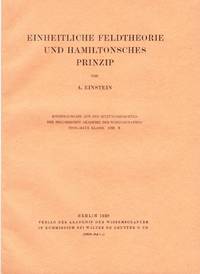
1929réf. 6551Berlin: Verlag der Akademie der Wissenschaften in Kommision bei Walter de Gruyter U. Co 1929. First separate edition. Fine. 6 pages in printed wraps. Not exactly an "offprint" since the pages are numbered from 1 and the pamphlet is given its own title page this is considered the first separate edition of a paper Einstein published in the periodical of the Prussian Academy. It is considered Einstein's initial effort having established general and special relativity to find a unified theory uniting gravity and electromagnetism a problem he struggled with for his remaining life. Verlag der Akademie der Wissenschaften in Kommision bei Walter de Gruyter U. Co paperback books
1938réf. 165146Paris 1938. paperback. Pp. 5-19 IN: Zeitschrift fur Freie Deutsche Forschung. Jahrgang 1 Nummer 1. Herausgegeben von der Freien Deutschen Hochschule in Paris. 168p. printed wrappers. Paris Juli 1938. First number of this scarce short-lived exile publication featuring German & Austrian writers and scholars. Fine. unknown books
1918réf. 50342Leipzig 1918. Prinzipielles zur allgemeinen relativitätstheorie. In Annalen der Physik 55 241-244 pp. Red cloth with gilt lettering on the spine. Bookbinder's embossed stamp of ffep. Whole volume: 632 pp. 1 folding plate. Figs. Text-illust. 210 x 130 mm. Very good. Approximate English translation of title: "On the foundations of the general theory of relativity." "Here we are given the first new presentation of the foundations of general relativity since the developments of March 1916 when Einstein gave his first systematic exposition." p. 300. Calaprice Kennefick & Shulmann. An Einstein Encyclopedia. 2015. Weil's Einstein Bibliography no. 96. Boni's Checklist no. 100. Also in this volume: Born Max 1882-1970. Elektronentheorie des Natürlichen optischen Drehungs vermögens isotroper und anisotroper Flüssigkeiten pp. 175-240. Approximate Eng. translation of title: "Electron theory of the natural optical rotation ability of isotropic and anisotropic liquids". Max Born 1882-1970 was a German physicist and mathematician who was instrumental in the development of quantum mechanics. He also made contributions to solid-state physics and optics as well as supervised a number of notable physicists in the 1920s and 1930s. Born won the 1954 Nobel Prize in Physics "for his fundamental research in quantum mechanics especially in the statistical interpretation of the wave function." In 1919 a chance meeting with Fritz Haber 1868-1934 led to the discussion of how an ionic compound is formed when a metal reacts with a halogen - a process now known as the Born-Haber cycle Wikipedia. . unknown books
1911réf. 50424Leipzig: Johann Ambrosius Barth 1911. The Genesis of General Relativity Einstein Albert 1879-1955. 1 Elementare betrachtungen über die thermische molekularbewengung in festen Körpern. In Annalen der Physik 35 9: 679-94 pp. Weil 42. 2 Über den Einfluß der Schwerkraft auf die Ausbreitung des lichtes. In Annalen der Physik 35 10: 898-908 pp. Weil 43. Red cloth gilt spine lettering. Figs. Text-illust. 214 x 140 mm. Whole volume: viii 1040 pp. 6 plates 3 b/w silver photos 1 colorized 2 folding. Very good. Approximate English translations of titles: 1 "Elementary considerations about thermal molecular motion in solid bodies" and 2 "On the influence of gravity on the propagation of light." "Einstein returns to his thoughts on gravitation and discusses his ideas on the static gravitational field no. 1 above advancing the "half-shift" prediction of the deflection of light by a massive body such as the Sun. In his early papers on the subject . . . he used two important features: the principle of equivalence and the role of the speed of light. In this paper he takes a broader perspective saying that if a light beam is bent in an accelerating frame of reference then if the theory is correct it must also be besnt by gravity by exactly the equivalent amount." Calaprice An Einstein Encyclopedia. "An important conclusion of this paper is that the velocity of light in a gravitational field is a function of the place. The equation: c = c01 / c2 signifies that there exists a relationship between the velocity of light and the gravitational potential; the latter influences the first." Weinstein Einstein's 1912-1913 struggles with Gravitation Theory: Importance of Static Gravitational Fields Theory. "Here no. 2 above Einstein continues the work he had begun in 1907 on the specific heat of solids where the heat agitation of solids was reduced to a monochromatic oscillation of the atom and the specific heat was determined based on the quantum treatment of an oscillator in a radiation field. He explains the discrepencies between his formula and the measurements at low temperatures" Calaprice An Einstein Encyclopedia. Weil's Einstein Bibliography nos. 42 and 43. Boni's Einstein Checklist nos. 38 39. . Johann Ambrosius Barth unknown books
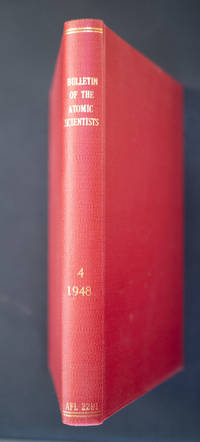
1948réf. 6625Chicago: The Atomic Scientists of Chicago 1948. Original edition. Ex-library. Very Good. 28 cm; 384 pages. Cloth-bound volume of 12 issues. Duplicate surplus stamp of Library of Congress on front free endpaper. Later owner's stamp on free endleaves blacked out. Lively forum of discussion of various scientific social and political implications of atomic energy as the post-war radioactive dust settled over the Pacific and wherever else open-air tests of atomic weaponry took place. Opens with Einstein's "Plea for International Understanding." Issue #2 features a written debate between Einstein and four Soviet scientists Semyonov Vavilov Frumkin and Ioffe. A scenario describes the potential effect of an atomic bomb on Washington DC. Justice William O. Douglas contributes "Democracy and Communism." Harry Truman presents a "Message to the Atomic Scientists." Other contributors include Cardinal Cushing Thomas E. Dewey Max von Laue and many other scientists and statesmen involved in the post-war debates The Atomic Scientists of Chicago hardcover books
1944réf. 556012New York: The American Christian Palestine Committee 1944. Softcover. Very Good. First separate edition. Small octavo. 12pp. Stapled self-wrappers. Slight age-toning on the wrappers and very tiny nicks soiling and light wear very good or better. Two articles jointly written by Einstein and Kahler in response to two articles laying out anti-Zionist testimony given by Dr. Philip Hitti of Princeton before the Committee on Foreign Affairs of the House of Representatives. Both of Hitti's articles and the Einstein and Kahler articles were all published in The Princeton Herald. This publication doesn't include the Hitti articles but summarizes them in the Einstein and Kahler rejoinders. Scarce. The American Christian Palestine Committee unknown books
1927réf. 433031927. Offprint from Sitzungsberichte der preussischen Akademie der Wissenschaften 1927. 235-245pp. 255 x 183 mm. Original printed wrappers. Fine. On the problem of motion in general relativity theory; a follow-up to his and Grommer's paper of the same title published earlier in 1927. Weil Albert Einstein Bibliography 160. unknown books
1945réf. 1292Princeton: Princeton University Press 1945. Second edition first printing. 1945 LANDMARK SUMMARY OF NOBELIST ALBERT EINSTEIN'S THEORIES THAT ESTABLISHED MODERN PHYSICS--COPY OF NOBELIST CARLETON GAJDUSEK WHO DISCOVERED KURU THE FIRST PRION DISEASE. 8 inches tall hardcover gray cloth binding gilt title to spine decorative bookplate of D. Carleton Gajdusek to front paste-down signature of D. Carleton Gajdusek to front free endpaper vi 135 pp near fine in very good unclipped jacket with faint splash mark to cover light wear to spine ends and corners in protective mylar sleeve. This first printing of the second edition contains an appendix added by the author discussing advances in the theory of relativity since the first edition in 1921. ALBERT EINSTEIN 1879 – 1955 was a German-born theoretical physicist widely acknowledged to be one of the greatest and most influential physicists of all time. Einstein is best known for developing the theory of relativity but he also made important contributions to the development of the theory of quantum mechanics. Relativity and quantum mechanics are together the two pillars of modern physics. In 1922 he was awarded the 1921 Nobel Prize in Physics "for his services to Theoretical Physics and especially for his discovery of the law of the photoelectric effect". The Meaning of Relativity: Four Lectures Delivered at Princeton University May 1921 is a book published by Princeton University Press in 1922 that compiled the 1921 Stafford Little Lectures at Princeton University given by Albert Einstein. The lectures were translated into English by Edwin Plimpton Adams. The lectures and the subsequent book were Einstein's last attempt to provide a comprehensive overview of his theory of relativity and is his only book that provides an accessible overview of the physics and mathematics of general relativity. The book is made of four lectures. The first is titled "Space and Time in Pre-Relativity Physics". The second lecture is titled The Theory of Special Relativity and discusses the special theory of relativity. The third and fourth lectures cover the general theory of relativity in two parts. Einstein added an appendix to update the book for its second edition published in 1945 offered here. PROVENANCE: DANIEL CARLTON GAJDUSEK 1923-2008 was an American medical doctor and researcher who was co-recipient of the Nobel Prize in Physiology or Medicine in 1976 for his work in Kuru the first prion disease. Gajdusek graduated from Harvard Medical school at age 23 served as head of virological and neurological research at the National Institute for Health in 1958; and inducted into the National Academy of sciences in 1974. Gajdusek's best-known work focused on kuru. This disease was rampant among the South Fore people of New Guinea in the 1950s and 1960s. Gajdusek connected the spread of the disease to the practice of funerary cannibalism by the South Fore. With elimination of cannibalism kuru disappeared among the South Fore within a generation. He proved his hypothesis by successfully transmitting the disease to primates and demonstrating that it had an unusually long incubation period of several years. This was the first demonstration of the infectious spread of a noninflammatory degenerative disease in humans. Subsequently additional human agents belonging to the same group were discovered. They include sporadic familial and variant Creutzfeldt–Jakob disease. Gajdusek recognized that diseases like Kuru and Creutzfeldt–Jakob disease were caused by a new infectious agent that had not yet been identified. Princeton University Press hardcover books
réf. 08777Np; 1923. First Edition. Fine. offprint from Sitzungsberichten der Presussichen Akademie der Wissenschaften Sitzung der physikalishch-mahematischen klasse vom 31 mai XVII. p. 137-140 bound in original orange printied wraps; quarto 254 x 184mm. Einstein's first investigation of Weyl's ideas published in the present work introduced the notion of distant parallelism; however Einstein later rejected Weyl's theory. Housed in a custom quarter-leather clamshell box. A fine copy. unknown books
1975réf. 161331Burbank CA: NBC 1975. Final Draft script for the twelfth episode of the thirteen episode 1975 comedy and variety show television series SIGNED on the front wrapper "Tom & Dick" by Tom and Dick Smothers with an inscription on the top left partially lost due to dampstaining "illegible Wishes from the Smothers Brothers." Copy belonging to uncredited cast or crew member David Carroll with manuscript marker and pencil annotations of his name or partial name "David C." on the top of the title page and two other pages with manuscript ink and marker annotations on 32 pages marking music cues. NBC's tamer and largely unsuccessful revival of CBS's 1967-1969 variety series "The Smothers Brothers Comedy Hour" which aired for thirteen episodes January 13 through May 19 1975. The episode on offer here was the penultimate episode which was taped on March 28 1975 and aired on May 12 1975 featuring guests Florence Henderson and David Gates. Of note the script is labeled as "Production #011 / Air Sequence #11" with a manuscript marker annotation of "12" over the air date of "May 5 1975." The May 5 episode of the series featured guests Kris Kristofferson Rita Coolidge and Arlo Guthrie and the episode found here featuring Henderson and Gates was aired as the twelfth episode on May 12 1975. Front wrapper integral with title page dated March 26 1975 noted as FINAL DRAFT. 90 leaves with last page of text numbered 77. Mimeograph duplication rectos only with blue pink yellow and green revision pages throughout undated. Pages Very Good with dampstaining throughout and silverfish damage to the extremities of the first three leaves. NBC unknown books
1915réf. 14657Leipzig and Berlin: B.G. Teubner 1915. With frontispiece portrait of Minkowski and text figures. Boards spine and corners frayed and cracking. Sammelband containing the original papers on the special and general theories of relativity with a foreword by O. Blumenthal. It is in Minkowski's famous paper Raum und Zeit Space and time that he proposes the concept of time as the fourth dimension and initiates a mathematical study that became the basis of the later development of the theory. Included here is the re-issue of that work by Einstein and Lorentz with notes by A. Sommerfeld published after Minkowski's untimely death along with other papers by the two scientists whose works led to the abandonment of space and time as separate entities. Weil 59; see Printing & the Mind of Man 401. B.G. Teubner unknown books
1911réf. 50315Leipzig: Johann Ambrosius Barth 1911. Einstein Albert 1879-1955. 1 Bemerkung zu dem Gesetz von Eötvös. In Annalen der Physik 34 1: 165-169 pp. 1910. Weil 38 Boni 35. 2 Eine beziehung zwischen dem elastischen Verhalten und der spezifischen Wärme bei festen Körpen mit einatomigem Molekül. In Annalen der Physik 34 1: 170-174 pp. 1910. Weil 39 Boni 36. 3 Bemerkungen zu den P. Hertzschen Arbeiten: "Über die mechanischen Grundlagen der Thermodynamik." In Annalen der Physik 34 1: 175-176 pp. 1910. Weil 40 Boni 37. 4 Bemerkung zu meiner Arbeit: "Eine Beziehung zwischen dem elastischen Verhalten . . ." In Annalen der Physik 34 3: p. 590. Weil 40. 5 Berichtigung zu meiner Arbeit: "Eine neue Bestimmung der Moleküldimensionen." In Annalen der Physik 34 3: p. 591. Weil 41. Leipzig: Johann Ambrosius Barth 1911. Whole volume: viii 1032 pp. 6 plates 5 folding 1 b/w/ silver photograph. Figs. Text-illust. 210 x 140 mm. Red cloth with gilt lettering on spine. First Edition. Pages are a little toned as are plates 5 and 6 otherwise Very Good. Approximate English translations of titles: 1 "Remarks on the law of Eötvös." 2 "A connection between the elastic conduct and the specific heat of solid bodies with monatomic molecule." 3 "Remarks on P. Hertz' work: 'On the mechanical foundations of thermodynamics.'" Eövtös' findings served as part of the basis of Albert Einstein's General Theory of Relativity in which the principle of equivalence acts as the keystone no. 1 above. "Einstein adds a comment on p.590 of the same journal no. 2 above. To supplement Sutherland's observation that infared eigenfrequencies of solid bodies possibly originate in the elastic vibrations of these bodies Einstein adds that electrically charged ions are the source of optical vibrations while the mututal motions of the entire molecule cause elastic vibrations." Calaprice Alice et al. An Einstein Encyclopedia. 2015. p. 291. Weil's Einstein Bibliography nos. 38 39 40 and 41. Boni's Einstein Checklist nos. 35 36 and 37. . Johann Ambrosius Barth unknown books
1912réf. 50338Leipzig: Johann Ambrosius Barth 1912. Einstein Albert 1879-1955. 1 Lichtgeschwindigkeit und Statik des Gravitationsfeldes pp. 355-369. Weil 47 Boni 43. 2 Zur Theorie des statischen Gravitationsfeldes pp. 443-458. Weil 48 Boni 44. 3 Nachtrag zu meiner Arbeit: "Thermodynamische Begrundung des photochemischen Aquivalentgesetzes" pp. 881-885. Weil 46 Boni 42. 4 Antwort auf eine Bemerkung von J. Stark: "Uber eine Anwedung des Planckschen Elementargesetzes" pp. 888. Weil 49 Boni 45. 5 Relativitat und Gravitation. Erwiderung auf eine Bemerkung des Hrn. A. Einstein pp. 1059-1064. Weil 50 Boni 46. In Annalen der Physik 38 1912. Red cloth with gilt lettering on the spine. Whole volume: 1064 pp. 8 plates. Text-figs. 210 x 130 mm. Very good copy. Approximate English translations of titles with brief explanations of referenced paper if available: 1 "The speed of light and the statics of the gravitational field." "Further exploring his studies of gravitation based on the equivalence principle Einstein sees with growing clarity that gravitation is intimitely linked with the problem of the measurement of space and time" p. 292. Calaprice Kennefick & Shulmann. An Einstein Encyclopedia. 2015.; 2 "On the theory of the static gravitational field." "Einstein more closely analyzes the equations of motion stated in no. 1 above concluding that those equations cannot be reconciled with the given field equations for c . . . because the principle of "action equals reaction" is violated. p. 290. Calaprice Kennefick & Shulmann. An Einstein Encyclopedia. 2015.; 3 "Addendum to my work: 'Thermodynamic justification of the photochemical equivalent law' "; 4 "Answer to my remark by J. Stark: "On an application of Planck's elementary law' "; 5 "Relativity and gravitation. Response to a remark by Mr. A Einstein". Weil's Einstein Bibliography nos. 47 48 46 49 and 50. Boni's Einstein Checklist nos. 43 44 42 45 and 46. . Johann Ambrosius Barth unknown books
1920réf. 37403Berlin: Springer 1920. Springer unknown books
1923réf. 433171923. Offprint from Sitzungsberichte der preussischen Akademie der Wissenschaften 1923. Single sheet pp. 76-77. 265 x 184 mm. A few marginal chips and tiny tears but very good. First edition offprint issue. The second of the four short papers Einstein published in 1923 on Eddington's program for a unified field theory. Weil Albert Einstein Bibliography 131n. unknown books
1922réf. 37430Berlin: Slowa 1922. 51 5pp. Original printed wrappers faded front hinge weak tears at spine. First edition in Russian of Weil 111; see Weil 111e. Slowa unknown books
1920réf. 374021920. Weil 110. Offprint from S. preuss. Akad. Wiss. unknown books
1923réf. 374061923. unknown books
1908réf. 50421Leipzig 1908. 1 Planck Max 1858-1947. Zur dynamik bewegter systeme. In Annalen der Physik 26 6: 1-34 pp. 2 Einstein Albert 1879-1965 and Jakob Laub 1882-1962. Über die elektromagnetischen grundgleichungen für bewegte Körper. In Annalen der Physik 26 8: 532-40 pp. Boni 22 Weil 22. 3 Einstein A. and J. Laub. Über die im elektromagnetischen felde auf ruhende Körper ausgeubten ponderomotorischen Krafte. In Annalen der Physik 26 8: 541-50 pp. Boni 23 Weil 23. Red cloth gilt lettering on spine. Figs. Text-illust. 230 x 141 mm. Whole volume: viii 1032 pp. 8 plates 3 folding 3 b/w silver photos. Spine a little worn but still Very Good. Approximate English translations of titles: 1 "On the dynamics of moving systems". 2 "On the fundamental electromagnetic equations for moving bodies;" and 3 "On the ponderomotive forces exerted on bodies at rest in the electromagnetic field." "Einstein wrote no. 2 above and "Elementary theory of Brownian motion" in Zeitschrift für Elektrochemie und angewandte physikalische Chemie 14 1908: 235-239 pp. in a three-week period with Jakob Laub his first scientific collaborator to address the problems of formulating relativistically invariant equations for electromagnetic fields in moving media first raised by Hermann Minowski the year before." Calaprice An Einstein Encyclopedia. 2015. A correction to this paper no. 2 was published later in the year in vol. 27 1908: 232 and a supplement for the following year in vol. 28 1909: 445-447. Elaborating on the relativistic transformation of Maxwell's vacuum equations . . . Einstein and Laub also consider the displacement vector D and the magnetic induction B. Weil's Einstein Bibliography nos. 22 23. Boni's Einstein Checklist nos. 22 23. Max Karl Ernst Ludwig Planck 1858-1947 was a German theoretical physicist who was awarded the 1918 Nobel Prize in Physics "in recognition of the services he rendered to the advancement of Physics by his discovery of energy quanta" nobelprize.org. Planck revolutionized human understanding of atomic and subatomic processes as the originator of the quantum theory. Jakob Laub 1882-1962 was a physicist who is best known for his work in the early period of special relativity having worked alongside Albert Einstein during that time. . unknown books
1950réf. 6682New York: Philosophical Library 1950. First edition. Very Good in pretty good dust jacket. 21 cm; 279 pages portrait frontispiece. Turquoise cloth in plain cream-colored dust jacket. Dust jacket chipped at top of spine. Of the variant dust jackets and issues this is the one with the fewest number of titles advertised on the rear and the price of $4.75 on the inside flap. Philosophical Library hardcover books
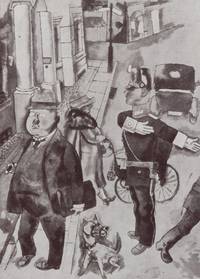
1926réf. 39022Berlin: Das Kunstarchiv Verlag 1926. First edition. Softcover. g. Quarto. 36pp. Original printed wrappers. Catalog published on the occasion of an exhibition of paintings and drawings by George Grosz held during the Spring of 1926 in Berlin at the Galerie Alfred Flechtheim. This catalog features 24 duo-tone and b/w photographic reproductions. Includes a poem by Gottfried Benn and four essay on the artist and his work by Carl Einstein Marc Neven Max Herrmann and Florent Fels. Some age-wear and moderate soiling on wrappers. Upper corners bumped thus slightly affecting pages throughout. Text in German gothic script with one of the four essays in French. Wrappers in overall good- to good interior in good to very good condition. Alfred Flechtheim 1878-1937 was a German art dealer art collector journalist and publisher. Flechtheim appeared in the art world shortly after 1900 with a collection of paintings by Vincent van Gogh and Paul Cézanne; French Avant garde early works of Pablo Picasso Georges Braque and André Derain; paintings of Wassily Kandinsky Maurice de Vlaminck Alexej von Jawlensky Gabriele Münter and the Rhein Expressionists Heinrich Campendonk August Macke Heinrich Nauen de and Paul Adolf Seehaus de. Flechtheim opened his first gallery in Düsseldorf in 1913 followed by galleries in Berlin Frankfurt Cologne and Vienna. Flechtheim served in the German Army during World War I but not at the front. His art business collapsed during the war but he re-opened in Düsseldorf in 1919. In 1921 he founded "Der Querschnitt" the Cross Section a cultural magazine. Legendary glamorous parties in Flechtheim's gallery overflowed with the glitterati of the new Berlin: movie stars titans of finance prizefighters and artists of every stripe. As Hitler rose to power in the late 1920s and early 1930s Flechtheim became a bête noire because of the art he espoused and championed. In 1933 Sturmabteilung men broke up an auction of Flechtheim's paintings. The Nazis aryanized Flechtheim's gallery as they would many other Jewish businesses and turned it over to Flechtheim's business manager Alex Vömel. After the war former party member Vömel said he didn't even remember who Flechtheim was. The Nazis seized and sold off Flechtheim's private collection as well as the contents of his gallery. Emigration and Death Six months after the Nazis came to power in 1933 Flechtheim penniless fled to Paris and tried to find work with his former business partner Daniel-Henry Kahnweiler. Flechtheim subsequently organized exhibits in London of the paintings of exiled German artists. In London Flechtheim slipped on a patch of ice was taken to a hospital punctured his leg on a rusty nail in his hospital bed developed septicemia leading to amputation of his leg and died. Das Kunstarchiv Verlag unknown books
1912réf. 50337Leipzig: Johann Ambrosius Barth 1912. Einstein Albert 1879-1955. Thermodynamische Begründung des photochemischen Äquivalentgesetzes. In Annalen der Physik 37 832-838 pp. Red cloth with gilt lettering on the spine. Whole volume: 1048 pp. 5 plates 4 folding 1 b/w silver photograph w/ small fold at foot. Figs. Text-illust. 210 x 130 mm. Very good copy. "A supplement published in vol. 38 1912: 881-884 See Book ID: 50338. Einstein presents a continuation of his earlier work on the interaction between light matter and on photochemical processes. It contrasts with earlier work in that it makes no use of the quantum hypothesis. He demonstrates how what he calls 'the law of photochemical equivalence' is deducible by purely thermodynamical arguments if one makes certain plausible assumptions. He wrote a supplement to the paper in five months later in the same journal." p. 291-2. Calaprice Kennefick & Shulmann. An Einstein Encyclopedia. 2015. Weil's Bibliography of Einstein's Papers no. 46. Boni's Bibliographical Checklist no. 42. . Johann Ambrosius Barth unknown books