211 résultats
1949réf. 140941039Evanston IL: The Library of Living Philosophers Inc 1949. First Edition. Near Fine/Very Good. First edition first printing. Bound in publisher's original dark blue cloth stamped in gilt. Near Fine with toning to pages offsetting to endsheets former owner name to front free endpaper and small sticker ghost to front paste down. In a Very Good dust jacket with fraying and chip at bottom spine end and short closed tear at head light edge wear toning and soiling to rear panel. The Library of Living Philosophers, Inc unknown books
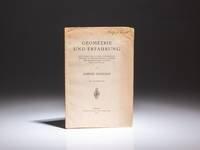
1921réf. 17649Berlin: Verlag Von Julius Springer 1921. First Trade Edition. Wraps. Very good. The first trade edition of Geometrie Und Erfahrung Geometry and Experience by Albert Einstein from the collection of Einstein's English translator Dr. Wilfrid Perrett. Octavo 20pp. Publisher's original wraps bound with two staples. Light soiling and wear on wraps internally clean. Includes two illustrations advertisements on verso of rear flap. Staples showing rust some wear to edges of original wraps. Weil 115 Schlipp-Shields 143 This copy is signed by Wilfrid Perrett on the front cover. This work first appeared in the Sitzungsberichte der Preussischen Akademie der Wissenschaften accompanied by an "author's offprint" which was bound in orange wrappers. Weil 114. This work is the first separate trade edition. The recipient of this copy Dr. Wilfrid Perrett worked with Dr. George Barker Jeffery to translate many of Einstein's most notable works into English. Perrett was a "distinguished German scholar" and would "overlook the literary side of the work" while Jeffery would oversee the mathematical translations. The two worked together on Das Relativitätsprinzip On the Relativity Principle beginning in 1922 and numerous other works by Einstein over his career. Jammer 113-114. Verlag Von Julius Springer unknown books
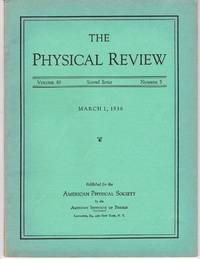
1936réf. 6550Lancaster PA: American Physical Society 1 March 1936. Second series volume 49 number 5. Very Good. ppl 341-422. Original green wraps. Slight nick at bottom edge of lower wrap else better than very good. Includes the retort by Einstein and Rosen originators of speculation on the existence of "worm-holes" in spacetime to objections made to the general theory of relativity. According to Galina Weinstein: "Between 1935 and 1936 Einstein was occupied with the Schwarzschild solution and the singularity within it while working in Princeton on the unified field theory and with his assistant Nathan Rosen on the theory of the Einstein-Rosen bridges. He was also occupied with quantum theory. He believed that quantum theory was an incomplete representation of real things. Together with Rosen and Boris Podolsky he invented the EPR paradox. I demonstrate that the two-body problem in general relativity was a heuristic guide in Einstein's and collaborators' 1935 work on the Einstein-Rosen bridge and EPR paradox." Also articles by notable physicists on radioactivity electron mobility quantum-mechanical measurement and so on. American Physical Society paperback books
1966réf. WMCE001New York: E. P. Dutton & Co. 1966 First edition first printing. Signed and inscribed by Mays on front free endpaper: "To Joe / Best Wishes / Willie Mays." Publisher's green and orange cloth with "Willie Mays" in blind to front board and spine lettered in black and orange; in its original unclipped dust jacket designed by Bob Korn with white front panel lettered in brown orange and green and a green spine. About fine book with light fading to spine and a hint of rubbing to foot of spine; very good price-clipped dust jacket with light wear to spine ends and some edgewear. With Beckett Letter of Authenticity. Overall a great boldly inscribed copy. Presentation copies from Mays are exceedingly scarce. In this book Willie Mays tells his life story with the help of prolific sportswriter Charles Einstein. Mays started playing professional baseball at 16 in the Negro Leagues and was soon drafted by the New York Giants. He went on to play 21 seasons with the Giants winning a World Series with the team in 1954. His over-the-shoulder catch in that World Series is one of the most iconic moments in sports history. A 24x All-Star and a 12x Gold Glove award winner Mays was inducted into the Hall of Fame in 1979 and was voted to the Major League Baseball All-Century Team in 1999. . Signed. First Edition. Hard Cover. Fine/Dust Jacket Included. New York: E. P. Dutton & Co. hardcover books
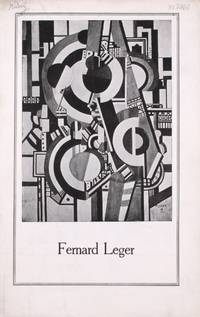
1925réf. 333269New York: Société Anonyme Inc 1925. First edition. 6 black and white illustrations 11 pp. 8vo. Side-stapled printed wrappers somewhat soiled. First edition. 6 black and white illustrations 11 pp. 8vo. Published in conjunction with an exhibition of Leger's work by the Société Anonyme from November 16th to the 28th 1925. Includes an introduction by Dreier a creative piece translated from the French of Karl Einstein and "Notations on Plastic Values" by Léger. Scarce OCLC only records a copy at Yale from the papers of Katherine S. Dreier. Collection of the Société Anonyme p. 218 Société Anonyme, Inc unknown books
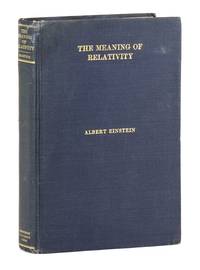
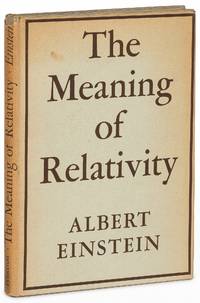
1923réf. 32639Princeton NJ: Princeton University Press 1923. Very Good. Princeton NJ: Princeton University Press 1923. First U.S. Edition. Octavo 18 cm; publisher's gilt-lettered navy cloth; 123pp. Boards bumped at corners spine ends scuffed. Water staining to spine crown bleeding into upper cover minor separation of head of spine material from book block. Last free endsheet creased. Endsheets toned. Endsheets first few pages last few pages and pages 106-112 show water staining at top margin but bulk of text block is clean and bright. Starting slightly after first free endsheet. A Very Good example overall. Collection of four lectures delivered by Einstein at Princeton for the Stafford Little Lectures in 1921. The majority of the lectures are an attempt to reconcile issues with his theory of relativity and defend it as well as give a comprehensive overview of the physics and math involved in the theory in an accessible way. Princeton University Press unknown books
1920réf. 43308Berlin: Springer 1920. 15pp. 221 x 146 mm. Original printed wrappers foxed. Minor internal foxing but very good. First edition cover title does not include the date Einstein delivered his lecture; see Weil. "By royal decree of June 24 1920 a special chair in Leiden University was created for Einstein enabling him to come to that university for short periods of his choosing. On October 27 1920 Einstein began his new position with an inaugural address on aether and relativity theory" Pais Subtle is the Lord p. 313. Weil Albert Einstein Bibliography 111. Springer unknown books
1930réf. 433061930. Offprint from Mathematische Annalen 102 1930. 685-697pp. Original printed self-wrappers. 233 x 157 mm. Very good apart from small split in lower spine. Weil Albert Einstein Bibliography 171. unknown books
1923réf. 374081923. Offprint from S. preuss. Akad. Wiss. Weil 137. unknown books
1923réf. 433181923. Offprint from Zeitschrift für Physik 16 1923. Single sheet unpaginated. 230 x 155 mm. One corner creased but very good. First edition offprint issue. Einstein's second response to Friedmann's groudbreaking paper on equations governing the expansion of space which made a valuable contribution to Einstein's theory of relativity and admitted the possibility of an expanding universe. Einstein at first believed that Friedmann's reasoning was incorrect then corrected his own objection in the present brief "Notiz" and called Friedmann's results "clarifying." Pais Subtle is the Lord p. 288. Weil Albert Einstein Bibliography 130. unknown books
1923réf. 374071923. Einstein Albert 1879-1955. Zur affinen Feldtheorie. Offprint from Sitzungsberichte der preussischen Akademie der Wissenschaften 17 1923. 137-140pp. 256 x 185 mm. Original printed wrappers. Fine. First Edition Offprint Issue. In 1923 Einstein published four short papers of which "Zur affinen Feldtheorie" is the third on Eddington's attempt at a unified field theory marking the beginning of a scientific passion that would dominate the remainder of his career. In 1921 British physicist Arthur Eddington had proposed a unified field theory inspired by the work of Hermann Weyl. "Einstein's own initial reaction was that Eddington had created a beautiful framework without content. Nevertheless he began to examine what would be made of these ideas and finally decided that 'I must absolutely publish since Eddington's idea must be thought through to the end.' That was what he wrote to Weyl. Three days later he wrote to him again about unified field theories: 'Above stands the marble smile of implacable Nature which has endowed us more with longing than with intellectual capacity.' Thus romantically began Einstein's adventures with general connections adventures that were to continue until his final hours" Pais Subtle is the Lord p. 343. This paper is included on Shields's list of Einstein's most significant papers; see Albert Einstein Philosopher-Scientist 1949 p. 758. Shields 175. Weil 132. . unknown books
1929réf. 374191929. Einstein Albert 1879-1955. Zur einheitlichen Feldtheorie. Offprint from Sitzungsberichten der preussischen Akademie der Wissenschaften 1 1929. 8vo. 8pp. Berlin: Verlag der Akademie der Wissenschaft 1929. 256 x 183 mm. Original printed wrappers slightly soiled and creased. Very good. First Separate Edition. "In 1928 Einstein embarked on a new approach to a unified field theory . . . involving what he called 'distant parallelism'. . . . By early 1929 he had solved the main problems involved in writing down field equations for his unified theory. On the day of official publication of the third of a formidably technical series of nine articles on the theory . . . excited headlines appeared in foreign newspapers throughout the world. . . . In this frenzied unscientific atmosphere Einstein's new theory was hailed in the press as an outstanding scientific advance. Yet Einstein had stated in his article that it was still tentative; and soon he found he had to abandon it Hoffman Einstein pp. 225-26. This paper is included on Shields's list of Einstein's most significant papers; see Albert Einstein Philosopher-Scientist 1949 p. 758. Weil 165. Pais Subtle is the Lord pp. 344-46. . unknown books
1907réf. 50420Leipzig: Johann Ambrosius Barth 1907. Einstein explicitly establishes E=mc2. Einstein Albert 1879-1955. 1 Über die Möglichkeit einer neuen Prüfung des Relativitätsprinzips. In Annalen der Physik 23 6: pp. 197-8. 2 Bemerkungen zu der Notiz von Hrn. Paul Ehrenfest: "Die translation deformierbarer Elektronen und der Flächensatz." In Annalen der Physik 23 6: pp. 206-8. 3 Über die vom relativitätsprinzip geforderte Trägheit der Energie. In Annalen der Physik 23 7: pp. 371-384. 8vo. Red cloth gilt lettering on spine. 214 x 140 mm. Whole volume: viii 1000 pp. 4 plates numbered Taf. I - IV. Tafs. I II and IV are folding Taf. III is b/w silver photograph tipped to sheet. Foot of the spine is repaired. Very good. Approximate English translations of titles: 1 "On the possibility of a new test of the principle of relativity." 2 "Remarks on Mr. Paul Ehrenfest's note: 'The translation of deformable electrons and the surface theorem.'" 3 "On the inertia of energy required by the principle of relativity." In "On the inertia of energy required by the relativity principle" May 1907 "Using rather than m V rather than c and 0 rather than E0 Einstein wrote his famous equation for the first time as V2= 0 and he did it in a footnote. At the end of that paper he introduced the symbol E0 to denote energy in the rest frame and wrote the famous expression again this time as =E0/V2." -Eugene Hecht How Einstein confirmed E0 = mc2 In the third paper Einstein explicitly establishes his famous equation E=mc2 although with different symbols. In this paper Einstein discussed the relationship between inertial mass and energy arguing for their complete equivalence namely that every mass has an equivalent energy just as every form of energy has an equivalent mass. This relation says that a photon can convert for the equivalence of mass and energy his celebrated equation E = mc2 Calaprice The Einstein Almanac. Weil's Einstein Bibliography nos. 17 18 and 19 respectively. Boni's Einstein Checklist nos. 17 18 and 19 respectively. . Johann Ambrosius Barth unknown books
1921réf. 433161921. Offprint from Sitzungsberichte der preussischen Akademie der Wissenschaften 1921. Single sheet pp. 882-883. 256 x 184 mm. Minor marginal tears one corner chipped but very good. First ediiton offprint issue. "Since after 1917 Einstein firmly believed that light-quanta were here to stay it is not surprising that he would look for new ways in which the existence of photons might lead to observable devations from the classical picture. In this he did not succeed. At one point in 1921 he thought he had found a new quantum criterion published in the present paper but it soon turned out to be a false lead" Pais Subtle is the Lord pp. 412-413. Weil Albert Einstein Bibliography 118. unknown books
1930réf. 510131930. Einstein Albert 1879-1955. Théorie unitaire du champ physique. In Annales de l'Institut Henri Poincaré 1 fasc. 1 1930: 1-24. With: Fermi Enrico 1901-54. La théorie du rayonnement. In ibid.: 25-52. Whole number. 2 74 2pp. 285 x 197 mm. uncut and unopened. Original printed wrappers a bit sunned lower corner of front wrapper chipped and creased. Very good. First Edition. This issue of the Annales de l'Institut Henri Poincaré contains the texts of Einstein's lecture on unified field theory and Fermi's lecture on the theory of radiation both delivered at the Institut in 1929. Weil Albert Einstein Bibliography 174. Not in Fermi Collected Papers. . unknown books
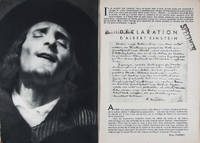
1933réf. 45000Paris: Société Anonyme Les Illustrés Français 1933. First edition. Softcover. g- to vg. Large quarto 11 1/2 x 8". 105 3pp. Original photo-illustrated wrappers with white lettering to front cover. This scarce issue of "Témoignages de Notre Temps" Witness to our Time is a loving and moving tribute to Jewish life and culture that spans ancient times to the early 1930s with the spectre of Hitler and the early persecutions of Jews in Nazi Germany Hitler became chancellor a few months prior on January 30th. Includes texts by Albert Einstein Dr. Chaïm Weizmann and others along with hundreds of splendid black-and-white photogravures many full page including Helmar Lerski's impressive series on Jews in Palestine. "Témoignages de Notre Temps" was edited by noted French photographer and publisher Lucien Vogel. Wrappers partly creased along edges. Page 5 with four "Spécimen" stamps not affecting lettering. Lower corner of the first 18 pages slightly creased. Lower front corner bumped thus slightly affecting pages throughout. Text in French. Wrappers in overall good- to good interior in good to very good condition. Société Anonyme Les Illustrés Français unknown books
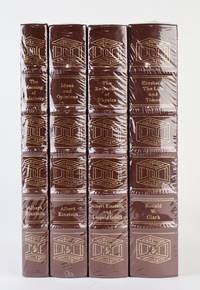
2004réf. 1393704Norwalk CT: The Easton Press 2004. Collector's Editions. Hardcover. Octavos Four Volumes. Bound in brown genuine leather with bright gilt spine titles and gilt motifs on covers. Gilt text blocks. Paper endpapers silk ribbons. In publisher's shrinkwrap. MA consignment. Shelved above Easton Press. 1393704. Shelved Dupont Bookstore. The Easton Press hardcover books
1945réf. 617621Princeton New Jersey: Princeton University Press 1945. Hardcover. Near Fine/Very Good. Second edition with a new appendix by Einstein and translated by Ernst G. Straus. Octavo. 135pp. Tiny owner name on front fly else fine in uniformly and modestly spine-toned very good dust jacket with nominal soiling. Princeton University Press hardcover books
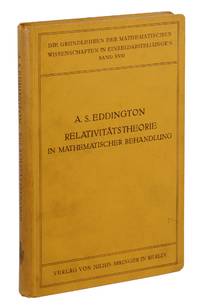
1925réf. 140945616Berlin: Verlag von Julius Springer 1925. First edition. First edition. xiv 377 1 4 pp. Bound in publisher's orangish yellow boards. Near Fine with light rubbing and soiling to boards tiny pen squiggle to front board. Contents bright and unmarked. An uncommon German-language physics text with an appendix by Einstein. Verlag von Julius Springer unknown books
1930réf. 433141930. Offprint from Sitzungsberichte der preussischen Akademie der Wissenschaften 1930. Single sheet pp. 1-2. 256 x 184 mm. Upper edge a bit creased light toning but very good. First edition offprint issue. One of Einstein's last papers on Riemann metrics and distant parallelism written the year before he abandonded this approach to constructing a unified field theory. Pais Subtle is the Lord p. 347. Weil Albert Einstein Bibliography 173. unknown books
1932réf. 433001932. Offprint from Sitzungsberichte der Preussischen Akademie der Wissenschaften 32 1932. 31pp. 256 x 183 mm. Original printed wrappers a little chipped and darkened small splits in spine. Very good. First edition offprint issue. Einstein's work on semivectors "was stimulated by Ehrenfest's insistence on a better understanding of the relation between single-valued and double-valued representations of the Lorentz group . . . Einstein and Mayer went on to relate semivectors to the Dirac equation and to generalize the formalism to general relativity" Pais Subtle is the Lord pp. 451-452. Weil Albert Einstein Bibliography 186. unknown books
1921réf. 18099New York: Henry Holt and Company 1921. THIRD EDITION. With frontispiece portrait Einstein dated 1920. Blue cloth small tear at top of spine corners slightly worn no dust wrapper; front hinge a bit loose otherwise a very clean copy. From the library of Martin J. Klein professor of the history of science at Yale and the first recipient of the Abraham Pais Prize for the History of Physics. This copy was given to Klein as a gift from his summer program NEH class of 1986 and is signed by 13 of his students. Third edition though the only change is the date on the title page of one of Einstein’s most renowned works intended for readers with a general scientific and philosophical background. Part I treats the special theory of relativity part II the general theory and part III considers the universe as a whole. Not in Weil or Boni. Henry Holt and Company unknown books
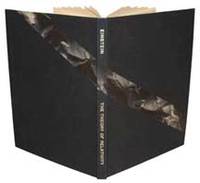
2005réf. CNAP071San Francisco: The Arion Press 2005. Hardcover. New. 10-1/2 by 8 inches eighty pages. Printed by letterpress from lead-alloy type cast in the Mackenzie & Harris typefoundry the formulas were set by hand as was the display type while the prose was composed and cast in Monotype. The types are Modern for the text with special characters as needed for mathematical symbols; Egyptian for the interspersed annotations printed in blue; and Lining Gothic for display. The paper is Schiller a German mouldmade sheet. A pixelated portrait of Einstein is the frontispiece. This image is based on a photograph taken about 1910 rendered as a coarse halftone for reference then handset in units of six-point type: three sizes of solid squares and one centered dot. Over 4000 pieces of type make up the picture. The portrait is printed in gray as is the famous equation: E=mc2 which appears on the flyleaves. The binding is dark blue cloth over boards with a band of tie-dyed Thai paper to create an unusual spatial effect spanning the cover diagonally. The titling on the spine is stamped in silver foil. The edition is limited to 400 numbered copies for sale. One of the great achievements in science Albert Einstein's Theory of Relativity was set forth in two papers published in the Leipzig physics journal Annalen der Physik in 1905. The German text was translated into English in 1923 by W. Perrett and G. B. Jeffrey and this is the version with some later corrections that is presented in this book. The Einstein papers are annotated by Richard Muller who has also provided a foreword and afterword. The foreword gives a general overview of the problems Einstein addressed against the background of nineteenth-century physics. The afterword carries the story from the miraculous year of 1905 when Einstein was only twenty-six through the effects of the theory on twentieth-century science. Muller conjectures on the progress of physics had Einstein not appeared and considers his career as a whole its last thirty-five years devoted mainly to an unsuccessful attempt to create a unified field theory. ___POSTAGE: International customers please note that additional postage may apply as the standard does not always cover costs; please inquire for details. ___Swan's Fine Books is pleased to be a member of the ABAA ILAB and IOBA and we stand behind every book we sell. Please contact us with any questions you may have we are here to help. The Arion Press hardcover books
réf. B34915-SCCambridge University Press. Collectible - Good. Great Britain: Cambridge at the Univ Press 1938. 1st UK 1st issue with gold lettering on spine and both endpapers present. Hardcover 12mo 319 pgs. Medium blue cloth gold gilt on spine. B/w plates and illustrations. Near very good book in a fair dust jacket. Corners and spine ends lightly bumped and worn. Contents clean and binding sound. Bookplate to front endpaper with writing in Latin name of Andrzei Falkiewicz written in and Alberto H R Ball Rectore at bottom edge. Jacket is edgeworn chipped and torn. Rear panel and spine are toned. Orig price 8s 6d on front flap. stem science physics Inquire if you need further information. Cambridge University Press hardcover books
1914réf. 50425Leipzig: Johann Ambrosius Barth 1914. 1 Einstein Albert 1879-1955 and A.driaan D.aniël Fokker 1887-1972. Die Nordströmsche Gravitationstheorie vom Standpunkt des absoluten Differentialkalküls. In Annalen der Physik 44 10: 321-328. 2 Born Max 1882-1970. Zur Raumgitter theorie des Diamanten. In Annalen der Physik 44 12: 605-642. 3 Schrödinger Erwin Rudolf Josef Alexander 1887-1961. Zur Dynamik elastisch gekoppelter Punktesysteme. In Annalen der Physik 44 14: 916-934. Leipzig: Johann Ambrosius Barth 1914. Whole volume: viii 1272 pp. 22 plates Numbered Taf. I-XXII. Taf. I-IX: b/w/ silver photos; Taf. XI w/ one b/w silver photo; Taf. XII is folding and XIII XIV are b/w silver photos; Taf. XV and XVI are large folding tables; Taf. XVII XVIII XIX b/w/ silv.photos; and Taf.XX--XXII are photographs of X-ray images. Figs. Text-illust. 210 x 140 mm. Red cloth gilt lettering on spine. Very good. Along the margin of p. 802 written in pencil are the words: "Mallock R.S. 1910" probably written in Lord Rayleigh's hand most likely in reference to the title "The dampening of sound by frothy liquids" by A. Mallock in Proc. R.S. Lond ser. A vol. 84: 391-94. London 1911. A.D. Fokker 1887-1972 was a Dutch physicist and cousin to aeronautical engineer Anthony Fokker 1890-1939. He was musically inclined having invented the 31EDO pipe organ. He earned his doctorate in 1913 continuing his studies with Albert Einstein Ernest Rutheford 1871-1937 and William Bragg 1862-1942. In his 1913 thesis he derived the Fokker-Planck equation with Max Planck 1858-1947. Fokker made contributions to special relativity and general relativity particularly the effects of the curvature of space-time formally called "geodetic precession". Wikipedia. . Johann Ambrosius Barth unknown books