Albert EinsteinABAA
211 résultats
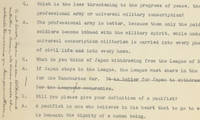
1502réf. 2446215/02/1933. He revises the typescript of his interview with the War Resisters League of which he was Honorary Chairman and calls out William Randolph Hearst and the head of the press and film empire in Germany who aided Hitler’s rise On philosophy: “The intellect without the emotions is insignificant”; On racism: “The main thing is that minority groups should be allowed security in the community.” They ought to be “accepted with friendliness as equal members” On the press: He criticizes William Randolph Heart by name but says “The freedom of the press is necessary despite all the dangers or abuse that come with it.”. On pacifism and peace keeping: “A pacifist is one who believes in his heart that to go to war is beneath the dignity of a human being” “Society needs some form of organization for security and protection in international life” and “An international police force…is almost absolutely necessary as one step toward achieving peace. Force when used by an impartial third party to achieve law and order it's not contrary to pacifism”. This document has never previously been offered for sale and was acquired by us from the family that has had it all this time Einstein was well known as a pacifist until Hitler’s rise to power. In 1930 on his second visit to America he joined the War Resisters League and accepted the office of Honorary Chairman. Einstein spoke to the organization that year saying “True pacifists must publicly declare in time of peace that they will not take up arms under any circumstances… even if only 2% of those assigned to perform military service should announce their refusal to fight governments would be powerless they would not dare send such a large number of people to jail.” The league then issued a pamphlet “Einstein on War Resistance” that was widely read and discussed. Meanwhile back in Germany the rising Nazi movement found a convenient target in Einstein and relativity branding the latter “Jewish physics” and sponsoring conferences and book burnings to denounce Einstein and his theories. The Nazis even enlisted other physicists to denounce Einstein; “One Hundred Authors Against Einstein” was published in 1931. When asked to comment on this denunciation of relativity by so many scientists Einstein replied that to defeat relativity one did not need the word of 100 scientists just one fact. <img class=""alignnone wp-image-24605 size-post-window"" src=""https://cdn.raabcollection.com/wp-content/uploads/20231204150044/Einstein-Feb-15-1933-3-1-1600x209.jpg"" alt="""" width=""1600"" height=""209"" /> In December 1932 Einstein decided to leave Germany. The reason: it became obvious to him that his life was in danger. A Nazi organization published a magazine with Einstein’s picture and the caption “Not Yet Hanged” on the cover. There was even a price on his head. In January 1933 Einstein came to the United States to serve at the California Institute of Technology in Pasadena California as a visiting professor. The appointment of Adolf Hitler as chancellor took effect late that month and Einstein decided he would not return to his home in Germany where he had been a professor at the Berlin Academy of Sciences. He would instead return to Europe and assess the situation from there. He and his wife Elsa returned by ship to Belgium in March 1933 to find that that their residences in Germany had been raided numerous times. Einstein accepted the fact that he could not return to Germany and turned in his passport to the German consulate; he also formally renounced his German citizenship. By the summer Einstein learned that his name was on a list of assassination targets. He resided in Belgium for some months and then moved to England for a short period. On October 17 1933 he returned to the US and took up a position at the Institute for Advanced Study at Princeton in New Jersey. And there he remained until his death. On February 15 1933 after Hitler had taken power but before Einstein learned that his homes had been raided he granted an interview to the War Resisters League at the home of one of its officials John Dorland. Dorland wanted the interview to be read aloud at the upcoming March 2 meeting of the members in Pasadena. He prepared a five page typescript of the interview and sent it to Einstein to review. As Dorland said in his cover letter to Einstein “Would you be kind enough to read it and if the answers misrepresent you in any detail may we request that you revise it in such particular as we are very anxious to have these correct.” He also asked Einstein's permission to read the interview aloud. This is the original typescript of the Einstein interview sent to Einstein by Dorland complete with Einstein’s handwritten notations. It is the only such annotated interview of Einstein that we have seen and it covers important topics. <img class=""alignnone wp-image-24606 size-post-window"" src=""https://cdn.raabcollection.com/wp-content/uploads/20231204150037/Einstein-Feb-15-1933-2-1-1600x247.jpg"" alt="""" width=""1600"" height=""247"" /> On page one Einstein makes it clear he was not ready to abandon his resistance to war. “The War Resisters” he stated at the interview “are doing a fine work. They have done more than any other peace group. A strong organized minority who have declared themselves absolutely against war is very powerful.” Question from Dorland. “Can we hope to convince everybody” Answer: “Oh no we cannot convince everybody but we do not need to. One strong man is worth much and has great influence Individuals thoroughly convinced and small groups working earnestly are of the utmost value.” Q: “In trying to arouse interest is it better to appeal to the intellect or the emotions” A: “To both; the intellect without the emotions is insignificant.” On page two Einstein states that “Public protests are very valuable” as is control over munitions production. “The private munitions business is a great threat to the peace of the world and there should be government control. Public opinion is not yet awake to the atrocities of the munitions firms.” Then Dorland changes the subject to “race relations.” Einstein responded “The main thing is that minority groups should be allowed security in the community.” Then Einstein hand writes in some thoughts. If they are not afforded such security “they should isolate themselves from the rest of society since they are not accepted with friendliness as equal members.” Then some fascinating free thoughts emerge. Clearly thinking of the Jews in Germany he crosses out “It insecurity is not so bad” and instead says “They can achieve a healthy existence”. But thinking of the current situation he finishes the thought by adding at least “Up until now!” He surely had less confidence about the future. On page three Einstein discusses the part to be played by international organizations. “The main thing is organization. Disputes will always come but we must have other methods than war for settling them. Society needs some form of organization for security and protection in international life.” Einstein then writes in “Obligatory court of arbitration. Unconditional obligation of the states to accept their verdicts and enforce them.” He is then asked which is less threatening to the progress of peace a professional army or universal military conscription. Einstein answers “The professional army is better because then only the professional soldiers become imbued with the military spirit.” Asked about Japan leaving the League of Nations he hand writes “It is better to let Japan secede from the League of Nations rather than have it the League compromised by a bad compromise.” Sooner let them go than compromise principles to keep them in. Lastly he is asked for his definition of a pacifist and responds “A pacifist is one who believes in his heart that to go to war is beneath the dignity of a human being.” <img class=""alignnone wp-image-24607 size-post-window"" src=""https://cdn.raabcollection.com/wp-content/uploads/20231204150030/Einstein-Feb-15-1933-5-1-1600x242.jpg"" alt="""" width=""1600"" height=""242"" /> On page four Einstein continues by saying that a pacifist “must be active in the prevention of war; that is he must support justice arbitration and conciliation.” In terms of having some international force enforce the peace Einstein is in favor. “an international police force as suggested by the French is almost absolutely necessary as one step toward achieving peace. Force when used by an impartial third party to achieve law and order it's not contrary to pacifism. This international force would exist only for a transition perhaps 20 years.” Dorland then asks Einstein “What do you think of the control over public opinion by the press” Einstein in the interview stated it was not good but in this document he elaborated further. “The freedom of the press is necessary despite all the dangers or abuse that come with it. This is the point with the biggest dependence of the peace movement peace work on economic circumstances. Hearst in America and Hugenberg in Germany demonstrate this fact with frightening clarity”. Alfred Hugenberg was the head of a press and film empire in Germany who aided Hitler’s rise. Einstein’s comparison of William Randolph Hearst with him is interesting. He clearly feels that the press in the wrong hands motivated by profit and political power was a danger. The next question was “Are religious bodies a power for peace” Einstein’s answer: “Not greatly now.” On the final page Einstein states his belief that though no one can change human nature “we can change traditional institutions.” <img class=""alignnone wp-image-24608 size-post-window"" src=""https://cdn.raabcollection.com/wp-content/uploads/20231204150023/Einstein-Feb-15-1933-4-1-1600x231.jpg"" alt="""" width=""1600"" height=""231"" /> This document is full of gems: “The intellect without the emotions is insignificant”; “The main thing is that minority groups should be allowed security in the community.” They ought to be “accepted with friendliness as equal members”; “Society needs some form of organization for security and protection in international life”; “A pacifist is one who believes in his heart that to go to war is beneath the dignity of a human being”; “An international police force…is almost absolutely necessary as one step toward achieving peace. Force when used by an impartial third party to achieve law and order it's not contrary to pacifism”; and “The freedom of the press is necessary despite all the dangers or abuse that come with it.” This is a great and fascinating rarity. A search of public sale records going back over 40 years turns up only one other example of an Einstein annotated interview nor have we ever had one. It wasn’t long in 1933 before the intensity of the threat from Naziism convinced Einstein that only force would be a deterrent a Hitler triumph. He resigned from the War Resisters League later in 1933. To Einstein pacifism became not an absolute concept but one that had to be re-examined depending on the magnitude of the threat. <img class=""alignnone wp-image-24457 size-post-window"" src=""https://cdn.raabcollection.com/wp-content/uploads/20231204150746/Folder-site-8-1600x1327.jpg"" alt="""" width=""1600"" height=""1327"" /> unknown books
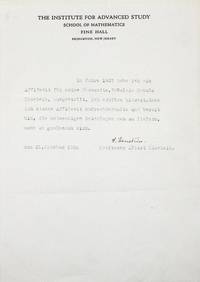
1938réf. 366717Princeton New Jersey 1938. 7 lines typed in German on letterhead of the Institute for Advanced Study School of Mathematics watermarked Chieftain Bond signed in ink. 4to 9-7/8 x 7-1/8 inches. Old folds. Fine. 7 lines typed in German on letterhead of the Institute for Advanced Study School of Mathematics watermarked Chieftain Bond signed in ink. 4to 9-7/8 x 7-1/8 inches. Im Jahre 1837 habe ich ein Affidavit für meine Verwandte Fräulein Ursula Einstein ausgestellt. Ich erkläre hiermit dass ich dieses Affidavit aufrechterhalte und bereit bin di notwendigen Unterlagen neu zi liefern wenn es gewünscht wird. den 31. Oktober 1938 signed Professor Albert Einstein. "In the year 1937 I signed an affidavit on behalf of my relative Miss Urusula Einstein. I hereby state that I continue to certify this affidavit is correct and am ready to submit the necessary documents anew if this is requested." Albert Einstein 1879-1955 German-born physicist renowned for developing the theory of relativity in papers published in 1905 and 1916 was awarded the Nobel Prize for Physics in 1921 and left Germany in 1933. He was associated with the Institute for Advanced Study at Princeton. This statement was almost certainly prepared in connection with efforts to assist his relative in emigrating. In a letter to his sister Maja Winteler-Einstein then resident in Switzerland dated December 1938 Einstein wrote "I am now working as some sort of itinerant relief committee and buckets of letters are coming in . I am helping the Ulm relatives with emigrating". Ursula Einstein born 1916 was able to get out; in 1940 she was a refugee in Port-au-Prince and later reached Brazil. Her younger sister Barbara was not so fortunate. Barbara Einstein born 1918 took her own life in March 1943 after her fiancé Harry Jacob was taken off to the concentration camps. A choice Einstein autograph. unknown books
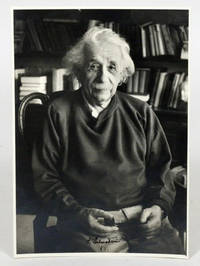
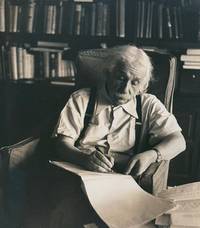
1954réf. 2832Princeton NJ: np 1954. First edition. nb. Fine. EXTREMELY RARE AND BEAUTIFUL SIGNED PHOTOGRAPH OF EINSTEIN BY FREDERICK PLAUT. SIGNED ON THE IMAGE BY EINSTEIN: "A. Einstein 54". A fine photograph of Einstein in 1954 a year before his death sitting in his Princeton home surrounded by books and holding his pipe gazing slightly away from the camera. In his 1964 collection of photographs The Unguarded Moment the photographer Frederick Plaut explains the circumstances of his evocative photo of the elderly Einstein: "There must be a moment in every professional photographer's life when he is so in awe of his subject that he can scarcely focus his camera. That moment for me was when I met Albert Einstein at his home in Princeton. Certainly the great man was not formidable; he greeted my wife and me graciously and proceeded to chat with her while I went to work. I remember that she asked him about his music and when he told her that he no longer played his violin she murmured 'That's too bad.' He smiled 'Ah no. It would have been too bad if I went on.' In the final moments of our visit Einstein looked at me very seriously. 'I hope' he said 'you can sell these pictures for a good price.' Astounded I blurted out: 'Oh no Sir. I have nothing to sell. I just wanted to photograph you.' His face clouded. 'Not sell them If I had known that I never would have let you take them.' After we left I realized the significant of a delightful remark attributed to Mrs. Einstein. Someone once asked Mrs. Einstein whether she understood Professor Einstein's theory of relativity. She answered without hesitation 'No but I understand Professor Einstein'" Frederick Plaut The Unguarded Moment A Photographic Interpretation. The photographer Frederick Plaut moved to the United States from Europe in 1940. After being "discovered" by the legendary photographer Edward Steichen Plaut soon was invited to exhibit in numerous exhibitions. "At the Museum of Modern Art his photographs have been shown in many exhibitions including: 'The Family of Man' 'Music and Musicians' 'The Exact Instant' and others. Plaut's work has appeared in Time Life Esquire Look Saturday Review Vogue U.S. Camera Modern and Popular Photography andRealities et al" The Unguarded Moment. Provenance: Acquired directly from the family of the original recipient Arthur Klein with the original mailing envelope stamped "Jan 27 '54" from The Institute for Advanced Study in Princeton where Einstein was working at the time. Arthur Klein is primarily known for founding with his wife Luce Spoken Arts a highly influential company formed in the 1950s that created and distributed recordings of the works of famous writers and artists usually reading from their own works. Princeton NJ: 1954. Silver gelatin print approximately 4.75 x 6.75 inches. With Plaut's studio stamp on verso. Fine condition with Einstein signature - nicely centered at the base of the photograph - particularly strong. As Plaut mentioned in his account of the photographic session he never intended to sell this photograph and it is likely very few of these photos were printed and distributed. EXTREMELY RARE: WE CAN FIND NO OTHER EXAMPLE OF THIS PHOTOGRAPH SIGNED BY EINSTEIN. np unknown books
1941réf. 2142520/12/1941. Brigitte Kaufmann was born in Germany but when the Nazis came to power in 1933 she fled to Paris. In France Kaufmann worked as an actress under the name of Brigitte Châtel and translated documents. She met her future husband Alfred Alexander-Katz in Paris and they married in 1939; the following day her husband was taken to an internment camp. He was given the choice of being interned in a labor camp or joining the Foreign Legion and chose the latter. Alexander was then sent to Clermont in Vichy France and the family relocated there. Dr. Walter Rudlin was a social science professor at Sarah Lawrence College in New York and actively involved in anti-fascist activities. He was the author of “The Growth of Fascism in Great Britain”. In September 1942 he left his position and joined the U.S. Board of Economic Welfare whose chair was Vice President Henry Wallace. His wife Eryl was interested in bringing Jews in Europe out of harm’s way and she knew the Alexander-Katz family. So Eryl sought to get Brigitte and her family safely out of Europe to Mexico and sought Einstein’s help. On March 12 1941 Einstein responded noting that Brigitte is his relative. “Thank you very much for your letter of March 11th. I am very gratified indeed to learn that our mutual friends Fred and Brigitte Alexander-Katz have some prospect to receive a visa into Mexico. I am certainly willing to vouch for their reliability and integrity both personal and political. I have known Mrs. Brigitte Alexander-Katz - whose family is related to mine - since she was a little girl. Her husband a very able engineer will certainly be useful to any country which receives him. If you will send me the address of the proper Mexican authority I shall gladly send any letter of recommendation desired.” This was a warm letter indeed expressing true concern and friendship for the Alexander-Katz family. On April 3 1941 Einstein again wrote Rudlin noting “Enclosed I am sending you the requested letters in the hope that they may be successful.” But there were delays and no visa so Rudlin wrote Einstein seven months later asking him to take the matter up with the Mexican government. Typed letter signed on his blind-embossed letterhead Princeton December 20 1941 to Mrs. Eryl Rudlin saying that he expects the visa to be granted but does not feel he ought to approach the Mexican government directly. “The Mexican authorities know that I am interested in the case of the Alexander-Katz family; they have kept me informed about the whole development of the matter. I have no doubt that admission to Mexico will be granted as it has been granted to hundreds of people in the same situation. I can give Mr. Alexander-Katz a recommendation but it is out of the question that I ask the Minister of Education to send him an official invitation. I have already done what could be done without intrusion.” Despite what he writes here to calm Mrs. Rudlin Einstein might have exerted some gentle pressure on Mexico by contacting the Mexican ambassador to the U.S. Gilberto Bosques; or the Alexander-Katz visas may have already being granted at that moment. The Einstein Archives is silent on this subject. But soon after Einstein soon wrote this letter in 1942 a telegram to the young Alexander-Katz family arrived stating that Einstein and Rudolph Uhlman a lawyer in New York had secured visas through Ambassador Bosques for them to escape to Veracruz Mexico aboard the ship San Thomé. In Mexico Brigitte she became a noted author actress director and translator. She became the first woman in Mexico to produce and direct television programs. Speaking five languages she also worked as a translator for UNESCO and Amnesty International. Her daughter Susana and granddaughter Sophie also became actors. unknown books
1934réf. 1478Princeton: np 1934. 1st Edition. No Binding. Very Good. AN IMPORTANT SIGNED LETTER in English by Einstein revealing his reservations of associating with communism even in the fight against fascism. Written from Princeton NJ to Professor Albert Sprague Coolidge of Harvard University and dated February 16 1934 the letter reads: My dear Professor Coolidge: I had an opportunity of meeting personally Lord Marley and has sic very favorably impressed by his personality. It became known to me that he sympathizes with the Russian Government i.g. with the Russian communist party and that the committee for which he is active is influenced by communists. The problem as to the attitude which is advisable to be taken towards this committee is rather complicated. On the one hand the world-wide danger of fascism makes it necessary that all enemies of fascism cooperate; on the other hand an action which has communist leanings might endanger that fight since the important task undertaken in defense of culture and civilization may be linked up with interests of a political party. I myself have severed my connections with the committee which with my permission had used my name up to the end of last year. It seems to me advisable to take an attitude as follows: to help their action against fascism but not to identify oneself with the committee. Very truly yours signed A. Einstein P.S. I wish you would be good enough to use this strictly confidentially. In 1934 Lord Baron Marley Dudley Leigh Aman toured the United States to raise funds for his association the World Committee for the Victims of German Fascism. Marley through his committee was "passionately advocating a scheme for which he was to become an international figurehead - resettlement of oppressed German and Polish Jews in the Jewish Autonomous Region" in Siberia. He published a book "The Brown Book of the Hitler Terror and the Burning of the Reichstag sponsored by the World Committee and with an Introduction written by Lord Marley himself which was the first popular exposé of what was happening in Hitler's Germany. It documented the destruction of political parties trade unions and universities book-burning and the building of concentration camps. "At a fundraising dinner held in his honour in New York in February 1934 where Einstein presumably met him just before writing this letter Marley opened the Brown Book and 'speaking quietly declaring that he did not intend to harrow' read aloud to his audience of 600 American Jews some of the collected evidence of Nazi repressions. Here were documentary records of what was happening in Germany - a substantiation of the brutality that hitherto had had no distinct form in the mind of the American Jewish public. What before had been the subject of a growing fear mingled with disbelief was now being presented as hard fact and supported with detailed evidence. The New York Times 8 February 2005 reports the audience being 'startled' by the disclosures and the night ending with $3500 raised for the World Committee" The Jewish Quarterly No. 198. Einstein was correct to be suspicious of Marley's activities for it was later determined that the "World Committee" was indeed a Communist front; Einstein writing here to Coolidge in 1934 was prescient about the motives of the committee. This letter in addition to underscoring Einstein's passionate stance against fascism is particularly important as documentary evidence of Einstein's caution about having any dealings with communism especially considering that the U.S. FBI worried about Einstein's political leanings kept a file on Einstein that grew to 1427 pages. Princeton NJ: February 16 1934. One 8.5 x 11 in. page. Envelope folds minor spotting. An outstanding letter with important and revealing content. np unknown books
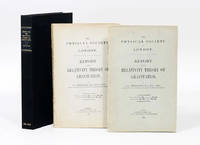
1918réf. 2839London: Fleetway Press 1918. FIRST EDITION. Original wrappers. Fine. THE FIRST INTRODUCTION OF EINSTEIN'S GENERAL RELATIVITY TO THE ENGLISH-SPEAKING WORLD. The groundbreaking first edition 1918 with the second edition 1920 containing the account of Eddington's 1919 expedition proving Einstein's theory both in original wrappers. "Einstein's discovery of the General Theory of Relativity was communicated to the Berlin Academy of Sciences in 1915. Because of the First World War direct communication with physicists in Germany was not possible but the papers were forwarded to Eddington who was then Secretary of the Royal Astronomical Society by Willem de Sitter a personal friend of Eddington's in neutral Holland. The theory is of considerable mathematical complexity but as Einstein stated in the last paragraph of his paper 'scarcely anyone who has fully understood this theory can escape from its magic'. Eddington was the ideal expositor of these ideas in English and within 2 years had written his Report on the Relativity Theory of Gravitation for the Physical Society of London" Malcolm Longair "Bending Space-time". The second edition is notable for containing a new preface that discusses the results of the "eclipse expedition" led by Eddington that verified General Relativity and catapulted Einstein into world-wide fame. This preface precedes Eddington's full report in the Philosophical Transactions. Provenance: Almost certainly Nobel Prize winning physicist's Charles Glover Barkla's copy of the 1918 report with an original 1918 receipt in Barkla's name laid in. Barkla won the 1917 Nobel Prize in Physics "for his discovery of the characteristic Röntgen radiation of the elements". London: Fleetway Press for The Physical Society of London 1918 and 1920. Octavo original wrappers; custom box. General light wear to wrappers. Beautiful copies. RARE. Fleetway Press unknown books
1931réf. 021909New York: Covici Friede 1931. First Edition. hardcover. Some pencil markings in text title page and endpapers darkened not really affecting Einstein's inscription; covers a little soiled. Good to Very Good and quite scarce. With a long biographical note and an appreciation by George Bernard Shaw. Subjects include Disarmament Pacifism the Jewish Homeland and more. This copy INSCRIBED and SIGNED by the author with his scarcer full signature on the front endpaper: "To little Pauline/Albert Einstein/1933." An uncommon title to find signed by the man of the century. With a letter of authenticity from James Spence if you need that kind of security blanket. Covici Friede hardcover books
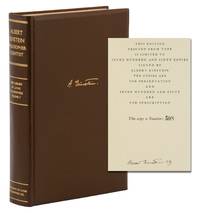
1949réf. 140948474Evanston Illinois: The Library of Living Philosophers Inc 1949. Signed Limited First Edition. Near Fine. First edition. Number 508 of a limited 760 copies signed and dated by Albert Einstein. 777 pp. Bound in publisher's brown leatherette stamped in gilt; top edge gilt; lacking the glassine dust jacket and slipcase. Text in English and German. Near Fine with very faint tidemark to edge of half-title frontisportrait and title page. A collection of critical essays devoted to the theoretical physicist by twenty-five eminent scholars and scientists with Einstein's remarks. Published on Einstein's 70th birthday the work has contributions by noted contemporaries such as Max Born Kurt Godel and Wolfgang Pauli. The Library of Living Philosophers, Inc unknown books
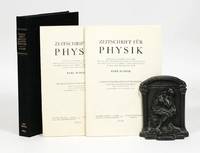
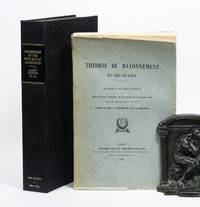
1922réf. 792Berlin: Springer 1922. First Edition. Wrappers. Near fine. 2 vols. in German the first appearance of 2 distinct papers in 2 separate periodical issues September 13 and November 17. Both are complete in original wrappers. Near fine small pencil name on the Nov. cover. Seems to be surprisingly rare. RBH lists no auction sales of Friedmann's article title and date since 1975 and only one copy of it is listed by OCLC but copies of the bound annual Zeitschrift für Physik are regularly available and should not in this case be considered in any way equivalent to our set in publisher's wrappers. 1. Friedmann's pioneering paper the first to seriously apply general relativity to cosmology without the stabilizing cosmological constant theorizing and mathematically formularizing an expanding universe dragging cosmology into a branch of physics. In Zeitschrift für Physik Band 10 He 16 September 13 1922 pages 377-386 "Here we have for the first time the idea of an expanding universe originating in a singularity-a big-bang." -Helge Kragh Cosmology and Controversy page 24. 2. Einstein's critical remarks on Friedmann's paper that he retracted in 1923. In Zeitschrift für Physik Band 11 He 4/5 November 17 1922 page 326. Springer unknown books
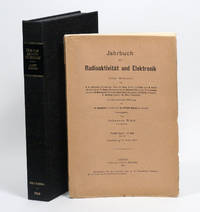
1908réf. 2507Leipzig: S. Hirzel 1908. First edition. original wrappers. Very Good. THE BIRTH OF GENERAL RELATIVITY: FIRST PRINTING IN RARE ORIGINAL WRAPPERS OF ONE ONE EINSTEIN'S MOST IMPORTANT PAPERS; containing the beginning of general relativity the derivations of the equivalence principle gravitational redshift and the gravitational bending of light. "Einstein's road to general relativity began in November 1907 when he was struggling against a deadline to finish an article for a science yearbook explaining his special theory of relativity. Two limitations of that theory still bothered him: it applied only to uniform constant-velocity motion. and it did not incorporate Newton's theory of gravity. "'I was sitting in a chair in the patent office at Bern when all of a sudden a thought occurred to me' he recalled. 'If a person falls freely he will not feel his own weight.' That realization which 'startled' him launched him on an arduous eight-year effort to generalize his special theory of relativity and 'impelled me toward a theory of gravitation.' Later he would call it 'the happiest though in my life.' "The tale of the falling man has become an iconic one and in some accounts it actually involves a painter who fell from the roof of an apartment building near the patent office. Einstein refined his thought experiment so that the falling man was in an enclosed chamber such as an elevator in free fall above the earth. In this falling chamber at least until it crashed the man would feel weightless. Any objects he emptied from his pocket and let loose would float alongside him. "Looking at it another way Einstein imagined a man in an enclosed chamber floating in deep space 'far removed from stars and other appreciable masses.' He would experience the same perceptions of weightlessness. 'Gravitation naturally does not exist for this observer. He must fasten himself with strings to the floor otherwise the slightest impact against the floor will cause him to rise slowly towards the ceiling.' "Then Einstein imagined that a rope was hooked onto the roof of the chamber and pulled up with a constant force. 'The chamber together with the observer then begin to move "upwards" with a uniformly accelerated motion.' The man inside will feel himself pressed to the floor. 'He is then standing in the chest in exactly the same way as anyone stands in a room of a house on our earth. The man in the chamber will come to the conclusion that he and the chest are in a gravitational field. Just then however he discovers the hook in the middle of the lid of the chest and the rope which is attached to it and he consequently comes to the conclusion that the chamber is suspended at rest in the gravitational field.' Einstein observed that inertial mass always equals gravitational mass and through his thought experiments concluded that "From this correspondence it follows that it is impossible to discover by experiment whether a given system of coordinates is accelerated or whether. the observed effects are due to a gravitational field." "Einstein called this 'the equivalence principle.' The local effects of gravity and of acceleration are equivalent. "In 1907 working against the deadline imposed by the Yearbook of Radioactivity and Electronics Einstein tacked on a fifth section to his article on relativity that sketched out his new ideas. He also came up with many predictions that could be tested including that light should be bent by gravity and that the wavelength of light emitted from a source with a large mass such as the sun should increase slightly in what has become known as the gravitational redshift. "It would take Einstein another eight years until November 1915 to work out the fundamentals of this theory and find the math to express it. Then it would take another four years before the most vivid of his predictions the extent to which gravity would bend light was verified by dramatic observations. But at least Einstein now had a vision one that started him on the road toward one of the most elegant and impressive achievements in the history of physics: the general theory of relativity" Isaacson Einstein 145-49. Weil in his bibliography also notes that "On p.443 are probably the first explicit statements both of the equivalence of inertial and gravitational mass and of the equation for mass in terms of energy now regarded as the theoretical basis for the release of atomic energy." Weil 21. Although Einstein submitted the paper on 4 December 1907 it wasn't published until the January 22 issue of the Jarbuch. Note: There was a very short "Correction" in a subsequent issue not included here. IN: Jahrbuch der Radioactivität under Electronik Vierter Band - 4. Heft No. 16 pp. 411-462. Leipzig: S. Hirzel 1908. Octavo original wrappers; handsome custom box. Light wear to wrappers and split to spine; text fine with Einstein paper largely unopened. AN EXTREMELY RARE COPY IN ORIGINAL WRAPPERS OF ONE OF EINSTEIN'S MOST IMPORTANT PAPERS. S. Hirzel unknown books
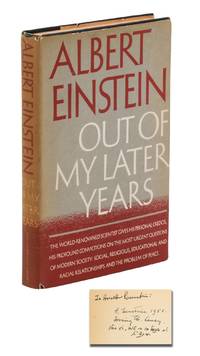
1950réf. 140948403New York: Philosophical Library 1950. First Edition. Near Fine/Near Fine. First edition first printing. Signed by Albert Einstein on the front free endpaper and dated the year of publication. Above and beneath Einstein's signature Rabbi Irving Levey has inscribed this book to former owner Harold Rosenstein and written two lines of Hebrew that translate to "A day that is exceptionally good 19 Kislev 5711." According to Rosenstein's grandson Einstein's signature was procured by Rabbi Levey who lead temple at the Jewish Center at Princeton from 1949-51. Levey and Einstein and worked together on issues relating to the then-newly formed State of Israel. vi 282 pp. Bound in publisher's blue cloth stamped in gilt. Near Fine with light rubbing to corners and spine ends offsetting at endsheets. In a Near Fine unclipped dust jacket with toning light edge wear small stain to rear flap. The iconic theoretical physicist's second collection of essays covering the years 1934-1950 surrounding his personal convictions around religious and humanitarian issues in the wake and aftermath of WWII. Boni 515. Philosophical Library unknown books
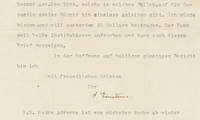
1941réf. 3262211/9/41. A generous demonstration by Einstein of his loyalty to friends and belief in the importance of music Dr. Theodor Rosenheim was a physician at the famed Medical University Clinic of the Charité in Germany in the 1880s. He was primarily concerned with the physiology and pathology of the digestive tract. He published an early textbook on the “Pathologie und Therapie der Krankheiten des Verdauungsapparates”. Rosenheim was one of the first in Germany to describe and publish on ulcerative colitis. He was intensively involved in the technical development of esophagoscopy and gastroscopy which at that time were only possible with rigid instruments. The Rosenheim line which was named after him described the largest diagonal diameter of the gastric percussion figure. Rosenheim was appointed professor extraordinarius at Berlin University in 1921. He also founded a polyclinic and a private sanatorium for stomach and intestinal patients. He was well respected in Berlin and his private practice developed successfully with a large circle of patients including Albert Einstein. Theodor’s wife was Hedwig Rosenheim and their daughter Kate was a hero of the Holocaust. She helped several thousand children from Jewish families to escape from Germany. She personally accompanied the legendary Kindertransporte to England among other places. She travelled to the USA in 1936 to negotiate directly with the aid organizations there. She then returned to Germany to actively continue the aid campaigns. Theodor died in 1939. Käte Rosenheim was able to flee Berlin together with her 72-year-old mother Hedwig Rosenheim on January 23 1941. They reached Havana Cuba via France Spain and Portugal. From there they were able to continue to New York where they arrived on April 1 1941. Albert Einstein was an accomplished violinist and music lover who was inspired by music in his scientific work. He often said that he would have been a musician if he hadn't pursued science. Another music lover was Hedwig Rosenheim. She had escaped Germany without her possessions especially her precious musical instruments. Upon arrival in the United States she contacted the old family friend Albert Einstein hoping he could help her get a flute either for herself or another escapee one who may have agreed to look for her. Einstein was sympathetic and rose to the occasion. He even contributed some of his personal funds to secure the flute. Typed letter signed his vacation house in Knollwood at Saranac Lake N.Y. September 11 1941 to his old friend Mrs. Hedwig Rosenheim in New York City. “ The matter of i.e. the quest for the flute shall not fail. First one should know what the committee is giving out – or loaning. Second there is the Hebrew Free Loan Society 108 Second Ave. New York which in such cases provides interest-free loans in exchange for the backing of two guarantors. I will serve as a guarantor and contribute 20 dollars on top of that. The man should visit both institutions and can show this letter. In the hope of receiving a positive report soon I remain with warm greetings your A. Einstein.” “PS. Starting next week my address will again be in Princeton.” The committee he referred may have been the American Jewish Joint Distribution Committee though there were others as well. It shows a lot about Einstein - his generosity his continued concern for old friends who had escaped from Germany and love for music - that he volunteered to make a personal financial contribution to obtaining the flute. <img class=""alignnone wp-image-25018 size-post-window"" src=""https://cdn.raabcollection.com/wp-content/uploads/20231204144051/Folder-site-11-1600x1327.jpg"" alt="""" width=""1600"" height=""1327"" /> unknown books
1916réf. 2364Braunschweig: Druck und Verlag von Friedr Vieweg and Son 1916. First edition. Original wrappers. Very Good. FIRST PRINTING IN ORIGINAL WRAPPERS OF ONE OF EINSTEIN'S MAJOR WORKS: HIS FIRST PAPER ON THE DERIVATION OF PLANK'S LAW AND PROVIDING THE THEORETICAL BASIS FOR THE LASER. "Einstein commended the 'unparalleled boldness' of Planck's derivation of 1900 meaning not only the problem itself but also the fact that it was based on assumptions that were not entirely free of contradictions. Einstein now succeeded in the first of two papers in eliminating that flaw. More interesting than the derivation itself was the general character of his methods. Einstein proceeded from Niels Bohr's basic--and by then well tested--assumption that the electrons within an atom occupy a number of discrete energy states and are able through emission or absorption of radiation to pass from one of those states to another. Added to this was an assumption of thermodynamic equilibrium between radiation field and atom as well as a consideration of the 'classical' limiting case at high temperatures--and there was Planck's formula. This brief argument. also covers emission stimulated by the radiation field; thus the formulas already by implication contain the theory of the laser though it was to take nearly half a century to be realized" Folsing Albert Einstein 389. Weil 85. The "implication" containing the theory of the laser was more fully developed in his companion paper "On the Quantum Theory of Radiation" published a few weeks later. In the first paper Einstein wrestled with the concept that the atomic emission of radiation could be a directed process; in the second paper he convincingly demonstrates that this is indeed the case. IN: Verhandl. D. Deutch. Phys. Ges. Vol 18 pp. 318-323. Braunschweig: Druck und Verlag von Friedr. Vieweg and Son 1916. Octavo original wrappers; housed in custom half leather chemise. One thread literally resewn on wrappers a little creasing and soiling. A beautiful copy. RARE IN ORIGINAL WRAPPERS. Druck und Verlag von Friedr Vieweg and Son unknown books
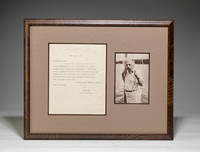
1946réf. 1206241946. Signed. EINSTEIN Albert. Typed letter signed. Princeton April 3 1946. Single sheet of gray letterhead measuring 8-1/2 by 11 inches; p. 1. Matted and framed with a portrait entire piece measures 19 by 15-1/2 inches. $9500.Original typed letter signed by Albert Einstein thanking his friend Dr. Isadore Held for his birthday wishes as well as for sending a new book that Einstein found both ""extraordinarily enlightening"" and humorous. Text in German.The letter typed on Einstein's personal letterhead with his name and Princeton address blindstamped at the top reads in full translation: ""3 April 1946. Dear Mr. Held: I would like to express my sincere thanks for your birthday wishes and for the sending of the last work of this wonderful contemporary. I have already read quite a bit and find that it is extraordinarily enlightening. His penetration into the mentality of far-off times and attitudes toward thinking is most remarkable and his humor no less. With fond greetings to you and your dear wife. Yours signed Albert Einstein."" This letter was written to Austrian-American medical Dr. Isadore Held who was friends with Einstein since at least 1938. Held and Einstein shared numerous interests particularly related to Jewish humanitarian relief and Israel. At Held's death Einstein wrote to his widow that ""True goodness emanated from this man who alleviated the harshness of human relations and who understood and forgave all weaknessesÉ As a role model for his fellow men he was the best that a human being can be."" Einstein was not a huge fan of birthdays though he happily acknowledged well wishes from friends. Just before turning 65 Einstein crankily said to a New York Times interviewer: ""What is there to celebrate Birthdays are automatic things. Anyway birthdays are for children."" In a 1954 letter to physicist Hans Mhsam Einstein described his birthday as ""a natural disaster a shower of paper full of flattery under which one is drowned."" Einstein was generally quite shy and did not like to be the center of attention particularly from strangers obsessed with his accomplishments and fame. However well-meaning letters and small gifts like the book given by Held were always welcomed and graciously accepted by Einstein. Original mailing creases and a few pinpoint holes along top edge possibly from stapling. About-fine condition. unknown books
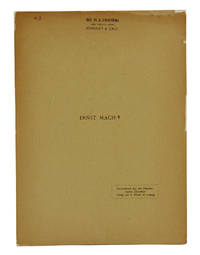
1916réf. 140941831Leipzig Germany: S. Hirzel 1916. First separate edition. First separate edition. 4 pp. Illustrated with portrait of August Mach from photograph. Publisher's original printed wrappers. Very Good with some small chips to fragile wrappers faint crease to top of front wrap contents toned with age. This copy belonged to Hans Albert Einstein Albert Einstein's oldest son with his inkstamp at top of front wrapper; likely a presentation copy from his father. Neatly written at top of front wrapper is "43" and date "14.III.16." OCLC/WorldCat locates four copies two at the University of Toronto one at the Smithsonian Institution and one at the American Philosophical Society. Weil 89. Very rare author's offprint stating "Uberreicht vom Verfasser" of the eulogy by Albert Einstein for fellow physicist Ernst Mach as first published in Physikalischen Zeitschrift. A noted scientist in his own right Mach is best known for the concept of "Mach's principle" which asserts that an entity's inertial mass is determined by all the other masses in the universe. Einstein in fact coined the phrase "Mach's principle" and his application of it had major ramifications for the development of his theory of general relativity Einstein in 1918 labeling it one of the "three pillars" of general relativity. S. Hirzel unknown books
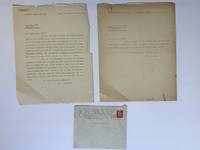
1931réf. 1403337Potsdam Germany 1931. Two letters by Albert Einstein. The first is a single-paged autograph letter signed by Albert Einstein with one horizontal fold and one vertical fold. In Very Good condition . Measuring 22.5 x 28.5 cm. Letter accompanied with mailing envelope both with matching paper-clip rust stain. Letter with some light wear along edges small staining to lower corner. Addressed to G. W. Meyer and dated 8 Oktober 31 in Potsdam the Letter reads in full: "Sehr geehrter Herr! Indem ich Ihnen für die Uebersendung des Buches von Henry George bestens danke sende ich Ihnen anliegend die gewünschte Meinungsäusserung mit der Bitte um Weiterleitung an Mrs. Evans. Mit ausgezeichneter Hochachtung" and signed in ink "A. Einstein". He thanks Meyer for serving as an intermediary in getting a book to him and for forwarding the enclosed letter. The second letter is a typed copy of Einstein's previously enclosed letter presumably made by Meyer before he passed the original on to Evans. Addressed to R. W. Evans and dated 8.10.1931 in Potsdam the letter discusses Henry George's economic theory of poverty and land nationalization compares it to Franz Oppenheimer's work and proposes questions to be asked. Presumably he was sent a copy of Henry George's Progress and Poverty. First published in 1879 it sparked the Progressive Era discussing the paradox of increasing inequality and poverty amid economic and technological progress as well as the economic value of land. Consignment. Shelved Case 3. The Letter reads in full: "Sehr geehrte Mrs. Evans! Ich habe das Buch von Henry George zum grössten Teil mit ausserordentlichem Interesse gelesen und glaube dass es in der Hauptsache einen unanfechtbaren Standpunkt vertritt insbesondere was die Ursache der Armut betrifft. Nie in diesem Buch vertretenen Ansichten stimmen soweit ich es beurteilen kann vollkommen mit den Resultaten des zeitgenössischen Professors Franz Oppenheimer überein der sie offenbar selbständig herausgefunden hat. Nicht einverstanden bin ich mit der Theorie des Zinses. Mit dem vorgeschlagenen Heilmittel der Verstaatlichung des Bodens und der Bodenschätzung scheint mir allerdings mehr ein Problem als eine Lösung gegeben zu sein. Soll z. Beispiel ein Boden Eigentum der Gemeinschaft das darauf hingestellte Haus aber Privateigentum sein Jedenfalls ist es schon von höchster Wichtigkeit dass das Wesen des Uebels klar aufgezeigt ist. Schon darum wäre es wichtig wenn das Buch die ihm gebührende Beachtung fände. Mit ausgezeichneter Hochachtung gez. A. Einstein." 1403337. Shelved Dupont Bookstore. unknown books
1924réf. 2905Berlin: Julius Springer 1924. First edition. original wrappers. Very Good. FIRST EDITION IN ORIGINAL WRAPPERS of the presentation of "Bose-Einstein statistics." “In 1924 Bose found a way to derive Planck’s equation for black body radiation using a statistical approach based entirely on the idea that light is made up of tiny particles photons. This echoed the statistical mechanics approach of Ludwig Boltzmann to the behaviour of gases but using a different statistical rule; it derives black body radiation entirely in quantum terms without using the idea of electromagnetic radiation at all. Bose wrote a paper about his discovery and sent it to Albert Einstein who immediately saw its significance translated it into German and arranged for its publication in the prestigious Zeitschrift für Physik. Einstein developed the idea to apply to other kinds of particle not just to a ‘gas’ of photons which is why this approach is usually referred to as ‘Bose-Einstein statistics’. Paul Dirac coined the name ‘bosons’ for particles which obey Bose-Einstein statistics" Gribbin Q is for Quantum. Particle Physics: One Hundred Years of Discoveries: “Discovery of new statistical counting rules for light quanta and a new derivation of Planck’s radiation law. Known as Bose-Einstein quantum statistics for particles with integer spins.” WITH a follow-up paper by Bose: "Wärmegleichgewicht im Strahlungsfeld bei Anwesenheit von Materie": "Bose's first paper in 'Zeitschrift für Physik' was followed by another that was also translated by Einstein and published during 1924. In it Bose provided a general statistical treatment of emission and absorption processes for electromagnetic radiation in equilibrium with matter. This paper was accompanied by a note by Einstein expressing serious doubts about the method. In January 1925 Bose wrote to Einstein from Paris that he was working on a paper he felt would remove these doubts. But it seems never to have been completed" DSB. Plancks Gesetz und Lichtquantenhypothese. IN: Zeitschrift für Physik Vol 26 No. 3 August 1924 pp. 178-81. Berlin: Julius Springer 1924. “Wärmegleichgewicht” Vol 27 No. 5/6 September 1924 pp. 384-93. Octavo original wrappers. “Planks Gesetz” with small closed tear at rear wrapper edge; otherwise fine condition; “Wärmegleichgewicht” with small chip to base of front wrapper. SCARCE in original wrappers. Julius Springer unknown books
1932réf. 1864np: np 1932. First edition. nb. UNPUBLISHED CANDID PHOTOGRAPHS OF EINSTEIN AND LETTERS BY WILLIAM HUBBARD OFFERING AN INTIMATE VIEW OF THE SCIENTIST ON VACATION. On March 2 1932 at the height of his career and world fame Albert Einstein and his wife Elsa set off on a vacation to their German homeland departing from Los Angeles on the M. S. San Francisco. Another passenger aboard the ship was the renowned music scholar William Lines Hubbard. Famous in his own right Hubbard was the music critic for the Chicago Tribune and author of a definitive 11-volume work on the history of opera published 1908. Accompanying Hubbard was his companion Julia Reid their cabins adjacent to that of the Einstein's. As was the practice during this era Hubbard kept detailed journals and letters of his travel experiences. This collection from the estate of Hubbard contains the following items: 1. Three unpublished small black-and-white and sepia photographs. The first photograph 4.5" x 2.5" pictures Einstein his wife Elsa the Ship's Captain Hubbard the tall figure and three other of the ship's passengers dated 3/14/32. The second photograph 3.5" x 3.25" is an outstanding full front image of Einstein his wife Elsa and the ship's Captain. The final photograph 4.5" x 2.5" is a full frontal image of Einstein and his wife Elsa both seated in deck chairs with the ship's Captain standing behind. 2. Typed letter dated March 22 1932 written while sailing through the South Atlantic. Six pages typed front and back on two pieces folded of the ship's original stationary approx. 7.5x11 in. Excerpts on Einstein include: Of our Six Passengers two are Prof. Einstein and wife. They are proving very delightful companions-- sincere unaffected and jolly. At first they were very reserved and merely bowed and smiled and "Guten-Morgan-ed" when entering and leaving the dining room but when they had become rested and saw that none of the rest of us planned to intrude they came forward and have been very genial. She is a great talker but talks interestingly. He walks deck smoking his stubby black pipe or whistling cheerily his gray hair blowing in the breeze. Each forenoon and sometimes in the afternoon he goes to the piano and plays for half hour or so. Plays in that satisfying manner peculiar to a man to whom music is a comfort and who thinks musically. It is in no wise brilliant playing but it is throughly enjoyable to hear. The rest of the time he sits in his steamer chair or in his cabin reading or thinking. On the 14th he had his 53rd birthday and the Capt had ordered from La Libertad Salvador where we had taken cargo the day before large bunches of easter and tiger lilies which in the morning were on the Einstein table together with a birthday cake the ship's cook had made and countless cards and letters which friends had sent. It was all a complete surprise to them both and their happiness was childlike in its spontaneity and sincerity. It was heart warming to watch them. They seem to appreciate being left to themselves and not being lionized. It is the third time they have come through the canal on these boards an they enjoy it to the full. 3. Typed letter dated April 1 1932 written while entering the English Channel. Seven pages on two approx. 8.5x11in sheets folded of the ship's original stationary. Excerpts on Einstein include: We had good fun watching for crocodiles along the banks as we came up the cut and Prof Einstein was especially gleeful when he discovered one. Professor Einstein loves the roung sic weather and has reveled in it. He and the Mme are proving very delightful fellow passengers. She is very chatty but chats interestingly and he struts up and down deck smoking his stubby pipe or whistling like a jolly kid his white hair blowing in the breeze. We have some talks occasionally and he yesterday when he saw the copy of Living Philosophies which I had given me sic before I left San Diego and in which his article is the first took the book and autographed his picture and wrote in remembrance of the happy days on board the San Francisco. I don't think I told you of his birthday which occurred on the 14 of March the day before we reached the Canal. The Capt came to know if it and when the Einsteins came to their table at breakfast they found it decorated with three huge vases of Easter and Tiger lilies which the Capt had secured in La Libertad. The cook had made a gorgeously decorated Torte-- one of the filled and frosted German cakes-- and there were letters and telegrams from friends which had been sent in the Capt's care. It was a complete surprise to the Einsteins and they were like two happy kiddies. It was gladdening to watch their simple and keen enjoyment. Later we had pieces of the Torte which were a bit of muchness for breakfast but which of course we ate. 4. Typed letter dated April 24 1932 written in Merano Italy. Six pages on five 5.5x7in sheets. While recalling a cargo transfer on the M. S. San Fransisco Hubbard writes: The Einsteins were especially enthusiastic and we had a great fun over the boss of the unloading. He was a huge and tremendously rotund gent wearing a soft felt hat and a short overcoat the buttons of which seemed fated to "bust off" at any moment. His chief employment seemed to be running about from side to side of the dock into the warehouse and out again clambering onboard and then clambering off and all the time shouting orders at the top of his voice and gesticulating wildly. Einstein had been reading the "Living Philosophies" which I had loaned him and was especially curious concerning Mencken and how he happened to be included in the great ones in the book. I gave him an outline of Mr. M's greatness and assured him that the book cold sic well largely on account of M being included. All of which amused the Einsteins greatly. So when this wild boss hove into sight that morning and began his excited directing Mrs E said "there is Mister Mencken" and thus he remained so long as we were in Rotterdam. The Einsteins were starting early the next morning for Berlin so they went about 9 pm to the custom house and had their 16 packages bundles and gifts examined. Frau Professor had a funny story to tell of their experience with the 150 pound bag of coffee that had been presented them in Salvador. 5. An official passenger list from the M. S. San Francisco printed on the ship's original stationary 4.75" x 8.25" dated March 2 1932. With "Professor Albert Einstein" and "Mrs. Albert Einstein" shown under the list of cabin passengers going from Los Angeles to Bremen. 6. A postcard depicting Hubbard's profile in black and white 3.45" x 5.45". All items in very good condition letters with wear and soiling at folds and housed in a custom cloth presentation folder. RARE FIRST-HAND TESTIMONY REVEALING THE PERSONALITY OF EINSTEIN IN RELAXED AND INFORMAL MOMENTS. np unknown books
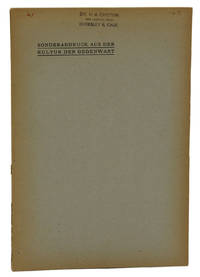
1925réf. 140941837Berlin: No Publisher 1925. Revised edition. 783-797 pp. Publisher's original printed wrappers. About Very Good with thin tear along front wrap fold near head a little chipping to wraps at spine front wrap hinge fragile contents toned with age. This copy belonged to Hans Albert Einstein Albert Einstein's oldest son with his inkstamp at top of front wrapper; likely a presentation copy from his father. Neatly written at top of front wrapper are "41" and 163." Very rare author's offprint from Die Kulture der Gegenwart of an essay on relativity theory which was first published in 1914 revised to incorporate Einstein's later research. OCLC/WorldCat locates no physical copies. Weil 71. [No Publisher] unknown books
1912réf. 2508Paris: Gauthier-Villars 1912. First edition. Original wrappers custom box. Very Good. RARE FIRST EDITION IN ORIGINAL WRAPPERS OF THE REPORTS FROM THE HISTORIC FIRST SOLVAY CONFERENCE "THE FIRST INTERNATIONAL CONFERENCE IN PHYSICS EVER ORGANIZED" AND A CRITICAL MOMENT IN THE BIRTH OF QUANTUM PHYSICS. In the short time that followed Planck's hypothesis of the universal constant that would bear his name the greatest minds in physics were largely at a loss about how to deal with the bizarre theoretical results that followed let alone the experimental results which confirmed them!. Much of the focus at the time was on black-body radiation including work by Planck himself as well as Lorentz Rayleigh and Jeans. However shortly before the first Solvay conference a young Einstein had also started investigating the related question of materials' specific heat. Kuhn. "The purpose of the first Solvay Conference was thus two-fold: first there was the need to examine whether classical theories molecular-kinetic theory and electrodynamics could in some undiscovered ways provide an explanation of the problem of black-body radiation and of the specific heat of polyatomic substances at low temperatures; secondly to consider phenomena in which the theory of quanta could be successfully used." Mehra. Underlying these questions was the more fundamental mystery of how to interpret the existence of the Planck constant. There were two camps both of which were represented at the conference. Planck's took the constant to indicate some fundamental constraint on the radiative processes of emission and absorption. For example "Sommerfeld introduced a version of the quantum hypothesis which he considered to be compatible with classical electrodynamics. He postulated that in 'every purely molecular process' a quantized quantity of action is exchanged." Staumann. Einstein's camp on the other hand took the quantum of action to represent the physicality of a perhaps pseudo-corpuscular theory of energy exchange - his photons of light. Although the debates that followed the lectures included in the proceedings did not rise to the famous heated exchange that Einstein would have with Bohr at the 1927 Solvay conference we do see some of the young Einstein's hotheadedness as he opens the debate following Planck's plenary lecture: "What I find strange about the way Mr. Planck applies Boltzmann's equation is that he introduces a state probability W without giving this quantity a physical definition. If one proceeds in such a way then to begin with Boltzmann's equation does not have a physical meaning." As translated by Straumann. It would take another 14 years for quantum mechanics to be fully formalized but the first Solvay conference represents a pivotal point in quantum history: "During 1911 the situation changed quickly. Articles that applied the quantum to other topics then outnumbered those on blackbody radiation for the first time and some were backed by impressive experimental evidence. In part because of that evidence physicists like Planck and Lorentz who had previously taken the constant h to be characteristic only of the radiation problem began to consider additional areas in which others had earlier staked quantum claims." Kuhn. Albert Einstein and the Solvay Conference: Among the most renown scientists of the day - including Ernest Rutherford Marie Curie and Max Planck - Einstein made quite an impression. At age 32 he was the second youngest participant in the conference. The youngest was British physicist Frederick Lindemann later to become scientific adviser to Winston Churchill. Although "Einstein had already published so many masterpieces none had actually been put to the test and his theories were looked on rather as tours de force than as definitive additions to knowledge. But his pre-eminence among the twelve greatest theoretical physicists of the day was clear to any unprejudiced observer." Frederick Lindemann quoted in Brian. References: Headline quote from the Solvay Institute website. Kuhn T. 1978 Black Body Theory and the Quantum Discontinuity 1894-1912. University of Chicago Press. Mehra J. 1975 The Solvay Conferences on Physics: Aspects of the Development of Physics Since 1911. Straumann N. 2011. On the first Solvay Congress in 1911. The European Physical Journal H 363 379-399. Denis Brian Einstein: A Life p.82. Paris: Gauthier-Villars 1912. Octavo original wrappers; custom box. Splits to top and bottom joint of upper wrapper two creases to front wrapper. Text in fine condition largely unopened. FIRST PRINTINGS IN ORIGINAL WRAPPERS ARE EXTREMELY SCARCE. Gauthier-Villars unknown books
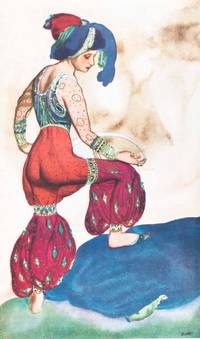
1927réf. 49047Berlin: Ernst Wasmuth A.-G 1927. First edition. Good- to fine condition. 176/330. 41 1pp. 42 plates with printed tissue guards. Original quarter vellum over brown paper-covered boards with gilt vignette on cover gilt lettering on spine. Title page with publisher's device and black double frame. Cover design by Lucian Zabel. With an introduction on Russian culture the tradition of ballet and theater set and costume design by Carl Einstein. Many of the plates with dates ranging from 1910 to 1923 including motifs created during the war. The motifs of the plates range from close-up figure drawings to simple folk costumes elaborate gowns for members of the Court mystical figures and various set designs. Illustrated with forty-two plates nineteen of them fully or partially colored by hand or pochoir some heightened in gilt or silver three b/w one sepia-toned lithograph and nineteen plates reproduced in high quality offset printing. The title page calls for forty-two plates and six illustrations in the text. Our copy is illustrated with seven tipped-in color offset reproductions and one b/w lithograph as endpiece on page seventeen. In addition the work is extra-illustrated with five color offset reproductions: one full-page embossed color plate with extensive hand-applied gilt overlay facing page seven Le Roi a full-page embossed color offset reproduction with extensive silver overlay facing plate one Phedre Thesee dated 1923 and three full page color offset reproductions facing plates fifteen L'Amazone with black overprinting twenty-five Scheherazade embossed and heightened in silver and Lampe d'Aladin multicolor overprint and thirty-six La Sultane embossed and overprinted in gilt facing the same image though with greater detail. The copies listed in OCLC vary in publication dates all calling for 42 plates and six in-text illustrations. Auction records call for 1925. One auction record for the 1925 edition calls for the lithograph line drawing in the text. Our copy contains two plates dated 1922 in addition to others dated 1917. We've been unable to find any bibliographic record that describes seven in-text illustrations or the five additional illustrations facing four of the plates and the first page of the text as described. Text in German. Binding with light wear along edges but vellum smudged and variously discolored. Block lightly starting at a few plates 11 15 19 27 30 42. A couples of tissue guards for plates loose but present. Binding in overall good- plates in very good to fine condition. Leon Bakst 1866-1924 was a Russian painter costume and set designer. Bakst studied art at the St. Petersburg Academy of Arts and was a member of the Sergei Diaghilev circle. In 1893 he moved to Paris for four years studying at the Academy Julian. He founded the magazine 'Mir Iskusstva World of Art' with his friends Alexander Benois Sergei Diaghilev and Valentin Serov. Bakst is best known for his work in set and costume design for the Ballet Russes. Ernst Wasmuth A.-G unknown books
1948réf. 2327Princeton NJ: np 1948. framed. Fine. ONE OF THE MOST CELEBRATED IMAGES OF EINSTEIN SIGNED BY MASTER PHOTOGRAPHER YOUSUF KARSH. On February 11 1948 Yousuf Karsh perhaps the most accomplished portrait photographer of his generation visited The Institute for Advanced Study in Princeton to fulfill a dream of his: to photograph Albert Einstein. As he later explained: "Among the tasks that life as a photographer had set me a portrait of Albert Einstein had always seemed a 'must' - not only because this greatest refugee of our century has been accounted by all the world as the most outstanding scientist since Newton but because his face in all its rough grandeur invited and challenged the camera." Karsh: Beyond the Camera David Travis ed. "At Princeton's Institute for Advanced Study I found Einstein a simple kindly almost childlike man too great for any of the postures of eminence. One did not have to understand his science to feel the power of his mind or the force of his personality" official Karsh website. "Awed before this unique intellect I yet ventured to ask Einstein his views on human immortality. He mused for a moment and then replied 'What I believe of immortality There are two kinds. The first lives in the imagination of people and is thus an illusion. There is a relative immortality which may conserve the memory of an individual for some generations. But there is only one true immortality on a cosmic scale ant that is the immortality of the cosmos itself. There is no other.' "He spoke of these ultimate mysteries as calmly as he might a student's question about mathematics - with such an air of quiet confidence indeed that I found his answer profoundly disturbing to one who held other views. Knowing him to be an accomplished violinist I turned the conversation and asked if there were any connection between music and mathematics. 'In art he said 'and in the higher ranges of science there is a feeling of harmony which underlies all endeavour. There is no true greatness in art or science without that sense of harmony. He who lacks it can never be more than a great technician in either field.' "Was he optimistic about the future harmony of mankind itself He appeared to ponder deeply and remarked in graver tones: 'Optimistic No. But if mankind fails to find a harmonious solution than there will be disaster on a dimension beyond anyone's imagination.' To what source should we look for the hope of the world's future 'To ourselves' said Einstein. He spoke sadly yet serenely as one who had looked into the universe far past mankind's small affairs. In this humor my camera caught him. the portrait of a man who had traveled beyond hope or despair." Yousuf Karsh Regarding Heroes. Opening quote from: Colin Naylor ed. Contemporary Photographers. Silver print. Photo taken Princeton 1948. Printed later. Signed by Karsh in full beneath the image on photographer's mount. With Karsh's original calling "card" - a 4x10 inch cardboard slip - included. Image: 8x9 inches. Framed to an overall size of 12x15 inches. Fine condition. np unknown books
1950réf. 2896Princeton: np 1950. Very Good. A beautiful photo of Einstein at work in his study seemingly absorbed with his thoughts. The photographer Hermann Landshoff like Einstein was a German-Jewish émigré who settled in the United States in the 1930s. His large body of work encompasses portraits of some of the most influential figures of the century. Landshoff was highly respected by his peers with his work prompting the American photographer Richard Avedon to claim "I owe everything to Landshoff." Landshoff visited Einstein to photograph him several times in the 1940s and early 1950s showing Einstein in quieter moments at his home or study in Princeton. With Landshoff's copyright stamp on verso marking this as a "Sample copy" and "Not for sale or reproduction." Also with Landshoff's signature on the original matte board. The original non-archival matte was removed during framing to better preserve the photo but the signature was preserved and is now displayed on verso. Gelatin silver print with sepia tones. Taken c.1950 likely a contemporary or early printing. Approx. 9.25 x 10.5 in 235 x 263 mm. Archivally framed under museum glass to a size of 16 x 17.5 in. A few tiny spots to image generally in fine condition handsomely framed. np unknown books
1914réf. 2124Berlin: Königlichen Akademie der Wissenschaften 1914. FIRST EDITION OFFPRINT. Original wrappers. Fine. FIRST EDITION COMMERCIAL OFFPRINT ISSUE of Einstein's important 1914 paper on the development of general relativity. "In summer 1914 Einstein felt that the new theory general relativity should be presented in a comprehensive review. He also felt that a mathematical derivation of the field equations that would determine them uniquely was still missing. "Both tasks are addressed in a long paper presented in October 1914 to the Prussian Academy for publication in its Sitzungsberichte. It is entitled 'The formal foundation of the general theory of relativity'; here for the first time Einstein gave the new theory of relativity the epithet 'general' in lieu of the more cautious 'generalized' that he had used for the Entwurf" Landmark Writings in Western Mathematics 1640-1940. "According to John Norton 'How Einstein Found His Field Equations' this major review article was intended to convey the full content of the 1913 'Entwurf' theory: 'The principal novelty lies in the mathematical formulation of the theory. Drawing on earlier work with Marcel Grossman Einstein formulated his gravitational field equations using a variation principle. Using this richer mathematical structure Einstein offered a proof purporting to demonstrate that his theory had the maximum covariance compatible with the hole argument; that is covariance under 'justified' transformation between the 'adapted coordinate systems' he had introduced with Grossman'" Calaprice The Einstein Almanac. Offprint from: Sitzungsberichte der Königlich Preussischen Akademie der Wissenschaften XLI 19 November 1914 pp. 1030-1085. Berlin: Königlichen Akademie der Wissenschaften 1914. Octavo original wrappers; custom box. Neat early ownership name on front wrapper. Only the slightest wear; a fine copy. Rare. Königlichen Akademie der Wissenschaften unknown books
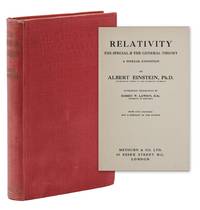
1920réf. 140949340London: Methuen & Co 1920. First Edition. Near Fine. First British edition first printing. xiii 3 138 2 8 pp. Bound in publisher's red cloth lettered in blind on front board and gilt on spine. Near Fine with light wear and fading to covers light foxing to upper textblock edge. Light foxing and offsetting to endpapers bookseller ticket to back pastedown and light toning to contents. Binding starting at pp. 33 and 97. A much nicer copy than normally found. The first British edition of Einstein's seminal work translated by Robert W. Lawson from the third German edition. Einstein's introduction to his revolutionary theory was written to be accessible to the general public. Methuen & Co unknown books