Einstein, AlbertBiblio.com

1 909 résultats
2006réf. SKU0620200Penguin Classics 2006-07-25. paperback. New. 5x0x7. New Textbook Ships with Tracking Penguin Classics paperback
réf. SKU0620198Touchstone 2067-10-30. paperback. New. 5x1x8. New Textbook Ships with Tracking Touchstone paperback
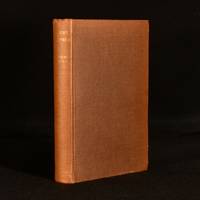
1931réf. 909Z26London: Thornton Butterworth Limited 1931. First edition. Cloth. Very Good Indeed. 8.5" by 5.5". None. The first UK edition later state binding of Anton Reiser's biography on the celebrated theoretical physicist Albert Einstein with a foreword by the incredible scientist himself. The very scarce first UK edition in a variant binding. First published in the U.S in 1930 by Albert & Charles Boni.Illustrated with a monochrome frontispiece. In the publisher's original brown cloth binding.This interesting biography on the noted theoretical physicist Albert Einstein was written by Rudolf Kayser under the pseudonym Anton Reiser. Kayser was the husband of Einstein's stepdaughter. The work also includes a foreword written by Albert Einstein himself. In the publisher's original cloth. Lacking dust wrapper. Externally excellent with fading to the spine a lean and slight bumping. Past owner's signature to the front free endpaper. Internally firmly bound with generally clean and age toned pages with spotting to the title page. Very Good Indeed Thornton Butterworth Limited hardcover
2007réf. x-080585858XLawrence Erlbaum Assoc Inc 2007. Hardcover. New. 1st edition. 452 pages. 9.00x6.50x1.00 inches. Lawrence Erlbaum Assoc Inc hardcover
2024réf. x-0691246173Princeton Univ Pr 2024. Hardcover. New. 1128 pages. 10.25x7.75x2.50 inches. Princeton Univ Pr hardcover
2024réf. x-1032490195Routledge 2024. Hardcover. New. 240 pages. 9.00x6.00x9.00 inches. Routledge hardcover
2024réf. x-1032490152Routledge 2024. Paperback. New. 240 pages. 9.00x6.00x9.00 inches. Routledge paperback
réf. A9780691246161Paperback / softback. New. paperback
réf. A9780393097337Hardback. New. An illustrated history of musical thought in the nineteenth century and its relationship to the Romantic movement. hardcover
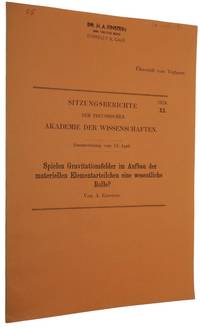
1919réf. 6166Berlin: Verlag der Akademie der Wissenschaften In Kommission bei Walter de Gruyter Reichsdruckerei 1919. First edition. First edition extremely rare author's presentation offprint 'Überreicht vom Verfasser' and the copy of Einstein's son Hans Albert of "Einstein's first attempt at a unified field theory" Pais Subtle is the Lord. Once Einstein completed work on the general theory of relativity at the end of 1915 "his attention shifted to the search for a unified theory of the electromagnetic and gravitational fields out of which he hoped to be able to explain the structure of matter. Quantum effects were to be derived from such a theory rather than postulated ad hoc. This remained his approach for the rest of his life" Cao Conceptual foundations of quantum field theory. . EINSTEIN'S FIRST ATTEMPT AT A UNIFIED FIELD THEORY" PAIS HANS ALBERT EINSTEIN'S COPY OF THE PRESENTATION OFFPRINT. First edition extremely rare author's presentation offprint 'Überreicht vom Verfasser' and the copy of Einstein's son Hans Albert of "Einstein's first attempt at a unified field theory" Pais Subtle is the Lord p. 287. Once Einstein completed work on the general theory of relativity at the end of 1915 "his attention shifted to the search for a unified theory of the electromagnetic and gravitational fields out of which he hoped to be able to explain the structure of matter. Quantum effects were to be derived from such a theory rather than postulated ad hoc. This remained his approach for the rest of his life" Cao Conceptual foundations of quantum field theory pp. 166-167. "As so often the case in relativity the story of quantum gravity begins with Einstein himself. Soon after the final formulation of general relativity he pointed out the need for a quantum modification of the theory. In his first paper on gravitational radiation the 1916 paper 'Näherungsweise Integration der Feldgleichungen der Gravitation' 'Approximate Integration of the Field Equations of Gravitation' Einstein argued that quantum effects must modify the general theory of relativity. Two years later he reiterated this conclusion the 1918 paper 'Über Gravitationswellen' 'On Gravitational Waves': 'As already emphasized in my previous paper the final result of this argument which demands a gravitational energy loss by a body due to its thermal agitation must arouse doubts about the universal validity of the theory. It appears that a fully developed quantum theory must also bring about a modification of the theory of gravitation.' Einstein writing in the 1919 paper offered here soon began to speculate whether gravitation plays a role in the atomistic structure of matter: 'There are reasons for thinking that the elementary formations which go to make up the atom are held together by gravitational forces. The above reflections show the possibility of a theoretical construction of matter out of the gravitational field and the electromagnetic field alone' In order to construct such a model of an 'elementary particle' Einstein shows that it is necessary to modify the original gravitational field equations .The major interest of this paper is that his attention now shifted from possible quantum modifications of general relativity to the search for a unified theory of the electromagnetic and gravitational fields on the basis of which he hoped to explain the structure of matter. Quantum effects are to be derived from such a theory rather than postulated ad hoc. Einstein remained committed to this approach for the rest of his life: the search for a 'natural' mathematical extension of the general theory in the hope that such a theory would somehow explain the quantization of matter and energy" Iyer and Bhawal Black Holes Gravitational Radiation and the Universe pp. 525-526. Einstein's work on unified field theory was inspired by James Clerk Maxwell's success in finding a unified theory of electricity and magnetism one of the greatest achievements of nineteenth century physics which showed that light was a form of electromagnetic wave and made possible modern inventios such as radio television and the telephone. Einstein continued his attempts to devise a unified theory of gravitation and electromagnetism for the rest of his life; his contributions in this area represent about a quarter of his entire research output and half his scientific production after 1920. Although he was ultimately unsuccessful a similar vision was realized in the decades after his death in the construction of the 'standard model' a unified theory of electromagnetism with the weak and strong nuclear forces which were unknown in Einstein's time and efforts to incorporate gravity into the model continue to this day. RBH lists three copies. OCLC lists only one copy none in US. Provenance: Hans Albert Einstein 1904-73 ink stamp and pencil notes on front wrapper. Hans Albert Einstein was a Swiss-American engineer and educator the second child and first son of physicists Albert Einstein and Mileva Marić. He was a long-time professor of hydraulic engineering at the University of California Berkeley. "As early as 1909 in his fundamental paper 'Zum gegenwärtigen Stand des Strahlungsproblems' 'On the current status of the radiation problem' which resulted from a discussion with Walter Ritz Einstein remarks 'dass des elektrische Elementarquantum e ein Fremdling ist in der Maxwell-Lorentzschen Elektrodynamik' 'that the electrical elementary quantum e is alien to Maxwell-Lorentz electrodynamics'. Einstein expressed the hope that 'die gleiche Modifikation der Theorie welche das Elementarquantum e als Konsequenz enthält auch die Quantenstruktur der Strahlung als Konsequenz enthalten wird' 'the same modification of the theory which contains the elementary quantum e as a consequence will also contain the quantum structure of radiation as a consequence'. Pauli 1949 in his review about 'Einstein's Contribution to Quantum theory' pointed out that though quantum theory later on deduced the quantum structure of radiation it has not solved Einstein's first problem and the elementary charge 'auch in der Quantenmechanik ein Fremdling geblieben ist' 'has also remained alien to quantum mechanics'. He emphasized that just this fact had been one of the strongest arguments to Einstein against the finality of the steps leading to quantum mechanics. "So during his Berlin years Einstein made it his task to find a synthesis of his general theory of relativity GRT and the then nascent quantum physics. In this connection he attributed logical primacy to the relevant relativistic field theory because it had reached a high degree of maturity in the GRT. After all Einstein's general-relativistic gravitation theory is the first theory on the fundamentals of physics working with genuinely non-linear equations and Einstein observed that such a nonlinearity is necessary for understanding the existence of the 'discrete field-quanta.' A linear theory allowing arbitrary superposition of fields would without further restrictions in the form of boundary and uniqueness conditions never lead to a discrete spectrum of solutions. But recourse to such restrictions means that the fields are held together by the operation of entities outside the scope of the theory . "In Einstein's view the problem of incorporating the elementary particles into field physics involved the question of finding field-theoretical models of electrons and protons which were the only known particles at that time. Einstein searched for solutions or general-relativistic field equations for the combined gravitational and electromagnetic fields representing mass and charge distributions with central symmetry and he hoped there would emerge self-consistent solutions only for discrete values of the mass and charge parameters i.e. for a 'particle spectrum.' "This 'Einstein particle problem' pursued ideas that had been developed already in the framework of the special theory of relativity and the Maxwell-Lorentz electrodynamics for instance in the nonlinear theory of the electromagnetic field by G. Mie and D. Hilbert. As an essential progress by the general-relativistic treatment Einstein regarded the genuine nonlinearity of the field equations which Mie and Hilbert had to introduce ad hoc and full consideration of the particle dynamics in the sense of the general-relativistic problem of motion. The generalizations of the Maxwell equations considered by Mie and Hilbert contain a too small number of components for the integrability conditions to determine the particle dynamics whereas the Einstein problem of motion in the GRT furnishers just this dynamics as a consequence of the integrability conditions for the field equations of gravitation. It is the GRT that with its metric field for the first time embraces inertia and gravity that is just those properties which are characteristic of all particles. "Einstein in fact succeeded in driving self-consistent gravitational and electromagnetic fields which can be interpreted as particle models of that kind. But his success depended on a weakening of his own equations of gravitation which physically amounts to the introduction of an additional hypothetical cosmical field of the 'Poincaré pressure.' By this weakening it becomes possible to set up self-consistent particle models with spherical symmetry for arbitrary centrosymmetric mass and charge distributions. In 1919 Einstein presented his result to the academy in his paper 'Spielen Gravitationsfelder im Aufbau der materiellen Elementarteilchen eine wesentliche Rolle' His answer to the question says that in his particle models the electrical field energy contributes ¾ and the gravitational energy ¼ of the total energy. "Einstein's first discourses on the particle problem in the GRT were closely related to the 1917/18 papers in which he laid the foundations of relativistic cosmology. In his Academy report 'Kosmologische Betrachtungen zur allgemeinen Relativitätstheorie' 'Cosmological considerations on the general theory of relativity' 1917 Einstein had by introducing the term λgμν with the 'cosmological constant' λ extended his equations of gravitation to his cosmological equations of gravitation Rμν - ½ gμνR λgμν = - κ Tμν . He could show that these equations permit as a particular solution with λ > 0 and constant positive mass density a statical model of the universe representing a closed spheric or elliptic three devotional Riemannian space . "In his paper of 1919 about the role of gravitation in the structure of elementary particles Einstein also interpreted the cosmological constant λ as the universal 'Poincaré' pressure' which according to a hypothesis of H. Poincaré is to guarantee the stability of Lorentz's electrons against their own repulsion forces. Einstein's ideas concerning this matter partly resulted from a controversial discussion with E. Schrödinger 1918 about the gravitational energy in the GRT and the structure of the energy tensor" Treder pp. 149-151. Indeed Schrödinger had pointed out another way of treating the cosmological constant: moving it from the left-hand side of equation where it represents a contribution to space-time curvature to the right-hand side where it represents a contribution to the energy-matter distribution. Then it would correspond physically to a kind of cosmic pressure. Schrödinger believed this might be the pressure postulated by Poincaré to maintain the stability of charged particles: an electric charge on the surface of a sphere creates a force pushing outwards so without any opposing force the charged sphere would explode outwards. Einstein never liked the cosmological constant. In the present paper he acknowledged that his introduction of the cosmological constant was "gravely detrimental to the formal beauty of the theory" Cambridge Companion to Einstein p. 257. Boni-Russ-L. 111; Schilpp 123; Weil 106. Treder 'Antimatter and the particle problem in Einstein's cosmology and field theory of elementary particles A historical essay on Einstein's work at the Akademie der Wissenschaften zu Berlin' Astronomische Nachrichten 296 1975 pp. 149-161. Large 8vo 254 x 182 mm pp. 349-356. Original printed wrappers. A very fine copy. Verlag der Akademie der Wissenschaften, In Kommission bei Walter de Gruyter [Reichsdruckerei] unknown
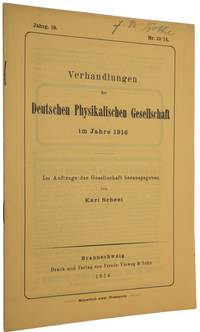
1916réf. 6164Braunschweig: Druck und Verlag von Friedr. Vieweg and Son 1916. First edition. First edition complete journal issue in original printed wrappers inscribed by Einstein to fellow Nobel Laureate Walther Bothe. "This work represents a major step forward in quantum theory" Calaprice p. 297. It introduced the concept of stimulated emission of radiation the theoretical basis for the laser; it also contained a new derivation of Planck's radiation law which provided as a by-product a justification of the frequency rule forming the basis of Bohr's theory of atomic spectra. . DISCOVERY OF STIMULATED EMISSION OF RADIATION THE PRINCIPLE OF THE LASER INSCRIBED BY EINSTEIN TO A FELLOW NOBEL LAUREATE. First edition complete journal issue in original printed wrappers inscribed by Einstein to fellow Nobel Laureate Walther Bothe. "This work represents a major step forward in quantum theory" Calaprice p. 297. It introduced the concept of stimulated emission of radiation the theoretical basis for the laser; it also contained a new derivation of Planck's radiation law which provided as a by-product a justification of the frequency rule forming the basis of Bohr's theory of atomic spectra. "According to Albert Einstein when more atoms occupy a higher energy state than a lower one under normal temperature equilibrium it is possible to force atoms to return to an unexcited state by stimulating them with the same energy as would be emitted naturally" Britannica. This is 'stimulated emission.' "To claim that Einstein almost invented the laser would be an exaggeration but the laser's underlying mechanism stimulated emission of radiation was a creation of his radiation theory" Kleppner pp. 32-33. "During the summer of 1916 less than a year after he had completed the general theory of relativity Einstein made a new major contribution to the quantum theory. The two papers he wrote then deal with the quantum theory of radiation by arguments that do not depend on the classical electromagnetic theory as had all earlier treatments of Planck's radiation law . When Einstein returned to the radiation problem in 1916 the quantum theory had undergone a major change. Niels Bohr's papers had opened a new and fertile domain for the application of quantum concepts - the explanation of atomic structure and atomic spectra. In addition Bohr's work and its generalizations by Arnold Sommerfeld and others constituted a fresh approach to the foundations of the quantum theory of matter" DSB. In this paper "Einstein considers a system of atoms in equilibrium with an external radiation field. An atom can change its internal energy state by absorbing or emitting radiation. Einstein introduces three basic assumptions about these exchanges of energy between matter and field. First the probability of absorption of radiation is proportional to the radiation density. Second there are two kinds of emission processes: one - spontaneous - following a law like that of radioactive decay; the other - stimulated - induced by the radiation field and with probability proportional to the radiation density. Third at equilibrium the atoms are distributed among their internal states according to the Boltzmann distribution law. From these assumptions Planck's law follows in a simple way. Einstein was very pleased with his derivation which he characterized in a letter to Besso: 'An amazingly simple derivation of Planck's formula I should like to say the derivation.' As a bonus from his derivation Einstein found that the energy difference between two internal energy states of the atom had to be equal to hv with v the frequency of the radiation absorbed or emitted in transitions between these two states thus confirming one of the postulates of Niels Bohr's theory of spectra" Papers 6 xxiii-xxiv. "Einstein meant the second part of this study a proof of the oriented character of the emission process to be his most essential contribution to quantum radiation theory this second paper was published later in 1916 as 'Zür Quantentheorie der Strahlung'. Instead Bohr gave more importance to the new deduction of the blackbody law; for this deduction reinforced the basic assumptions of his atomic theory and completed them with a statistical description of radiation processes" Darrigol p. 120. Provenance: Inscribed by Einstein on front wrapper "für. Dr Bothe" i.e. Walther Bothe 1891-1957. "In 1929 in collaboration with W. Kolhörster Bothe introduced a new method for the study of cosmic and ultraviolet rays by passing them through suitably arranged Geiger counters and by this method demonstrated the presence of penetrating charged particles in the rays and defined the paths of individual rays. For his discovery of the 'method of coincidence' and the discoveries subsequently made by it which laid the foundations of nuclear spectroscopy Bothe was awarded jointly with Max Born the Nobel Prize in Physics 1954" . While Einstein commended Planck's epoch-making derivation of his radiation law in 1900 which ushered in the quantum era he had also noted its limitations. Einstein also saw inconsistencies in Planck's derivation of his law. For Einstein this inconsistency was no reason to reject Planck's quantum theory but it was a reason to study the foundations of traditional radiation theory and if needed revise them. "As Einstein had noted in 1906 Planck's derivation of the Rayleigh-Jeans law uν = 8πν2/c3 kT between average resonator energy uν and radiation spectrum ν only applied to classical resonators T is the temperature k is Boltzmann's constant. A new quantum-theoretical picture of the interaction between matter and radiation was needed. Einstein found it in the summer of 1916 after the completion of his general theory of gravitation left him more time for quantum meditation. "The new picture presumably emerged from a combination of three elements: Einstein's derivation of the law of photochemical equivalence his analogy between quantum states and chemical species and Niels Bohr's theory of atomic spectra. According to Bohr atoms and molecules can only exist in a series of quantum states S0 S1 . . . Sn . . . with well-defined energies E0 E1 . . . En . . . Their interaction with radiation occurs through quantum jumps with characteristic values of the frequency of the emitted or absorbed radiation. Regarding the quantum states as chemical species and remembering his photochemical reasoning Einstein knew that he could derive Wien's law by balancing the absorption process Sn hν → Sn1 with the emission process Sn1 → Sn hν and by making the probability of the first reaction proportional to the density of radiation at frequency ν. Something in this reasoning needed to be altered in order to get Planck's law instead of Wien's. "At this point Einstein appealed to an analogy between classical and quantum theory. According to classical theory an oscillating dipole spontaneously emits radiation whether or not radiation is initially present in its surroundings. When external radiation encounters this dipole it may either be absorbed if the phase of the incoming wave agrees with that of the oscillator or it may be amplified in the contrary case. In the quantum theory of radiation Einstein similarly admitted the existence of three kinds of processes: spontaneous emission Ausstrahlung absorption negative Einstrahlung and stimulated emission positive Einstrahlung. The modern terminology is Bohr's. For the probability per time unit of the respective sorts of quantum jump Einstein assumed the forms Anm ÏνBnm ÏνBmn where n is the upper quantum state m the lower one and Ïν is the density of radiation at the frequency ν. "Einstein did not say much on the nature of the probabilities he thus introduced. He only commented that his theory had the weakness to leave to chance the instant and direction of the spontaneous emission of light. He also noted the similarity between spontaneous emission and radioactive decay. Undoubtedly he would have preferred a theory in which the emission and absorption probabilities were deduced from an underlying deterministic theory. He nonetheless expressed his 'full trust in the present way of reasoning'. The probabilistic description of the interaction was a natural counterpart of the discrete character of quantum states: if a quantum system evolves mostly through quantum jumps then the probability of a quantum jump obviously is the main quantity of physical interest. Instead of speculating on the precise timing and fine structure of the jumps Einstein proceeded to show what could be done by means of the new probability coefficients. "At thermal equilibrium Einstein reasoned statistical mechanics requires the number of atoms in a quantum state n to be proportional to exp−En /kT. The kinetic equilibrium between the atoms and surrounding radiation further requires that the number of quantum jumps from m to n should be equal to the number of reverse jumps: ÏνBnm exp−Em /kT = ÏνBnm Anm exp−En /kT. In the high temperature limit for which Ïν → ∞ this condition gives Bnm = Bmn. Therefore the equilibrium value uν of the density Ïν is given by uνexpEn − Em/kT - 1 = Anm / Bnm. According to a thermodynamic theorem by Wien uν/ν3 must be a function of ν/T only. Hence En − Em must be proportional to ν. Einstein thus derived Bohr's strange frequency rule ΔE = hν with complete generality and without recourse to any of the empirical laws of spectra. He then required the expression of uν to agree with the Rayleigh-Jeans law in the low-frequency limit. The outcome was Planck's law as well as the relation Anm / Bnm = 8πhν3/c3 between Einstein's two probability coefficients . "Einstein's new theory of radiation is now remembered for the introduction of stimulated emission which famously permitted the conception of masers and lasers. For Einstein and for his contemporaries the importance of these memoirs lay elsewhere. First Einstein filled an important gap in the derivation of Planck's law by means of a simple statistical description of radiation processes. Second he corroborated two basic assumptions of Bohr's atomic theory: the existence of stationary states and the frequency rule. In this regard it should be emphasized that before Einstein's and Sommerfeld's contributions of 1916 Bohr believed that his frequency rule only applied to strictly periodic systems. For instance he regarded the Zeeman effect as a violation of this rule. Einstein's new considerations established its complete generality" Darrigol in Cambridge Companion to Einstein pp. 134-136. "The implication of Einstein's theory of stimulated emission was that if one arranges for a large number of atoms to be in identical excited states a stray photon of the right energy can stimulate one atom to emit another photon which stimulates another. and all the atoms release their excess energy in a sudden cascade. What's more the photon released by stimulated emission will be in phase - coherent - with the one that stimulated it and so all the light produced in the cascade will be coherent. "In 1955 American physicist Charles Townes of Columbia University in New York an expert in molecular spectroscopy and his co-workers showed how stimulated emission could be used to make a device for generating or amplifying microwaves which they called a maser microwave amplified stimulated emission of radiation. Three years later Townes and Arthur Schawlow explained how to extend the idea to visible and infrared frequencies to make an 'optical maser' - in effect the laser. "They proposed using ordinary incoherent light to pump atoms into an excited state setting up the 'population inversion' in which the atoms are primed to return to their ground state by emitting photons. And their design used an optical cavity - basically two mirrors between which photons would bounce - to trap the emitted photons while they stimulated more emission. The device they explained would generate 'extremely monochromatic single-wavelength and coherent light'. Theodore Maiman of the Hughes Research Laboratories in Malibu California described such a device using a ruby crystal already used for masers as the lasing medium in 1960" 'A century ago Einstein sparked the notion of the laser' Physics World History Blog 31 August 2017. Weil 85. Calaprice An Einstein Encyclopedia 2015. Darrigol From c-numbers to q-numbers 1992. Kleppner 'Rereading Einstein on radiation' Physics Today 58 2005 pp. 30-33. Pais Subtle is the Lord 1982. 8vo 228 x 154 mm pp. 315-332. Original printed wrappers. A fine copy. Druck und Verlag von Friedr. Vieweg and Son unknown
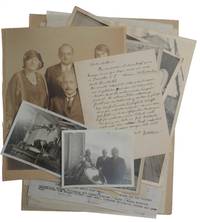
1931réf. 60051931. First edition. An important group of photographs documenting Einstein's visit to Caltech. The main purpose of the visit was to discuss Edwin Hubble's observations made in 1929 with the 100-inch telescope at the Mount Wilson Observatory which showed that light from distant nebulae galaxies was red-shifted indicating that the universe was expanding. Einstein had believed that the universe is static and had introduced his 'cosmological constant' into his equations of general relativity to allow for a static solution. When Einstein met Hubble at the Mount Wilson Observatory in January and February 1931 he was visibly moved with Hubble's discovery and reportedly said with tears in his eyes that "It was the most beautiful and satisfying interpretation of astronomical science." In light of the new evidence Einstein published a paper two months later renouncing the concept of a cosmological constant whose invention Einstein denounced as "the greatest blunder of my life." . 'the greatest blunder of my life'. An important group of photographs documenting Einstein's second visit to America and his first to the California Institute of Technology which began at the end of December 1930. The main purpose of the visit was to discuss Edwin Hubble's observations made in 1929 with the 100-inch telescope at the Mount Wilson Observatory then the largest telescope in the world which showed that light from distant nebulae galaxies was red-shifted indicating that the universe was expanding. Einstein had believed that the universe is static and had introduced his 'cosmological constant' into his equations of general relativity to allow for a static solution. When Einstein met Hubble at the Mount Wilson Observatory in January and February 1931 he was visibly moved with Hubble's discovery and reportedly said with tears in his eyes that "It was the most beautiful and satisfying interpretation of astronomical science." In light of the new evidence Einstein published a paper two months later renouncing the concept of a cosmological constant whose invention Einstein denounced as "the greatest blunder of my life." Einstein was accompanied on his visit by Walther Mayer 1887-1948 who had been appointed as his mathematical assistant in 1929. Mayer and Einstein worked together on several approaches towards a unified field theory. "On the way over Einstein and his mathematical calculator Walther Mayer holed up working on revisions to his unified field theory in an upper-deck suite with a sailor guarding the door" Isaacson p. 368. Two of the photographs are of Einstein at Mount Wilson one with Mayer and the observatory's director Walter Adams 1876-1956 who had confirmed Einstein's prediction of the gravitational red-shift although his observations were later shown to be faulty; the other with Mayer and solar physicist Charles St. John 1857-1935 who had assisted Hubble with his red-shift observations. Another photograph shows Einstein between fellow Nobel Laureates Albert Michelson 1852-1931 and Robert Millikan 1868-1953 Caltech's "chairman of the executive council" effectively its president. Together with Edward Morley Michelson had in 1887 carried out the famous Michelson-Morley experiment which failed to detect evidence of the existence of the luminiferous ether; this provided crucial evidence for the early acceptance of special relativity. On this trip Einstein "paid tribute to the aging Michelson carefully praising his famous experiments that detected no ether drift without explicitly saying that they were a basis for his special theory of relativity" Isaacson p. 372. "In the early 1930s Einstein came to California specifically to consult with scientists at the California Institute of Technology. Few members of the general public understood the nature of his visits but they idolized him all the same. From the moment his boat docked in San Diego on December 31 1930 the reception accorded him by Californians was one part show business one part hero worship and one part genuine affection. Groups of children dressed in blue and white middies serenaded him and thrust wreaths of flowers into his hands two bands struck up tunes and in Los Angeles a theatrical group the Yale Puppeteers opened a play called Mr. Noah in which the ark landed on Mt. Wilson instead of on Mt. Ararat . "As early as 1913 Einstein was looking for experimental verification for the correctness of his theory of general relativity and he had been in correspondence with Caltech's George Ellery Hale asking him to make an astronomical measurement. He was anxious to know if Hale could detect the influence of the sun's gravitation field upon a light ray. Hale replied that in order to try he needed a solar eclipse. The experiment was finally carried out in 1919 by two British expedition teams and again in 1922 by an American team of astronomers - and it did confirm the theory of general relativity. "There were cosmological implications in this theory and they attracted a lot of attention in the 1920s and 1930s - nowhere more than at Caltech. Millikan had been urging Einstein to visit the campus for some time and in the fall of 1930 he agreed to spend the winter quarter in Pasadena. Not only would he be able to discuss his theory and its interpretation with distinguished scientists; he would also be meeting old friends again - Richard Tolman the cosmologist; Paul Epstein the theoretical physicist; and Theodore von Karman the aerodynamicist . "The new Athenaeum at Caltech was the setting for many dinners to honor Einstein. At the first on January 15 1931 the guests included the physicist and Nobel Laureate A. A. Michelson and 200 members of the California Institute Associates. Several weeks later a second dinner was held at which all the astronomers from the Institute and the Mt. Wilson Observatory were present. Edwin Hubble was there as was Charles E. St. John who verified the third prediction of the theory of general relativity the gravitational red-shift. Colleagues came from Berkeley including Tolman's close friend and co-author G. N. Lewis who wrote to say he was coming with a friend - though not without some mildly humorous trepidation. As he put it in his letter to Tolman: 'I have just accepted an invitation from Oppenheimer to drive me down. Do you think I should take out accident insurance' "Einstein was not without a sense of humor himself. At a farewell luncheon in his honor on February 24 1931 which was sponsored by the Pasadena Chamber of Commerce he said: "I want to thank the extraordinary group of scholars in the fields of physics and astronomy who have afforded me glimpses of their work. They have conducted me not only into the world of atoms and crystals but also to the surface of the sun and into the outermost depths of space. There I saw worlds which are flying away from us with incomprehensible rapidity in spite of the fact that their inhabitants do not know us well enough to justify any such action'" Goodstein. "Millikan was a physicist who had won the Nobel Prize in 1923 for having 'verified experimentally Einstein's all-important photoelectric equation.' He likewise verified Einstein's interpretation of Brownian motion. So it was understandable that as he was building Caltech into one of the world's pre-eminent scientific institutions he worked diligently to bring Einstein there. "Despite al they had in common Millikan and Einstein were different enough in their personal outlooks that they were destined to have an awkward relationship. Millikan was so conservative scientifically that he resisted Einstein's interpretation of the photoelectric effect and his dismissal of the ether even after they were apparently verified by his own experiments. And he was even more conservative politically. A robust and athletic son of an Iowa preacher he had a penchant for patriotic militarism that was as pronounced as Einstein's aversion to it" Isaacson p. 373. "To physics posterity Viennese mathematician Walther Mayer is mostly known as 'Einstein's calculator'. He had apparently been called that at the California Institute of Technology in Pasadena which Einstein and Mayer visited together in the winter of 1930/31. It is true that in order to advance in his studies to construct a unified field theory Einstein relied on the expertise of mathematicians. With his unified field theory Einstein attempted to formally join his own theory of general relativity with Maxwell's electromagnetism. "When Einstein was looking for a new mathematics assistant in 1929 Mayer was hired on the recommendation of eminent mathematician Richard von Mises. Like Einstein von Mises at that time held a professorship in Berlin. Walther Mayer then served as private lecturer at the University of Vienna finishing the second volume of a very well received textbook series on differential geometry which he co-authored with fellow Viennese mathematician Adalbert Duschek. Subsequently Mayer and Einstein worked together on several approaches towards a unified field theory consisting of 1 the analysis of solutions to Einstein's so-called distant teleparallelism approach 2 the invention of a variant of the Kaluza-Klein theory in which not space-time but attached vector spaces are 5-dimensional and finally 3 the construction of a formalism they referred to as "semi-vectors" for interpreting Dirac-spinors in simpler classical field-theoretical terms and reformulating the Dirac equation accordingly. Their joint work was published in 7 papers over a period of roughly four years 1930-1934 . "While being humbly appreciative of the vital improvement that Einstein brought to his career Mayer was at the same time also quite unhappy about his role as Einstein's 'appendage'. Einstein however was aware of and respected this sentiment of Mayer's: When he bargained his Princeton position with Abraham Flexner a founding director of Princeton's Institute for Advanced Study he insisted on an independent professorship for Mayer as well. After some back and forth this was indeed granted at the last minute. However the question of Mayer's legitimacy as an independent professor at Princeton surfaced again after their arrival. Feeling unwelcomed and not sufficiently supported by Einstein Mayer finally ended their collaboration after just one further joint paper in 1934. He felt that his career would be advanced best if from now on he would focus entirely on his own studies in pure mathematics. In the end Mayer was able to retain his tenure at Princeton for the rest of his life but he subsequently appeared to have wished to no longer be associated with work on unified field theory. On the outside Einstein and Mayer remained in friendly contact while Einstein found new collaborators. The ones immediately succeeding Walther Mayer at Princeton were Boris Podolsky and Nathan Rosen" Lessel. The photographs are accompanied by a number of letters from Mayer to his brother Arthur in Austria discussing Einstein's work Hitler and the Nazis. Mayer was Jewish and it was only through Einstein's intervention that he was given the title of professor at the University of Vienna. Mayer immediately took a leave of absence from this position to continue his collaboration with Einstein when he had returned to Berlin. At a press conference on his arrival in New York Einstein was asked "'What do you think of Adolf Hitler' Einstein replied 'He is living on the empty stomach of Germany. As soon as economic conditions improve he will no longer be important'" Isaacson p. 369. "On the day he left New York Einstein revised slightly one of the statements he had made on his arrival. Asked again about Hitler he declared that if the Nazis were ever able to gain control he would consider leaving Germany" ibid. p. 371. In April 1933 Einstein discovered that the new German government had passed laws barring Jews from holding any official positions including teaching at universities. He left Germany in summer 1933 and took up a position at the Institute for Advanced Study in Princeton despite Millikan's efforts to lure him to Caltech. He remained at the Institute until his death in 1955. Goodstein 'Albert Einstein in California' Engineering and Science May-June 1979 pp. 17-19 - Isaacson Einstein. His Life and Universe 2007. Lessel 'Walther Mayer - more than 'Einstein's calculator'' - ;/span> . unknown
réf. A9781032378428Hardback. New. There’s religion in my marketing! There’s marketing in my religion! Selling the Sacred explores the religio-cultural and media implications of a two-sided phenomenon: marketing religion as a product and marketing products as religion. hardcover
2024réf. x-1032378417Routledge 2024. Paperback. New. 384 pages. 9.19x6.13x0.91 inches. Routledge paperback
2014réf. x-0415854717Routledge 2014. Paperback. New. reprint edition. 166 pages. 7.50x5.25x0.75 inches. Routledge paperback
réf. A9781138171190Hardback. New. hardcover
1938réf. ZB1269206Cambridge at the University Press 1938. First UK Edition in Second Issue Binding bound in limp boards with no front end-paper as published in this Issue and stamped in SILVER rather than Gold. 319 pp. 3 plates and numerous black & white illustrations in the text faint wear to cover edges else veruy good in a fragmentary dust jacket. - If you are reading this this item is actually physically in our stock and ready for shipment once ordered. We are not bookjackers. Buyer is responsible for any additional duties taxes or fees required by recipient's country. Cambridge at the University Press hardcover
réf. OTF-S-9781403944962Springer. New. BRAND NEW GIFT QUALITY! NOT OVERSTOCKS OR MARKED UP REMAINDERS! DIRECT FROM THE PUBLISHER! Springer unknown
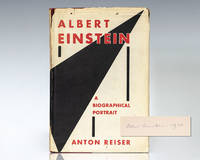
1930réf. 138499New York: Albert & Charles Boni 1930. First edition of this Einstein biography written by Rudolf Kayser a German literary historian and husband to Albert Einstein's stepdaughter Ilse under the pseudonym Anton Reiser. Octavo original cloth frontispiece of Einstein. Signed and dated by Einstein in the year of publication on the front free endpaper "Albert Einstein 1930." Near fine in a very good dust jacket. Rare signed and in the original dust jacket. Albert Einstein developed the general theory of relativity one of the two pillars of modern physics alongside quantum mechanics. Einstein's work is also known for its influence on the philosophy of science. Einstein is best known in popular culture for his mass–energy equivalence formula E = mc2 which has been dubbed "the world's most famous equation". He received the 1921 Nobel Prize in Physics for his "services to theoretical physics" in particular his discovery of the law of the photoelectric effect a pivotal step in the evolution of quantum theory David Bodanis. Albert & Charles Boni hardcover
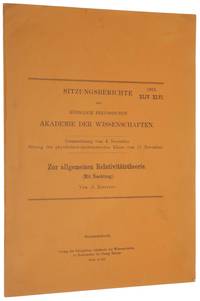
1915réf. 5863Berlin: Königlichen Akademie der Wissenschaften 1915. First edition. First editions very rare offprint of the first two of the papers published in November 1915 that document his final version of the general theory of relativity. "In the half century and more of Einstein's work in science one discovery stands above all as his greatest achievement. It is his general theory of relativity" Norton. . EINSTEIN'S COMPLETION OF THE GENERAL THEORY OF RELATIVITY. First editions very rare offprint of the first two of the papers published in November 1915 that document Einstein's final version of the general theory of relativity. "In the half century and more of Einstein's work in science one discovery stands above all as his greatest achievement. It is his general theory of relativity" Norton. "There was difficulty reconciling the Newtonian theory of gravitation with its instantaneous propagation of forces with the requirements of special relativity; and Einstein working on this difficulty was led to a generalization of relativity - which was probably the greatest scientific discovery that was ever made" Dirac quoted in Chandrasekhar p. 3. Einstein's special theory of relativity 1905 showed that the laws of physics are the same in all inertial i.e. non-accelerating frames of reference. It was then natural to ask whether it was possible to extend this principle of relativity to the more general case of frames of reference in arbitrary states of motion. This problem became linked to a theory of gravitation with Einstein's 'equivalence principle' of 1907 according to which the effects of gravity are locally equivalent to those of accelerated motion. Einstein's first steps towards a geometrical theory of gravitation were taken in August 1912 when his friend Marcel Grossmann provided the necessary mathematical tools. "Some time between August 10 and August 16 it became clear to Einstein that Riemannian geometry is the correct mathematical tool for what we now call general relativity theory. The impact of this abrupt realization was to change his outlook on physics and physical theory for the rest of his life" Pais p. 210. The resulting 'Entwurf' theory 1913 had much in common with the final theory of 1915 but based on a fallacious argument Einstein abandoned the requirement that the theory should be 'generally-covariant' i.e. that arbitrary frames of reference should be allowed. "After three years of fruitless peregrinations the revelation came to Einstein that he had been constantly on the wrong track although in 1913 he had been so near to the right solution" Lanczos p. 211. On November 4 1915 he presented to a plenary session of the Prussian Academy a new version of general relativity 'Zur allgemeinen Relativitätstheorie' "based on the postulate of covariance with respect to transformations with determinant 1" and stated that he had "completely lost confidence" in the 'Entwurf' equations. On November 18 he published his calculation of the precession of the perihelion of Mercury based on the new theory: its agreement with observation confirmed that the theory was correct the Entwurf theory predicted half the observed value of the precession. "In June 1905 while still a patent examiner in Bern Einstein submitted his famous work on the electrodynamics of moving bodies to the Annalen der Physik. This work contained his special theory of relativity in which he asserted the equivalence of all inertial frames of reference as a fundamental postulate of physics. The question which then naturally arose was whether it was possible to extend this principle of relativity to the more general case of frames of reference in arbitrary states of motion. But he could find no workable basis for such an extension until he tried to incorporate gravitation into his new special theory of relativity for a review article in 1907 'Uber das Relativitätsprinzip und die ausdemselben gezogenen Folgerungen' Jahrbuch der Radioaktivitat und Elektronik 4 1907 411-62. The difficulties of this task led him to a new principle later to be called the 'principle of equivalence.' "On the basis of the fact that all bodies fall alike in a gravitational field Einstein postulated the complete physical equivalence of a homogeneous gravitational field and a uniform acceleration of the frame of reference. This extended the principle of relativity to the case of uniform acceleration. It also foreshadowed the problem whose complete solution would lead him to his general theory of relativity: the construction of a relativistically acceptable theory of gravitation based on the principle of equivalence" Norton p. 258. One application of the equivalence principle proved crucial to the subsequent development of his ideas on general relativity. Einstein considered an observer standing on a rotating disc - a non-inertial accelerating reference frame. According to special relativity measuring rods aligned with the circumference of the disc will contract due to their motion whereas measuring rods positioned along the radius of the disc will not. Hence the ratio of the circumference of the disc to its diameter will be less than π. "The spatial geometry for the rotating observer is therefore non-euclidean. Invoking the equivalence principle Einstein concluded that this will be true for an observer in a gravitational field as well. This then is what first suggested to Einstein that gravity should be represented by curved space-time. "To describe curved space-time Einstein turned to Gauss's theory of curved surfaces a subject he vaguely remembered from his student days at the ETH in Zürich. He had learned it from the notes of his classmate Marcel Grossmann. Upon his return to his alma mater as a full professor of physics in 1912 Einstein learned from Grossmann now a colleague in the mathematics department of the ETH about the extension of Gauss's theory to spaces of higher dimension by Riemann and others. Riemann's theory provided Einstein with the mathematical object with which he could unify the effects of gravity and acceleration: the metric field" Janssen p. 65. The first product of this collaboration was the Entwurf einer verallgemeinerten Relativitätstheorie und einer Theorie der Gravitation published before the end of June 1913 which contained many of the essential features of the final general theory of relativity; most importantly it introduced the 'metric' of space-time. In Minkowski's formulation of special relativity 1908 the most important quantity is the 'world function' of two events which determines the metric and causal structure of space-time. If these events have coordinates x y z t and x' y' z' t' in some inertial reference frame the world function is: c2t' - t2 - x' - x2 - y' - y2 - z' - z2 where c is the speed of light. Its crucial property is that it depends only on the two events and not on the choice of inertial reference frame - in other words it is unchanged 'invariant' when x y z t and x' y' z' t' are both subjected to any Lorentz transformation. Einstein and Grossmann began with the world function in differential form: ds2 = c2dt2 - dx2 - dy2 - dz2 If we now subject x y z t to an arbitrary coordinate transformation not necessarily a Lorentz transformation this takes the general form ds2 = g11dx12 g12dx1dx2 . ; the collection of quantities gμν which in general depend on the coordinates x1 x2 x3 x4 is called the metric. Based on analogy with Newton's theory Einstein expected that the gravitational equations should be of the form Gμν = Tμν where Gμν is a purely geometric quantity constructed solely from the metric gμν and its derivatives up to the second order and the 'stress-energy tensor' Tμν contains the information about the matter that is producing the gravitational field including energy density momentum fluxes and stresses. The question was: what exactly should Gμνbe Einstein and Grossmann found that generally covariant equations did not seem to be compatible with energy-momentum conservation or reduce to the equations of Newtonian gravitational theory for weak static fields both essential requirements of the correct theory. Einstein therefore decided to settle in the 'Entwurf' for equations with very limited covariance - instead of arbitrary changes in coordinates only linear ones were allowed. The restricted covariance of the 'Entwurf' field equations continued to bother him until in late August 1913 he convinced himself that such restrictions are unavoidable by means of the infamous "hole argument" first published as an addendum to the reprint of the 'Entwurf' article in Zeitschrift für Physik in January 1914. This ingenious argument showed correctly that if the gravitational equations were generally covariant the metric gμν would not be uniquely determined by the matter distribution i.e. by Tμν. He concluded incorrectly that this implied that general covariance must be ruled out the hole argument does not work if only linear coordinate transformations are allowed. The appropriate analogy is with electromagnetism: the metric is analogous to the scalar and vector potentials of electromagnetism and it was well known certainly to Einstein that these potentials are not uniquely determined by the charges and currents producing the electromagnetic field. That the 'Entwurf' theory was incorrect was made clear by Einstein's attempt in collaboration with Michele Besso another former classmate to explain the motion of the perihelion of Mercury. In 1859 Urbain Jean Joseph Le Verrier had observed the 'precession' of Mercury's orbit: this orbit is an ellipse but the ellipse is not fixed in space but slowly rotates. From early on in his search for a new relativistic theory of gravitation Einstein had been interested in the problem of Mercury's perihelion. In a letter to his friend Conrad Habicht in 1907 Einstein had already expressed his hope that such a theory would explain the anomalous advance of Mercury's perihelion. Besso visited Einstein in Zürich in June 1913 and the two men calculated the precession expected on the basis of the 'Entwurf' theory. Disappointingly it was only about half the observed anomaly. Einstein left Zürich in March 1914 to take up a professorship in Berlin which was to be his home until December 1932. He made no further progress on the gravitational equations until the summer of 1915 although a detailed exposition of the 'Entwurf' theory was published in October 1914 in which Einstein maintained the need for restricted covariance and even claimed that this determined the gravitational Lagrangian uniquely. "Einstein still believed in the 'old' theory as late as July 1915 between July and October he found objections to that theory and his final version was conceived and worked out between late October and November 25 . What made Einstein change his mind between July and October Letters to Sommerfeld and Lorentz show that he had found at least three objections against the old theory: 1 its restricted covariance did not include uniform rotations 2 the precession of the perihelion of Mercury came out too small by a factor of about 2 and 3 his proof of October 1914 of the uniqueness of the gravitational Lagrangian was incorrect. Einstein got rid of all these shortcomings in a series of four brief articles offered here . "On November 4 Einstein presented to the plenary session of the Prussian Academy a new version of general relativity 'based on the postulate of covariance with respect to transformations with determinant 1'. He began this paper by stating that he had 'completely lost confidence' in the equations proposed in October 1914. At that time he had given a proof of the uniqueness of the gravitational Lagrangian. He had realized meanwhile that this proof 'rested on misconception' and so he continued 'I was led back to a more general covariance of the field equations a requirement which I had abandoned only with a heavy heart in the course of my collaboration with my friend Grossmann three years earlier' . "Einstein and Grossmann had concluded that the gravitational equations could be invariant under linear transformations only and Einstein's justification for this restriction was based on the belief that the gravitational equations ought to determine the gμν uniquely a point he continued to stress in October 1914. In his new paper he finally liberated himself from this three-year-old prejudice. That is the main advance on November 4. His answers were still not entirely right. There was still one flaw a much smaller one which he eliminated three weeks later. But the road lay open. He was lyrical. 'No one who has really grasped it can escape the magic of this new theory.' "The remaining flaw was of course Einstein's unnecessary restriction to unimodular transformations. The reasons which led him to introduce this constraint were not deep I believe. He simply noted that this restricted class of transformations permits simplifications of the tensor calculus . The new equations are a vast improvement over the Einstein-Grossmann equations and cure one of the ailments he had diagnosed only recently: unimodular transformations do include rotations with arbitrarily varying angular velocities. In addition he proved that the new equations can be derived from a variational principle and that the conservation laws are satisfied" Pais pp. 250-252. On November 11 he submitted a 'Nachtrag' to his paper of a week earlier. "Einstein proposes a scheme that is even tighter than the one of a week earlier. Not only shall the theory be invariant with respect to unimodular transformations . but more strongly it shall satisfy the condition that the determinant of the matrix gμν is equal to minus one . During the next two weeks Einstein believed that this new condition had brought him closer to general covariance . One week later he remarked that 'no objections of principle' can be raised against it" ibid. pp. 252-253. Norton p. 309 points out that Einstein had in fact made a significant advance in this paper: namely he had finally found generally covariant field equations that reduced to the Newtonian equations in the weak field limit" ibid. p. 253. On November 18 still retaining the restrictions of his paper of a week earlier Einstein presented in 'Erklarung der Perihelbewegung des Merkur aus der allgemeinen Relativitätstheorie'"two of his greatest discoveries. Each of these changed his life. The first result was that his theory explains . quantitatively . the secular rotation of the orbit of Mercury discovered by Le Verrier . without the need of any special hypothesis. This discovery was I believe by far the strongest emotional experience in Einstein's scientific life perhaps in all his life. Nature had spoken to him. He had to be right. 'For a few days I was beside myself with joyous excitement'. Later he told Fokker that his discovery had given him palpitations of the heart. What he told de Haas is even more profoundly significant: when he saw that his calculations agreed with the unexplained astronomical observations he had the feeling that something actually snapped in him . "Einstein's discovery resolved a difficulty that was known for more than sixty years. Urbain Jean Joseph Le Verrier had been the first to find evidence for an anomaly in the orbit of Mercury and also the first to attempt to explain this effect . In 1859 he found that the perihelion of Mercury advances by thirty-eight seconds per century due to 'some as yet unknown action on which no light has been thrown . a grave difficulty worthy of attention by astronomers'" ibid. pp. 253-254. A more accurate measurement of 43 seconds was made by Simon Newcomb in 1882 and this was precisely the value predicted by the new theory. The prediction of the bending of light in a gravitational field was treated only briefly in 'Erklarung der Perihelbewegung des Merkur aus der allgemeinen Relativitätstheorie' probably because no accurate measurement of it had been made so this prediction could not be confirmed at the time. Einstein had realised in 1907 based on the equivalence principle that some bending of light should occur but he believed that the effect was too small to be observed. In 1911 he realized that the effect could be detected for starlight grazing the sun during a total eclipse and found that the amount of bending in that case is 0''.87 - this value could in fact have been computed by Newton from his law of gravitation and his corpuscular theory of light. In 3 Einstein discovered that general relativity implies a bending of light by the sun equal to 1".74 twice the Newtonian value. This factor of 2 set the stage for a confrontation between Newton and Einstein. "It was not until May 1919 that two British expeditions obtained the first useful photographs and not until November 1919 that their results were formally announced . In March 1917 the Astronomer Royal Sir Frank Watson Dyson drew attention to the excellence of the star configuration on May 29 1919 an eclipse date for measuring the alleged deflection . Two expeditions were mounted one to Sobral in Brazil led by Andrew Crommelin from the Greenwich Observatory and one to Principe Island off the coast of Spanish Guinea led by Eddington. Before departing Eddington wrote 'The present eclipse expeditions may for the first time demonstrate the weight of light i.e. the Newton value; or they may confirm Einstein's weird theory of non-Euclidean space; or they may lead to a result of yet more far-reaching consequences - no deflection' . The expeditions returned. Data analysis began. According to a preliminary report by Eddington to the meeting of the British Association held in Bournemouth on September 9-13 the bending of light lay between 0''.87 and double that value. Word reached Lorentz. Lorentz cabled Einstein . Then came November 6 1919 the day on which Einstein was canonized" Pais 304-305. At a joint meeting of the Royal Society and the Royal Astronomical Society on that date Dyson concluded his remarks with the statement "'After a careful study of the plates I am prepared to say that they confirm Einstein's prediction. A very definite result has been obtained that light is deflected in accordance with Einstein's law of gravitation'" ibid. p. 305. Three remarks may be made on the speed with which after eight years of struggle Einstein completed these final papers on his theory. The first is that Einstein had come very close to the correct gravitational equations in the second half of 1912 - they are recorded in his 'Zurich notebook' - but he discarded them because of his arguments against general covariance as we have seen. Once he no longer believed in these arguments he could return to the work carried out in the Zurich notebook and complete it. The second is that the detailed calculations in 3 relating to Mercury's perihelion were in fact very similar to those he had carried out with Besso in 1913 and so required relatively little extra effort. The final point is that Einstein was in competition with the great Göttingen mathematician David Hilbert. Weil 75 76 77; Chandrasekhra 'The general theory of relativity: Why "It is probably the most beautiful of all existing theories" Journal of Astrophysics 5 1984 pp. 3-11; Eisenstaedt The Curious History of Relativity 2006; Janssen 'Of pots and holes: Einstein's bumpy road to general relativity' Annalen der Physik 14 Supplement 2005 pp. 58-85; Lanczos Einstein Decade: 1905-1915 1974; Norton 'How Einstein found his field equations: 1912-1915' Historical Studies in the Physical Sciences 14 1984 pp. 253-316; Pais Subtle is the Lord 1982. Large 8vo 253 x 180 mm pp. 778-786 & 799-801. Original printed wrappers. Königlichen Akademie der Wissenschaften unknown
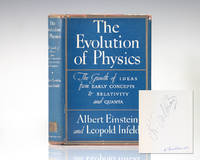
1951réf. 140033New York: Simon and Schuster 1951. Later printing of this classic work which traces the development of ideas in physics. Octavo original blue cloth. Boldly signed by both authors on the front free endpaper "A. Einstein. 53" and "L. Infeld 1958." Near fine in a very good dust jacket. We have never seen another example signed by both authors. Rare and desirable. Upon publication The Saturday Review of Literature praised Evolution of Physics as "masterly Einstein and Infelds book should do much to spread an understanding and appreciation one of the great dramas in the evolution of human thought." Simon and Schuster hardcover
réf. 109875Stockholm Aldus / Bonnier 1964. 8:o. 332 4 s. Mörkblått halvmarokängband blekt guldornerad rygg med upphöjda bind och med omslaget medbundet ryggen har blekts till grönt. Ur Lars Berglöfs bibliotek med hans initialer i guld på ryggen. Fint exemplar av en bok som annars sällan överhuvudtaget är inbunden! Det tyska originalet ”Mozart - sein Character sein Werk” utkom 1945 och denna svenska översättning av Kajsa Rootzén utkom första gången 1956. unknown
2013réf. DADAX0415854717Routledge 2013-07-02. 1. paperback. New. 5.08x0.44x7.80. Buy with confidence. Excellent Customer Service & Return policy. Routledge paperback
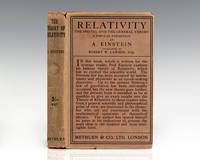
1920réf. 131697London: Methuen and Co 1920. First edition of the scientist's ground breaking work. Octavo original red cloth frontispiece of the author and with five diagrams. Near fine in the rare original dust jacket with loss of section of rear panel and flap. Tape repairs to verso. Translated by Robert W. Lawson. Scarce in the original dust jacket. Housed in a custom half morocco clamshell box by the Harcourt Bindery. It can hardly be disputed that the theories put forth in this book are among the most important in the history of modern science. "The imprint of Einstein's work on the different areas of physical science is so large and varied" writes Gerald Holton in a recent assessment "that a scientist who tries to trace it would be hard put to know where to start" Simmons The Scientific 100. Methuen and Co hardcover
2012réf. x-1107670950Cambridge Univ Pr 2012. Paperback. New. reissue edition. 146 pages. 7.75x5.00x0.25 inches. Cambridge Univ Pr paperback