2,986 results
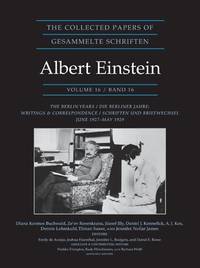
2021ref. 1-0691216819Princeton Univ Pr 2021. Hardcover. New. 1192 pages. 10.00x7.48x2.80 inches. Princeton Univ Pr hardcover
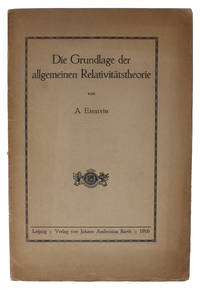
1916ref. 60254Leipzig Ambrosius Barth 1916. 8vo. Uncut in the original printed wrappers. Light discolouration to margins of wrappers. Inner hinges with professional repairs. Small stamp exlibris to lower part of title-page. Previous owner's name Erik Broekmeyer in contemporary hand to upper outer corner of title-page. A fine copy. 64 pp. First issue of the first edition in book form being not an offprint of the"Annalen der Physik" journal issue as often stated but a separate edition of the paper completely re-set and with significant changes and additions including for the first time in print the "Einleitung" and the "Inhalt".The first issue is distinguished from the later reprints by the printing of "Sonderdruck aus dem "Annalen der Physik" Band 49 1916" and "Druck von Metzger & Wittig in Leipzig. 314" to the verso of the title-page and "Metzger & Wittig Leipzig" to the foot of the back wrapper. Furthermore "This separate edition is printed on good strong paper the wrappers are of strong material too and it is described now as 'the original edition' of this classic paper" Weil. Einstein's seminal "General Theory of Relativity" has had an immense impact on all science philosophy and man's view of the world in general. Few other books of the 20th century can be said to have so basically altered the way that we view the world and our place in it. Determining space and time as being interwoven into a single continuum known as "space-time" and determining that there is no absolute space-time coordinate system - i.e. that there are no absolute positions in time and pace - established the fact that events that occur at the same time for one observer could occur at different times for another i.e. all positions in space and time are relative. This general theory of relativity here presented in its full exposition for the first time in book form is now a basic foundation for scientific thought."The theory of relativity has transformed astrophysics and indeed the whole scientific outlook." PMM."Whereas Special Relativity had brought under one set of laws the electromagnetic world of Maxwell and Newtonian mechanics as far as they applied to bodies in uniform relative motion The General Theory did the same thing for bodies with the accelerated relative motion epitomized in the acceleration of gravity. But first it had been necessary for Einstein to develop the true nature of gravity from his principle of equivalence.Basically he proposed that gravity was a function of matter itself and that its effects were transmitted between contiguous portions of space-time. Where matter exists so does energy; the greater the mass of matter involved the greater the effect of the energy which can be transmitted. In addition gravity affected light. exactly as it affected material particles. Thus the universe which Newton had seen and for which he had constructed his apparently impeccable mechanical laws was not the real universe. Einstein's paper gave not only a correct picture of the universe but also a fresh set of mechanical laws by which its details could be described" R.W. Clark. "This paper was the first comprehensive overview of the final version of Einstein's general theory of relativity after several expositions of preliminary versions and latest revisions of the theory in November 1915. It includes a self-contained exposition of the elements of the tensor calculus that are needed for the theory. T. Sauer in Landmark Writings in Western Mathematics. PMM: 408. Horblit 26 c. Weil 80.Boni: 781 Schilpp-Schields: 86. unknown
2007ref. 1-0980224829La Prensa Quimica 2007. Map. New. escolastica edition. 1 pages. Spanish language. 40.00x5.30x5.30 inches. La Prensa Quimica unknown
2007ref. 1-0980224845La Prensa Quimica y Chem-Data Publications 2007. Paperback. New. escolastica edition. 1 pages. Spanish language. 40.00x6.00x6.00 inches. La Prensa Quimica y Chem-Data Publications paperback
2016ref. 1-395770457Xsaxoniabuch 2016. Paperback. New. 80 pages. German language. 8.66x6.69x0.19 inches. saxoniabuch paperback
2007ref. 1-0980224837La Prensa Quimica 2007. Paperback. New. escolastica edition. 1 pages. Spanish language. 40.00x6.00x6.00 inches. La Prensa Quimica paperback
2005ref. 1-0974734187Chem-Data Publications 2005. Poster. New. 1 pages. 37.50x1.80x1.30 inches. Chem-Data Publications unknown
2007ref. 1-0980224853La Prensa Quimica 2007. Paperback. New. escolastica edition. 1 pages. Spanish language. 40.00x5.30x5.30 inches. La Prensa Quimica paperback
1938ref. ZB1269206Cambridge at the University Press 1938. First UK Edition in Second Issue Binding bound in limp boards with no front end-paper as published in this Issue and stamped in SILVER rather than Gold. 319 pp. 3 plates and numerous black & white illustrations in the text faint wear to cover edges else veruy good in a fragmentary dust jacket. - If you are reading this this item is actually physically in our stock and ready for shipment once ordered. We are not bookjackers. Buyer is responsible for any additional duties taxes or fees required by recipient's country. Cambridge at the University Press hardcover
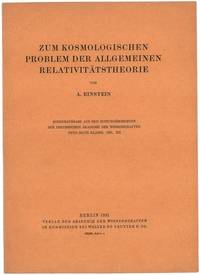
1931ref. 289801931. S.Ber. Akad. Wiss. Berl. 1931/12. - Berlin Verlag der Akademie der Wissenschaften 1927 8°5 S. orig. Broschur. First Edition! A fine and fresh copy in the rare off-print form from the "Sitzungsbereichte." Interesting is to note in the publisher's ad on the last page of the back-cover that all the off-prints of Einstein's papers published by the Academy between 1914 and 1921 are marked out ofprint as early as 1931! Weil N0.179; Schilp-Shields No. 249 unknown
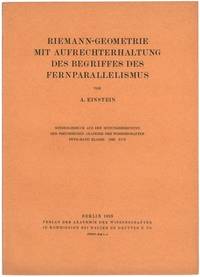
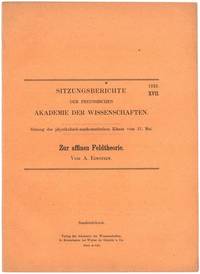
1928ref. 270901928. S.Ber. Akad. Wiss. Berl. 1928/17. - Berlin Verlag der Akademie der Wissenschaften 1928 8° 7 S. orig. Broschur. First Edition; the rare off-print from the "Sitzungsberichte". 'The general relativity theory splendidly justified his work. In this mathematical apparatus developed from Riemann's address Einstein found the frame to fit his physicals ideas his cosmology and cosmogeny; and the spirit of Riemann's address was just what physics needed: the metric structure determined by physical data'. -cf. DSB XI 447-456 Riemann Weil No.161; Schilpp-Shields No. 217; Alicke No. 139. unknown
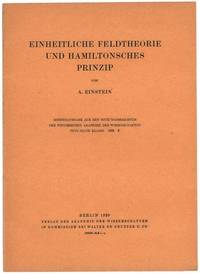
1928ref. 270911928. S.Ber. Akad. Wiss. Berl. 1928/10. - Berlin Verlag der Akademie der Wissenschaften 1929 8° 6 S. orig. Broschur. First Edition; the rare off-print from the "Sitzungsberichte". Weil No.166; Schilpp-Shields No. 227; Alicke No. 143. unknown
1909ref. 662931909. Physik. Zschr. 10. - Leipzig Verlag von S. Hirzel 1909 4° XXII 2 1040 pp. mit Textabbildungen und 26 Tafeln Halbleinenband d.Zt.; St.a.Tit. feines Expl. A LANDMARK W. PAULI FIRST EDITION "of this extensive paper given as lecture before the 81st assembly of the "Gesellschaft Deutscher Naturforscher" in Salzburg on 21st September 1909. He spoke on "The Development of Our View of the Nature and Constitution of Radiation" a topic that embraced both relativity and quanta. Among those who attended Einstein's lecture were some of the world's foremost physicists. In Einstein's austere opinion his address regarded strictly as a work of science was of little importance since as he writes to a co-worker it contained nothing new. Einstein was being overmodest. Besides to many in Einstein's audience and it should be born in mind that it was the year after Minkowski's stirring introduction of the concept of the fourth dimension this Lecture came as a revelation. The occasion was important for Einstein too. He had been working for years in a sort of scientific exile and his curiosity as to what great scientists were like in face-to-face discussion was at least as great as their curiosity about him. His confidence in himself was certainly not harmed when he found that he was able to hold his own easily in their company. Moreover at this congress Einstein first met Planck. In addition he made new'lasting friendships leading to a voluminous scientific correspondence. Amongst those attending the congress were Max von Laue Max Born. Arnold Sommerfeld Hasnohrl. Ladenburg. Max von Laue was to be the first to publish in 1911 the first text-book on relativity theory. All of them are present in this issue with scientific papers of their own." Walter Alicke Weil No. 30; Schilpp-Shields No. 30; Hoffmann Einstein p. 93; Alicke Nr. 34 unknown
1909ref. 524241909. Verh. Dtsch. Physik. Ges. 11/ 1-24. - Hrsg. im Auftrage der Gesellschaft von Karl Scheel. - Braunschweig Druck und Verlag von Friedrich Vieweg und Sohn 1909 8° VII 749 pp. Abbildungen Halbleinenband d.Zt.; St.a.Tit.; feines Expl. First Edition! The true first printing see below of this paper which Wolfgang Pauli said "can be considered as one of the landmarks in the development of theoretical physics" Schilpp p. 154. This paper marks the introduction of the modern "photon" concept although the term itself was introduced much later in a 1926 paper by Gilbert N. Lewis. It contains "the first well-conceived promulgation of the wave-particle duality of light which had implications as profound as Einstein's earlier theoretical breakthroughs" Isaacson p.157. Einstein here anticipated the principle of complementarity one of the fundamental principles of quantum mechanics. His own proposal for a solution of the wave-particle paradox - that Maxwell's equations for electromagnetic fields be modified to allow wave solutions that are bound to singularities of the field - was never developed although it may have influenced Louis de Broglie's pilot wave hypothesis for quantum mechanics developed in his famous thesis Recherches sur la théorie des quanta 1924. The present paper was also published in Physikalische Zeitschrift Vol. 10 1909 but the Verhandlungen printing has priority: it was published on 30 October 1909 the Physikalische Zeitschrift printing appeared on 10 November. "This extensive paper given as lecture before the 81st assembly of the "Gesellschaft Deutscher Naturforscher" in Salzburg on 21st September 1909. He spoke on "The Development of Our View of the Nature and Constitution of Radiation" a topic that embraced both relativity and quanta. Among those who attended Einstein's lecture were some of the world's foremost physicists. In Einstein's austere opinion his address regarded strictly as a work of science was of little importance since as he writes to a co-worker it contained nothing new. Einstein was being overmodest. Besides to many in Einstein's audience and it should be born in mind that it was the year after Minkowski's stirring introduction of the concept of the fourth dimension this Lecture came as a revelation. The occasion was important for Einstein too. He had been working for years in a sort of scientific exile and his curiosity as to what great scientists were like in face-to-face discussion was at least as great as their curiosity about him. His confidence in himself was certainly not harmed when he found that he was able to hold his own easily in their company. Moreover at this congress Einstein first met Planck. In addition he made new'lasting friendships leading to a voluminous scientific correspondence. Amongst those attending the congress were Max von Laue Max Born. Arnold Sommerfeld Hasnohrl. Ladenburg. Max von Laue was to be the first to publish in 1911 the first text-book on relativity theory. All of them are present in this issue with scientific papers of their own." Walter Alicke 11. Jahrg. 30. Oktober 1909 Nr. 20 - Vorgetragen in der Sitzung der physiklaischen abteilung der 81. Versalung Deutscher Naturforscher und Ärzte zu Salzburg am 21. September 1909." Weil No. 30; Schilpp-Shields No. 30; Hoffmann Einstein p. 93. unknown
1930ref. 270851930. S.Ber. Akad. Wiss. Berl. 1930/ 6. - Berlin Verlag der Akademie der Wissenschaften 1930 8° 13 S. orig. Broschur. First Edtion; the rare off-print from the "Sitzungsberichte". Weil No. 170; Schilpp-Shields No.240; Alicke No. 144 unknown
1914ref. 273931914. Verh. Ges. Naturf. Ärzte 85.Vers. Wien 1913. - 12/1 Bd.: Naturwissenschaftliche Abteilungen. - Leipzig F.C.W. Vogel 1914 8° 4 366 VIII 834 pp. 108 Abbildungen 3 Taf. Halbledereinband der Zeit; feines Expl. First and original edition of Einstein's famous lecture in a well preserved copy. By 1913 Einstein had reached a temporary impasse following the publication of his and Marcel Grossmann's "Entwurf einer Verallgemeinerten Relalitivitätstheorie.". but his view on the need for generalising the Special Theory aroused great interest and in September he but them before the 85th Congress. held in Vienna. The auditorium was packed with scientists anxious to hear about a theory even more outlandish than Special Relativity. In some ways they were disappointed. Instead of the esoteric explanations they had expected there came one of Einstein's minor masterpieces of simple statement an account in which he compared the development of the various theories of gravitation with the development of successive concepts of electricity. Weil No. 54; Clark-Einstein pp.158ff; Schilpp-Shields No. R8; Alicke No.51a. unknown
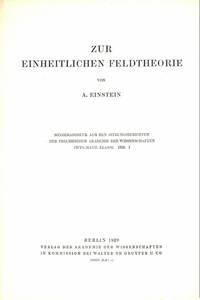
1929ref. 270931929. S.Ber. Akad. Wiss. Berl. 1929/ 1. - Berlin Verlag der Akademie der Wissenschaften 1930 8° 8 S. in schönem Pappband der Zeit. First Edition! "The unified Field Theory" is one of Einstein's last important scientific works. According to Weil "This paper represents a new development which was immediate news. A translation by L.L.Whyte appeared in the London Times of Feb. 4 1929. It was quoted in full in "Observatory" vol. 52 under the title "New Field Theory" pp.82-87 and 1930 pp.11-118." In 1928 Einstein embarked on a new approach to a unified field theory . involving what he called 'distant parallelism' . By early 1929 he had solved the main problems involved in writing down field equations for his unified field theory. On the day of offical publication of the third of a formidably technical series of 9 articles on the theory . excited headlines appeared in foreign newspapers throughout the world . In this frenzied unscientific atmosphere Einstein's new theory was hailed in the press as an outstanding scientific advance. Yet Einstein had stated in his article it was still tentative; and soon he found he had to abandon it. - cf.Parkinson Breakthroughs p.279 Weil No. 165 Schlipp Einstein No.226; Alicke No. 141; Norman Coll. I 700 unknown
1923ref. 317401923. S.Ber. Akad. Wiss. Berl. 1923/ 8. - Berlin Verlag der Akademie der Wissenschaften 1923 8° 4 S. orig. Broschur. First edition. A fine fresh copy in the rare off-print form. Marked with an asterisk by Weil denoting a major paper. "Einstein's attempts to formulate a unified field theory stemmed from his dissatisfaction with the general relativity theory which did not adequately incorporate the electromagnetic field into the geometry of space-time. In 1918 Hermann Weyl had begun investigating the possibility of constructing a unified field theory preserving the dimensionality of space-time while formally altering its geometry making it a special case of the class known as affine geometries. Einstein's first investigation of Weyl's ideas published in the present paper introduced the notion of distant parallelism; however Einstein later rejected Weyl's theory." Weil No. 132; Schilpp--Shields No. 171; Alicke No.113; Norman Library 698; Boni 141 unknown
1927ref. 445581927. Die Naturwissenschaften 15/22. - Berlin Verlag von Julius Springer 1927 4° 1 Portrait von Sir Isaac Newton 2 p.273-296 Broschur. First German Edition of Albert Einstein's fine contribution "On Isaac Newton . His Mechanics. . Influence on Growth of Theoretical Physics" Manch Guardian 13 col 7-14 col 3 19iii 1927 in commemoration of the 200th anniversary of Newton's death published on the 25.March 1927. The Published Weil No. 158; Schilpp-Shields No. 2o8; Alicke No.134; Walis 71.503 unknown
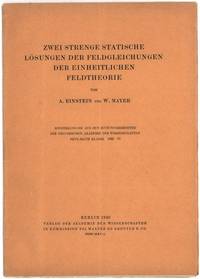
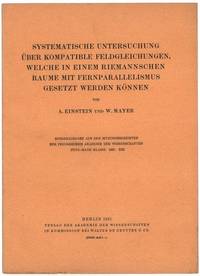
1931ref. 270891931. S.Ber. Akad. Wiss. Berl. 1931/13. - Berlin Verlag der Akademie der Wissenschaften 1931 8° 11 S. orig. Broschur. First Edition; the rare off-print from the "Sitzungsberichte". More and more frequently Einstein chose his assistants from mathematicians." One of the chief of them at that time was Professor Walter Mayer a small round individual who at first sight seemed crushed beneath the personality of Einstein. Einstein's family called him Mayerle and this Swabian diminutive suited him to perfection. But in Mayer's self-effacement there was more affection than respect. He gently contradicted Einstein interrupted him when necessary follwed up an argument and smiled a little mysteriously his head on one side as he watched the figures drawn up in front of him. "It is he who produced all my calculations; his skill is fantastic you know "Einstein used to say. In October 1933 Mayer followed Einstein in his American exile. -cf. Alicke Weil No.180; Schilpp-Shields No. 250; Alicke No. 149. unknown
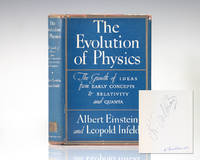
1951ref. 140033New York: Simon and Schuster 1951. Later printing of this classic work which traces the development of ideas in physics. Octavo original blue cloth. Boldly signed by both authors on the front free endpaper "A. Einstein. 53" and "L. Infeld 1958." Near fine in a very good dust jacket. We have never seen another example signed by both authors. Rare and desirable. Upon publication The Saturday Review of Literature praised Evolution of Physics as "masterly Einstein and Infelds book should do much to spread an understanding and appreciation one of the great dramas in the evolution of human thought." Simon and Schuster hardcover
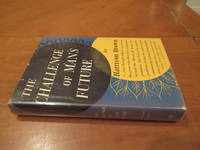
1954ref. 052515New York: Viking 1954. 1st Edition 1st Printing. Hardcover. Fine/Very Good Jacket. Xii 290 Pp. Turquoise Cloth Spine Gilt. First Printing Indicated. Fine No Marks Gilt Brilliant. Dust Jacket Priced $3.75 Slight Usage. Dust Jacket Blurbs By William O. Douglas Robert M. Hutchins Paul B. Sears Harold C. Urey Albert Einstein H. J. Muller; Brown Was An Outstanding Scientist Himself; But Few World Politicians Or Business Leaders 1946 To Present Ever Tried To Seriously Address These Issues Apparently Because They're Not There Primarily For The General Welfare. Harrison Scott Brown 1917 - 1986 Was An American Nuclear Chemist And Geochemist. He Was A Political Activist Who Lectured And Wrote On The Issues Of Arms Limitation Natural Resources And World Hunger. During World War Ii Brown Worked At The Manhattan Project's Metallurgical Laboratory And Clinton Engineer Works Where He Worked On Ways To Separate Plutonium From Uranium. The Techniques He Helped Develop Were Used At The Hanford Site To Produce The Plutonium Used In The Fat Man Bomb Dropped On Nagasaki. After The War He Lectured On The Dangers Of Nuclear Weapons. After The War He Worked At The University Of Chicago Where He Pioneered Nuclear Geochemistry. The Study Of Meteorites By Brown And His Students Led To The First Close Approximation Of The Age Of The Earth And The Solar System. In 1948 Brown Was Awarded The American Association For The Advancement Of Science Prize For His Work On Meteorites.Between 1951 And 1977 He Worked At The California Institute Of Technology Caltech Where He Contributed To Advances In Telescopic Instrumentation Jet Propulsion And Infrared Astronomy. While There He Attracted Several Former Colleagues And Highly Regarded Scientists To The Team. Together They Made Advancements In Telescopic Instrumentation Jet Propulsion Contributing To Nasa's Early Planetary Exploration Missions And Infrared Astronomy. In June 1954 He Was One Of Twenty Scientists Under The Age Of Forty Identified By Fortune Magazine As "Top Young Scientists In U. S. Universities And Industry". In The Early 1970S He Began Working More Directly On The Resource/Environment Issues That He Had Been Developing In His Books. In 1977 He Became Director Of The Newly Created Resource Systems Institute Of The East-West Center In Hawaii Where He Turned Full Time To Work On Understanding And Influencing The Interactions Of Energy Mineral And Food Systems In The Asia-Pacific Region Themes He Had Developed In His Books Since The 1950S. Viking hardcover
1906ref. 59121Leipzig Johann Ambrosius Barth 1906. Full cloth. Spine with gilt lettering. In: "Annalen der Physik. Vierte Folge. Band 20. Herausgegeben von Paul Drude." Portrait Paul Drude VIII1048 pp. and 6 plates. Einstein papers: pp. 199-206 and 627-33. Internally fine and clean. The entire volume offered. Broad margins. Both papers first edition. It was for the papers "Ueber einen die Erzeugung und Verwandlung des Lichtes betreffenden heuristischen Gesichtspunkt" of 1905 and "Zur Theorie der Lichterzeugung. Theory of light emission and absorption the offered item that Einstein was awarded the Nobel Prize in 1921. "The quantum theory has affected virtually every branch of physics. Its earliest and one of its most significant developments was Einstein's application of the theory to what is known as the 'photo-electrical effect'.Einstein explained this effext by suggesting that the classical view that light is emitted in the form of continous waves must be abandoned. The photo-electrical effect could be explained only as an example of quantum action where the waves of light or X-rays are emitted in minute particles or bullets. It is he size of the bullet the wave-lenght of the radiation which determines the number of electrons ejected. It was for this and not for the theory of relativity that Einstein was awarded the Nobel Prize in 1921. Einstein's two fundamental papers on this subject are "Ueber einem Erzeugung." 1905 and Zur Theorie der Lichterzeugung the paper offered here" PMM the note to 391. In the second paper Principle of the conservation of the centre of mass motion and the inertia of energy he shows that the conservation of mass is a special application of his energy principle E= Mc2 - Weil: 12 & 13.Among the many papers in this volume we have Max von Laue: Zur Thermodynamik der Inteferenzerscheinungen. pp. 365-378. hardcover
2009ref. __4896422848Tōkyō : Michitani 2009. 2009. Tankobon Hardcover. New. Japanese language. 7.72x5.28x1.50 inches. Tōkyō : Michitani, 2009. hardcover
1922ref. 58897Leipzig: Verlag und Druck von B.G. Teubner 1922. 8vo. In the original green cloth binding. Fine and clean. 159 1 pp. Fourth edition. hardcover