EINSTEIN, Albert, & Marcel GrossmanBiblio.com
2986 risultati
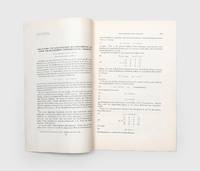
1913rif. 188059Leipzig and Berlin: B. G. Teubner 1913. Generalizing relativity First edition of Einstein's early articulation of general relativity his first paper to describe gravity as the curvature of spacetime containing "virtually all the essential features of his general theory of relativity" Norton p. 253. In 1912 Einstein's old school friend Marcel Grossman 1878-1936 secured him a professorship at ETH Zurich where they had both studied as undergraduates. The two men began a collaboration to provide a firmer mathematical foundation to Einstein's concept of gravity as a geometrical property of time and space. The two sections of the Entwurf outline the resulting theory in full complete with gravitational field equations relating the curvature of spacetime to the distribution of mass and energy within it. Einstein contributed the initial section focussing on physical theories while Grossman added the following section developing the more complex mathematical formulae. Michel Janssen editor of the Einstein Papers Project notes that the Entwurf "was published as a separatum in early 1913 and was reprinted the following year in Zeitschrift für Mathematik und Physik" p. 1. The Zeitschrift reprint includes an added section outlining the famed "Hole" argument. An offprint dated 1914 was published with the journal. Provenance: Edward Vermilye Huntington 1874-1952 the American academic who studied the foundations of mathematics at Harvard for 40 years with his signature on the front wrapper. Octavo. Device to title page formulae in the text. Original light green wrappers printed in black. Light rubbing chipping and creasing to wrappers contents clean: a very good copy indeed. Boni 50; Norman 693; Weil 58a. Michael Janssen "Einstein's First Systematic Exposition of General Relativity" 2004; John Norton "How Einstein found his field equations: 1912-1915" Historical Studies in the Physical Sciences vol. 14 no. 2 1984. unknown
rif. 150644Plaster bust of theoretical physicist Albert Einstein mounted on a wood pedestal base with an incised signature within the plaster. The entire piece measures 15 inches by 8 inches. From the collection of actress LeGrand Mellon 1937-2005 an American performer whose career spans film television and theater. In addition to her acting career Mellon had been involved in creative and cultural work connected to Haiti launching micro-businesses and continuing the work of her late first husband William Larimer Mellon III with Hôpital Albert Schweitzer. In very good condition. Albert Einstein developed the general theory of relativity one of the two pillars of modern physics alongside quantum mechanics. Einstein's work is also known for its influence on the philosophy of science. Einstein is best known in popular culture for his mass–energy equivalence formula E = mc2 which has been dubbed "the world's most famous equation". He received the 1921 Nobel Prize in Physics for his "services to theoretical physics" in particular his discovery of the law of the photoelectric effect a pivotal step in the evolution of quantum theory David Bodanis. unknown
1955rif. 060140New York: Pantheon Books 1955. First Edition . Cloth. Very Good /Good. 86 Pp. Blue Cloth. First Edition. Book Very Good Dj First State Priced $4.00 Considerable Wear Chipping At Corners 2" Mostly Closed Tear Near Top Of Front Spine Edge No Marks. Pantheon Books hardcover
1953rif. GB0000CIJJXI3N01Cassell 1953. Hardcover. Good. Missing dust jacket; Pages can have notes/highlighting. Spine may show signs of wear. ~ ThriftBooks: Read More Spend Less.Dust jacket quality is not guaranteed. Cassell hardcover
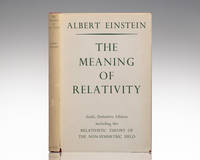
1956rif. 149754London: Methuen & Co. Ltd 1956. Sixth edition of Einstein's clear and systematic exposition of the theory of relativity with the ownership stamp on the front and rear pastedowns "Stephen Hawking Newton Institute University of Cambridge Cambridge England." Octavo original cloth. Translated By Edwin Plimpton Adams and Ernest G. Straus. Fine in a very good dust jacket. An exceptional association. In the book Einstein outlines both the special and general theories of relativity explaining their mathematical foundations and physical implications particularly regarding the nature of space time and gravitation. Designed for readers with a background in physics and mathematics the text serves as both a summary of Einstein’s groundbreaking contributions and an accessible guide to the conceptual shifts his theories introduced to modern science. The work remains a significant historical and intellectual document illustrating Einstein’s effort to communicate complex scientific ideas with clarity and precision. Methuen & Co. Ltd hardcover
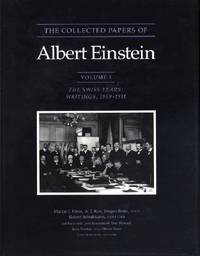
rif. 64180238Princeton University Press . Hardback. New. pp. 670 Index Princeton University Press hardcover
rif. 346807Methuen & Co 1922. FIRST EDITION ownership of Kenneth J Maidment Vice Chancellor of Auckland Univesity dated Merton College 1930 octavo orange/brown buckram boards gilt lettering to spine blind stamp lettering to front board unpaginated prelims 123pp VG light fading & soiling to spine light bruising to extrems light soiling to boards light to moderate tanning & foxing to page edges moderate foxing to prelims occasional minro markings throughout aforementioned prev. ownership signature to ffep occasional light cracking to gutters Methuen & Co 1922 hardcover
1944rif. 182569London: The Jewish Agency for Palestine 1944. First separate edition of Einstein's appeal for Zionism. Einstein was one of the most prominent international supports of Zionism. He argues Palestine is the only place historically spiritually and culturally tied to the Jewish people. Whereas the Arabs with many homelands the Jews have nowhere else to go. Their claims are rooted not in conquest or nationalism but in justice and survival. The article was originally published in the Princeton Herald earlier that year. This publication prints the article alongside other speeches and letters by Einstein extracted from his 1930 About Zionism. Provenance: Jews' College Library London with their shelf mark to the front wrapper and their stamp to the front wrapper verso. Octavo. Original wrappers. Library markings see note a little creased and spotted. A good copy. unknown
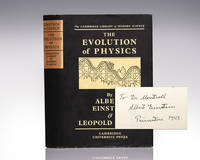
1938rif. 150250Cambridge: Cambridge University Press 1938. First edition of this classic work which traces the development of ideas in physics. Octavo original blue cloth. Presentation copy inscribed by Albert Einstein on the half-title page "To Dr. Montrell Albert Einstein Princeton 1943." Near fine in a near fine price-clipped dust jacket. On publication The Saturday Review of Literature praised Evolution of Physics as "masterly Einstein and Infelds book should do much to spread an understanding and appreciation one of the great dramas in the evolution of human thought." Cambridge University Press hardcover
1955rif. 059673New York: Pantheon Books 1955. First Edition . Cloth. Near Fine/Near Fine. 86 Pp. Blue Cloth. First Edition. Book Near Fine Slight Rubbing At Corners. Dj Priced $4.50 Second State First State Is $4.00 With Tiny Chip At Center Of Bottom Edge Of Spine. Pantheon Books hardcover
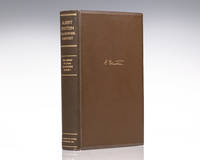
1949rif. 148432Evanston: The Library of Living Philosophers Inc. 1949. First edition of Einstein's singular autobiography. Octavo original cloth with gilt titles to the spine top edge gilt frontispiece of Einstein by Yousuf Karsh. Edited by Paul Arthur Schilpp. In near fine condition. Written by the man considered the "Person of the Century" by Time magazine this is not a glimpse into Einstein's personal life but an extension and elaboration into his thinking on science. Two of the great theories of the physical world were created in the early 20th century: the theory of relativity and quantum mechanics. Einstein created the theory of relativity and was also one of the founders of quantum theory. Here Einstein describes the failure of classical mechanics and the rise of the electromagnetic field the theory of relativity and of the quanta. "The greatest physicist of the 20th century" PMM 408. The Library of Living Philosophers, Inc. hardcover
2000rif. mon0003697463Princeton University Press 7/26/2009 12:00:01 A. paperback. Good. 0.7000 9.9000 7.4000. Princeton University Press paperback
1989rif. 1-0691085269Princeton Univ Pr 1989. Hardcover. New. 696 pages. 10.50x8.25x1.50 inches. Princeton Univ Pr hardcover
rif. 6c770Ad. Mampe Bln. 1886. 60/45 S. Leinen Stempel auf Titel. - Widmung des Herausgebers auf Titel - unknown
rif. 6d275311. Aufl. Max Hesses Verl. Berlin 1929. VII 1079 S./ S. 1090 - S. 2105 mit Noten Halbledereinbände berieben/ bestoßen/ 1 Einbanddeckel gelockert/ 1 Rücken etwas eingerissen. unknown
1950rif. 059077New York: Philosophical Library 1950. 1st Edition Reprint. Hardcover. Near Fine. 282 Pp. Dark Blue Cloth Lettered In Gilt. First Edition But A Later Printing Lacking The Frontispiece Portrait Of Einstein By Lotte Jacobi. Book Is Near Fine Light Rubbing At Corners Lettering Strong No Marks. Philosophical Library hardcover
1934rif. 180324Princeton: Princeton University Press 1934. First edition offprint issue of the fourth and final paper on Einstein and Mayer's semi-vectors in which they aimed to incorporate the Dirac equation into the general theory of relativity. This last article "was presented foremost as an exercise with exclusively mathematical appeal" Van Dongen p. 106. Large octavo pp. 7. Disbound from wrappers wire-stitched. Nicks and a handful of short closed tears to extremities: a very good copy. Boni 225; Weil 193. Jeroen van Dongen Einstein's Unification 2010. unknown
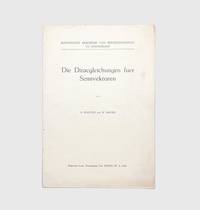
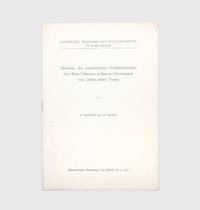
1933rif. 180322Amsterdam: Koninklijke Akademie van Wetenschappen 1933. First edition offprint issue of the second of Einstein and Mayer's four classic papers on semi-vectors in which they aimed to incorporate the Dirac equation into the general theory of relativity. "By introducing semi-vectors Einstein wanted to arrive at a mathematically simpler and more general formulation of spinors. The semi-vector generalization of the Dirac equation was thought to give a unified description of charged elementary particles in particular of the electron and proton. In their second semi-vector paper Einstein and Mayer were on the lookout for the most general Dirac system possible for the semivector" Van Dongen pp. 103-11. Large octavo pp. 20. Original cream wrappers front wrapper printed in black. Wire-stitching sometime removed front wrappers lightly soiled: a very good copy. Boni 222; Weil 191. Jeroen van Dongen Einstein's Unification 2010. unknown
1933rif. 180318Amsterdam: Koninklijke Akademie van Wetenschappen 1933. First edition offprint issue of the third of Einstein and Mayer's four classic papers on semi-vectors in which they aimed to incorporate the Dirac equation into the general theory of relativity. "By introducing semi-vectors Einstein wanted to arrive at a mathematically simpler and more general formulation of spinors. The semi-vector generalization of the Dirac equation was thought to give a unified description of charged elementary particles in particular of the electron and proton" Van Dongen pp. 103-5. Large octavo pp. 4. Original cream wrappers front wrapper printed in black wire-stitched as issued. Extremities gently creased short closed tears at spine ends occasional light foxing: a very good copy. Boni 223; Weil 192. Jeroen van Dongen Einstein's Unification 2010. unknown
1945rif. 180350Lancaster Pennsylvania: American Physical Society 1945 & 1946. His most significant later contribution to cosmology First editions offprint issues of the papers that introduced the Swiss-cheese model of the universe. Einstein and Straus revised the FLRW metric by suggesting that the universe is in fact inhomogeneous. "In two ground-breaking papers Einstein and Straus showed how galaxies fit into a Universe with zero pressure. This model helps to describe the universe observed today" Harwit p. 573. Quarto pp. 5. Disbound wire-stitched as issued. Nicks and creasing to extremities short closed tears to outer margins pp. 120-1 of Influence detached rear blank almost detached: in very good condition. Boni 252 & 252.1; Weil 216. Martin Harwit Astrophysical Concepts 2010. unknown
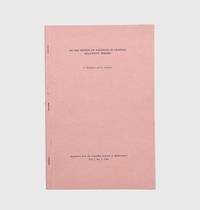
1949rif. 180348Ottowa: Canadian Mathematical Society 1949. Their final collaboration First edition offprint issue. Einstein and Infeld demonstrate that "field equations alone suffice as a basis for solving the problem of motion in general relativistic theory since the Einstein equations not only determine how particles must respond to gravitational forces but also contain the information necessary to describe those forces" Calaprice p. 323. Octavo pp. 34. Original orange wrappers wire-stitched as issued front cover lettered in black. Front wrapper lightly marked: a near-fine copy. Boni 259; Weil 223. Alice Calaprice An Einstein Encyclopedia 2015. unknown
1932rif. 180272Easton Pennsylvania: Mack Printing Company 1932. Einstein revises his "biggest blunder" First edition journal issue of the paper in which Einstein rejected his 1917 cosmological constant and acknowledged the expansion of the universe. Drawing on Hubble's law Einstein and de Sitter proposed that the constant should be set equal to zero thereby offering a new model of the universe. "In 1917 Einstein had shown how to construct a universe that was static by introducing a 'cosmological constant' into his equations. This matched well with the idea current before Hubble's 1924 measurement of the distances to the nebulae of a small and static 'universe' that was confined to the stars of the Milky Way galaxy. Einstein's idea of a static universe suspended between gravity pulling inward and the cosmological constant making the universe expand was ruled out by Hubble's data" Kirshner pp. 9-12. In Einstein and de Sitter's revised model "the galaxies receded forever but the recession rate declines to zero as time approaches infinity. Some sources indicate that this is the first attempt to describe our universe rather than a mathematical abstraction of universes possible under general relativity. Shortly after Einstein formally renounced his cosmological constant and according to George Gamow called it 'the biggest blunder of my life'" Wenner. Einstein and de Sitter 1872-1934 were close collaborators in the 1920s at Leiden where de Sitter was chair of astronomy and Einstein was a visiting professor. De Sitter is also known for the concepts of De Sitter space and the De Sitter universe. Large octavo. Original brown wrappers covers printed in black. Short closed tears to spine a little loss to ends corners gently creased: a very good copy. Boni 214; Weil 184; Wenner p. 256. Robert P. Kirshner "Hubble's Diagram and Cosmic Expansion" Proceedings of the National Academy of Sciences of the United States of America vol. 101 no. 1 December 2003. unknown
rif. H1017Leipzig J. A. Barth 1906 S. 371-381. Halbleinenband der Zeit mit goldgeprägtem Rückentitel gr. 8°. Vorderdeckel etwas berieben.2 St. a. Titel. Text sauber und frisch. bedeutender Botaniker und Nachfolger Dryanders als Bibliothekar Joseph Banks' ist noch heute durch seine Entdeckung der sog. Brownschen Bewegung auch Brownschen Molekularbewegung Brownian Movement im Jahr 1827 bekannt. Bei Beobachtungen mit dem Mikroskop fiel ihm die unregelmäßige Zitterbewegung von auf der Wasserfläche dahintreibenden Blütenstaubpartikeln auf. Brown konnte keine Erklärung dafür finden. Es war Albert Einstein der 1905 herausfand dass sie durch Zusammenstöße mit unter dem Mikroskop nicht sichtbaren Atomen und Molekülen herrührt. Einstein veröffentlichte seine Beobachtung in den Abhandlungen "Über die von der molekularkinetischen Theorie der Wärme geforderte Bewegung von in ruhenden Flüssigkeiten suspendierten Teilchen" Annalen der Physik 4. Folge Bd. 17 1905 und – hier vorliegend - "Zur Theorie der Brownschen Bewegung" dass. Bd. 19 1906. Die erfolgreiche Erklärung der brownschen Bewegung gilt als Meilenstein auf dem Weg zum wissenschaftlichen Nachweis der Existenz der Moleküle und damit der Atome. Robert Brown 1773-1858 zählte zu den bedeutendsten Botanikern der ersten Hälfte des 19. Jahrhunderts. Nach dem Studium der Medizin und Botanik in Edinburgh wurde er zunächst als Militärarzt im Norden Irlands tätig. 1798 machte er die Bekanntschaft von Joseph Banks – ein Treffen das entscheidend für sein ganzes weiteres Leben sein sollte. Banks bot ihm eine Stelle als Naturwissenschaftler auf Flinders Expedition zur Erforschung der australischen Küsten an. Brown nahm an und arbeitete in der Folge eng mit dem Pflanzenmaler Ferdinand Bauer zusammen. Als Flinders aufgrund des untragbaren Zustandes des Expeditionsschiffs "Investigator" gezwungen war die Reise vorzeitig abzubrechen blieben Brown und Bauer in Port Jackson zurück um ihre Forschungen bis zur Rückkehr Flinders' fortzuführen. Brown ging in der Folge nach Van Diemens-Land Tasmanien Bauer auf die Norfolk-Insel. 1805 traf man sich in Sydney wieder und trat die Heimreise an. Kurz nach seiner Rückkehr wurde Brown zum Bibliothekar der Linnéan Society. 1810 nach dem Tod Dryanders übernahm er dessen Stelle in der Bibliothek Banks'. Letzterer gab Brown testamentarisch das Recht auf lebenslange Nutzung seiner Sammlungen und seiner Bibliothek. Als man diese 1827 ins British Museum verlegte wurde Brown zum Bibliothekar und Kurator der dortigen botanischen Abteilung. Nach Banks' Tod gab Brown seine Stellung als Bibliothekar der Linnéan Society auf und fungierte von 1849 bis 1853 als deren Präsident. Bereits 1839 hatte man ihm für seine Forschungen über den pflanzlichen Befruchtungsprozess die Copley-Medaille verliehen. unknown
1921rif. 148232New York: Harcourt Brace and Company 1921. First edition of this popular science book that made Albert Einstein’s theory of relativity accessible to general readers. Octavo original cloth frontispiece with black and white illustrations. In very good condition name to the title page. Easy Lessons in Einstein 1920 by Edwin E. Slosson is an early and influential work of science communication that seeks to explain Albert Einstein’s theory of relativity in accessible terms for a general audience. Written at a time when Einstein’s ideas were gaining international attention but remained largely misunderstood by the public Slosson's book demystifies complex scientific concepts such as space-time the constancy of the speed of light and the relativity of motion using analogies and clear language rather than technical mathematics. As a chemist and science writer Slosson played a key role in making cutting-edge scientific developments comprehensible to non-specialists. The book reflects both the growing public fascination with modern physics in the early 20th century and the importance of translating theoretical science into broader cultural understanding. Harcourt, Brace and Company hardcover
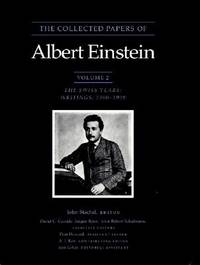
1987rif. 1-0691084076Princeton Univ Pr 1987. Hardcover. New. illustrated edition. 502 pages. 10.50x8.25x1.75 inches. Princeton Univ Pr hardcover