2,986 results
1936ref. 47073Lancaster American Physical Society 1936. 4to. In: "The Physical Review" Vol. 49 Second Series. X971 pp. Entire volume offered. Einstein & Rosen's paper: pp. 404-405. First printing of Einstein and Rosen's answer to Silberstein's critique of Einstein's Theory of Relativity ."Ludwik Silberstein who initially was a supporter of the special theory objected at different occasions against general relativity. In 1920 he argued that the deflection of light by the sun as observed by Arthur Eddington et al. 1919 is not necessarily a confirmation of general relativity but may also be explained by the Stokes-Planck theory of complete aether drag. However such models are in contradiction with the aberration of light and other experiments see "Alternative theories". And in 1935 Silberstein claimed to have found a contradiction in the Two-body problem in general relativity. However also this claim was refuted by Einstein and Rosen 1935 in the paper offered."Wikipedia. unknown
1902ref. 38834Berlin J.A. Barth 1902. Contemp. hcloth. Top of spine with light wear bottom of spine with small nicks. "Annalen der Physik. Vierte Folge. Band 8. Hrsg. von Paul Drude." VIII928 pp. and 7 plates. Einstein paper: pp. 798-814. Internally fine and clean. The whole volume offered. First editon. - Weil No 2. hardcover
1906ref. 46962Leipzig Johann Ambrosius Barth 1906. Bound together in one contemp. halfcalf. Spine gilt. Minor scratches to spine. A stamp to titlepage and htitle. "Annalen der Physik. Vierte Folge. Band 20. Herausgegeben von Paul Drude." Portrait Paul Drude VIII1048 pp. and 6 plates. Einstein papers: pp. 199-206 and 627-33. The entire volume offered. Both papers first edition. It was for the papers "Ueber einen die Erzeugung und Verwandlung des Lichtes betreffenden heuristischen Gesichtspunkt" of 1905 and "Zur Theorie der Lichterzeugung. Theory of light emission and absorption the offered item that Einstein was awarded the Nobel Prize in 1921."The quantum theory has affected virtually every branch of physics. Its earliest and one of its most significant developments was Einstein's application of the theory to what is known as the 'photo-electrical effect'.Einstein explained this effext by suggesting that the classical view that light is emitted in the form of continous waves must be abandoned. The photo-electrical effect could be explained only as an example of quantum action where the waves of light or X-rays are emitted in minute particles or bullets. It is he size of the bullet the wave-lenght of the radiation which determines the number of electrons ejected. It was for this and not for the theory of relativity that Einstein was awarded the Nobel Prize in 1921. Einstein's two fundamental papers on this subject are "Ueber einem Erzeugung." 1905 and Zur Theorie der Lichterzeugung the paper offered here" PMM the note to 391. In the second paper Principle of the conservation of the centre of mass motion and the inertia of energy he shows that the conservation of mass is a special application of his energy principle E= Mc2 - Weil: 12 & 13.Among the many papers in this volume we have Max von Laue: Zur Thermodynamik der Inteferenzerscheinungen. pp. 365-378. unknown
1917ref. 38838Braunschweig Vieweg & Sohn 1917. Contemp. hcalf. Spine worn and covers detached. Internally clean and fine. "Verhandlungen der Deutschen Physikalischen Gesellschaft im Jahre 1917. Neunzehnter Jahrgang. Herausgegeben von Karl Scheel." V372 pp. Einstein paper: pp. 82-92. The whole volume offered. First edition. Containing also Max von Laue: "Bandenspektrum und molekulare Quantendrehungen; pp.130-38. and "Ein Versagen der klassischen Optik: pp. 19-21. - Weil No 94. unknown
1914ref. 38840Braunschweig Vieweg & Sohn 1914. Later full cloth. A stamp to the general titlepage. IX1072;414 pp. textillustrations. "Verhandlungen der Deutschen Physikalischen Gesellschaft im Jahre 1914. Sechzehnter Jahrgang. Hrsg. von Karl Scheel." Einstein paper pp. 820-828. Internally clean and fine. The whole volume offered First edition. In this paper "Contributions to quantum theory" two considerations are given which are interrelated by a common goal inasmuch as it is attempted to derive two of the most importent achievementss of quantum theory viz. Planck's radiation law and Nernst's third law of thermodynamics in a new manner. The proofs do not involve Boltzmann's equation and are thus based enterely on macroscopic thermodynamics. They do introduce however the quantum hupothesis. Einstein points out that the alleged 'proofs' which try to derive the theorem of Nernst from the mere fact that the heat capacity of all substances goes to zero at absolute zero temterature are not genuine. Cornelius Lanczos.- Weil No 67. hardcover
1907ref. 38817Leipzig J.A. Barth 1907. Contep. hcloth. Both hinges with a tear at upper part. "Annalen der Physik Vierte Folge. Band 23. Herausgegeben von W.Wien und M. Planck" VIII1000 pp. and 4 plates. Einstein's papers pp. 197-98 a. 206-209 a. 371-384. Internally fine and clean. The whole volume offered. All 3 papers in first edition. - The first paper "New possibility of testing the relativity principle" deals with the shift of canal rays in the Dobbler effect as a possible confirmation of the Principle of Relativity - the confirmation became actual only in 1938 when new improved instrumentation made it possible. - The second paper "remarks concerning Paul Ehrenfest's note: 'Translation of the deformable electron and the momentum law' Einstein gives his answer by relating it to his Theory of Relativity. - The third paper "The inertia of energy as demanded by the principle of relativity" which is a importen paper as it i is the first to state E=mc2 in its general form. general form. This new relation which was adumbrated already in his paper of 1906 Das prinzip von der Erhaltung der Schwerpunktsbewegung brings about the complete unification of mass and energy into a single concept. In natural units which make c=1 we have E=m i.e. mass and energy are one and the same quantity. Every form of energy also has a mass value just as every mass represents a definite amount of energy. - Weil Nos 1718 a. 19 hardcover
1907ref. 47457Leibzig Johann Ambrosius Barth 1907. 8vo. Contemp. hcalf. Spine gilt. Title-and tomelabels with gilt lettering. Slightly rubbed. In "Annalen der Physik" Vierte Folge Band 23. VIII1000 pp. a. 4 plates. The entire volume offered. Einstein's paper: pp.371-384. A small stamp on titlepage Gmelin.Institut. Internally clean and fine. First edition of the first explicit statement of Einstein's energy-mass equation E=mc2.Nearly all descriptions of Einstein's scientific work state that the mass-energy equivalence E=mc2 was first formulated in Einstein's 1907 review paper 'Über das Relativitätsprinzip und die aus demselben gezogenen.' published in 'Jahrbuch der Radioaktivität und Elektronik' see Weil no. 21 and Dictionary of Scientific Biography vol. 4 pp.323 for examples. However in his paper 'Über die von Relativitätsprincip geforderte Trägheit der Energie' the offered paper which predates the former mentioned by six months Einstein gave a clear statement of the mass-energy equivalence E=mc2. See Lanczos: The Einstein Decade pp.149-150 and 153 as well as Volume 2 of 'The Collected Papers of Albert Einstein' pp. 428.Einstein's first paper regarding the relation E=mc2 is his fourth 1905 paper 'Ist die Trägheit eines Körpers von seinem Energieinhalt abhängig'. In this short paper Einstein showed that a body releasing the energy E in the form of radiation will have its mass decreased by E/c2 and concluded that the mass of a body is a measure of its energy content e.g. that all energy has mass. The next time Einstein returns to the subject is in his 1906 paper 'Das Prinzip von der Erhaltung der Schwerpunkts Bewegung und die Trägheit der Energie.'. Here Einstein concluded that one must either ascribe the inertial mass E/c2 to any form of energy E or else give up the fundamental law mechanics regarding conservation of the motion of the center of gravity. Then finally in the 1907 paper 'Über die von Relativitätsprincip geforderte Trägheit der Energie.' the offered paper Einstein makes the decisive step of assuming that all mass has energy. On page 382 Einstein considers the total energy of a moving mass point as the sum of its kinetic energy and its rest energy. In classical mechanics it is most convenient to set the second term to zero but in relativistic mechanics one obtains the simplest expression by setting the rest energy equal to mc2. Einstein then continues to show that this stipulation cannot lead to a contradiction in any relativistic argument. In a footnote on page 382 Einstein states for the first time the equation E=mc2 and mentions that this equation is the expression of the principle of the equivalence of mass and energy - see Volume 2 of 'The Collected Papers of Albert Einstein' pp. 428.The volume contains another paper by Einstein "Bemerkungen zu der Notiz von Hrn. Paul Ehrenfest: "Die Translation deformierbarer Elektronen und der Flächensatz"" pp.206-208. - Weil No. 18.Collected Works Doc. 45. Weil 19. Boni 19. unknown
1925ref. 39308Paris Gauthier-Villars et Cie 1925. Small8vo. Uncut in orig. printed wrappers. Portrait. 4562 pp. Publisher's Cat. 6 pp. 2 leaves with an insignificant small loss of upper right corner. A fine copy. First French edition of the initials papers on Special Relativity. It is a translation of the 2 Einstein-papers which appeared in 1905 "Elektrodynamik bewegter Körper" and "Ist die Trägheit eines Körpers von seinem Energieinhalt abhängig ". Published in the series "Les Maitres de la Pensee scientifique". - Weil: 9 c - Schielpp-Schields: 189. - Boni-Laurence: 9 B and 10 B. unknown
1921ref. 46479Berlin Julius Springer 1921. Uncut in orig. printed wrappers. 20 pp. Some marks on the 3 last leaves and on backwrapper probably after a rubberband. First edition. - Weil: 115. - Boni: 122. unknown
1913ref. 38802Leipzig 15. December 1913. 4to. "Physikalische Zeitschrift No. 25 15. December 1913. 14 Jahrgang" pp. 1249-1312. Einsteins paper: 1249-1266 Discussion pp. 1262-66. First edition. This is the famous address that Einstein gave on the occasion on the 85th Congress "Versammlung Deutscher Naturforscher und Aerzte zu Wien" in their meeting September 23 1913 together with the ensuing discussion. - Weil No. 54. unknown
1921ref. 38642Berlin Julius Springer 1921. Uncut in orig. printed wrappers. 20 pp. First edition. - Weil: 115. - Boni: 122. unknown
1916ref. 47015Berlin Julius Springer 1916. Royal8vo. Bound in contemporary half calf with gilt lettering to spine. In "Die Naturwissenschaften" 4 Jahrgang 1916. A very nice and clean copy. Pp. 509-510. Entire volume: XIV 866 pp. First printing of Einstein's only paper on aircrafts. In it he proposed a new shape for aircraft wings. Disappointed that nobody took up his idea he took it to an airline in Berlin. A prototype was constructed but it performed poorly and it was never put into service. unknown
1916ref. 29308Braunschweig Vieweg & Sohn 1916. 8vo. Fine later boards the orig. printed frontwrapper from the Journal pasted on frontcover. Extract from "Verhandlungen d. deutschen Physikalischen Gesellschaft.18. Jahrgang. Nr. 6/7". pp. 173-177 and 1 textillustr. First edition. - Weil No. 82. hardcover
1927ref. 38844Berlin Julius Springer 1927. 4to. Contemp. hcloth. Spine a bit worn. "Die Naturwissenschaften. Hrsg. von Arnold Berliner. 15. jahrgang" XXIV1000 pp. Einstein paper: pp. 273-276 and 1 portrait of Newton. - Born Paper: pp. 238-242. - Planck paper: 529-531. - Sommerfeld paper 825-832 - von Frisch papers: pp. 321-326 and pp. 963-968. The whole volume offered. All papers in first edition. The Einstein paper is his contribution to the Anniversary volume of Newton's death. - Weil No 158. - Planck: Akademie No. 165 - K. v. Frisch received the Nobel Prize for his works on animal psychology and behaviour in 1975. hardcover
1922ref. 28358Berlin Gruyter & Co. 1922. 4to. Orig.printed orange wrappers. Offprint/Sonderabdruck aus Sitzungsberichten. pp. 18-22. Fine fresh copy. First edition in the rare Offprint still called "Abdruck". - Weil No. 120.The early Offprints from "Sitzungsberichten." are called "Sonderabdruck" up to Weil No.165 including this. From Weil 166 they are called "Sonderausgabe.". - Before 161 up to 160 the Offprints do not have separate title and pagination the pagination follows the numbering in the periodical. From 166 the Offprint has both separate printed title and pagination. - So Weil Nos 161-165 is still "Abdruck" but with separate title and pagination. These facts are not mentioned in the bibliographies. unknown
1923ref. 43840Berlin Julius Springer 1923. 8vo. Entire volume 19 and 20 of "Zeitschrift für Physik" bound in contemporary black half cloth with gilt title to spine. Library stamp to title-page and paper label pasted on to lower part of spine. Minor wear to extremities. A nice and clean copy. Pp. 301-6. Entire volume: IV 426 pp. First edition.Weil 138; Schilpp-Shields 178.The volume also contains:Meitner Lise. Ueber eine mögliche Deutung des kontinuierlichen beta-Strahlenspektrums. Pp. 307-321.Pauli W. Zur Frage der Zuordnung der Komplexstrukturterme in starken und in schwachen äusseren Feldern. Pp. 371-88. hardcover
1917ref. 22780Braunschweig Fridr. Vieweg. & Sohn 1917. "Heft 38 sammlung Vieweg" 8vo. Orig. printed wrappers. Title page with ink note and owners name. Some underlinings in ink. IV70 pp. Second printing of the original from the same year. Weil No. 90. unknown
1930ref. 28367Berlin Gruyter & Co. 1930. 4to. Orig. printed orange wrappers. Offprint/Sonderausgabe aus Sitzungsberichten.pp. 1-8. Fine fresh copy. First edition in the scarce Offprint with its separate printed title and separate pagination. See Weil No. 169 where this is not mentioned.The early Offprints from "Sitzungsberichten." are called "Sonderabdruck" up to Weil No.165 including this. From Weil 166 they are called "Sonderausgabe.". - Before 161 up to 160 the Offprints do not have separate title and pagination the pagination follows the numbering in the periodical. From 166 the Offprint has both separate printed title and pagination. - So Weil Nos 161-165 is still "Abdruck" but with separate title and pagination. These facts are not mentioned in the bibliographies. unknown
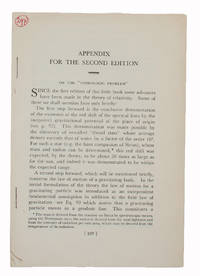
1950ref. 465431950. 8vo. Original proof-copy of the latest stage presumably final proof in the same format as the printed version and with no corrections printed on rectos and versos. Stapled twice in left margin. A few marginal creases. A proof- number to upper left corner in red ink 297. Pp. 109-148 tipped-in errata slip at p. 147. Very rare original proof-copy of the two highly important appendices for Einstein's "The Meaning of Relativity" third edition 1950 the second appendix being one of the most important pieces Einstein ever wrote namely the appendix "in which he described his most recent work on unification" Pais and the work which was hailed by The New York Times under the heading "New Einstein theory gives a master key to the universe". The first appendix which appeared for the second edition of the work remained unchanged throughout the history of "the Meaning of Relativity" and was written because "Since the first edition of this little book some advances have been made in the theory of relativity. . The first step forward is the conclusive demonstration of the existence of the red shift of the spectral lines by the negative gravitational potential of the place of origin" . A second step forward which will be mentioned briefly concerns the law of motion of a gravitating body." . A third step forward concerning the so-called "cosmologic problem" wiil be considered here in detail." pp. 109-10. The present 40 pages constitute the final proof-copy of the entire appendices I and II to the Generalized Theory of Gravitation exactly as they appeared in the third edition Princeton in 1950. Einstein's "The Meaning of Relativity" was originally published in 1922 on the basis of his "Vier Vorlesungen ueber Relativitetstheorie" given at Princeton in 1921. A second edition with an appendix appendix I appeared in 1945 several issues and editions of this appeared also and in 1949 the third edition with the seminal Appendix II printed for the first time appears also appeared in 1950 in Princeton. In 1950 a revised edition of the third edition appears having Appendix II slightly revised and in 1953 the heavily revised fourth edition appears. THIS IS THE PROOF-COPY OF APPENDICES I AND II FOR THE "THIRD EDITION INCLUDING THE GENERALIZED THEORY OF GRAVITATION" PRINCETON 1950. The main focus of the work throughout all these editions of the work since 1949 is Appendix II which deals with Einstein's main interest the generalization of the Gravitation Theory which was to unite the general theory of relativity with electromagnetism recovering an approximation for quantum theory and presenting us with a theory to explain the universe as a unified entity the ultimate goal for the greatest physicist that ever lived. "This was Einstein's ultimate response to the mechanical-electromagnetic crisis in physical theory he had first talked about in the opening of his 1905 light quantum-paper." Nandor in D.S.B. p. 330. It was indeed Einstein's aim to provide an explanation of the universe through his unified field theory although he was well aware that his sort of field theory might not exist. However even the establishing of the non-existence of it could bring us closer to an explanation than we had ever been before. There is no topic of greater importance to Einstein than his theory of unification. "In 1949 Einstein wrote a new appendix for the third edition of his "The Meaning of Relativity" in which he described his most recent work on unification. It was none of his doing that a page of his manuscript appeared on the front page of "The New York Times" under the heading "New Einstein theory gives a master key to the universe". He refused to see reporters and asked Helen Dukas to relay this message to them: "Come back and see me in twenty years"." Pais p. 350. unknown
1907ref. 47020Berlin J.A. Barth 1907. 8vo. 2 issues to both the original printed yellow wrappers. No backstrip. Wrappers loose. In: "Annalen der Physik. Vierte Folge. Band 22" No. 1. and No. 4. Pp. 1-208 1 fold. plate a. 1 portrait P. Curie a. pp. 609-800 1 plate. Entire issues offered. Einsteins paper: pp. 180-190 and p. 800. Astamp to verso of plates and a few leaves. THE PRINTED WRAPPERS LOOSE. First printing of a major paper in Quantum Theory introducing the first systematic introduction of probability factors in Quantum Theory."From 1905 through 1909 Einstein published five major papers on the hypothesis of energy quanta its theoretical implications and its use in the explanation of various phenomena. Among these papers we have his importent paper "Die Plancksche." and in his second paper from 1906d he asserted that Planck's derivation implicitly assumes quantification of the enrgies of charged oscillators. Now in the paper offered he returned to this question showing that if the structure function in phase space he had introduced earlier is assumed to restrict the oscillators to orbits with energies that are integral mulætiples of 'hv' then the average oscillator energy in a canonical ensemble yealds Planck's law when substituted in eg. The works contains the first systematic introduction of probability factors in the mathematics of Quantum Theory." Weil: nos 15 1-2 with an asterix denoting a major paper. - Boni: 15. unknown
1909ref. 47376Braunschweig Friedrich Vieweg und Sohn 1909. 8vo. Bound in contemporary half calf with gilt lettering to spine. In "Verhandlungen der Deutsche Physikalische Gesellschaft" 11 Jahrgang 1909. Reprinted same year in "Physikalische Zeitschrift 10". Bound with "Berichte der Deutschen Physikalischen Gesellschaft" 7 Jahrgang 1909. Capitals and hindges with wear. Internally very fine and clean. Pp. 482-500. Entire volume: 2 749 3 VII 450 pp. First printing of Einstein's famous lecture in which he anticipated the discovery of black-body radiation and famously stated that: "the next phase in the development of theoretical physics will bring us a theory of light which may be regarded as a sort of fusion of the undulatory and emission theories of light" The present paper Pp. 482-3. He furthermore stated that the electromagnetic fields that constitute light will no longer appear to be states of a hypothetical medium but rather independent entities emitted by the sources of light exactly as in the Newtonian emission theory of light. The paper was delivered as a lecture before the 81st assembly of the 'Gesellschaft Deutscher Naturforscher' in Salzburg on 21st September 1909.The occasion was important for Einstein since he for years had been working in scientific exile. Among those who attended Einstein's lecture were some of the world's foremost physicists such as; Max von Laue Max Born Arnold Sommerfeld. All published papers of their own in the present volume. Weil No. 30. unknown
1926ref. 43839Berlin Julius Springer 1926. Lex8vo. In "Die Naturwissenschaften" Vierzehnter Jahrgang 1926. Entire volume offered bound in a nice contemporary half calf with five raised band and gilt lettering to spine. Minor wear to capitals otherwise a very fine and clean copy. Einstein: Pp. 223-24; Pp. 300-1; Bohr: Pp. 1-10. Entire volume: XXVIII 1286 72 pp. First edition of all three papers. In the first paper Einstein explains the causes behind Baer's law: Due to the rotation of the earth erosion occurs mostly on the right banks of rivers in the Nothern Hemisphere while in the Southern Hemisphere erosion occurs primarily on the left banks. Weil Nos 150;154 unknown
1923ref. 48937Berlin Julius Springer 1923. 8vo. Bound in contemporary half cloth with gilt lettering to spine. Library stamp to front free end paper and titel page. In "Zeitschrift für Physik" bd. 19. Fine and clean. Pp. 301-6. Entire volume: IV 415 pp. First edition.Weil 138; Schilpp-Shields 178.The volume also contains:Meitner Lise. Ueber eine mögliche Deutung des kontinuierlichen beta-Strahlenspektrums. Pp. 307-321. hardcover
1929ref. 28362Berlin Gruyter & Co. 1929. 4to. Orig. orange printed wrappers. Offprint/Sonderabdruck aus Sitzungsberichten.pp. 1-8. Fine fresh copy. First edition in the rare Offprint still called "Abdruck" but having separate printed title and separate pagination. See Weil No. 165 where this is not mentioned.Weil No. 165 with an asterix denoting a major work. "The Unified Field-Theory is one of the last importent works by Einstein. This paper presents a new development which was immediate news; translations and abstracts of ite appeared at once besides numerous articles in general periodicals" W. Alicke.The early Offprints from "Sitzungsberichten." are called "Sonderabdruck" up to Weil No.165 including this. From Weil 166 they are called "Sonderausgabe.". - Before 161 up to 160 the Offprints do not have separate title and pagination the pagination follows the numbering in the periodical. From 166 the Offprint has both separate printed title and pagination. - So Weil Nos 161-165 is still "Abdruck" but with separate title and pagination. These facts are not mentioned in the bibliographies. unknown
1931ref. 38732Berlin Akademie der Wissenschaften 1931-32. 4to. Both papers with orig. printed orange wrappers. Offprints Sonderausgabe "Sitzungsberichten der Preussischen Akademie der Wissenschaften". 19;10 pp. Fine and clean. First edition. - Weil: 182 and 185. With asteerix denoting major paper. unknown