Einstein, Arthur W, JrBiblio.com
3 027 résultats
2017réf. 1-1476667918McFarland Publishing 2017. Paperback. New. reprint edition. 258 pages. 10.00x7.00x0.75 inches. McFarland Publishing paperback
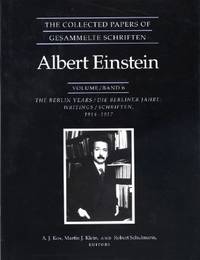
1996réf. 1-0691010862Princeton Univ Pr 1996. Hardcover. New. 626 pages. Other language. 10.50x8.25x1.50 inches. Princeton Univ Pr hardcover
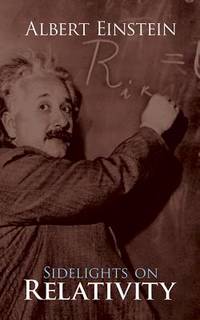
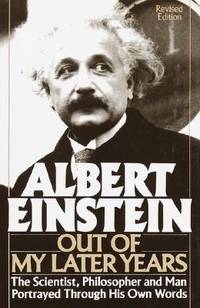
1983réf. 1-048624511XDover Pubns 1983. Paperback. New. 56 pages. 8.00x5.50x0.25 inches. Dover Pubns paperback
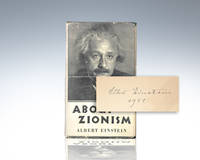
1931réf. 146050New York: The MacMillan Company 1931. First edition of this volume of Einstein's speeches and letters concerning his views on Zionism. Octavo original cloth. Boldly signed and dated in the year of publication on the front free endpaper "Albert Einstein 1931." Near fine with light toning to the endpapers in the scarce original dust jacket which is in good condition with some wear. Translated and edited with an introduction by Leon Simon. Exceptionally rare signed. Einstein was a prominent supporter of both Labor Zionism and efforts to encourage Jewish-Arab cooperation. He supported the creation of a Jewish national homeland in the British mandate of Palestine but was opposed to the idea of a Jewish state "with borders an army and a measure of temporal power." In a letter to Jawaharlal Nehru dated June 13 1947 he asserted "Long before the emergence of Hitler I made the cause of Zionism mine because through it I saw a means of correcting a flagrant wrong.The Jewish people alone has for centuries been in the anomalous position of being victimized and hounded as a people though bereft of all the rights and protections which even the smallest people normally has.Zionism offered the means of ending this discrimination." Einstein's speeches lectures and letters concerning Zionism were first published in 1930 by The Soncino Press and eleven of these essays were later collected in The World as I See It published in 1933 which Einstein dedicated "to the Jews of Germany". The MacMillan Company hardcover
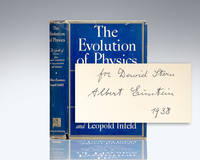
1938réf. 146188Cambridge: Cambridge University Press 1938. First edition of this classic work which traces the development of ideas in physics. Octavo original blue cloth. Presentation copy inscribed by the author in the year of publication on the second free endpaper "For David Stern Albert Einstein 1938." Fine in a near dust jacket with a few small closed tears. Trade editions signed by Einstein are scarce. Upon publication The Saturday Review of Literature praised Evolution of Physics as "masterly Einstein and Infelds book should do much to spread an understanding and appreciation one of the great dramas in the evolution of human thought." Cambridge University Press hardcover
réf. ria9780323796804_inpHardback. New. New Book; Fast Shipping from UK; Not signed; Not First Edition; N/A hardcover
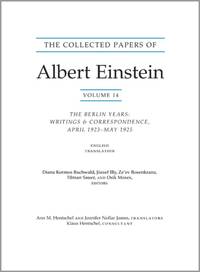
réf. ria9780691164229_inpPaperback / softback. New. New Book; Fast Shipping from UK; Not signed; Not First Edition; In the almost one hundred writings and more than one thousand letters included in this volume Einstein is revealed yet again as the consummate puzzler of myriad scientific problems as well as the invested participant in social and poli paperback
2001réf. 1-3898211681ibidem-Verlag 2001. Paperback. New. 134 pages. German language. 8.11x5.67x0.39 inches. ibidem-Verlag paperback
1957réf. 056866Amsterdam / New York 1957: North-Holland Publishing Company/ Interscience Publishers 1957. First Edition . Red Cloth. Near Fine/Very Good. Photographs. 172 Pp. Includes Einstein's 1953 Paper And Many Others. Always A Scarce Book Altho Not Rare. Near Fine Some Fading To Spine Cloth Ownership Name Of Joseph L. Snider Professor Of Physics At Oberlin. Original Clear Unprinted Dust Jacket Shrunken Rear Cover A Lirttle Ripply And With A Short Tear Near Center. North-Holland Publishing Company/ Interscience Publishers hardcover
1994réf. 240218012Modern Library 1994. hardcover. New. 5x1x8. 9780517093801 NEW Inside and Out! Clean & Crisp Pages. E-mail for more info./pics Modern Library hardcover
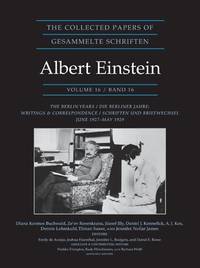
2021réf. 1-0691216819Princeton Univ Pr 2021. Hardcover. New. 1192 pages. 10.00x7.48x2.80 inches. Princeton Univ Pr hardcover
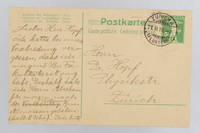
1910réf. 83637Zurich Zurich 1910. Fine. Einstein writes to a friend who introduced him to Carl Jung Zurich Zurich 21 juin 1910 9 x 14 cm une carte postale Autograph postcard signed by Albert Einstein to Ludwig Hopf. 18 lines written verso and recto address also in Einstein's handwriting. Postmarked June 21 1910. Published in The Collected Papers of Albert Einstein Volume 5: The Swiss Years: Correspondence 1902-1914 Princeton University Press 1993 n°218 p. 242. An exceptional and highly aesthetic card from Albert Einstein to ""the friend of the greatest geniuses of his time"" - according to Schrödinger - mathematician and physicist Ludwig Hopf who introduced Einstein to another 20th-century genius: Carl Jung. The master invites his pupil Hopf to a dinner party whose guests include scientist Max Abraham future great rival during Einstein's Zurich years and a fervent opponent of his theory of relativity. The recipient Ludwig Hopf joined Einstein in 1910 as an assistant and student at his physics and kinetic theory seminars at the University of Zürich. They signed two fundamental papers on the statistical aspects of radiation and gave their names to the ""Einstein-Hopf"" velocity-dependent drag force. Their letter exchanges retrace the complex path of Einstein's work on relativity and gravitation bearing witness to their great complicity and Hopf's invaluable contribution to the Master's research. A few months after writing the postcard Hopf even found an error in Einstein's calculations of the derivatives of certain velocity components which Einstein corrected in a paper the following year. They also formed a musical duo Hopf accompanied on the piano the Master's violin performing pieces by great musical geniuses like Bach and Mozart. With this card Einstein invited his pupil and friend Hopf to dinner with Max Abraham at the dawn of a major scientific controversy that would pit them against each other from 1911 onwards. Abraham's theory of special relativity failed to convince Einstein who criticized its lack of observational verification and its failure to predict the gravitational curvature of light. In 1912 their dispute became public through scientific articles. Abraham never acknowledged the validity of Einstein's theory. During their brilliant artistic and intellectual exchanges Hopf undoubtedly succeeded where Freud had failed as he declared to him in a letter: ""I shall break with you if you boast of having converted Einstein to psychoanalysis. A long conversation I had with him a few years ago showed me that analysis was as hermetic to him as the theory of relativity can be to me"" Vienna September 27 1931. As a fervent supporter of psychoanalysis Hopf is known to have introduced the famous psychoanalyst Carl Jung to Einstein. Hopf and his teacher both left for Prague's Karl-Ferdinand University in 1911 where they met writer Franz Kafka and his friend Max Brod in Madame Fanta's salon. With the rise of the Nazi regime the fates of the two theoreticians were plagued by persecution and exile. Einstein first took refuge in Belgium Hopf in Great Britain after his dismissal in 1934 from the University of Aachen because of his Jewish origins. They continued their prolific correspondence in the midst of the turmoil Einstein suggesting to Hopf the opening of a university abroad for exiled German students. Hopf died shortly after his appointment as chair of Mathematics studies at Trinity College Dublin in July 1939. A precious invitation from the great physicist to one of the final dinner gatherings of the ""old school"" of science embodied by Max Abraham on the eve of the publication of the theory of general relativity which would overturn classical conceptions of space and time and propel Science into the 20th century. unknown
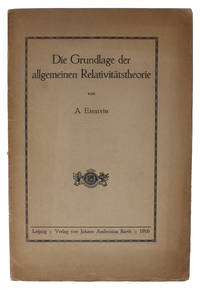
1916réf. 60254Leipzig Ambrosius Barth 1916. 8vo. Uncut in the original printed wrappers. Light discolouration to margins of wrappers. Inner hinges with professional repairs. Small stamp exlibris to lower part of title-page. Previous owner's name Erik Broekmeyer in contemporary hand to upper outer corner of title-page. A fine copy. 64 pp. First issue of the first edition in book form being not an offprint of the"Annalen der Physik" journal issue as often stated but a separate edition of the paper completely re-set and with significant changes and additions including for the first time in print the "Einleitung" and the "Inhalt".The first issue is distinguished from the later reprints by the printing of "Sonderdruck aus dem "Annalen der Physik" Band 49 1916" and "Druck von Metzger & Wittig in Leipzig. 314" to the verso of the title-page and "Metzger & Wittig Leipzig" to the foot of the back wrapper. Furthermore "This separate edition is printed on good strong paper the wrappers are of strong material too and it is described now as 'the original edition' of this classic paper" Weil. Einstein's seminal "General Theory of Relativity" has had an immense impact on all science philosophy and man's view of the world in general. Few other books of the 20th century can be said to have so basically altered the way that we view the world and our place in it. Determining space and time as being interwoven into a single continuum known as "space-time" and determining that there is no absolute space-time coordinate system - i.e. that there are no absolute positions in time and pace - established the fact that events that occur at the same time for one observer could occur at different times for another i.e. all positions in space and time are relative. This general theory of relativity here presented in its full exposition for the first time in book form is now a basic foundation for scientific thought."The theory of relativity has transformed astrophysics and indeed the whole scientific outlook." PMM."Whereas Special Relativity had brought under one set of laws the electromagnetic world of Maxwell and Newtonian mechanics as far as they applied to bodies in uniform relative motion The General Theory did the same thing for bodies with the accelerated relative motion epitomized in the acceleration of gravity. But first it had been necessary for Einstein to develop the true nature of gravity from his principle of equivalence.Basically he proposed that gravity was a function of matter itself and that its effects were transmitted between contiguous portions of space-time. Where matter exists so does energy; the greater the mass of matter involved the greater the effect of the energy which can be transmitted. In addition gravity affected light. exactly as it affected material particles. Thus the universe which Newton had seen and for which he had constructed his apparently impeccable mechanical laws was not the real universe. Einstein's paper gave not only a correct picture of the universe but also a fresh set of mechanical laws by which its details could be described" R.W. Clark. "This paper was the first comprehensive overview of the final version of Einstein's general theory of relativity after several expositions of preliminary versions and latest revisions of the theory in November 1915. It includes a self-contained exposition of the elements of the tensor calculus that are needed for the theory. T. Sauer in Landmark Writings in Western Mathematics. PMM: 408. Horblit 26 c. Weil 80.Boni: 781 Schilpp-Schields: 86. unknown
2007réf. 1-0980224829La Prensa Quimica 2007. Map. New. escolastica edition. 1 pages. Spanish language. 40.00x5.30x5.30 inches. La Prensa Quimica unknown
2007réf. 1-0980224845La Prensa Quimica y Chem-Data Publications 2007. Paperback. New. escolastica edition. 1 pages. Spanish language. 40.00x6.00x6.00 inches. La Prensa Quimica y Chem-Data Publications paperback
2016réf. 1-395770457Xsaxoniabuch 2016. Paperback. New. 80 pages. German language. 8.66x6.69x0.19 inches. saxoniabuch paperback
2007réf. 1-0980224837La Prensa Quimica 2007. Paperback. New. escolastica edition. 1 pages. Spanish language. 40.00x6.00x6.00 inches. La Prensa Quimica paperback
2005réf. 1-0974734187Chem-Data Publications 2005. Poster. New. 1 pages. 37.50x1.80x1.30 inches. Chem-Data Publications unknown
2007réf. 1-0980224853La Prensa Quimica 2007. Paperback. New. escolastica edition. 1 pages. Spanish language. 40.00x5.30x5.30 inches. La Prensa Quimica paperback
1973réf. 054767Horizon Press 1973. 2nd Edition 1st Printing. Hardcover. Near Fine/Near Fine. Xxiii 246 Pp. First Reprinting Of The Scarce 1921 Book Here With A New 1970 Introduction. Fine In Near Fine Dust Jacket Priced $8.50. Horizon Press hardcover
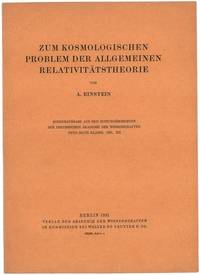
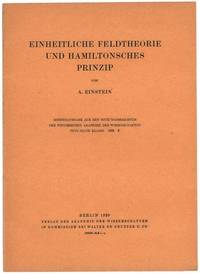
1931réf. 289801931. S.Ber. Akad. Wiss. Berl. 1931/12. - Berlin Verlag der Akademie der Wissenschaften 1927 8°5 S. orig. Broschur. First Edition! A fine and fresh copy in the rare off-print form from the "Sitzungsbereichte." Interesting is to note in the publisher's ad on the last page of the back-cover that all the off-prints of Einstein's papers published by the Academy between 1914 and 1921 are marked out ofprint as early as 1931! Weil N0.179; Schilp-Shields No. 249 unknown
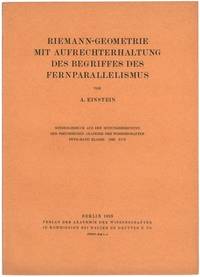
1928réf. 270901928. S.Ber. Akad. Wiss. Berl. 1928/17. - Berlin Verlag der Akademie der Wissenschaften 1928 8° 7 S. orig. Broschur. First Edition; the rare off-print from the "Sitzungsberichte". 'The general relativity theory splendidly justified his work. In this mathematical apparatus developed from Riemann's address Einstein found the frame to fit his physicals ideas his cosmology and cosmogeny; and the spirit of Riemann's address was just what physics needed: the metric structure determined by physical data'. -cf. DSB XI 447-456 Riemann Weil No.161; Schilpp-Shields No. 217; Alicke No. 139. unknown
1928réf. 270911928. S.Ber. Akad. Wiss. Berl. 1928/10. - Berlin Verlag der Akademie der Wissenschaften 1929 8° 6 S. orig. Broschur. First Edition; the rare off-print from the "Sitzungsberichte". Weil No.166; Schilpp-Shields No. 227; Alicke No. 143. unknown
1909réf. 662931909. Physik. Zschr. 10. - Leipzig Verlag von S. Hirzel 1909 4° XXII 2 1040 pp. mit Textabbildungen und 26 Tafeln Halbleinenband d.Zt.; St.a.Tit. feines Expl. A LANDMARK W. PAULI FIRST EDITION "of this extensive paper given as lecture before the 81st assembly of the "Gesellschaft Deutscher Naturforscher" in Salzburg on 21st September 1909. He spoke on "The Development of Our View of the Nature and Constitution of Radiation" a topic that embraced both relativity and quanta. Among those who attended Einstein's lecture were some of the world's foremost physicists. In Einstein's austere opinion his address regarded strictly as a work of science was of little importance since as he writes to a co-worker it contained nothing new. Einstein was being overmodest. Besides to many in Einstein's audience and it should be born in mind that it was the year after Minkowski's stirring introduction of the concept of the fourth dimension this Lecture came as a revelation. The occasion was important for Einstein too. He had been working for years in a sort of scientific exile and his curiosity as to what great scientists were like in face-to-face discussion was at least as great as their curiosity about him. His confidence in himself was certainly not harmed when he found that he was able to hold his own easily in their company. Moreover at this congress Einstein first met Planck. In addition he made new'lasting friendships leading to a voluminous scientific correspondence. Amongst those attending the congress were Max von Laue Max Born. Arnold Sommerfeld Hasnohrl. Ladenburg. Max von Laue was to be the first to publish in 1911 the first text-book on relativity theory. All of them are present in this issue with scientific papers of their own." Walter Alicke Weil No. 30; Schilpp-Shields No. 30; Hoffmann Einstein p. 93; Alicke Nr. 34 unknown
1909réf. 524241909. Verh. Dtsch. Physik. Ges. 11/ 1-24. - Hrsg. im Auftrage der Gesellschaft von Karl Scheel. - Braunschweig Druck und Verlag von Friedrich Vieweg und Sohn 1909 8° VII 749 pp. Abbildungen Halbleinenband d.Zt.; St.a.Tit.; feines Expl. First Edition! The true first printing see below of this paper which Wolfgang Pauli said "can be considered as one of the landmarks in the development of theoretical physics" Schilpp p. 154. This paper marks the introduction of the modern "photon" concept although the term itself was introduced much later in a 1926 paper by Gilbert N. Lewis. It contains "the first well-conceived promulgation of the wave-particle duality of light which had implications as profound as Einstein's earlier theoretical breakthroughs" Isaacson p.157. Einstein here anticipated the principle of complementarity one of the fundamental principles of quantum mechanics. His own proposal for a solution of the wave-particle paradox - that Maxwell's equations for electromagnetic fields be modified to allow wave solutions that are bound to singularities of the field - was never developed although it may have influenced Louis de Broglie's pilot wave hypothesis for quantum mechanics developed in his famous thesis Recherches sur la théorie des quanta 1924. The present paper was also published in Physikalische Zeitschrift Vol. 10 1909 but the Verhandlungen printing has priority: it was published on 30 October 1909 the Physikalische Zeitschrift printing appeared on 10 November. "This extensive paper given as lecture before the 81st assembly of the "Gesellschaft Deutscher Naturforscher" in Salzburg on 21st September 1909. He spoke on "The Development of Our View of the Nature and Constitution of Radiation" a topic that embraced both relativity and quanta. Among those who attended Einstein's lecture were some of the world's foremost physicists. In Einstein's austere opinion his address regarded strictly as a work of science was of little importance since as he writes to a co-worker it contained nothing new. Einstein was being overmodest. Besides to many in Einstein's audience and it should be born in mind that it was the year after Minkowski's stirring introduction of the concept of the fourth dimension this Lecture came as a revelation. The occasion was important for Einstein too. He had been working for years in a sort of scientific exile and his curiosity as to what great scientists were like in face-to-face discussion was at least as great as their curiosity about him. His confidence in himself was certainly not harmed when he found that he was able to hold his own easily in their company. Moreover at this congress Einstein first met Planck. In addition he made new'lasting friendships leading to a voluminous scientific correspondence. Amongst those attending the congress were Max von Laue Max Born. Arnold Sommerfeld Hasnohrl. Ladenburg. Max von Laue was to be the first to publish in 1911 the first text-book on relativity theory. All of them are present in this issue with scientific papers of their own." Walter Alicke 11. Jahrg. 30. Oktober 1909 Nr. 20 - Vorgetragen in der Sitzung der physiklaischen abteilung der 81. Versalung Deutscher Naturforscher und Ärzte zu Salzburg am 21. September 1909." Weil No. 30; Schilpp-Shields No. 30; Hoffmann Einstein p. 93. unknown