Einstein, Albert & Mayer, WalterBiblio.com
3 027 résultats
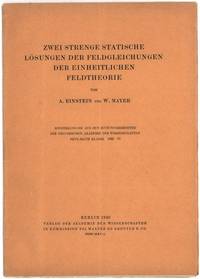
1930réf. 270851930. S.Ber. Akad. Wiss. Berl. 1930/ 6. - Berlin Verlag der Akademie der Wissenschaften 1930 8° 13 S. orig. Broschur. First Edtion; the rare off-print from the "Sitzungsberichte". Weil No. 170; Schilpp-Shields No.240; Alicke No. 144 unknown
1914réf. 273931914. Verh. Ges. Naturf. Ärzte 85.Vers. Wien 1913. - 12/1 Bd.: Naturwissenschaftliche Abteilungen. - Leipzig F.C.W. Vogel 1914 8° 4 366 VIII 834 pp. 108 Abbildungen 3 Taf. Halbledereinband der Zeit; feines Expl. First and original edition of Einstein's famous lecture in a well preserved copy. By 1913 Einstein had reached a temporary impasse following the publication of his and Marcel Grossmann's "Entwurf einer Verallgemeinerten Relalitivitätstheorie.". but his view on the need for generalising the Special Theory aroused great interest and in September he but them before the 85th Congress. held in Vienna. The auditorium was packed with scientists anxious to hear about a theory even more outlandish than Special Relativity. In some ways they were disappointed. Instead of the esoteric explanations they had expected there came one of Einstein's minor masterpieces of simple statement an account in which he compared the development of the various theories of gravitation with the development of successive concepts of electricity. Weil No. 54; Clark-Einstein pp.158ff; Schilpp-Shields No. R8; Alicke No.51a. unknown
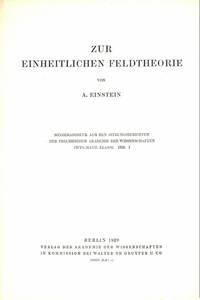
1929réf. 270931929. S.Ber. Akad. Wiss. Berl. 1929/ 1. - Berlin Verlag der Akademie der Wissenschaften 1930 8° 8 S. in schönem Pappband der Zeit. First Edition! "The unified Field Theory" is one of Einstein's last important scientific works. According to Weil "This paper represents a new development which was immediate news. A translation by L.L.Whyte appeared in the London Times of Feb. 4 1929. It was quoted in full in "Observatory" vol. 52 under the title "New Field Theory" pp.82-87 and 1930 pp.11-118." In 1928 Einstein embarked on a new approach to a unified field theory . involving what he called 'distant parallelism' . By early 1929 he had solved the main problems involved in writing down field equations for his unified field theory. On the day of offical publication of the third of a formidably technical series of 9 articles on the theory . excited headlines appeared in foreign newspapers throughout the world . In this frenzied unscientific atmosphere Einstein's new theory was hailed in the press as an outstanding scientific advance. Yet Einstein had stated in his article it was still tentative; and soon he found he had to abandon it. - cf.Parkinson Breakthroughs p.279 Weil No. 165 Schlipp Einstein No.226; Alicke No. 141; Norman Coll. I 700 unknown
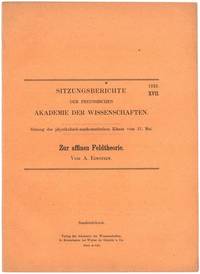
1923réf. 317401923. S.Ber. Akad. Wiss. Berl. 1923/ 8. - Berlin Verlag der Akademie der Wissenschaften 1923 8° 4 S. orig. Broschur. First edition. A fine fresh copy in the rare off-print form. Marked with an asterisk by Weil denoting a major paper. "Einstein's attempts to formulate a unified field theory stemmed from his dissatisfaction with the general relativity theory which did not adequately incorporate the electromagnetic field into the geometry of space-time. In 1918 Hermann Weyl had begun investigating the possibility of constructing a unified field theory preserving the dimensionality of space-time while formally altering its geometry making it a special case of the class known as affine geometries. Einstein's first investigation of Weyl's ideas published in the present paper introduced the notion of distant parallelism; however Einstein later rejected Weyl's theory." Weil No. 132; Schilpp--Shields No. 171; Alicke No.113; Norman Library 698; Boni 141 unknown
1927réf. 445581927. Die Naturwissenschaften 15/22. - Berlin Verlag von Julius Springer 1927 4° 1 Portrait von Sir Isaac Newton 2 p.273-296 Broschur. First German Edition of Albert Einstein's fine contribution "On Isaac Newton . His Mechanics. . Influence on Growth of Theoretical Physics" Manch Guardian 13 col 7-14 col 3 19iii 1927 in commemoration of the 200th anniversary of Newton's death published on the 25.March 1927. The Published Weil No. 158; Schilpp-Shields No. 2o8; Alicke No.134; Walis 71.503 unknown
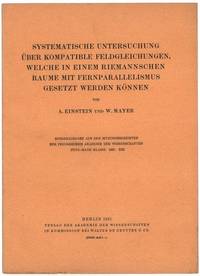
1931réf. 270891931. S.Ber. Akad. Wiss. Berl. 1931/13. - Berlin Verlag der Akademie der Wissenschaften 1931 8° 11 S. orig. Broschur. First Edition; the rare off-print from the "Sitzungsberichte". More and more frequently Einstein chose his assistants from mathematicians." One of the chief of them at that time was Professor Walter Mayer a small round individual who at first sight seemed crushed beneath the personality of Einstein. Einstein's family called him Mayerle and this Swabian diminutive suited him to perfection. But in Mayer's self-effacement there was more affection than respect. He gently contradicted Einstein interrupted him when necessary follwed up an argument and smiled a little mysteriously his head on one side as he watched the figures drawn up in front of him. "It is he who produced all my calculations; his skill is fantastic you know "Einstein used to say. In October 1933 Mayer followed Einstein in his American exile. -cf. Alicke Weil No.180; Schilpp-Shields No. 250; Alicke No. 149. unknown
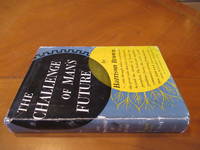
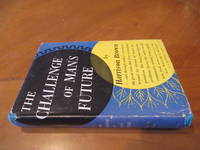
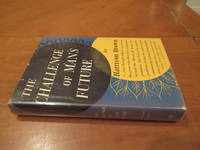
1954réf. 052602New York: Viking 1954. 1st Edition 1st Printing. Hardcover. Good/Fair. Xii 290 Pp. Turquoise Cloth Spine Gilt. First Printing Indicated. Light Wear Gilt Brilliant Faint Dampstainig To Cloth. Dust Jacket Priced $3.75 Very Worn Dampstainied Extensive Tape Repairs To Inside Of Jacket Fair Only. Dust Jacket Blurbs By William O. Douglas Robert M. Hutchins Paul B. Sears Harold C. Urey Albert Einstein H. J. Muller; Brown Was An Outstanding Scientist Himself; But Few World Politicians Or Business Leaders 1946-Present Out Of Hundreds Of Thousands Ever Tried To Seriously Address These Issues Apparently Because They're Not There For The General Welfare. Harrison Scott Brown 1917 - 1986 Was An American Nuclear Chemist And Geochemist. He Was A Political Activist Who Lectured And Wrote On The Issues Of Arms Limitation Natural Resources And World Hunger. During World War Ii Brown Worked At The Manhattan Project's Metallurgical Laboratory And Clinton Engineer Works Where He Worked On Ways To Separate Plutonium From Uranium. The Techniques He Helped Develop Were Used At The Hanford Site To Produce The Plutonium Used In The Fat Man Bomb Dropped On Nagasaki. After The War He Lectured On The Dangers Of Nuclear Weapons. After The War He Worked At The University Of Chicago Where He Pioneered Nuclear Geochemistry. The Study Of Meteorites By Brown And His Students Led To The First Close Approximation Of The Age Of The Earth And The Solar System. In 1948 Brown Was Awarded The American Association For The Advancement Of Science Prize For His Work On Meteorites.Between 1951 And 1977 He Worked At The California Institute Of Technology Caltech Where He Contributed To Advances In Telescopic Instrumentation Jet Propulsion And Infrared Astronomy. While There He Attracted Several Former Colleagues And Highly Regarded Scientists To The Team. Together They Made Advancements In Telescopic Instrumentation Jet Propulsion Contributing To Nasa's Early Planetary Exploration Missions And Infrared Astronomy. In June 1954 He Was One Of Twenty Scientists Under The Age Of Forty Identified By Fortune Magazine As "Top Young Scientists In U. S. Universities And Industry". In The Early 1970S He Began Working More Directly On The Resource/Environment Issues That He Had Been Developing In His Books. In 1977 He Became Director Of The Newly Created Resource Systems Institute Of The East-West Center In Hawaii Where He Turned Full Time To Work On Understanding And Influencing The Interactions Of Energy Mineral And Food Systems In The Asia-Pacific Region Themes He Had Developed In His Books Since The 1950S. Viking hardcover
1954réf. 052601New York: Viking 1954. 1st Edition 1st Printing. Hardcover. Fine/Good. Xii 290 Pp. Turquoise Cloth Spine Gilt. First Printing Indicated. Near Fine No Marks Gilt Brilliant Bumping To Spine Ends. Dust Jacket Priced $3.75 Wear Chipping At Corners Short Edge Tears Good Only. Dust Jacket Blurbs By William O. Douglas Robert M. Hutchins Paul B. Sears Harold C. Urey Albert Einstein H. J. Muller; Brown Was An Outstanding Scientist Himself; But Few World Politicians Or Business Leaders 1946-Present Out Of Hundreds Of Thousands Ever Tried To Seriously Address These Issues Apparently Because They're Not There For Our General Welfare. Per Wikipedia Harrison Scott Brown 1917 - 1986 Was An American Nuclear Chemist And Geochemist. He Was A Political Activist Who Lectured And Wrote On The Issues Of Arms Limitation Natural Resources And World Hunger. During World War Ii Brown Worked At The Manhattan Project's Metallurgical Laboratory And Clinton Engineer Works Where He Worked On Ways To Separate Plutonium From Uranium. The Techniques He Helped Develop Were Used At The Hanford Site To Produce The Plutonium Used In The Fat Man Bomb Dropped On Nagasaki. After The War He Lectured On The Dangers Of Nuclear Weapons. After The War He Worked At The University Of Chicago Where He Pioneered Nuclear Geochemistry. The Study Of Meteorites By Brown And His Students Led To The First Close Approximation Of The Age Of The Earth And The Solar System. In 1948 Brown Was Awarded The American Association For The Advancement Of Science Prize For His Work On Meteorites.Between 1951 And 1977 He Worked At The California Institute Of Technology Caltech Where He Contributed To Advances In Telescopic Instrumentation Jet Propulsion And Infrared Astronomy. While There He Attracted Several Former Colleagues And Highly Regarded Scientists To The Team. Together They Made Advancements In Telescopic Instrumentation Jet Propulsion Contributing To Nasa's Early Planetary Exploration Missions And Infrared Astronomy. In June 1954 He Was One Of Twenty Scientists Under The Age Of Forty Identified By Fortune Magazine As "Top Young Scientists In U. S. Universities And Industry". In The Early 1970S He Began Working More Directly On The Resource/Environment Issues That He Had Been Developing In His Books. In 1977 He Became Director Of The Newly Created Resource Systems Institute Of The East-West Center In Hawaii Where He Turned Full Time To Work On Understanding And Influencing The Interactions Of Energy Mineral And Food Systems In The Asia-Pacific Region Themes He Had Developed In His Books Since The 1950S. Viking hardcover
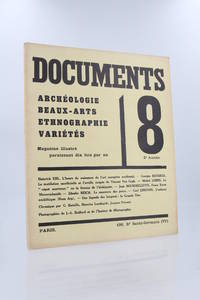
1930réf. 80796Paris: Calmann Lévy 1930. Fine. Calmann Lévy Paris 1930 22 x 27.50 cm broché First edition of this issue of the important journal dealing notably with archaeology fine arts and ethnography with Georges Bataille and Carl Einstein as principal editors. Very handsome copy. Contributions by Heinrich Ehl: ""L'heure de naissance de l'art européen occidental"" Georges Bataille ""La mutilation sacrificielle et l'oreille coupée de Vincent Van Gogh"" Michel Leiris: ""Le ""caput mortuum"" ou la femme de l'alchimiste"" Jean Bourdeillette: ""Franz Xaver Messerschmidt"" Zdenko Reich: ""Le massacre des porcs"" Carl Einstein: ""L'enfance néoloithique Hans Arp"" Jacques Prévert Maurice Leenhardt. Issue illustrated with photographs by Jacques-André Boiffard Calmann Lévy unknown
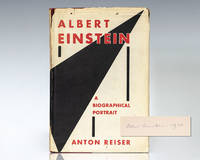
1930réf. 138499New York: Albert & Charles Boni 1930. First edition of this Einstein biography written by Rudolf Kayser a German literary historian and husband to Albert Einstein's stepdaughter Ilse under the pseudonym Anton Reiser. Octavo original cloth frontispiece of Einstein. Signed and dated by Einstein in the year of publication on the front free endpaper "Albert Einstein 1930." Near fine in a very good dust jacket. Rare signed and in the original dust jacket. Albert Einstein developed the general theory of relativity one of the two pillars of modern physics alongside quantum mechanics. Einstein's work is also known for its influence on the philosophy of science. Einstein is best known in popular culture for his mass–energy equivalence formula E = mc2 which has been dubbed "the world's most famous equation". He received the 1921 Nobel Prize in Physics for his "services to theoretical physics" in particular his discovery of the law of the photoelectric effect a pivotal step in the evolution of quantum theory David Bodanis. Albert & Charles Boni hardcover
1930réf. 81582Paris: Calmann Lévy 1930. Fine. Calmann Lévy Paris 1930 22 x 27.50 cm broché First edition of this issue of this important journal dealing notably with archaeology fine arts and ethnography and whose principal editors were Georges Bataille and Carl Einstein. A small tear at the foot of the spine a slight tear without loss at the foot of pages 21-22. Contributions by Heinrich Ehl: ""L'heure de naissance de l'art européen occidental"" Georges Bataille ""La mutilation sacrificielle et l'oreille coupée de Vincent Van Gogh"" Michel Leiris: ""Le ""caput mortuum"" ou la femme de l'alchimiste"" Jean Bourdeillette: ""Franz Xaver Messerschmidt"" Zdenko Reich: ""Le massacre des porcs"" Carl Einstein: ""L'enfance néoloithique Hans Arp"" Jacques Prévert Maurice Leenhardt. Issue illustrated with photographs by Jacques-André Boiffard. Calmann Lévy unknown
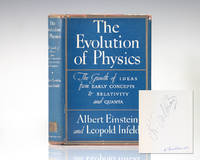
1951réf. 140033New York: Simon and Schuster 1951. Later printing of this classic work which traces the development of ideas in physics. Octavo original blue cloth. Boldly signed by both authors on the front free endpaper "A. Einstein. 53" and "L. Infeld 1958." Near fine in a very good dust jacket. We have never seen another example signed by both authors. Rare and desirable. Upon publication The Saturday Review of Literature praised Evolution of Physics as "masterly Einstein and Infelds book should do much to spread an understanding and appreciation one of the great dramas in the evolution of human thought." Simon and Schuster hardcover
1954réf. 052515New York: Viking 1954. 1st Edition 1st Printing. Hardcover. Fine/Very Good Jacket. Xii 290 Pp. Turquoise Cloth Spine Gilt. First Printing Indicated. Fine No Marks Gilt Brilliant. Dust Jacket Priced $3.75 Slight Usage. Dust Jacket Blurbs By William O. Douglas Robert M. Hutchins Paul B. Sears Harold C. Urey Albert Einstein H. J. Muller; Brown Was An Outstanding Scientist Himself; But Few World Politicians Or Business Leaders 1946 To Present Ever Tried To Seriously Address These Issues Apparently Because They're Not There Primarily For The General Welfare. Harrison Scott Brown 1917 - 1986 Was An American Nuclear Chemist And Geochemist. He Was A Political Activist Who Lectured And Wrote On The Issues Of Arms Limitation Natural Resources And World Hunger. During World War Ii Brown Worked At The Manhattan Project's Metallurgical Laboratory And Clinton Engineer Works Where He Worked On Ways To Separate Plutonium From Uranium. The Techniques He Helped Develop Were Used At The Hanford Site To Produce The Plutonium Used In The Fat Man Bomb Dropped On Nagasaki. After The War He Lectured On The Dangers Of Nuclear Weapons. After The War He Worked At The University Of Chicago Where He Pioneered Nuclear Geochemistry. The Study Of Meteorites By Brown And His Students Led To The First Close Approximation Of The Age Of The Earth And The Solar System. In 1948 Brown Was Awarded The American Association For The Advancement Of Science Prize For His Work On Meteorites.Between 1951 And 1977 He Worked At The California Institute Of Technology Caltech Where He Contributed To Advances In Telescopic Instrumentation Jet Propulsion And Infrared Astronomy. While There He Attracted Several Former Colleagues And Highly Regarded Scientists To The Team. Together They Made Advancements In Telescopic Instrumentation Jet Propulsion Contributing To Nasa's Early Planetary Exploration Missions And Infrared Astronomy. In June 1954 He Was One Of Twenty Scientists Under The Age Of Forty Identified By Fortune Magazine As "Top Young Scientists In U. S. Universities And Industry". In The Early 1970S He Began Working More Directly On The Resource/Environment Issues That He Had Been Developing In His Books. In 1977 He Became Director Of The Newly Created Resource Systems Institute Of The East-West Center In Hawaii Where He Turned Full Time To Work On Understanding And Influencing The Interactions Of Energy Mineral And Food Systems In The Asia-Pacific Region Themes He Had Developed In His Books Since The 1950S. Viking hardcover
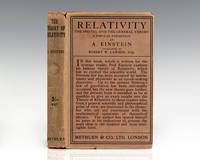
1920réf. 131697London: Methuen and Co 1920. First edition of the scientist's ground breaking work. Octavo original red cloth frontispiece of the author and with five diagrams. Near fine in the rare original dust jacket with loss of section of rear panel and flap. Tape repairs to verso. Translated by Robert W. Lawson. Scarce in the original dust jacket. Housed in a custom half morocco clamshell box by the Harcourt Bindery. It can hardly be disputed that the theories put forth in this book are among the most important in the history of modern science. "The imprint of Einstein's work on the different areas of physical science is so large and varied" writes Gerald Holton in a recent assessment "that a scientist who tries to trace it would be hard put to know where to start" Simmons The Scientific 100. Methuen and Co hardcover
réf. SONG1913057305Used: Good unknown
réf. DADAX0367731339New unknown
réf. DADAX1936488175New unknown
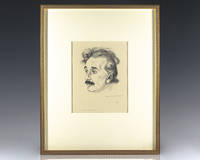
1923réf. 1272041923. Lithograph portrait of "the father of modern physics" Albert Einstein by well-known artist Hermann Struck. Signed by Einstein "Albert Einstein 1923" and Struck "Herman Struck 138/150". In fine condition. Matted and framed the entire piece measures 19.75 inches by 15.5 inches. An exceptional piece. Hermann Struck was a German Jewish artist known for his etchings. In 1908 Struck published "Die Kunst des Radierens" "The Art of Etching" which became a seminal work on the subject. His students included Marc Chagall Lovis Corinth Jacob Steinhardt Lesser Ury and Max Liebermann. Struck did commissioned portraits of Albert Einstein Ibsen Nietzsche Freud Herzl Oscar Wilde among others. unknown
réf. DADAX3030470369New unknown
1971réf. 046762New York: Walker & Company 1971. 1st Edition 1st Printing. Hardcover. Near Fine/Very Good. Xi 240 Pp. First Printing. Near Fine Book No Marks. Dj Priced $8.50 Light Wear Walker & Company hardcover
1906réf. 59121Leipzig Johann Ambrosius Barth 1906. Full cloth. Spine with gilt lettering. In: "Annalen der Physik. Vierte Folge. Band 20. Herausgegeben von Paul Drude." Portrait Paul Drude VIII1048 pp. and 6 plates. Einstein papers: pp. 199-206 and 627-33. Internally fine and clean. The entire volume offered. Broad margins. Both papers first edition. It was for the papers "Ueber einen die Erzeugung und Verwandlung des Lichtes betreffenden heuristischen Gesichtspunkt" of 1905 and "Zur Theorie der Lichterzeugung. Theory of light emission and absorption the offered item that Einstein was awarded the Nobel Prize in 1921. "The quantum theory has affected virtually every branch of physics. Its earliest and one of its most significant developments was Einstein's application of the theory to what is known as the 'photo-electrical effect'.Einstein explained this effext by suggesting that the classical view that light is emitted in the form of continous waves must be abandoned. The photo-electrical effect could be explained only as an example of quantum action where the waves of light or X-rays are emitted in minute particles or bullets. It is he size of the bullet the wave-lenght of the radiation which determines the number of electrons ejected. It was for this and not for the theory of relativity that Einstein was awarded the Nobel Prize in 1921. Einstein's two fundamental papers on this subject are "Ueber einem Erzeugung." 1905 and Zur Theorie der Lichterzeugung the paper offered here" PMM the note to 391. In the second paper Principle of the conservation of the centre of mass motion and the inertia of energy he shows that the conservation of mass is a special application of his energy principle E= Mc2 - Weil: 12 & 13.Among the many papers in this volume we have Max von Laue: Zur Thermodynamik der Inteferenzerscheinungen. pp. 365-378. hardcover
1922réf. 58897Leipzig: Verlag und Druck von B.G. Teubner 1922. 8vo. In the original green cloth binding. Fine and clean. 159 1 pp. Fourth edition. hardcover
réf. A9780435995218Multiple-component retail product. New. Transdisciplinary theme: How we express ourselves Unit of Inquiry: Feelings unknown
1930réf. 110352New York: Albert & Charles Boni 1930. First edition of this Einstein biography written by Rudolf Kayser a German literary historian and husband to Albert Einstein's stepdaughter Ilse under the pseudonym Anton Reiser. Octavo original cloth frontispiece of Einstein. Signed and dated by Einstein on the front free endpaper in the year of publication "Albert Einstein New York 1930." In near fine condition. Housed in a custom half morocco clamshell box. Albert Einstein developed the general theory of relativity one of the two pillars of modern physics alongside quantum mechanics. Einstein's work is also known for its influence on the philosophy of science. Einstein is best known in popular culture for his mass–energy equivalence formula E = mc2 which has been dubbed "the world's most famous equation". He received the 1921 Nobel Prize in Physics for his "services to theoretical physics" in particular his discovery of the law of the photoelectric effect a pivotal step in the evolution of quantum theory David Bodanis. Albert & Charles Boni hardcover
2007réf. x-0415409772Routledge 2007. Paperback. New. 1st edition. 241 pages. 9.00x6.25x0.75 inches. Routledge paperback