Einstein, ABiblio.com

3.003 Ergebnisse
Best.-Nr. 72535Braunschweig Friedrich Vierweg & Sohn; Berlin J. Springer 1924. 8vo 22.8 x 15.4 cm. 6 pp. Original printed wrappers. = On the theory of radiometer forces. "The Crookes radiometer also known as a light mill consists of an airtight glass bulb containing a partial vacuum with a set of vanes which are mounted on a spindle inside. The vanes rotate when exposed to light with faster rotation for more intense light providing a quantitative measurement of electromagnetic radiation intensity. The reason for the rotation was a cause of much scientific debate in the ten years following the invention of the device" Wikipedia. James Clerk Maxwell first gave a wrong then a correct explanation. However some subtleties still needed to be solved and in 1924 Albert Einstein had a crack at it "A partial explanation is that gas molecules hitting the warmer side of the vane will pick up some of the heat bouncing off the vane with increased speed. Giving the molecule this extra boost effectively means that a minute pressure is exerted on the vane. The imbalance of this effect between the warmer black side and the cooler silver side means the net pressure on the vane is equivalent to a push on the black side and as a result the vanes spin round with the black side trailing. The problem with this idea is that while the faster moving molecules produce more force they also do a better job of stopping other molecules from reaching the vane so the net force on the vane should be the same. The greater temperature causes a decrease in local density which results in the same force on both sides. Years after this explanation was dismissed Albert Einstein showed that the two pressures do not cancel out exactly at the edges of the vanes because of the temperature difference there. The force predicted by Einstein would be enough to move the vanes but not fast enough" Wikipedia. Contained first paper in: Zeitschrift für Physik volume 271. The complete issue in its original wrappers. Front wrapper slightly spotted at the fore and bottom edges. Volume number written on spine. A very good clean copy. Weil 139. unknown
Best.-Nr. 72537Braunschweig Friedrich Vierweg & Sohn; Berlin J. Springer 1924. 8vo 22.8 x 15.4 cm. 10 pp. Original printed wrappers. = First paper by the Indian physicist Satyendra Nath Bose 1894-1974 on thermal equilibrium in the radiation field in the presence of matter and second paper sent to Albert Einstein with the request to translate and publish it in a German physics journal. Einstein saw the importance of the paper but he disagreed with its contents and decided to add a lengthy comment. Subsequently Bose saw a way to circumvent Einstein's critique but never published this rebuttal. Nearly 50 years later Bose stated that he was disappointed by Einstein's remarks ".Bose had his own approach to quantum theory based on his views about the interconnectedness of spontaneous and induced emissions which formed the subject matter of his second and third papers. He did not agree with Einstein's proposal to treat them as independent physical processes. Stationary states in atoms have zero widths both in the old and the new quantum theories and therefore have infinite life-times whereas in reality they do decay and jump down to lower energy states with a finite life-time. What is the origin of these finite widths In Bose's view they are the consequence of the interaction between atom and environment as he attempted to show in his second and third papers. But Einstein did not agree and dismissed his views with the remark that in a world consisting of a single excited hydrogen atom and nothing else the atom would obviously emit a photon and come down to its ground-state! Einstein did not explain what would excite an atom in such a world. Bose was very disappointed by this simply because the world does have much more than a single hydrogen atom and inevitably every atom has an environment" Wali. Contained in: Zeitschrift für Physik volume 275-6. The complete issue in its original wrappers. Upper right corner somewhat bumped throughout. Rear wrapper slightly frayed at edges; minimal spotting at the fore and bottom edges. Volume number written on spine; otherwise a very good clean copy. Schilpp 188; Wali K. C. 2009. Satyendra Nath Bose: His Life and Times: Selected Works with Commentary p. xxvi. unknown
Best.-Nr. A9780691164229Paperback / softback. New. paperback
Best.-Nr. 72349Leipzig Johann Ambrosius Barth 1910-1911. 8vo 21.0 x 14.0 cm. viii 1032 pp.; numerous text illustrations for the whole volume. Contemporary grained half cloth over marbled boards. Spine with gilt title. = This is the complete fourth series volume 34 dating from a period when Albert Einstein was at his most active. the following five contributions are included: Bemerkung zu dem Gezetz von Eötvös pp. 165-169; Eine Beziehung zwischen dem elastischen Verhalten und der spezifischen Wärmte bei festen Körpern mit einatomigen Molekül pp. 170-174; Bemerkungen zu den P. Hertzschen Arbeiten: "Über die mechanischen Grundlagen der Thermodynamik" pp. 175-176 published back to back in the first issue; and Bemerkungen zu meiner Arbeit: "Eine beziehung zwischen dem elastischen Verhalten" p. 590; Berichtigung zu meiner Arbeit: "Eine neue Bestimmung der Moleküldimensionen" pp. 591-592 published back to back in the third issue. The third title Eine Beziehung zwischen dem elastischen Verhalten und der spezifischen Wärmte bei festen Körpern mit einatomigen Molekül is marked by Weil as a "principal" work. Three centimeters of spine top missing; label on spine; old stamp on front free endpaper recto top margin of half-title and title; rear joint weak otherwise a very good clean copy. Weil 38 39 40 and 41. The penultimate paper is not in Weil. hardcover
1938Best.-Nr. 043366Cambridge: Cambridge University Press 1938. 1st Edition. Hardcover. Very Good/Good. Octavo. ppX 319. 1st printing. The Cambridge Library of Modern Science Series. Prior owner details to FPD. DJ shows loss to head of upper cover is grubby and in protective plastic. Cambridge University Press hardcover
2010Best.-Nr. 042673London: The Folio Society 2010. 1st Thus. Hardcover. As New/No Dust Jacket. Octavo. pp XVIII 370. 1st printing. An unread book in a fine condition slipcase showing slight use. The Folio Society hardcover
Best.-Nr. 0996615520.Ghardcover. Good. Access codes and supplements are not guaranteed with used items. May be an ex-library book. hardcover
1998Best.-Nr. __069104841XPrinceton Univ Pr 1998. Paperback. New. illustrated edition. 650 pages. 10.00x8.00x1.75 inches. Princeton Univ Pr paperback
1906Best.-Nr. 432891906. Einstein Albert 1879-1955. Über eine Methode zur Bestimmung des Verhältnisses der transversalen und longitudinalen Masse des Elektrons. Offprint from Annalen der Physik 21 1906. 583-586pp. 223 x 145 mm. Original printed wrappers chipped spine splitting minor spotting. Light toning but very good. First Edition Rare Offprint Issue. In his landmark 1905 paper on special relativity Einstein used the velocity-dependent concepts of transverse and longitudinal mass for the moving electron these terms have now been replaced with the concept of relativistic mass first defined by Lewis and Tolman in 1909. In the present paper Einstein proposed an experimental method for determining the ratio of the transverse to the longitudinal mass and invited experimentalists to verify his special theory of relativity. Einstein later abandoned velocity-dependent mass concepts stating in 1948 that "it is better to introduce no other mass concept than the 'rest mass' m" quoted in L. B. Okun "The concept of mass" Physics Today 1989: 31-36. Lavenda A New Perspective on Relativity pp. 7-8. Weil Albert Einstein Bibliography 14. . unknown
Best.-Nr. 8483061333.Ghardcover. Good. Access codes and supplements are not guaranteed with used items. May be an ex-library book. hardcover
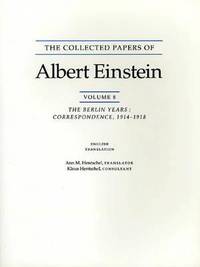
Best.-Nr. ria9780691048413_inpPaperback / softback. New. New Book; Fast Shipping from UK; Not signed; Not First Edition; Opens in spring 1914 when Einstein takes up a research professorship at the Prussian Academy of Sciences in Berlin and closes with the collapse of the German Empire four and one-half years later. This work touches on various aspects of paperback
1930Best.-Nr. 510131930. Einstein Albert 1879-1955. Théorie unitaire du champ physique. In Annales de l'Institut Henri Poincaré 1 fasc. 1 1930: 1-24. With: Fermi Enrico 1901-54. La théorie du rayonnement. In ibid.: 25-52. Whole number. 2 74 2pp. 285 x 197 mm. uncut and unopened. Original printed wrappers a bit sunned lower corner of front wrapper chipped and creased. Very good. First Edition. This issue of the Annales de l'Institut Henri Poincaré contains the texts of Einstein's lecture on unified field theory and Fermi's lecture on the theory of radiation both delivered at the Institut in 1929. Weil Albert Einstein Bibliography 174. Not in Fermi Collected Papers. . unknown
1914Best.-Nr. 50425Leipzig: Johann Ambrosius Barth 1914. 1 Einstein Albert 1879-1955 and A.driaan D.aniël Fokker 1887-1972. Die Nordströmsche Gravitationstheorie vom Standpunkt des absoluten Differentialkalküls. In Annalen der Physik 44 10: 321-328. 2 Born Max 1882-1970. Zur Raumgitter theorie des Diamanten. In Annalen der Physik 44 12: 605-642. 3 Schrödinger Erwin Rudolf Josef Alexander 1887-1961. Zur Dynamik elastisch gekoppelter Punktesysteme. In Annalen der Physik 44 14: 916-934. Leipzig: Johann Ambrosius Barth 1914. Whole volume: viii 1272 pp. 22 plates Numbered Taf. I-XXII. Taf. I-IX: b/w/ silver photos; Taf. XI w/ one b/w silver photo; Taf. XII is folding and XIII XIV are b/w silver photos; Taf. XV and XVI are large folding tables; Taf. XVII XVIII XIX b/w/ silv.photos; and Taf.XX--XXII are photographs of X-ray images. Figs. Text-illust. 210 x 140 mm. Red cloth gilt lettering on spine. Very good. Along the margin of p. 802 written in pencil are the words: "Mallock R.S. 1910" probably written in Lord Rayleigh's hand most likely in reference to the title "The dampening of sound by frothy liquids" by A. Mallock in Proc. R.S. Lond ser. A vol. 84: 391-94. London 1911. A.D. Fokker 1887-1972 was a Dutch physicist and cousin to aeronautical engineer Anthony Fokker 1890-1939. He was musically inclined having invented the 31EDO pipe organ. He earned his doctorate in 1913 continuing his studies with Albert Einstein Ernest Rutheford 1871-1937 and William Bragg 1862-1942. In his 1913 thesis he derived the Fokker-Planck equation with Max Planck 1858-1947. Fokker made contributions to special relativity and general relativity particularly the effects of the curvature of space-time formally called "geodetic precession". Wikipedia. . Johann Ambrosius Barth unknown
1913Best.-Nr. 50339Leipzig: Johann Ambrosius Barth 1913. Einstein Albert 1879-1955. Einige argumente fur die annahme einer molekularen agitaation beim absoluten nullpunkt. In Annalen der Physik 40 pp.551-560. With: Otto Stern 1888-1969. Red cloth with gilt lettering on the spine. Whole volume: 1056 pp. 1 plate. 210 x 130 mm. A very good copy. "Some arguments for the assumption of molecular agitation at absolute zero." In this paper Einstein and Stern show that the quantum theory of solids to give the best agreement with experiments at normal temperatures seems to demand that at absolute zero a residual energy would remain in the solids which they term "zero-point energy." They thus introduced this important concept to physics." p. 292. Calaprice Kennefick & Shulmann. An Einstein Encyclopedia. 2015. Otto Stern was a German-American physicist and Nobel Laureate in Physics. He was the second most nominated person for a Nobel Prize with 82 nominations in the years 1925-1945 ultimately winning in 1943 "for his contribution to the development of the molecular rat method and his discovery of the magnetic moment of the proton". In 1912 Stern did his doctoral dissertation in concentrated solutions. After receiving his Ph.D. degree Stern took advantage of his economic independence to join Albert Einstein at Prague. Stern was with Einstein from the spring of 1912 until 1914. Weil's Bibliography no. 53. . Johann Ambrosius Barth unknown
1912Best.-Nr. 50337Leipzig: Johann Ambrosius Barth 1912. Einstein Albert 1879-1955. Thermodynamische Begründung des photochemischen Äquivalentgesetzes. In Annalen der Physik 37 832-838 pp. Red cloth with gilt lettering on the spine. Whole volume: 1048 pp. 5 plates 4 folding 1 b/w silver photograph w/ small fold at foot. Figs. Text-illust. 210 x 130 mm. Very good copy. "A supplement published in vol. 38 1912: 881-884 See Book ID: 50338. Einstein presents a continuation of his earlier work on the interaction between light matter and on photochemical processes. It contrasts with earlier work in that it makes no use of the quantum hypothesis. He demonstrates how what he calls 'the law of photochemical equivalence' is deducible by purely thermodynamical arguments if one makes certain plausible assumptions. He wrote a supplement to the paper in five months later in the same journal." p. 291-2. Calaprice Kennefick & Shulmann. An Einstein Encyclopedia. 2015. Weil's Bibliography of Einstein's Papers no. 46. Boni's Bibliographical Checklist no. 42. . Johann Ambrosius Barth unknown
1918Best.-Nr. 50342Leipzig 1918. Prinzipielles zur allgemeinen relativitätstheorie. In Annalen der Physik 55 241-244 pp. Red cloth with gilt lettering on the spine. Bookbinder's embossed stamp of ffep. Whole volume: 632 pp. 1 folding plate. Figs. Text-illust. 210 x 130 mm. Very good. Approximate English translation of title: "On the foundations of the general theory of relativity." "Here we are given the first new presentation of the foundations of general relativity since the developments of March 1916 when Einstein gave his first systematic exposition." p. 300. Calaprice Kennefick & Shulmann. An Einstein Encyclopedia. 2015. Weil's Einstein Bibliography no. 96. Boni's Checklist no. 100. Also in this volume: Born Max 1882-1970. Elektronentheorie des Natürlichen optischen Drehungs vermögens isotroper und anisotroper Flüssigkeiten pp. 175-240. Approximate Eng. translation of title: "Electron theory of the natural optical rotation ability of isotropic and anisotropic liquids". Max Born 1882-1970 was a German physicist and mathematician who was instrumental in the development of quantum mechanics. He also made contributions to solid-state physics and optics as well as supervised a number of notable physicists in the 1920s and 1930s. Born won the 1954 Nobel Prize in Physics "for his fundamental research in quantum mechanics especially in the statistical interpretation of the wave function." In 1919 a chance meeting with Fritz Haber 1868-1934 led to the discussion of how an ionic compound is formed when a metal reacts with a halogen - a process now known as the Born-Haber cycle Wikipedia. . unknown
1908Best.-Nr. 50421Leipzig 1908. 1 Planck Max 1858-1947. Zur dynamik bewegter systeme. In Annalen der Physik 26 6: 1-34 pp. 2 Einstein Albert 1879-1965 and Jakob Laub 1882-1962. Über die elektromagnetischen grundgleichungen für bewegte Körper. In Annalen der Physik 26 8: 532-40 pp. Boni 22 Weil 22. 3 Einstein A. and J. Laub. Über die im elektromagnetischen felde auf ruhende Körper ausgeubten ponderomotorischen Krafte. In Annalen der Physik 26 8: 541-50 pp. Boni 23 Weil 23. Red cloth gilt lettering on spine. Figs. Text-illust. 230 x 141 mm. Whole volume: viii 1032 pp. 8 plates 3 folding 3 b/w silver photos. Spine a little worn but still Very Good. Approximate English translations of titles: 1 "On the dynamics of moving systems". 2 "On the fundamental electromagnetic equations for moving bodies;" and 3 "On the ponderomotive forces exerted on bodies at rest in the electromagnetic field." "Einstein wrote no. 2 above and "Elementary theory of Brownian motion" in Zeitschrift für Elektrochemie und angewandte physikalische Chemie 14 1908: 235-239 pp. in a three-week period with Jakob Laub his first scientific collaborator to address the problems of formulating relativistically invariant equations for electromagnetic fields in moving media first raised by Hermann Minowski the year before." Calaprice An Einstein Encyclopedia. 2015. A correction to this paper no. 2 was published later in the year in vol. 27 1908: 232 and a supplement for the following year in vol. 28 1909: 445-447. Elaborating on the relativistic transformation of Maxwell's vacuum equations . . . Einstein and Laub also consider the displacement vector D and the magnetic induction B. Weil's Einstein Bibliography nos. 22 23. Boni's Einstein Checklist nos. 22 23. Max Karl Ernst Ludwig Planck 1858-1947 was a German theoretical physicist who was awarded the 1918 Nobel Prize in Physics "in recognition of the services he rendered to the advancement of Physics by his discovery of energy quanta" nobelprize.org. Planck revolutionized human understanding of atomic and subatomic processes as the originator of the quantum theory. Jakob Laub 1882-1962 was a physicist who is best known for his work in the early period of special relativity having worked alongside Albert Einstein during that time. . unknown
Best.-Nr. 504141 First Edition journal issue. The brilliant follow-up to Einstein's landmark 1905 paper on the photoelectric effect. In the 1905 paper Einstein had explained the photoelectric effect-the emission of electrons from a metal when irradiated by light-by making the revolutionary proposal that light rather than consisting of continuous waves was instead made up of discrete particles of energy "light quanta" which transferred their entire payload of energy to an electron on impact. In the 1905 paper Einstein made use of Planck's mathematical formula for blackbody radiation which had introduced the concept of energy quanta but he was only able to derive part of the formula. In his 1906 paper Einstein "used his statistical mechanics to demonstrate that when light interacts with matter Planck's entire formula can arise only from the existence of light quanta-not from waves" Cassidy; emphasis ours. Einstein had realized as he stated in the present paper that "'Planck's theory makes implicit use of the . . . light-quantum hypothesis' . . . his acceptance of Planck's formula albeit as a hypothesis led to a major advance in his own work" Pais Subtle is the Lord p. 378. In 1921 Einstein was awarded the Nobel Prize in physics for his work on the photoelectric effect. Cassidy David "Einstein on the Photoelectric Effect." Einstein: Image and Impact. American Institute of Physics n.d. Web. Accessed 09 July 2014. Shields "Writings of Albert Einstein" in Albert Einstein: Philosopher-Scientist 1948 pp. 689-758 no. 13; also included in Shields' "Chronological list of principal works" on p. 757. Weil Albert Einstein: A Bibliography no. 12. 2 First Edition journal issue of Einstein's second paper on the inertia of energy following his 1905 paper "Ist die Trägheit eines Körpers von seinem Energieinhalt abhängig" Is the inertia of a body dependent on its energy content. In the present paper Einstein presented another argument in support of the proposition that a body's energy depends on its energy content. "About a year after he first introduced the inertia of energy Einstein published a paper entitled "The Principle of the Conservation of the Center of Gravity and the Inertia of Energy" in which he showed that E = mc2 is necessary and sufficient to ensure that the center-of-mass theorem holds for systems in which 'not only mechanical but also electromagnetic processes take place' . . . As Einstein acknowledges his paper is similar to Poincaré's contribution to the Lorentz Festschrift 1900. Einstein showed that in order to avoid the kind of violations of the center-of-mass theorem discussed by Poincaré one has to assume that energy has inertia" Janssen pp. 39-40. Janssen "The Trouton experiment E = mc2 and a slice of Minkowski space-time" in Revisiting the Foundations of Relativistic Physics: Festschrift in Honor of John Stachel 2003 pp. 27-54. Weil Albert Einstein Bibliography 13. . unknown
1912Best.-Nr. 50338Leipzig: Johann Ambrosius Barth 1912. Einstein Albert 1879-1955. 1 Lichtgeschwindigkeit und Statik des Gravitationsfeldes pp. 355-369. Weil 47 Boni 43. 2 Zur Theorie des statischen Gravitationsfeldes pp. 443-458. Weil 48 Boni 44. 3 Nachtrag zu meiner Arbeit: "Thermodynamische Begrundung des photochemischen Aquivalentgesetzes" pp. 881-885. Weil 46 Boni 42. 4 Antwort auf eine Bemerkung von J. Stark: "Uber eine Anwedung des Planckschen Elementargesetzes" pp. 888. Weil 49 Boni 45. 5 Relativitat und Gravitation. Erwiderung auf eine Bemerkung des Hrn. A. Einstein pp. 1059-1064. Weil 50 Boni 46. In Annalen der Physik 38 1912. Red cloth with gilt lettering on the spine. Whole volume: 1064 pp. 8 plates. Text-figs. 210 x 130 mm. Very good copy. Approximate English translations of titles with brief explanations of referenced paper if available: 1 "The speed of light and the statics of the gravitational field." "Further exploring his studies of gravitation based on the equivalence principle Einstein sees with growing clarity that gravitation is intimitely linked with the problem of the measurement of space and time" p. 292. Calaprice Kennefick & Shulmann. An Einstein Encyclopedia. 2015.; 2 "On the theory of the static gravitational field." "Einstein more closely analyzes the equations of motion stated in no. 1 above concluding that those equations cannot be reconciled with the given field equations for c . . . because the principle of "action equals reaction" is violated. p. 290. Calaprice Kennefick & Shulmann. An Einstein Encyclopedia. 2015.; 3 "Addendum to my work: 'Thermodynamic justification of the photochemical equivalent law' "; 4 "Answer to my remark by J. Stark: "On an application of Planck's elementary law' "; 5 "Relativity and gravitation. Response to a remark by Mr. A Einstein". Weil's Einstein Bibliography nos. 47 48 46 49 and 50. Boni's Einstein Checklist nos. 43 44 42 45 and 46. . Johann Ambrosius Barth unknown
1907Best.-Nr. 50420Leipzig: Johann Ambrosius Barth 1907. Einstein explicitly establishes E=mc2. Einstein Albert 1879-1955. 1 Über die Möglichkeit einer neuen Prüfung des Relativitätsprinzips. In Annalen der Physik 23 6: pp. 197-8. 2 Bemerkungen zu der Notiz von Hrn. Paul Ehrenfest: "Die translation deformierbarer Elektronen und der Flächensatz." In Annalen der Physik 23 6: pp. 206-8. 3 Über die vom relativitätsprinzip geforderte Trägheit der Energie. In Annalen der Physik 23 7: pp. 371-384. 8vo. Red cloth gilt lettering on spine. 214 x 140 mm. Whole volume: viii 1000 pp. 4 plates numbered Taf. I - IV. Tafs. I II and IV are folding Taf. III is b/w silver photograph tipped to sheet. Foot of the spine is repaired. Very good. Approximate English translations of titles: 1 "On the possibility of a new test of the principle of relativity." 2 "Remarks on Mr. Paul Ehrenfest's note: 'The translation of deformable electrons and the surface theorem.'" 3 "On the inertia of energy required by the principle of relativity." In "On the inertia of energy required by the relativity principle" May 1907 "Using rather than m V rather than c and 0 rather than E0 Einstein wrote his famous equation for the first time as V2= 0 and he did it in a footnote. At the end of that paper he introduced the symbol E0 to denote energy in the rest frame and wrote the famous expression again this time as =E0/V2." -Eugene Hecht How Einstein confirmed E0 = mc2 In the third paper Einstein explicitly establishes his famous equation E=mc2 although with different symbols. In this paper Einstein discussed the relationship between inertial mass and energy arguing for their complete equivalence namely that every mass has an equivalent energy just as every form of energy has an equivalent mass. This relation says that a photon can convert for the equivalence of mass and energy his celebrated equation E = mc2 Calaprice The Einstein Almanac. Weil's Einstein Bibliography nos. 17 18 and 19 respectively. Boni's Einstein Checklist nos. 17 18 and 19 respectively. . Johann Ambrosius Barth unknown
1906Best.-Nr. 504131906. Einstein Albert 1879-1955. Über eine Methode zur Bestimmung des Verhältnisses der transversalen und longitudinalen Masse des Elektrons. In Annalen der Physik 21 1906. 583-586pp. Figs. Text-illust. 214 x 140 mm. Laid-in item: notecard with penciled notes probably in the hand of Lord Rayleigh. Red cloth gilt spine. Frontis portrait of P. Curie d. 1906. Whole volume: viii 1056pp. 9 plates 5 b/w silver photos 4 folding. Small cut on spine starting approximately two inches from the head and is about three inches in length -very thin- otherwise Very Good. First Edition Whole Volume. In his landmark 1905 paper on special relativity Einstein used the velocity-dependent concepts of transverse and longitudinal mass for the moving electron these terms have now been replaced with the concept of relativistic mass first defined by Lewis and Tolman in 1909. In the present paper Einstein proposed an experimental method for determining the ratio of the transverse to the longitudinal mass and invited experimentalists to verify his special theory of relativity. Einstein later abandoned velocity-dependent mass concepts stating in 1948 that "it is better to introduce no other mass concept than the rest mass" quoted in L. B. Okun "The concept of mass" Physics Today 1989: 31-36. Lavenda A New Perspective on Relativity pp. 7-8. Weil's Einstein Bibliography no. 14. Boni's Einstein Checklist no. 14 John William Strutt third Baron Rayleigh Lord Rayleigh 1842-1919 was a british mathematician and physicist; he was one of the very few members of higher nobility who won fame as an outstanding scientist. Rayleigh was born as the son of John James Strutt second Baron and his wife Clara Elizabeth La Touche eldest daughter of Captain Richard Vicars R.E. Lord Rayleigh was awarded the 1904 Nobel Prize in Physics "for his investigations of the densities of the most important gases for his discovery of argon in connection with these studies." Rayleigh provided the first theoretical treatment of the elastic scattering of light by particles much smaller than the light's wavelength now known as "Rayleigh scattering" - a process which notably explains why the sky is blue. He also made extensive contributions to fluid dynamics e.g. the Rayleigh number critereon for the stability of the Taylor-Couette flow etc. Rayleigh also formulated the circulation theory of aerodynamic lift. His derivation of the Rayleigh-Jeans law for classical black body radiation played an important role in the birth of quantum mechanics i.e. the Ultraviolet catastrophe. During the first World War he was president of the United Kingdom government's Advisory Committee for Aeronautics. Notable students of the 3rd Lord Rayleigh include J.J. Thomson 1856-1940 and Sir William Ramsay 1852-1916 who was awarded the Nobel Prize in Chemistry in 1904 "in recognition of his services in the discovery of the elements in air." In 1871 he married Evelyn Balfour sister of the future prime minister the Earl of Balfour and daughter of James Maitland Balfour and his wide Blanche the daughter of the second Marquis of Salisbury. They had three sons the eldest of whom Robert John Strutt 1875-1946 was to become Professor of Physics at Imperial College of Science and Technology London. Strutt inherited the title of fourth Baron Rayleigh after his father's death in 1919. nobelprize.org. Also in this volume: Einthoven Willem 1860-1927. Weitere mitteilungen ueber das saitengalvanometer. Analyse der saitengalvanometrischen kurven. Masse und spannung des quarzfadens und widerstand gegen die fadenbewengung. Erster teil. In Annalen der Physik ser. 4 21 1906. 483-514 pp. Willem Einthoven 1860-1927 was a Dutch doctor and physiologist who won the Nobel Prize in Physiology or Medicine in 1924 "for his discovery of the mechanism of the electrocardiogram" nobelprize.org. . unknown
1910Best.-Nr. 50336Leipzig: Johann Ambrosius Barth 1910. Einstein Albert 1879-1955. 1 Uber einen Satz der Wahrscheinlichkeitsrechnung und seine Anwendung in der Strahlungstheorie with L. Hopf. pp. 1096-1104. Weil 34 Boni 29. 2 Statistiche Untersuchung der Bewegung eines Resonators in einem Strahlungsfeld with L. Hopf. pp. 1105-1115. Weil 35 Boni 30. 3 Theorie der Opaleszens von homogenen Flüssigkeiten und Flüssigkeitsgemischen in der Nähe des kritischen Zustandes. pp. 1275-1298. Weil 36. In Annalen der Physik und Chemie 33. Red cloth with gilt lettering on the spine. Whole volume: viii 1584 pp. 6 plates. Text-figs. 210 x 130 mm. Very good copy. Approximate English translations of titles and brief explanations of papers: 1 "On a theorem of probability calculus and its application in the radiation theory." "Einstein and Hopf wrote this paper to show that the failure of statistical mechanics vis-a-vis the radiation law cannot be ameliorated by proposing that individual statistical events in the emission of light from different points on the surface of a luminous body are not actually independent but instead are interdependent with each other. Even if one assumes a failure to be statistically independent one derives the same usual form of the radiation law as Fourier sum." p. 290. Calaprice Kennefick & Shulmann. An Einstein Encyclopedia. 2015. 2 "Statistical investigation of the movement of a resonator in a radiation field." With: L. Hopf. "The authors make use of the results in no. 1 above demonstrating that the Rayleigh-Jeans law of radiation is an unavoidable consequence of statistics even if we avoid assumptions that we may think need correction. In other words we cannot blame statistics for a faulty result." p. 290. Calaprice Kennefick & Shulmann. An Einstein Encyclopedia. 2015. 3 "Theory of the opalescence of homogenous liquids and liquid mixtures near the critical state"."Einstein explains the optical effects that occur near the critical point of a fluid at which liquid gas phases can coexist and of a binary mixture of liquids that can also explain the blue color of the sky. It adds to earlier stuidies that provided evidence for the atomistic constitution of matter and is one of the most difficult papers to understand." p. 290. Calaprice Kennefick & Shulmann. An Einstein Encyclopedia. 2015. "October 1910. E. completes a paper on critical opalescence his last major work in classical statistical physics." Pais Subtle is the Lord. 523. Weil's Einstein Bibliography nos. 34 35 and 36 respectively. Boni's Einstein Checklist nos. 29 30 and 31 respectively. . Johann Ambrosius Barth unknown
1911Best.-Nr. 50315Leipzig: Johann Ambrosius Barth 1911. Einstein Albert 1879-1955. 1 Bemerkung zu dem Gesetz von Eötvös. In Annalen der Physik 34 1: 165-169 pp. 1910. Weil 38 Boni 35. 2 Eine beziehung zwischen dem elastischen Verhalten und der spezifischen Wärme bei festen Körpen mit einatomigem Molekül. In Annalen der Physik 34 1: 170-174 pp. 1910. Weil 39 Boni 36. 3 Bemerkungen zu den P. Hertzschen Arbeiten: "Über die mechanischen Grundlagen der Thermodynamik." In Annalen der Physik 34 1: 175-176 pp. 1910. Weil 40 Boni 37. 4 Bemerkung zu meiner Arbeit: "Eine Beziehung zwischen dem elastischen Verhalten . . ." In Annalen der Physik 34 3: p. 590. Weil 40. 5 Berichtigung zu meiner Arbeit: "Eine neue Bestimmung der Moleküldimensionen." In Annalen der Physik 34 3: p. 591. Weil 41. Leipzig: Johann Ambrosius Barth 1911. Whole volume: viii 1032 pp. 6 plates 5 folding 1 b/w/ silver photograph. Figs. Text-illust. 210 x 140 mm. Red cloth with gilt lettering on spine. First Edition. Pages are a little toned as are plates 5 and 6 otherwise Very Good. Approximate English translations of titles: 1 "Remarks on the law of Eötvös." 2 "A connection between the elastic conduct and the specific heat of solid bodies with monatomic molecule." 3 "Remarks on P. Hertz' work: 'On the mechanical foundations of thermodynamics.'" Eövtös' findings served as part of the basis of Albert Einstein's General Theory of Relativity in which the principle of equivalence acts as the keystone no. 1 above. "Einstein adds a comment on p.590 of the same journal no. 2 above. To supplement Sutherland's observation that infared eigenfrequencies of solid bodies possibly originate in the elastic vibrations of these bodies Einstein adds that electrically charged ions are the source of optical vibrations while the mututal motions of the entire molecule cause elastic vibrations." Calaprice Alice et al. An Einstein Encyclopedia. 2015. p. 291. Weil's Einstein Bibliography nos. 38 39 40 and 41. Boni's Einstein Checklist nos. 35 36 and 37. . Johann Ambrosius Barth unknown
1911Best.-Nr. 50316Leipzig: Johann Ambrosius Barth 1911. Einstein Albert 1879-1955. Elementare Betrachtungen über die thermische Molekular bewegung in festen Körpern. In Annalen der Physik 35 9: 679-694 pp. Whole issue disbound from larger volume but still stitched together front wrapper detached chipped with loss and tears else very good. Whole issue: pp. 617-816 3 plates. First edition of Einstein's sequel and complement to his 1907 paper on Planck's theory of radiation and heat translated as Elementary Observations on Thermal Molecular Motion in Solids. Einstein tries to improve upon his model of specific heats after realizing the model was inocrrect at very low temperatures. The correct answer would come a year later with the Debye model. "Elementary observations on thermal molecular motion in solids. . . Here Einstein continues the work he had begun in 1907 on the specific heat of solids where the heat agitation of solids was reduced to a monochromatic oscillation of the atom and the specific heat was determined based on the quantum treatment of an oscillator in a radiation field. He explains the discrepancies between his formula and the measurements at low temperatures." p. 291. Calaprice Kennefick & Shulmann. An Einstein Encyclopedia. 2015. Weil's Einstein Bibliography no. 42. . Johann Ambrosius Barth unknown
1911Best.-Nr. 50424Leipzig: Johann Ambrosius Barth 1911. The Genesis of General Relativity Einstein Albert 1879-1955. 1 Elementare betrachtungen über die thermische molekularbewengung in festen Körpern. In Annalen der Physik 35 9: 679-94 pp. Weil 42. 2 Über den Einfluß der Schwerkraft auf die Ausbreitung des lichtes. In Annalen der Physik 35 10: 898-908 pp. Weil 43. Red cloth gilt spine lettering. Figs. Text-illust. 214 x 140 mm. Whole volume: viii 1040 pp. 6 plates 3 b/w silver photos 1 colorized 2 folding. Very good. Approximate English translations of titles: 1 "Elementary considerations about thermal molecular motion in solid bodies" and 2 "On the influence of gravity on the propagation of light." "Einstein returns to his thoughts on gravitation and discusses his ideas on the static gravitational field no. 1 above advancing the "half-shift" prediction of the deflection of light by a massive body such as the Sun. In his early papers on the subject . . . he used two important features: the principle of equivalence and the role of the speed of light. In this paper he takes a broader perspective saying that if a light beam is bent in an accelerating frame of reference then if the theory is correct it must also be besnt by gravity by exactly the equivalent amount." Calaprice An Einstein Encyclopedia. "An important conclusion of this paper is that the velocity of light in a gravitational field is a function of the place. The equation: c = c01 / c2 signifies that there exists a relationship between the velocity of light and the gravitational potential; the latter influences the first." Weinstein Einstein's 1912-1913 struggles with Gravitation Theory: Importance of Static Gravitational Fields Theory. "Here no. 2 above Einstein continues the work he had begun in 1907 on the specific heat of solids where the heat agitation of solids was reduced to a monochromatic oscillation of the atom and the specific heat was determined based on the quantum treatment of an oscillator in a radiation field. He explains the discrepencies between his formula and the measurements at low temperatures" Calaprice An Einstein Encyclopedia. Weil's Einstein Bibliography nos. 42 and 43. Boni's Einstein Checklist nos. 38 39. . Johann Ambrosius Barth unknown