Einstein, AlbertBiblio.com
2,976 results
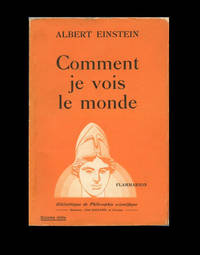
1934ref. 1564Paris: Paul Gaultier de l'Institut 1934. 1st Edition. Paul Gaultier de l'Institut. 13 x 19.5cm. 258pp. Handsome illustrated cover. How I see the World. Judaism Politics and Pacifism in Germany 1933. Translated from the German by Colonel Cros. Content: Comment je vois le Monde - Politique et Pacifisme - Allemagne - Le Judaisme - Science. Minor wear at edges and spine Bright and clean inside and out. Very good condition. Paul Gaultier, de l'Institut unknown
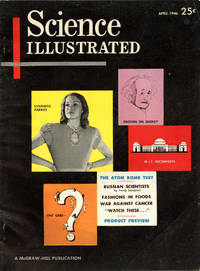
1946ref. 1576McGraw-Hill 1946. 1st Edition. IN ORIGINAL WRAPPERS THE FIRST PUBLICATION BY EINSTEIN OF THE FAMILIAR EQUATION E=mc2 IN THAT SPECIFIC FORM. Eight months after Hiroshima the editors of Science Illustrated turned to Albert Einstein to explain "the form of the energy that destroyed Hiroshima;" "to explain in his own words what takes place in the operation of his law" Science Illustrated 1 1 pp. 17 April 1946. The editors believed that given the deployment of two nuclear weapons "average citizens" wanted at least a layman's understanding of the mathematical law that enabled atomic explosions so that they were better able to understand the destruction the bombs unleashed ibid. The mathematical equation or law in question was one Einstein published in 1905 in his Theory of Special Relativity but the form in which it was then written was longer and more complex. In the paper offered here Einstein presents the equation we all now know a shorter more understandable derivation of his equation based upon the law of the conservation of momentum the pressure of radiation and the aberration of light: E = mc2. In layman's terms Einstein also explains the equivalence of mass and energy and discusses the profound 'urgent' implications of his principle ibid. In this article Einstein writes: "'What takes place can be illustrated with the help of our rich man. The atom M is a rich miser who during his life gives away no money energy. But in his will he bequeaths his fortune to his sons M' and M'' on condition that they give to the community a small amount less than one thousandth of the whole estate energy or mass. The sons together have somewhat less than the father had the mass sum M' M'' is somewhat smaller than the mass M of the radioactive atom. But the part given to the community though relatively small is still so enormously large considered as kinetic energy that it brings with it a great threat of evil. Averting that threat has become the most urgent problem of our time" ibid. CONDITION & DETAILS: Complete issue bound in its original wrappers. 4to. pp. 1-128. Very slighy scuffing to the front wrap. There are no address labels. Bright and very clean throughout. McGraw-Hill unknown
1920ref. 1433Berlin: Julius Springer 1920. 1st Edition. FIRST EDITION IN ORIGINAL WRAPPERS OF EINSTEIN'S LEIDEN LECTURE EXPLAINING AT LENGTH HIS THEORY OF THE ETHER ALONG WITH THOSE OF LORENTZ & MAXWELL. Very good condition. "Einstein's lecture at the University of Leiden on the occasion of his appointment as a visiting professor summarized his current views on the ether and retrospectively looked at the development of his opinions on the physical properties of space" Calaprice The Einstein Almanac 86. In this lecture Einstein recanted his earlier denial of the ether writing: "Recapitulating we may say that according to the general theory of relativity space is endowed with physical qualities; in this sense therefore there exists an ether. According to the general theory of relativity space without ether is unthinkable; for in such space there not only would be no propagation of light but also no possibility of existence for standards of space and time measuring-rods and clocks nor therefore any space-time intervals in the physical sense. But this ether may not be thought of as endowed with the quality characteristic of ponderable media as consisting of parts which may be tracked through time. The idea of motion may not be applied to it" Einstein Ather 1920. In this lecture Einstein also sought "to reconcile his theory of relativity with his mentor's Lorentz's cherished concept of the aether. Einstein stressed that special relativity took away the last mechanical property of Lorentz's aether: immobility. However he continued that special relativity does not necessarily rule out the aether because the latter can be used to give physical reality to acceleration and rotation. This concept was fully elaborated within general relativity in which physical properties which are partially determined by matter are attributed to space but no substance or state of motion can be attributed to that "aether" aether = curved space-time" Wikipedia. CONDITION & DETAIL: Berlin Julius Springer 1920. Complete in original cream colored wrappers. 8vo. 22 x 15cm. 15pp. Slight toning. Very good condition. ITEM: Ather und Relativitätstheorie. Rede gehalten am 5. Mai 1920 an der Reichs-Universität zu Leiden. Julius Springer unknown
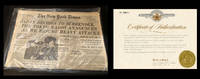
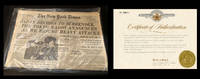
1945ref. 1437New York: The New York Times 1945. 1st Edition. First edition of the August 14th 1945 issue of the New York Times complete with "Certificate of Authentication" by the Historic Newspaper Archives. The certificate is #379910; it is signed and includes the seal of the archive. Einstein's article appears in Calaprice's Einstein Almanac No. 244. The certificate will accompany the paper. Most assume that Einstein received the Nobel Prize for his theory of relativity and his famous equation E=mc2. However it was for neither. In 1921 Einstein won the Nobel Prize for discovering the photoelectric effect in 1905. This principle states that when sunlight shines on a metal it emits electrons from the surface of the material. The energy from sunlight photons then transfers to the atoms' electrons and knocks them loose. This discovery was so significant that it has influenced the development of many types of technology from electron microscopes to modern solar cells as we know them today. ALSO INCLUDED: An article by Lewis headlined: "Atoms Not Occult Einstein Declares; Physicist Explains Nuclear and Solar Energy but Refuses to Discuss Use in Bomb" ALSO INCLUDED: New York Time's announces Japan's surrender in 3 line large headline "Japan Decides To Surrender The Tokyo Radio Announces As We Resume Heavy Attacks". CONDITION: Historic Newspaper Archives see above has placed the issue in archival plastic and then into an Archive snap close bag. see photo By any measure this complete issue appears in very good condition. The New York Times unknown
1931ref. 1435New York: New York Times 1931. 1st Edition. First edition of the October 19th 1931 issue of the New York Times complete with "Certificate of Authentication" by the Historic Newspaper Archives. The certificate is #379912; it is signed and includes the seal of the archive. Einstein was asked to contribute to the New York Times' "World Mourns the Death of Edison; Body to Lie in State in Laboratory.". CONDITION: Historic Newspaper Archives see above has placed the issue in archival plastic and then into an Archive snap close bag. see photo By any measure this complete issue appears in very good condition. New York Times unknown
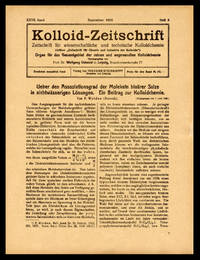
1920ref. 14561920. 1st Edition. First edition in original wraps of Einstein's review of a paper by Nobel Prize winner Walter Rudolf Hess entitled Theory of the Viscosity of Heterogeneous Systems. CONDITION: The journal was published in three sections. All three are here all bright clean and in near fine condition. paperback
1925ref. 14131925. 1st Edition. FIRST EDITION IN ORIGINAL PICTORIAL WRAPPERS. Near fine condition. "This paper is an early example of a series of papers - which continued until his death - in which he explored within the confines of general relativity possible pathways in the direction of a unified field theory. Here he discusses whether it is possible to explain why electrons and protons have equal charge but unequal masses. He notes that a more natural solution to the field equations would be particles of opposite sign and equal mass thus anticipating but for unrelated "Select Annotated Biography 114 p. 307. ALSO INCLUDED: Zeeman "Lorentz en de Hypothese der Licht-Quanta Bij de Voortplanting Van Licht" pp. 325-330 Lorentz was Zeeman's mentor. ALSO INCLUDED: Some of the issue is a memorial to Lorentz. CONDITION DETAILS: Complete issue. Very slight wear at the spine. Bright and clean inside and out. Near fine condition. unknown
1914ref. 1199Braunschweig: Friedr. Vieweg & Sohn 1914. 1st Edition. FIRST EDITION FULL VOLUME OF THE FRANCK-HERTZ EXPERIMENT: THE FIRST ELECTRICAL MEASUREMENT TO CLEARLY SHOW THE QUANTUM NATURE OF ATOMS - PROOF OF THE QUANTIZED MODEL OF THE BOHR ATOM & OF PLANCK'S QUANTUM THEORY. Note that this volume includes both the first and second Franck-Hertz experiment. In the first they demonstrate that atoms can only absorb and be excited by specific amounts of energy; in the second experiment performed the same year they demonstrate that the frequency of the light emitted following the collision of electrons with mercury atoms corresponds precisely with the energy lost by the electrons in the collision. Franck and Hertz received the Nobel Prize for this work specifically "for their discovery of the laws governing the impact of an electron upon an atom" Nobel Prize Committee. Of equal import this volume also contains a paper by Einstein in which he uses the light quantum hypothesis to give new derivations of Planck's radiation law and Nernst's third law of thermodynamics. His "proofs introduced the quantum hypothesis" Calaprice The Einstein Almanac 40. In 1914 James Franck and Gustav Hertz were working together in the Physics Institute of Berlin and were "particularly interested in ionization i.e. in the process in which an electron is removed from an atom" The Harvest of a Century" p. 102-103. The experiment they devised now known commonly as the Franck-Hertz experiment is "a vivid illustration of the quantization of energy" that relied on methodology so simple "that it is now carried out regularly by undergraduates. They accelerated electrons through a low-pressure gas of mercury. When the electrons' energy reach the energy of a stationary state of mercury they gave up a quantum of energy to the mercury resulting in a stepwise shape to the curve of current through the apparatus. This demonstrated that atoms could absorb energy only in discrete amounts" Peacock The Quantum Revolution 40. "Franck and Hertz had not only shown for the first time that electrons lose their kinetic energy to mercury atoms in energy quanta but also that these energy quanta are equal to the energy of the light emitted by the same atoms if interpreted with Einstein's light-quantum hypothesis.This was the first experimental determination of Planck's constant not using blackbody radiation" Brandt 103. CONDITION & DETAILS: Braunschweig: Friedr. Vieweg & Sohn. 8vo. Unobtrusive stamp on front paste down and title page. In-text figures throughout. Tightly bound in leather over marbled paper boards; gilt-lettered and tooled at the slightly faded and spotted spine which looks worse in the image due to the bright light than it does to the eye. Unusually beautiful marbled paper edges. Bright and very clean throughout. Near fine. Friedr. Vieweg & Sohn hardcover
1915ref. 1200Braunschweig: Friedr. Vieweg & Sohn 1915. 1st Edition. FIRST EDITION FULL BOUND VOLUME OF THE EINSTEIN-DE HAAS EFFECT -- an experimental observation that illustrates the relationship between magnetism and angular momentum and in which a change in the magnetic moment causes the rotation of a free body. In this 1915 paper Albert Einstein and Wander de Haas report that changing the magnetization of a suspended iron rod by applying an external magnetic field leads to mechanical rotation of the rod - a result that still stands as a textbook illustration of the relationship between magnetism and angular momentum. Papers by Planck The Quantum Hypothesis for Molecules with Multiple Degrees of Freedom von Laue Warburg Siegbahn and Born are also present. Einstein had long contemplated Ampère's 1820 conjecture that magnetism is caused by the microscopic circular motions of electric charges. In light of this Einstein and de Haas devised an experiment to test not just Ampère's hypothesis but also "Lorentz's theory that the rotating particles are electrons. The aim of the experiment was to measure the torque generated by a reversal of the magnetization of an iron cylinder" Calaprice Einstein Almanac 52. In the experiment Einstein and de Haas designed "a magnetic material was suspended with the aid of a thin string inside a magnetic field coil. When the magnetic field was increased by the application of an electric current through the field coil the magnetic material is magnetized. In order to keep the total magnetic moment of the magnetic material constant the latter rotates. This classical Einstein-de Haas effect demonstrates that the spin angular momentum is of the same nature as the angular momentum of rotating bodies as conceived in classical mechanics" Ganzhorn Nature Communications 7 11443 2016. Einstein spoke enthusiastically of the experimental results he and de Haas has achieved stating that they had "given firm proof of the existence of Ampère's molecular currents" Pais Subtle is the Lord 245. ALSO INCLUDED: Papers by Planck "Die Quantenhypotese für Molekeln mit mehreren Freiheitsgraden" and "Bemerkung über die Entropiekonstante zweiatomiger Gase" as well as a paper by von Laue "Die Einsteinischen Energieschwankungen" CONDITION & DETAILS: Braunschweig: Friedr. Vieweg & Sohn. 8vo. Unobtrusive stamp on front paste down and title page. In-text figures throughout. Tightly bound in leather over marbled paper boards; gilt-lettered and tooled at the slightly faded spine. Unusually beautiful marbled paper edges. Bright and very clean throughout. Near fine. Friedr. Vieweg & Sohn hardcover
1920ref. 1123Berlin: Akademie der Wissenschaften 1920. 1st Edition. First edition bound extract of a paper The Propagation of Sound in Partially Dissociated Gases "that is a bit off the beaten track for Einstein though its subject fluids liquids and gases is one he dabbled in throughout his life" Calaprice Einstein Almanac. Weil 110; Boni 119. Recognizing that while the "chemical equilibrium properties of gases were well understood precise knowledge of the velocity of gas reactions was not sufficiently available" Einstein sought to establish a method for the calculation of the rate of chemical reactions in a gas by means of observations on the propagation of sound Mason Physical Acoustics 13. CONDITION & DETAILS: Berlin: Akademie der Wissenschaften. Octavo. First edition bound extract. The binding is marbled paper boards over black cloth. Inside and out near fine condition. Akademie der Wissenschaften hardcover
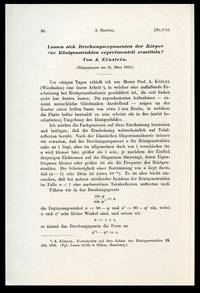
ref. 1061Braunschweig: Druck und Vieweg. 1st Edition. FIRST EDITION FULL VOLUME OF THE PAPER IN WHICH EINSTEIN PROVIDES THE FIRST DESCRIPTION OF THE NATURE OF THE REFRACTIVE INDEX FOR X-RAYS here clearly demonstrating that phase contrast effects are significant. "Inspired by the presence of fringes at the edges of objects in early X-ray images and by considerations of optical dispersion theory Einstein suggested in 1918 that the real part of the index of refraction for X-rays in matter is slightly less than unity. This was confirmed in 1924 by Larsson et al. in measurements of wavelength-dependent refraction of X-rays by a prism" Hornberger Quantitative Amplitude 1. "A century later most x-ray microscopy and nearly all medical imaging remains based on absorption contrast even though phase contrast offers orders of magnitude improvements in contrast and reduced radiation exposure at multi-keV x-ray energies"ResearchGate November 2015. Weil 104. Note that we offer this paper separately in its original printed wraps. ALSO INCLUDED: Einstein's reply to Gehrcke's paper "Über den Äther" also present in this volume pp. 165-169. ALSO INCLUDED: Papers by E. Goldstein A. Landé Max Born and J. Petzoldt. CONDITION & DETAILS: Braunschweig: Druck und Vieweg. Full volume. Complete. 4to 9.25 x 6.25 inches; 225 x 150mm. Ex-libris with armorial bookplate on the front pastedown. Bound in brown cloth rubbed at the edges; the cloth has torn at the spine and has been re-glued. Clean throughout. Good . Druck und Vieweg paperback
1921ref. 1014Paris: Gauthier-Villars 1921. 1st Edition. FIRST FRENCH EDITION OF A 1921 LECTURE BY EINSTEIN ON THE "GEOMETRIZATION OF PHYSICS AND RELATIVITY AND THE RELATION OF MATHEMATICS TO THE EXTERNAL WORLD" Dictionary of Scientific Biography 4 330. WEIL 115b. French translation by Maurice Solovince. In the same year in which he won the Nobel Prize 1921 Einstein delivered this paper as a lecture at "a commemorative session of the Prussian Academy of Sciences in honor of Frederick the Great" Calaprice Einstein Almanac 65. In "Geometrie und Erfahrung" Geometry and Experience Einstein advances his theory that space conforms to non-Euclidean principles of geometry -- a corollary of the Theory of Relativity - and as stated generally sums up his views on the "geometrization of physics and relativity and the relation of mathematics to the external world" DSB. It is in this lecture that Einstein also provides his famous answer to the puzzling question of why mathematics should be so well adapted to describing the external world: "Insofar as the laws of mathematics refer to the external world they are not certain; and insofar as they are certain they do not refer to reality" ibid. Calaprice put it like this: "He questioned whether human reasoning even without direct experience could lead to an understanding of the properties of real things merely through thought" Calaprice 1921. CONDITION & DETAILS: Paris Gauthier-Villars. 8vo. 9 x 5.75 inches; 225 x 143mm 2 19 1. Two in-text illustrations. Very slight soiling to the front wrap. Minor chipping lower right corner. Bright and clean throughout. See photos. Gauthier-Villars unknown
1946ref. 858Lancaster: American Physical Society 1946. 1st Edition. FIRST EDITION IN ORIGINAL WRAPS OF SIGNIFICANT CORRECTIONS & ADDITIONS BY EINSTEIN & STRAUS TO AN IMPORTANT PAPER; AS WELL A PAPER BY CHANDRASEKHAR ON THE ORIGIN OF THE SOLAR SYSTEM. In 1945 Albert Einstein and Ernst G. Straus introduced their Swiss cheese model of the universe in a paper entitled "The Influence of the Expansion of Space on the Gravitation Fields Surrounding the Individual Stars". Weil 216. The following year they published "Corrections and Additional Remarks to Our Paper" the 1945 paper the paper offered here. In early 1945 Einstein returned to long held cosmological questions as he sought to try to understand whether the expansion of the universe caused the solar system to expand as well - or more specifically the influence of the expansion of space on the gravitational field in the neighborhood of a star. Working with Straus the two began studying the effect of inhomogeneities in an expanding model. "By the spring of 1945 Einstein and Straus had found a new type of possible universe using Einstein's equations. It described a universe which looked largely like one of the simple expanding universes of Friedmann and Lemaître containing material like galaxies which exerted no pressure. But it has spherical regions removed from it like bubbles in a Swiss cheese. Each empty hole then had a mass placed at its centre. The mass was equal in magnitude to what had been excavated to create the hole. This was a step towards a more realistic universe in which the matter was not smoothly spread with the same density everywhere but gathered up into lumps like galaxies which were spread about in empty space. Barrow The Book of Universes 106-107. ALSO INCLUDED: S. Chandrasekhar's "On a New Theory of Weizsäcker on the Origin of the Solar System". In 1945 C. F. v. Weizsäcker proposed a new theory of the origin of the solar system which appeared to merit consideration. Weizsäcker argued "that there would be turbulence in the solar nebula which would give rise to the formation of eddies having angular motion opposite to that of the rotation of the nebula" Abhyankar The Origin BASI 26 339. Weizsäcker's "principal idea was to regard the formation of a planetary system around a star as a possible last stage in the formation of the star itself" Chandrasekhar 1946 94. He believed that "the protoplanets were supposed to have formed at the sites of the ball bearing eddies and the merger of the protoplanets in the same orbit produced the known planets" Abhyankar 343. In the paper offered here the Indian American astrophysicist S. Chandrasekhar challenged Weizsäcker's theory and showed "that there will be a wide spectrum of turbulence with smaller eddies within the larger ones and there would be no regular pattern as suggested by Weizsäcker. Further the life time of the eddies will be too short for the formation of the planets" ibid. In other words Chandrasekhar's work "indicated that the regular pattern of vortices originally postulated by Weizsäcker could not occur but instead must be replaced by a range of eddy sizes" Brush A History of Modern Planetary Physics 14. Chandrasekhar's work led to the abandonment of Weizsäcker's theories. INCLUDED: Nobel Prize winner Percy Williams Bridgman's "Recent Work in the Field of High Pressures" pp. 1-94 an important review of work done in the field of high pressure physics between Bridgman's seminal 1930 work and 1946 the year he won the prize and R. Samuel's "The Dissociation Spectra of Covalent Polyatomic Molecules" pp. 103-148. CONDITION & DETAILS: Lancaster: American Physical Society. Complete issue in original wraps. 4to. 10.5 x 8 inches; 263 x 200mm. Very slight wear at the edges of the wraps and head and foot of the spine; small closed tear see images. Bright and clean throughout. Very good condition. American Physical Society paperback
1918ref. 581Leipzig: Johann Ambrosius Barth 1918. 1st Edition. FIRST EDITION OF EINSTEIN'S DISCUSSION OF MACH'S PRINCIPLE a theory Einstein names and one which was historically important to the inspiration that would lead to general relativity. Mach's principle states that "local physical laws are determined by the large-scale structure of the universe" Wikipedia. To Einstein Mach's principle posited the belief that inertia originates in a kind of interaction between bodies. "So strongly did Einstein believe at that time in the relativity of inertia that in this paper he stated it as being on equal footing three principles on which a satisfactory theory of gravitation should rest: 1. The principle of relativity as expressed by general covariance. 2. The principle of equivalence. 3. Mach's principle the first time this term entered the literature" Pais The Science of Albert Einstein 287. Einstein brought Mach's principle into mainstream physics while working on general relativity. Indeed it was Einstein who first coined the phrase Mach's principle. Weil 96. Boni 100. Collected Papers 1918e. ALSO IN THIS VOLUME Max Born's Electron theory of natural optic rotation processes in isotropic and anisotropic liquids pp. 177-240. CONDITION & DETAILS: Leipzig: Johann Ambrosius Barth. 8vo. 8 x 5 inches; 200mm x 125mm; Full volume with front original wrap of each issue 1-8 is bound in the rear. Handsomely rebound in three-quarter calf over marbled paper boards; four raised bands at the spine; gilt-lettered and tooled. Very tightly bound. Ex-libris with five numbers written in a light hand on the title page and a very occasional round stamp within. Very good condition. Johann Ambrosius Barth hardcover
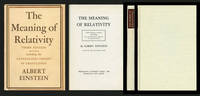
1950ref. 409Princeton: Princeton University Press 1950. Third Edition. FIRST PRINTED OF THE THIRD & EXTENDED EDITION COMPLETE WITH ORIGINAL DUST JACKET of four lectures Einstein delivered at Princeton University in May 1921. The lectures intended as further explanation of Einstein's famous theory of relativity and its developments were titled 'Space and Time in Pre-Relativity Physics' 'The Theory of Special Relativity' The General Theory of Relativity' 'The General Theory of Relativity II.' "This edition contains both an appendix discussing certain advances in the theory of relativity since 1921 and a new appendix on his generalized theory of gravitation. According to the Weil bibliography of Einstein's works this is Weil 124a. CONDITION & DETAILS: Large 12mo 7.5 x 5.25 inches 187 x 131mm. 8 145 3. The dust-jacket is not price-clipped; small closed tear at the foot of the front wraps and head of rear wraps both small and minor. Very good condition safe in archival mylar. Bound in tan cloth gilt-lettered at the spine; the binding is tight and solid. Bright and very clean inside and out. Very good condition. Princeton University Press paperback
1906ref. 292Leipzig: Barth 1906. 1st Edition. FIRST EDITION FIRST ISSUE of two important 1906 Einstein papers. Einstein wrote two papers on the photoelectric effect his revolutionary 1905 paper and "Zur Theorie der Lichterzeugung und Lichtabsorption" his continuation of it. In them Einstein employed Planck's theory that luminous energy can be absorbed or emitted only in discrete amounts called quanta and proposed a theory of light quanta involving particles with no mass photons whose energy depended on frequency. All of Einstein's experimental results confirmed that light actually consisted of discrete energy packets. "Based on this theory Einstein wrote an equation describing how the photoelectric effect works. The energy of individual electrons emitted by a photocell is a function of the frequency of the light hitting the photocell and the rate of electron emission is a function of the light source's intensity number of photons with sufficient energy being emitted. This is contrary to what is predicted by classical physics" History of Physics: The Wenner Collection. In this Einstein's second paper on photoelectrics he revisited Planck's theory and from it developed his ideas to show that an electromagnetic wave such as light could be described as a particle photon with discrete quanta of energy that was dependent on its frequency. In the long history of quantum mechanics this would lead to a theory of unity between subatomic particles and electromagnetic waves called wave-particle duality in which particles and waves were neither one nor the other but had certain properties of both. At first Einstein believed that light-quantum hypothesis was merely 'heuristic': that it behaved only as if it consisted of discontinuous quanta. But in this paper and others to follow Einstein used his statistical mechanics to demonstrate that when light interacts with matter Planck's entire formula can arise only from the existence of light quanta -- not from waves. In other words in explaining the photoelectric effect by extending Planck's concept of quantum of energy had Einstein "demonstrated that his own 'light-quantum hypothesis' was implicit in Planck's earlier work" Honner The Description of Nature 31. ALSO included in this volume is "Daz Prinzip von der Erhaltung." The Principle of Conservation of Motion of the Center of Gravity and the Inertia of Energy. In this "ingenious thought experiment involving energy transport in a hollow cylinder Einstein returned to the relationship between inertial mass and energy giving more general arguments for their complete equivalence" Calaprice The Einstein Almanac 18. This was the first statement that the conservation of mass is a special case of the conservation of energy. CONDITION & DETAILS: Leipzig: Barth 1906. Octavo. 8.75 x 6 inches; 222 x 152mm. Ex-libris bearing minimal markings only a small stamp on the title page. Illustration: 6 plates and figures throughout. Entire volume in black cloth gilt-lettered at the spine. The cloth is a bit rubbed and scuffed and there is fading at the spine. Solidly and tightly bound. Bright and clean throughout. Barth hardcover
1925ref. 79Paris: Gauthier-Villars 1925. First French edition of Zur Elektrodynamik bewegter Korper On the Electrodynamics of Moving Bodies and 1st die Tragheit eines Korpers von seinem Energieinhalt abhangig Does the Inertia of a Body Depend on its Energy Content. Both 1905 treatises are "beyond compare and without precedent one of the greatest scientific achievements in content and one of the most brilliant in style" Gosling Albert Einstein. The first paper is "a landmark in the development of physics one of the two papers that laid out the theory of special relativity formulated a new conception of time. By assuming that the speed of light is the same to every observer moving at a constant velocity Einstein showed that space and time were not independent: spacetime was born. According to Hermann Weyl in 1918 this theory 'led to the discovery that time is associated as a fourth coordinate on an equal footing with the other three coordinates of space and that the scene of material events the world is therefore a four-dimensional metrical continuum.' It was a revolutionary piece of scientific work" Calaprice The Einstein Almanac 15. In the second work Einstein uses "the postulates of the special theory of relativity Einstein showed that energy radiated is equivalent to mass lost. For the first time he concluded that 'the mass of a body is a measure of its energy content'" ibid 16. CONDITION & DETAILS: Paris: Gauthier-Villars 1925. Small 8vo. 4 56 2 6 catalog. ILLUSTRATION: Frontispiece portrait of Einstein. EXTERIOR: Complete issue bound in original light brown stiff wraps. Some light surface dirt on the front wraps and a small area in the lower right where a piece of tape has been removed. Two barely visible repairs at the spine. Tightly bound. INTERIOR: Complete. Very small spot at the upper margin of page 3. Otherwise very good condition throughout. Gauthier-Villars paperback
ref. 3421027307.Ghardcover. Good. Access codes and supplements are not guaranteed with used items. May be an ex-library book. hardcover
2010ref. 46545London: Folio Society. 2010. Hardcover. Very Good-. Silver decorated hardback covers in slipcase. There is one page in the book that has some creases and wrinkles at the edges.; 370 pages . Folio Society hardcover
ref. 1258112779.Gpaperback. Good. Access codes and supplements are not guaranteed with used items. May be an ex-library book. paperback
1945ref. BOOKS 53604 IVery clean sound book apart from small owner's ink stamp front endpaper. Jacket shows wear to the extremities with slight loss affecting the last letter in the author's name but front and back panels quite nice. Not price-clipped. Princeton Univ Press Princeton 1945 1st edition Hardcover Cloth 8vo. i 135pp. Index. Buff cloth gilt. In publisher's jacket. First printing so indicated by "1945" on the title and copyright pages of the second edition. With appendix to the second edition. Princeton Univ Press hardcover
ref. 1715276949.Ghardcover. Good. Access codes and supplements are not guaranteed with used items. May be an ex-library book. hardcover
ref. 0837101247.Ghardcover. Good. Access codes and supplements are not guaranteed with used items. May be an ex-library book. hardcover
1938ref. 339701Simon and Schuster 1938. First Thus. Hardcover. Very Good. First American edition. 8vo in blue cloth spine title in gilt. Binding tight and square glue residue on both pastedowns p.o. name in ink on the front pastedown long neat inscription in pencil on the ffep corners and spine ends pushed and very lightly rubbed. Simon and Schuster hardcover
ref. 1147888450.Gpaperback. Good. Access codes and supplements are not guaranteed with used items. May be an ex-library book. paperback