3,003 results
1920ref. 023653London: Methuen & Co. Ltd. 1920 pp.xiii 140 including Index Bibliography and 3 Appendixes plus 8-page publisher's catalogue at thr back. Illustrated with a Frontis portrait of the author. Red cloth with gilt title on slightly faded and darkened spine. Very slight fading to top and fore edge of front board. Black ink stain to top edge of rear board and tiny black ink spot to top spine corner of front board. Front and rear free endpapers lightly tanned and two small very light splash marks to blank verso of Contents page. Otherwise pages are clean. Methuen & Co. Ltd. hardcover
1987ref. L3 b771 L2 b2038 seThe Collected Papers of Albert Einstein Volume 1: The Early Years 1879-1902 Original Texts German Edition. Editor: John Stachel; Associate Editors: David C. Cassidy Robert Schulmann. 1987 Princeton University Press. Hardcover 502 pp. Princeton University Press. hardcover
1880ref. 24284A unique and important artifact of his childhood. ALBERT EINSTEIN. Ephemera. Set of Anker-Steinbaukasten children's building blocks by F. Ad. Richter & Cie. Rudolstadt Germany c.1880s. Approximately 160 composite quartz sand chalk and linseed oil blocks in red limestone and slate gray in various sizes and shapes together with three or more sets of building plans all contained in two wooden boxes with printed Anker-Steinbaukasten labels. Einstein spent his childhood building "complicated structures" with these Anker-Steinbaukasten blocks. Accepting his later theory that "Imagination is more important than knowledge" the toys that encouraged his imagination became building blocks for the most important scientific theories of the last millennium. His sister Maja Winteler-Einstein describing his childhood recalled that "The games he played … were very characteristic of Albert's capacities. These were mostly puzzles fretsaw work the erection of complicated structures with the well-known Anker building blocks and above all the construction of multi-storied card castles with which he filled his leisure." "Beitrag für sein Lebensbild" in The collected papers of Albert Einstein. ed. John Stachel. Volume 1: The early years. 1879-1902. Princeton University Press 1987 p.lix. Translated from German. Based on the work of German educator Friedrich Froebel who created the concept of kindergarten these composite stone blocks were a popular toy of the 1880s and 1890s. The blocks were designed to help develop childrens' tactile senses and manual dexterity and also to stimulate imagination creativity and three-dimensional perception. Fellow scientist J. Robert Oppenheimer as well as architects Frank Lloyd Wright and Walter Gropius are among the geniuses who are known to have played with Anker blocks. Provenance The set had passed by direct descent from Albert Einstein to the consignor from whom we acquired the blocks at Christie's London on July 13 2016. Condition A few blocks chipped and worn with original instructions and boxes worn soiled and defective. Albert Einstein 1879-1955 was a German-Swiss born theoretical physicist internationally recognized as one of the greatest physicists of all time. He enunciated the general theory of Relativity with law explaining the relationship between the speed of light and its consequence the equivalence of mass and energy E=MC2. For his work in theoretical physics—largely for his 1905 paper on photons and photo-electricity—Einstein was awarded the Nobel Prize for Physics announced in November 1922 retroactive for 1921. Working on a unified field theory he then attempted to explain gravitation and electromagnetism within one set of laws. With the expulsion of Jewish scholars from Germany after Hitler's rise to power Einstein joined the Institute for Advanced Study in Princeton New Jersey 1933 which became the most celebrated research center in the world. In 1939 he signed a letter written to President Franklin Roosevelt warning him of the possibility of Germany developing a nuclear bomb. He urged the U.S. to begin uranium research thus beginning the top secret "Manhattan Project." Later at Princeton he tried to develop a unified field theory and to refute the accepted interpretation of quantum physics both unsuccessfully. Einstein received U.S. citizenship in 1940.
1993ref. R3215France: Éditions du Seuil Collection Science ouverte 1993 ÉPUISÉ mais DISPONIBLE. « La correspondance du couple s'étend de 1897 à 1903 peu après leur mariage. Ces lettres révèlent un Einstein peu connu optimiste confiant et heureux malgré les difficultés familiales et professionnelles qu'affronte le jeune couple. Mileva y montre une forte personnalité - « mon égal » dit Einstein qui admire sa maturité affective et intellectuelle. Elle contribuera de façon essentielle aux succès scientifiques d'Einstein.». Couverture souple. Comme neuf. Éditions du Seuil (Collection Science ouverte) paperback
2010ref. 51710London: The Folio Society. New. 2010. Hardcover in slipcase. B&W Photos; Large 8vo 9" - 10" tall; 400 pages; 2010 The Folio Society. Slipcased HC still sealed in publisher's shrink-wrap. Still sealed and essentially new; Fine in all respects. . The Folio Society hardcover
ref. a87636Berlin 1923 Vieweg Braunschweig Springer. Original printing of this article at pp.301-306 in one complete volume of Zeitschrift fur Physik Volume 19. Included in complete volume 18. Hardcover. Octavo 415p. 148 text figures original contermporary binding. Many additional articles on Physics in volume as well by Hertz Sommerfeld Lise Meitner Georg Joos and others. Good cover board edges and tips worn light spotting on cover end papers toned.hinges not cracked; binding secure; text clean; no owner marks . hardcover
ref. 141115022CROWN PUBLISHERS 1931-01-01. Unknown Binding. Very Good. 0x0x0. CROWN PUBLISHERS unknown
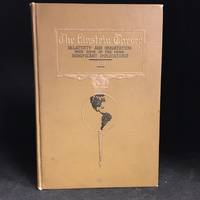
ref. 126956Burlington: Lutheran Literary Board 1923. Hardcover 84pp. Very good no dust jacket. Light brown cloth with embossed title and decoration in gilt. Notes index errata slip. There is a previous owner's stamp. Based on the work of Albert Einstein. Science Gravitation Science Theory of Relativity. Lutheran Literary Board Hardcover
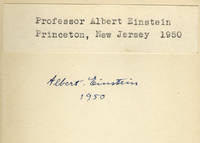
1949ref. 32820624Original yellow cloth. Near fine dust jacket supplied from another copy. Early typed slip stating "Professor Albert Einstein / Princeton New Jersey 1950" mounted to top of front free endpaper. Light soiling. Very good Signed and dated 1950 by Albert Einstein on the front free endpaper. This is the English translation of Einstein's Mein Weltbild first published in German in 1934 and then in English as The World As I See Itin the same year. This abridged edition of 1949 omits the scientific essays preserving the extensive essays concerning philosophy religion Judaism economics current events government politics war and peace. Philosophical Library hardcover
1939ref. 240København: J.H. Schultz Forlag 1939. Hardcover. Very Good. Half bound leather and marbled paper boards. Boards rubbed and discolored spine faded. Small tear at bottom edge of half title and title page. Small yellow stain at top corner of page 287 and the following page. J.H. Schultz Forlag hardcover
ref. 62548Southern Illinois University Press. Paperback. Very Good. 8x5x1. Book is in very nice condition text is unmarked and pages are tight. Southern Illinois University Press paperback
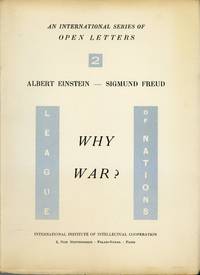
1933ref. 32820626Original wrappers. Near fine. First edition in English one of 2000 numbered copies. Translated from the German by Stuart Gilbert. Einstein initiated this correspondence with Freud as part of the International Institute of Intellectual Co-operation's effort to promote dialogue among leading thinkers to promote peace. At the time Einstein and Freud were perhaps the most famous thinkers in the world. Laid in is a 2pp leaflet advertising this publication and noting the various formats and their prices. International Institute of Intellectual Cooperation, League of Nations paperback
1933ref. 32820627Original wrappers. Price neatly blacked out at lower corner. Tiny chip from back wrapper. Very good. FIRST EDITION. This scarce collection of Einstein's writings on war and peace was published in 1933 the year the Nazis took power in Germany and the year Einstein left Germany for the United States. In his prefatory note Einstein writes "Mr. Lief the editor Alfred Lief has taken great trouble in collecting utterances of mine having pacifistic content and he presents them with my authorization. … I consider it my duty to confess my pacific conviction publicly. May the seriousness of my purpose be transferred to you my readers! A. Einstein." John Day paperback
1950ref. 32820550This photograph shows a reunion of friends. The Sternbergers and Einstein had known one other in Europe and met again in Princeton. Ilse was Sternberger's wife collaborator and perennial foil. She was a constant source of warmth during sometimes-contentious sittings. She also helped document their life publishing several articles on Sternberger's work and their sessions with famous sitters after his death. Gelatin silver print 20 x 30 in. Archivally framed. Estate Edition a limited edition of 10 copies embossed and numbered. $2500 unframed; framed: $3000
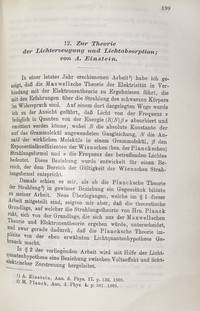
1906ref. 32820369Contemporary half dark green roan. Rubbed some chipping separation at upper joint. Library markings. FIRST EDITION of "On the Theory of Light Production and Light Absorption" pp. 199-206. This classic in the history of physics is Einstein's second paper on the photoelectric effect. Einstein reconciles his and Planck's independent derivations of the blackbody formula E=hν. Planck's derivation of this formula ascribed it to a restriction on the energy changes possible when radiation is produced or absorbed by matter which implied no restriction on the energies of either matter or radiation. Einstein's 1905 derivation ascribed it to a restriction on the energy of radiation alone but in this paper he proposes the modern idea that the energies of both matter and radiation are quantized which led to his work on quantum specific heats. and FIRST EDITION of "The Principle of Conservation of Motion of the Center of Gravity and the Inertia of Energy" pp. 627-633. In this "ingenious thought experiment involving energy transport in a hollow cylinder Einstein returned to the relationship between inertial mass and energy giving more general arguments for their complete equivalence" Calaprice The Einstein Almanac. This is the first statement that the conservation of mass is a special case of the conservation of energy. Annalen der Physik
1949ref. 38664The Library of Living Philosophers. Very Good in Very Good dust jacket. 1949. First Edition. Hardcover. First edition of Einstein's autobiography. Blue cloth. Bookplate to ffep. Glue darkening along hinges. Book is tight and square. Gilt unfaded. The clipped jacket shows wear along edges and shows general toning. ; The Library of Living Philosophers; Vol. 7; 8vo 8" - 9" tall . The Library of Living Philosophers hardcover
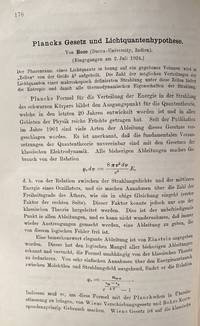
1924ref. 32820524FIRST EDITION of this classic in the history of quantum mechanics "Planck's Law and Light Quantum Hypothesis" pp. 178-181 in vol. 26. Bose sent this paper to Einstein who translated it into German for this initial publication with the comment "In my opinion Bose's derivation of the Planck formula signifies an important advance." In this paper he "succeeded in deriving the Planck blackbody radiation law without reference to classical electrodynamics. Einstein's generalization of Bose's method led to the first of two systems of quantum statistical mechanics known as the Bose-Einstein statistics. Paul Dirac later coined the term 'boson' for particles that obey these statistics" DSB. "With their work Bose and Einstein established the field of quantum statistics one year before the appearance of quantum mechanics" Brandt The Harvest of a Century This volume also contains three papers by Werner Heisenberg. Complete vols. 25-26. Contemporary half calf. Near fine without any library markings.
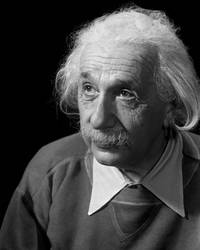
1950ref. 32820558In this portrait Sternberger shows Einstein dressed informally. Einstein was keenly aware of his public image and often attempted to show a cheerful visage. The common backgrounds of the two men helped the photographer to put Einstein in a relaxed state and to capture him in a more vulnerable pose. Marcel Sternberger and Albert Einstein had known each other in Europe long before the two met again in Princeton New Jersey for this session. Before the men left Europe Einstein had furnished the preface to a book written by Sternberger. After a warm welcome and lemonade the men settled in for the sitting. They discussed various topics including World War II and the state of American education. Although some photographs from the session show Einstein with a telltale twinkle in his eye here the great scientist appears fatigued. The seriousness of their conversation seems to have worn him down. Still the conversation had its moments of levity. At one moment Sternberger asked Einstein to remove his suspenders. Einstein replied "I am going to lose my trousers! I can't." Einstein instead put on one of his trademark sweatshirts. Here modern science's greatest mind is forever immortalized as only Sternberger could. He has found a depth of personality exceeding photographs produced without regard to the sitter's inner psychological state. Gelatin silver print 16 x 20 in. Archivally framed. Estate Edition a limited edition of 20 copies embossed and numbered. $1250 unframed; framed: $1650
1931ref. 0037-23-06New York: Peter Smith 1931. 157p cloth no DW significant spotting primarity on the spine and back of the bookscarce Good Peter Smith hardcover
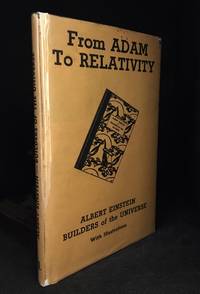
ref. 129894Los Angeles: U.S. Library Association Inc. 1932 1st edition. Hardcover 96pp. Near fine in very good dust jacket. Blue and white patterned cloth in a printed yellow dust jacket. Illustrations. The dust jacket is price-clipped and has minor edgewear. This is as nice a copy as you will ever see. From ADAM to RELATIVITY. The construction of the world and how its ideas have changed told by the great thinkers in their own words with illustrations. Science. U.S. Library Association, Inc. Hardcover
1951ref. 108Book is in good condition. Some darkening evident on ends of pages. Dust jacket is worn but intact and has been wrapped in Mylar for protection. Tudor Publishing Company hardcover
1978ref. 2111902152907861Kodansha 1978. Soft Cover. Fine. Size: B6 size Kodansha paperback
1956ref. 2092902140302645David company 1956. Soft Cover. Fine. Number of books: 1 David company paperback
ref. a107696bBraunschweig 1917 first edition. Vieweg. Hardcover octavo. 372p. Einstein article pp. 82-92 . Articles by Max Planck and Max Born as well in same volume. Near Fine. spine and tips black cloth black textured papercovered boards. No owner marks except two small light institute stamps on front end paper and on titlepage. Binding secure; text clean. . hardcover
ref. a105134bBraunschweig 1917 first edition. Vieweg. Hardcover thick octavo. 3/4 brown cloth with black/white marbled boards. 372p. 346p. Einstein article pp. 82-92 . Articles by Max Planck and Max Born as well in same volume. Good plus binding secure; hinges not cracked; lower cover tips worn; wear on top spine end; sseveral old Hugarian library name stamp on end papers and titlepage. no spine numbers no bookplate no pocket. . hardcover