EINSTEIN, AlbertBiblio.com
1 894 résultats
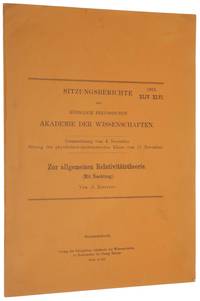
1915réf. 5863Berlin: Königlichen Akademie der Wissenschaften 1915. First edition. First editions very rare offprint of the first two of the papers published in November 1915 that document his final version of the general theory of relativity. "In the half century and more of Einstein's work in science one discovery stands above all as his greatest achievement. It is his general theory of relativity" Norton. . EINSTEIN'S COMPLETION OF THE GENERAL THEORY OF RELATIVITY. First editions very rare offprint of the first two of the papers published in November 1915 that document Einstein's final version of the general theory of relativity. "In the half century and more of Einstein's work in science one discovery stands above all as his greatest achievement. It is his general theory of relativity" Norton. "There was difficulty reconciling the Newtonian theory of gravitation with its instantaneous propagation of forces with the requirements of special relativity; and Einstein working on this difficulty was led to a generalization of relativity - which was probably the greatest scientific discovery that was ever made" Dirac quoted in Chandrasekhar p. 3. Einstein's special theory of relativity 1905 showed that the laws of physics are the same in all inertial i.e. non-accelerating frames of reference. It was then natural to ask whether it was possible to extend this principle of relativity to the more general case of frames of reference in arbitrary states of motion. This problem became linked to a theory of gravitation with Einstein's 'equivalence principle' of 1907 according to which the effects of gravity are locally equivalent to those of accelerated motion. Einstein's first steps towards a geometrical theory of gravitation were taken in August 1912 when his friend Marcel Grossmann provided the necessary mathematical tools. "Some time between August 10 and August 16 it became clear to Einstein that Riemannian geometry is the correct mathematical tool for what we now call general relativity theory. The impact of this abrupt realization was to change his outlook on physics and physical theory for the rest of his life" Pais p. 210. The resulting 'Entwurf' theory 1913 had much in common with the final theory of 1915 but based on a fallacious argument Einstein abandoned the requirement that the theory should be 'generally-covariant' i.e. that arbitrary frames of reference should be allowed. "After three years of fruitless peregrinations the revelation came to Einstein that he had been constantly on the wrong track although in 1913 he had been so near to the right solution" Lanczos p. 211. On November 4 1915 he presented to a plenary session of the Prussian Academy a new version of general relativity 'Zur allgemeinen Relativitätstheorie' "based on the postulate of covariance with respect to transformations with determinant 1" and stated that he had "completely lost confidence" in the 'Entwurf' equations. On November 18 he published his calculation of the precession of the perihelion of Mercury based on the new theory: its agreement with observation confirmed that the theory was correct the Entwurf theory predicted half the observed value of the precession. "In June 1905 while still a patent examiner in Bern Einstein submitted his famous work on the electrodynamics of moving bodies to the Annalen der Physik. This work contained his special theory of relativity in which he asserted the equivalence of all inertial frames of reference as a fundamental postulate of physics. The question which then naturally arose was whether it was possible to extend this principle of relativity to the more general case of frames of reference in arbitrary states of motion. But he could find no workable basis for such an extension until he tried to incorporate gravitation into his new special theory of relativity for a review article in 1907 'Uber das Relativitätsprinzip und die ausdemselben gezogenen Folgerungen' Jahrbuch der Radioaktivitat und Elektronik 4 1907 411-62. The difficulties of this task led him to a new principle later to be called the 'principle of equivalence.' "On the basis of the fact that all bodies fall alike in a gravitational field Einstein postulated the complete physical equivalence of a homogeneous gravitational field and a uniform acceleration of the frame of reference. This extended the principle of relativity to the case of uniform acceleration. It also foreshadowed the problem whose complete solution would lead him to his general theory of relativity: the construction of a relativistically acceptable theory of gravitation based on the principle of equivalence" Norton p. 258. One application of the equivalence principle proved crucial to the subsequent development of his ideas on general relativity. Einstein considered an observer standing on a rotating disc - a non-inertial accelerating reference frame. According to special relativity measuring rods aligned with the circumference of the disc will contract due to their motion whereas measuring rods positioned along the radius of the disc will not. Hence the ratio of the circumference of the disc to its diameter will be less than π. "The spatial geometry for the rotating observer is therefore non-euclidean. Invoking the equivalence principle Einstein concluded that this will be true for an observer in a gravitational field as well. This then is what first suggested to Einstein that gravity should be represented by curved space-time. "To describe curved space-time Einstein turned to Gauss's theory of curved surfaces a subject he vaguely remembered from his student days at the ETH in Zürich. He had learned it from the notes of his classmate Marcel Grossmann. Upon his return to his alma mater as a full professor of physics in 1912 Einstein learned from Grossmann now a colleague in the mathematics department of the ETH about the extension of Gauss's theory to spaces of higher dimension by Riemann and others. Riemann's theory provided Einstein with the mathematical object with which he could unify the effects of gravity and acceleration: the metric field" Janssen p. 65. The first product of this collaboration was the Entwurf einer verallgemeinerten Relativitätstheorie und einer Theorie der Gravitation published before the end of June 1913 which contained many of the essential features of the final general theory of relativity; most importantly it introduced the 'metric' of space-time. In Minkowski's formulation of special relativity 1908 the most important quantity is the 'world function' of two events which determines the metric and causal structure of space-time. If these events have coordinates x y z t and x' y' z' t' in some inertial reference frame the world function is: c2t' - t2 - x' - x2 - y' - y2 - z' - z2 where c is the speed of light. Its crucial property is that it depends only on the two events and not on the choice of inertial reference frame - in other words it is unchanged 'invariant' when x y z t and x' y' z' t' are both subjected to any Lorentz transformation. Einstein and Grossmann began with the world function in differential form: ds2 = c2dt2 - dx2 - dy2 - dz2 If we now subject x y z t to an arbitrary coordinate transformation not necessarily a Lorentz transformation this takes the general form ds2 = g11dx12 g12dx1dx2 . ; the collection of quantities gμν which in general depend on the coordinates x1 x2 x3 x4 is called the metric. Based on analogy with Newton's theory Einstein expected that the gravitational equations should be of the form Gμν = Tμν where Gμν is a purely geometric quantity constructed solely from the metric gμν and its derivatives up to the second order and the 'stress-energy tensor' Tμν contains the information about the matter that is producing the gravitational field including energy density momentum fluxes and stresses. The question was: what exactly should Gμνbe Einstein and Grossmann found that generally covariant equations did not seem to be compatible with energy-momentum conservation or reduce to the equations of Newtonian gravitational theory for weak static fields both essential requirements of the correct theory. Einstein therefore decided to settle in the 'Entwurf' for equations with very limited covariance - instead of arbitrary changes in coordinates only linear ones were allowed. The restricted covariance of the 'Entwurf' field equations continued to bother him until in late August 1913 he convinced himself that such restrictions are unavoidable by means of the infamous "hole argument" first published as an addendum to the reprint of the 'Entwurf' article in Zeitschrift für Physik in January 1914. This ingenious argument showed correctly that if the gravitational equations were generally covariant the metric gμν would not be uniquely determined by the matter distribution i.e. by Tμν. He concluded incorrectly that this implied that general covariance must be ruled out the hole argument does not work if only linear coordinate transformations are allowed. The appropriate analogy is with electromagnetism: the metric is analogous to the scalar and vector potentials of electromagnetism and it was well known certainly to Einstein that these potentials are not uniquely determined by the charges and currents producing the electromagnetic field. That the 'Entwurf' theory was incorrect was made clear by Einstein's attempt in collaboration with Michele Besso another former classmate to explain the motion of the perihelion of Mercury. In 1859 Urbain Jean Joseph Le Verrier had observed the 'precession' of Mercury's orbit: this orbit is an ellipse but the ellipse is not fixed in space but slowly rotates. From early on in his search for a new relativistic theory of gravitation Einstein had been interested in the problem of Mercury's perihelion. In a letter to his friend Conrad Habicht in 1907 Einstein had already expressed his hope that such a theory would explain the anomalous advance of Mercury's perihelion. Besso visited Einstein in Zürich in June 1913 and the two men calculated the precession expected on the basis of the 'Entwurf' theory. Disappointingly it was only about half the observed anomaly. Einstein left Zürich in March 1914 to take up a professorship in Berlin which was to be his home until December 1932. He made no further progress on the gravitational equations until the summer of 1915 although a detailed exposition of the 'Entwurf' theory was published in October 1914 in which Einstein maintained the need for restricted covariance and even claimed that this determined the gravitational Lagrangian uniquely. "Einstein still believed in the 'old' theory as late as July 1915 between July and October he found objections to that theory and his final version was conceived and worked out between late October and November 25 . What made Einstein change his mind between July and October Letters to Sommerfeld and Lorentz show that he had found at least three objections against the old theory: 1 its restricted covariance did not include uniform rotations 2 the precession of the perihelion of Mercury came out too small by a factor of about 2 and 3 his proof of October 1914 of the uniqueness of the gravitational Lagrangian was incorrect. Einstein got rid of all these shortcomings in a series of four brief articles offered here . "On November 4 Einstein presented to the plenary session of the Prussian Academy a new version of general relativity 'based on the postulate of covariance with respect to transformations with determinant 1'. He began this paper by stating that he had 'completely lost confidence' in the equations proposed in October 1914. At that time he had given a proof of the uniqueness of the gravitational Lagrangian. He had realized meanwhile that this proof 'rested on misconception' and so he continued 'I was led back to a more general covariance of the field equations a requirement which I had abandoned only with a heavy heart in the course of my collaboration with my friend Grossmann three years earlier' . "Einstein and Grossmann had concluded that the gravitational equations could be invariant under linear transformations only and Einstein's justification for this restriction was based on the belief that the gravitational equations ought to determine the gμν uniquely a point he continued to stress in October 1914. In his new paper he finally liberated himself from this three-year-old prejudice. That is the main advance on November 4. His answers were still not entirely right. There was still one flaw a much smaller one which he eliminated three weeks later. But the road lay open. He was lyrical. 'No one who has really grasped it can escape the magic of this new theory.' "The remaining flaw was of course Einstein's unnecessary restriction to unimodular transformations. The reasons which led him to introduce this constraint were not deep I believe. He simply noted that this restricted class of transformations permits simplifications of the tensor calculus . The new equations are a vast improvement over the Einstein-Grossmann equations and cure one of the ailments he had diagnosed only recently: unimodular transformations do include rotations with arbitrarily varying angular velocities. In addition he proved that the new equations can be derived from a variational principle and that the conservation laws are satisfied" Pais pp. 250-252. On November 11 he submitted a 'Nachtrag' to his paper of a week earlier. "Einstein proposes a scheme that is even tighter than the one of a week earlier. Not only shall the theory be invariant with respect to unimodular transformations . but more strongly it shall satisfy the condition that the determinant of the matrix gμν is equal to minus one . During the next two weeks Einstein believed that this new condition had brought him closer to general covariance . One week later he remarked that 'no objections of principle' can be raised against it" ibid. pp. 252-253. Norton p. 309 points out that Einstein had in fact made a significant advance in this paper: namely he had finally found generally covariant field equations that reduced to the Newtonian equations in the weak field limit" ibid. p. 253. On November 18 still retaining the restrictions of his paper of a week earlier Einstein presented in 'Erklarung der Perihelbewegung des Merkur aus der allgemeinen Relativitätstheorie'"two of his greatest discoveries. Each of these changed his life. The first result was that his theory explains . quantitatively . the secular rotation of the orbit of Mercury discovered by Le Verrier . without the need of any special hypothesis. This discovery was I believe by far the strongest emotional experience in Einstein's scientific life perhaps in all his life. Nature had spoken to him. He had to be right. 'For a few days I was beside myself with joyous excitement'. Later he told Fokker that his discovery had given him palpitations of the heart. What he told de Haas is even more profoundly significant: when he saw that his calculations agreed with the unexplained astronomical observations he had the feeling that something actually snapped in him . "Einstein's discovery resolved a difficulty that was known for more than sixty years. Urbain Jean Joseph Le Verrier had been the first to find evidence for an anomaly in the orbit of Mercury and also the first to attempt to explain this effect . In 1859 he found that the perihelion of Mercury advances by thirty-eight seconds per century due to 'some as yet unknown action on which no light has been thrown . a grave difficulty worthy of attention by astronomers'" ibid. pp. 253-254. A more accurate measurement of 43 seconds was made by Simon Newcomb in 1882 and this was precisely the value predicted by the new theory. The prediction of the bending of light in a gravitational field was treated only briefly in 'Erklarung der Perihelbewegung des Merkur aus der allgemeinen Relativitätstheorie' probably because no accurate measurement of it had been made so this prediction could not be confirmed at the time. Einstein had realised in 1907 based on the equivalence principle that some bending of light should occur but he believed that the effect was too small to be observed. In 1911 he realized that the effect could be detected for starlight grazing the sun during a total eclipse and found that the amount of bending in that case is 0''.87 - this value could in fact have been computed by Newton from his law of gravitation and his corpuscular theory of light. In 3 Einstein discovered that general relativity implies a bending of light by the sun equal to 1".74 twice the Newtonian value. This factor of 2 set the stage for a confrontation between Newton and Einstein. "It was not until May 1919 that two British expeditions obtained the first useful photographs and not until November 1919 that their results were formally announced . In March 1917 the Astronomer Royal Sir Frank Watson Dyson drew attention to the excellence of the star configuration on May 29 1919 an eclipse date for measuring the alleged deflection . Two expeditions were mounted one to Sobral in Brazil led by Andrew Crommelin from the Greenwich Observatory and one to Principe Island off the coast of Spanish Guinea led by Eddington. Before departing Eddington wrote 'The present eclipse expeditions may for the first time demonstrate the weight of light i.e. the Newton value; or they may confirm Einstein's weird theory of non-Euclidean space; or they may lead to a result of yet more far-reaching consequences - no deflection' . The expeditions returned. Data analysis began. According to a preliminary report by Eddington to the meeting of the British Association held in Bournemouth on September 9-13 the bending of light lay between 0''.87 and double that value. Word reached Lorentz. Lorentz cabled Einstein . Then came November 6 1919 the day on which Einstein was canonized" Pais 304-305. At a joint meeting of the Royal Society and the Royal Astronomical Society on that date Dyson concluded his remarks with the statement "'After a careful study of the plates I am prepared to say that they confirm Einstein's prediction. A very definite result has been obtained that light is deflected in accordance with Einstein's law of gravitation'" ibid. p. 305. Three remarks may be made on the speed with which after eight years of struggle Einstein completed these final papers on his theory. The first is that Einstein had come very close to the correct gravitational equations in the second half of 1912 - they are recorded in his 'Zurich notebook' - but he discarded them because of his arguments against general covariance as we have seen. Once he no longer believed in these arguments he could return to the work carried out in the Zurich notebook and complete it. The second is that the detailed calculations in 3 relating to Mercury's perihelion were in fact very similar to those he had carried out with Besso in 1913 and so required relatively little extra effort. The final point is that Einstein was in competition with the great Göttingen mathematician David Hilbert. Weil 75 76 77; Chandrasekhra 'The general theory of relativity: Why "It is probably the most beautiful of all existing theories" Journal of Astrophysics 5 1984 pp. 3-11; Eisenstaedt The Curious History of Relativity 2006; Janssen 'Of pots and holes: Einstein's bumpy road to general relativity' Annalen der Physik 14 Supplement 2005 pp. 58-85; Lanczos Einstein Decade: 1905-1915 1974; Norton 'How Einstein found his field equations: 1912-1915' Historical Studies in the Physical Sciences 14 1984 pp. 253-316; Pais Subtle is the Lord 1982. Large 8vo 253 x 180 mm pp. 778-786 & 799-801. Original printed wrappers. Königlichen Akademie der Wissenschaften unknown
réf. 109875Stockholm Aldus / Bonnier 1964. 8:o. 332 4 s. Mörkblått halvmarokängband blekt guldornerad rygg med upphöjda bind och med omslaget medbundet ryggen har blekts till grönt. Ur Lars Berglöfs bibliotek med hans initialer i guld på ryggen. Fint exemplar av en bok som annars sällan överhuvudtaget är inbunden! Det tyska originalet ”Mozart - sein Character sein Werk” utkom 1945 och denna svenska översättning av Kajsa Rootzén utkom första gången 1956. unknown
2013réf. DADAX0415854717Routledge 2013-07-02. 1. paperback. New. 5.08x0.44x7.80. Buy with confidence. Excellent Customer Service & Return policy. Routledge paperback
réf. B9780195007329Paperback / softback. New. paperback
réf. B9781258115357Paperback / softback. New. paperback
réf. 1568219830.Gpaperback. Good. Access codes and supplements are not guaranteed with used items. May be an ex-library book. paperback
1931réf. SKU1139774Simon and Schuster 1931. Hardcover. Good. New York 1931; black boards with gold cover titles and spine titles; mild corner and edge wear; some discoloration at edges; orange dust jacket with black cover titles and spine titles; light chipping at jacket edges; parts of jacket edges taped over; 8vo - over 7 3/4" to 9 3/4" tall; "ex libris" sticker on front pastedown; rest of interior is clean and unmarked. 333 pages. Simon and Schuster hardcover
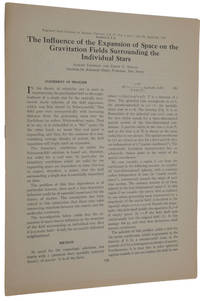
1945réf. 5054Lancaster PA: American Physical Society 1945. First edition. First edition extremely rare offprints of Einstein & Straus's introduction of the 'Swiss-cheese' model of the universe. "By the spring of 1945 Einstein and Straus had found a new type of possible universe using Einstein's equations . This was a step towards a more realistic universe in which the matter was not smoothly spread with the same density everywhere but gathered up into lumps like galaxies which were spread about in empty space" Barrow The Book of Universes pp. 106-107. . EINSTEIN'S 'SWISS-CHEESE' MODEL OF THE UNIVERSE - OFFPRINT ISSUE. First edition extremely rare offprints of Einstein & Straus's introduction of the 'Swiss-cheese' model of the universe. "After a decade and a half of sometimes intense work on cosmology Einstein returned to the subject only occasionally in his later years. His most significant later contribution was a discussion of the impact of cosmological expansion on the gravitational field surrounding a star i.e. the offered papers . This was an important first step in understanding the impact of global cosmological expansion on local physics" Janssen & Lehner pp. 257-8. In the 1920s and 1930s a general relativistic model of the universe was developed called the Friedmann-Lemaître-Robertson-Walker FLRW model which correctly described the expansion of the universe discovered by Edwin Hubble. But the FLRW model was 'homogeneous' - it described a universe which looks the same wherever the observer is located. The actual universe however is manifestly inhomogeneous - it contains stars galaxies and clusters of galaxies. Einstein and Straus's papers represent the first serious attempt to model an inhomogeneous universe. "By the spring of 1945 Einstein and Straus had found a new type of possible universe using Einstein's equations. It described a universe which looked largely like one of the simple expanding universes of Friedmann and Lemaître containing material like galaxies which exerted no pressure. But it had spherical regions removed from it like bubbles in a Swiss cheese. Each empty hole then had a mass placed at its centre. The mass was equal in magnitude to what had been excavated to create the hole. This was a step towards a more realistic universe in which the matter was not smoothly spread with the same density everywhere but gathered up into lumps like galaxies which were spread about in empty space" Barrow pp. 106-107. Not on OCLC; no copies in auction records. In 1916 just a few months after Einstein had formulated his general theory of relativity Karl Schwarzschild had found a solution of Einstein's equations which described the gravitational field in the vicinity of a spherical distribution of mass such as a star or to anticipate later developments a black hole. This was in fact the first exact solution of Einstein's equations to be found - Einstein had earlier calculated an approximate solution which was enough to show that his theory correctly accounted for the advance of Mercury's perihelion. However at great distances from the star Schwarzschild's solution approaches the flat Minkowski spacetime with zero curvature and not the FLRW solution that represented an expanding universe. It seemed therefore that Schwarzschild's solution could not correctly describe the gravitational field of a star in an expanding FLRW universe. If the expansion of the universe meant that Schwarzschild's solution had to be modified this could make it possible to detect and measure the expansion of the universe by making local observations rather than by observing the motion of distant galaxies as Hubble had done. The problem of describing the gravitational field of a star in an expanding FLRW universe was addressed by Einstein and Straus in the offered papers. "In the early 1930s theorists began to develop a richer account of the evolution of the universe based on expanding models. Hubble's results qualitatively agreed with the redshift effect calculated in these models but the utility of the simple dynamical models depends on whether the universe is approximately uniform. The status of this assumption was the focus of lively debate . Relativistic cosmologists regarded the idealized uniformity of the FLRW models as a simplifying assumption . The unrelenting uniformity built into the FLRW models conflicts with the clear non-uniformity of the stars star clusters and galaxies of the local universe but the models might still serve as a useful approximation if the non-uniformities are negligible at larger scales" Janssen & Lehner p. 256. "By 1944 Einstein had recruited a new assistant at Princeton. His assistants were always talented young mathematicians who could make up for Einstein's self-confessed weakness in this area. Ernst Straus 1922-1983 was something of a mathematical prodigy . He was born in Munich but after the Nazis came to power in 1933 his family fled to Palestine where he was educated at high school and at the Hebrew University in Jerusalem. Straus didn't stay to take an undergraduate degree and instead while still a teenager moved to New York's Columbia University in 1941 to begin graduate research. In 1944 he found himself recruited as Einstein's new research assistant at the Institute for Advanced Study in Princeton. The young Straus had no background in physics and his mathematical inclinations were towards number theory and 'pure' mathematical topics but he lost no time in filling the gap left by the departures of Nathan Rosen 1935-45 and Leopold Infeld 1936-38" Barrow pp. 105-6. Einstein and Straus found an exact solution of the equations of general relativity in which a spherical 'hole' is cut out of an FLRW universe and the hole is replaced by a single mass point e.g. a star surrounded by a spherical cavity. The initially homogeneous matter within the cavity can be thought of as having been "condensed into the star". Einstein and Straus found that the interior of the cavity is described by the standard Schwarzschild solution. The radius of the hole is such that at its spherical boundary the outward pull from the cosmological masses is just balanced by the inward pull from the star. The cavity boundary expands according to the Hubble expansion of the whole universe. The universe outside the cavity is described by the standard expanding homogeneous FLRW solution. The possibility of exactly matching the Schwarzschild solution near the star to the FLRW solution outside it showed that it was not in fact possible to detect the expansion of the universe by making observations close to the star. There were similar solutions with more than one hole - Einstein said that this reminded him of the holes in Swiss cheese. The static vacuum region inside the cavity is now called an 'Einstein-Straus vacuole'. The methods introduced by Einstein and Straus in these papers have been used extensively to model inhomogeneities in the universe. For example in 1968 Martin Rees and Dennis Sciama investigated the effects of large-scale inhomogeneities such as superclusters of galaxies on the cosmic microwave background the so-called 'Rees-Sciama effect'. The Swiss-cheese model has also been used in the study of inflationary models of the early universe. According to this theory the universe expanded exponentially in the first tiny fraction of a second after the big bang with some parts of space-time expanding more quickly than others. This created 'bubbles' in space-time. The Swiss-cheese "embodies a natural way to model physical problems such as describing the boundary between a galaxy and intergalactic space or the relation between bubbles at the end of an inflationary era by taking two different regions where the behaviour is smooth and joining them at a surface of discontinuity" Ellis et al. p. 426. In the last decade several authors have suggested that Swiss-cheese models might solve a long-standing problem on the rate of expansion of the universe. Distant supernovas have been observed to be dimmer than expected on the basis of standard cosmological theories indicating that the universe is expanding faster than these theories predict. This has been explained by hypothesizing the existence of 'dark energy' although exactly what dark energy might be is a mystery. But if the light from distant supernovas had to cross large vacuoles in reaching an observer on the earth these would act like concave lenses making the supernovas appear dimmer and further away than they really are. Other authors have noted that the Milky Way is near the centre of a region that has fewer galaxies than other parts of the universe and that we might be living near the centre of a particularly large vacuole perhaps more than a billion light years in diameter see for example Bonnor. Weil 216. Barrow The Book of Universes 2011. Bonnor 'A generalisation of the Einstein-Straus vacuole' Classical and Quantum Gravity 17 2000 pp. 2739-2748. Ellis Maartens & MacCallum Relativistic Cosmology 2012. Janssen & Lehner eds. The Cambridge Companion to Einstein 2014. Together two offprints 4to 267 x 200 mm pp. 120-124 & 148-149. Stapled as issued in original self-wrappers. American Physical Society unknown
1920réf. B6223Toronto; London: the Ryerson Press.; Methuen & Co. Edition. 1920. A near fine example text and illustrations clean and crisp. . Edition: First Canadian Edition. after the first London. Binding: Contemporary full red cloth title on flat spine debossed stamped title on the upper board lacks the dust jacket. Notes: Albert Einstein 1879 – 1955 was a German-born theoretical physicist who developed the theory of relativity one of the two pillars of modern physics alongside quantum mechanics. His work is also known for its influence on the philosophy of science. He is best known to the general public for his mass–energy equivalence formula which has been dubbed "the world's most famous equation". He received the 1921 Nobel Prize in Physics "for his services to theoretical physics and especially for his discovery of the law of the photoelectric effect" a pivotal step in the development of quantum theory. Size: Octavo 8vo. Illustration: Illustrated with five diagrams and numerous in text mathematical equations. A foundation work in physics and astronomy. Category: Book Canada; Book Science & Technology; the Ryerson Press.; Methuen & Co. Edition. hardcover
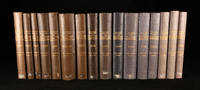
1922réf. 692L1Berlin: Akademie der Wissenchaften 1922-38. Cloth. Very Good Indeed. 10.5" by 7.5". None. A scarce complete run of the Akademie der Wissenschaften's publications from the year 1922-38 which contain twenty-six first editions of Einstein's lectures held at the Prussian Academy 1922-38. Containing 26 first editions of Einstein's lectures held at the Prussian Academy 1922-38 some library ink stamps some toning occasional fraying and one or two closed tears bound with original printed wrappers uniform cloth spines slightly faded and with remnants of paper labels at foot large 8vo Comprising of the following works by Einstein: 1. Zur Theorie der Lichtfortpflanzung in dispergierenden Medien 1922 pp. 18-22; 2. Bemerkung zu der Abhandlung von E. Trefftz: Das statische Gravitationsfeld zweier Massenpunkte in der Einsteinschen Theorie 1922 pp. 448-449; 3. Zur allemeinen Relativitätstheorie 1923 pp. 32-38; 4. Bemerkung zu meiner Arbeit "Zur allgemeinen Relativitätstheorie" 1923 pp. 76-77; 5. Zur affinen Feldtheorie 1923 pp. 137-140; 6. Bietet die Feldtheorie Moeglichkeiten fuer die Loesung des Quantenproblems 1923 pp. 359-364; 7. Quantentheorie des einatomigen idealen Gases 1924 pp. 261-267; 8. Quantentheorie des einatomigen idealen Gases. Zweite Abhandlung 1925 pp. 3-25; 9. Einheitliche Feldtheorie von Gravitation und Elektrizität 1925 pp.414-419; 10. Über die Interferenzeigenschaften des durch Kanalstrahlen emittierten Lichtes 1926 pp. 334-340; 11. With J. Grommer: Allgemeine Relativitätstheorie und Bewegungsgesetz 1927 pp.2-13; 12. Zu Kaluzas Theorie des Zusammenhanges von Gravitation und Elektrizität. Erste Mitteilung 1927 pp. 23-25; 13. Zu Kaluzas Theorie des Zusammenhanges von Gravitation und Elektrizität. Zweite Mitteilung 1927 pp. 26-30; 14. Allgemeine Relativitätstheorie und Bewegungsgesetz 1927 pp. 235-245; 15. Reimann-Geometrie mit Aufrechterhaltung des Begriffes des Fernparallelis-mus 1928 pp. 217-221; 16. Neue Möglichkeit für Eine Einheitliche Feldtheorie von Gravitation und Elektrizität 1928 pp. 224-227; 17. Zur einheitlichen Feldtheorie 1929 pp. 2-7; 18. Einheitlichen Feldtheorie 1929 pp. 2-7; 19. Die Kompatabilität der Feldgleichungen in der einheitlichen Feldtheorie 1930 pp. 18-23; 20. With Walter. Mayer: Zwei Strenge Statische Losungen der Feldgleichungen der Einheitlichen Feldtheorie 1930 pp. 110-120; 21. Zur Theorie der Raeume mit Riemann-Metrik und Fernparallelismus 1930 pp. 401-402; 22. Die Kompatibilitaet der Feldgleichungen in der einheitlichen Feldtheorie 1930 pp. 18-23; 23. Zum Kosmologischen Problem der allgemeinen Relativitaetstheorie 1931 pp. 235-237; 24. Systematische Untersuchung über kompatible Feldgleichungen welche in einem Riemannschen Raume mit Fern-Parallelismus gesetzt werden können 1931 pp. 257-265; 25. Einheitliche Theorie von Gravitation und Elektrizitaet 2. Abhandlung 1932 pp. 130-137; 26. Semi-Vektoren und Spinoren 1932 pp. 522-550. Einstein is known for developing the theory of relativity which is one of the two pillars of modern physics. His work greatly influenced the philosophy of science and for producing the world's most famous equation 'E= mc2'. He won the Nobel Prize in Physics in 1921 for his services to theoretical physics and for his discovery of the law of the photoelectric effect. The papers to this work include Einstein's papers on Bose-Einstein condensation the phenomenon that causes bosons to become a superfluid at low temperatures. There is also Einstein's two part commentary on Kaluza's theory involving field equations in five-dimensional space. These papers are from the Royal Prussian Academy of Sciences which was first established in 1700. In uniform full cloth bindings. With the original paper wraps bound in. Externally all volumes are very smart. Light fading to the spine. Light shelfwear to the joints. Small split to the front joint of 1929 volume. A few marks to the tail of spines with evidence of library label removal. Internally all volumes are firmly bound. Institutional stamp to the verso of original wraps bound in for the Bodleian Library with their cancellation stamps. Repair to the front wrap of 1928 wrap. Minor chips to the occasional extremity. Pages are slightly age toned to edges due to paper used. Otherwise pages are very clean. Very Good Indeed Akademie der Wissenchaften hardcover
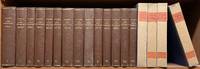
réf. 84067Leipzig Breitkopf und Härtel 1918-35. 8vo. Later brown cloth up to 1932 1932-35 sewn as issued in boxes. 14 volumes and four boxes. With library stamps from Musikmuseet in Stockholm. All published. Alfred Einstein was editor up to 1933 when he had to leave Nazi Germany. Editor for the two last years was Max Schneider. hardcover
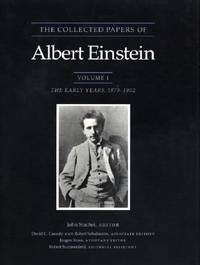
1987réf. 50442Princeton University Press 1987. First Edition . Cloth. Fine/Near Very Fine. 4to - over 9¾" - 12" tall. Edited by John Stachal. Very large very heavy sturdy book quality blue cloth very bright gilt lettering on spine 433 pages illustrations throughout including drawings and formulas. DJ glossy beneath mylar black background photo of young Einstein in white frame at center front. DJ has light crease along bottom back. Near Very Fine DJ/Very Fine book. Princeton University Press hardcover
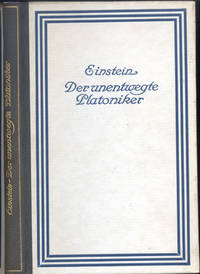
réf. 0336-02Lpz. Wolff 1918. 177 2 S. OHLdr. mit Kopfgoldschnitt u. Rückengoldpräg. EA. W.- G.² 6; Raabe/Hannich-B. 65.4 - In nur 850 Expl. gedruckt. - Enthält die drei Erzählungen: Der unentwegte Platoniker; G.F.R.G. Gesellschaft für religiöse Gründungen; Die Mädchen auf dem Dorfe. Lpz., Wolff [1918]. unknown
1970réf. P-24781New York: Horizon Press 1970. Hardcover. Fine/First Edition. Octavo. The first book publication of these conversations and interviews with the legendary physicist as translated by Henry L. Brose. Single 1970 date on copyright page and $8.50 flap price bound in the original grey cloth with Einstein's name debossed on the front cover. A clean unmarked copy quite fine and uncommon thus. Archival Mylar jacket cover included. Horizon Press hardcover
1950réf. P-27103Princeton: Princeon University Press 1950. Hardcover. Fine/3rd Edition. Duodecimo. The revised third edition including The Generalized Theory Of Gravitation.' 12mo 165 pp 2 leaves index. Original cloth. Book is fine in very good unclipped dust jacket with light spine tanning and a small 1/$" V chip to the lower spine. Attractive and solid in the archival Mylar jacket cover. Princeon University Press hardcover
1979réf. P-18052Princeton NJ: Princeton University Press 1979. Hardcover. As New/First Edition. Octavo. With the reeata slip laid in. First publication of these letters by Einstein. A clean unmarked and unclipped copy. Princeton University Press hardcover
réf. 600810New York: Oxford University Press 1962. First Paperback Edition; Fifteenth Printing. Softcover. Very Good in wraps. Rubbing on panel edges. Toning on text block edges.; 492 pages. Oxford University Press unknown
1950réf. 059077New York: Philosophical Library 1950. 1st Edition Reprint. Hardcover. Near Fine. 282 Pp. Dark Blue Cloth Lettered In Gilt. First Edition But A Later Printing Lacking The Frontispiece Portrait Of Einstein By Lotte Jacobi. Book Is Near Fine Light Rubbing At Corners Lettering Strong No Marks. Philosophical Library hardcover
1998réf. 1-0691059381Princeton Univ Dept of Art & 1998. Hardcover. New. illustrated edition. 198 pages. 8.75x6.00x0.75 inches. Princeton Univ Dept of Art & hardcover
2019réf. 1-0764357271Schiffer Pub Ltd 2019. Hardcover. New. 272 pages. 11.25x8.75x1.25 inches. Schiffer Pub Ltd hardcover
1950réf. 046941New York: Philosophical Library 1950. 1st Edition 1st Printing. Hardcover. Near Fine/Very Good. Frontispiece. 282 Pp. Green Cloth Lettered In Gilt On Front CoverAlso Lettered In Gilt In Spine Stamped On Two Blocks Of Dark Blue Background. Dust Jacket Priced $4.75 With Only 15 Titles On Rear Panel Two First Published In 1950 The Others First Published By Philosophical Library 1942 To 1949. Frontispiece Portrait Of Einstein By Lotte Jacobi. There Are Many Issues With Identical Pagination In Cloth Or Boards Of Various Colors All With Later Post-1950 Publications Indicated On The Rear Panel In Both The Plainer Dust Jacket As On This Copy And In A More Elaborate Jacket; We Believe This Is The First Issue Only By A Process Of Elimination Not Having Seen Many Different Bindings And Dust Jackets. Book With Light Wear Gilt Brilliant No Marks. Dust Jacket With Wear Small Losses/Chips At Corners Not Price Clipped Slight Browning To Spine Panel. Philosophical Library hardcover
réf. 697874291Springer . Papeback. New. pp. 400 Springer unknown
1955réf. 21242781955. London: Victor Gollancz Ltd. 1955. offered with:BLACKETT Patrick Maynard Stuart. The Atom and the Charter. London and Hereford: the Hereford Times for 'Fabian Publications ltd in conjunction with Victor Gollancz Ltd'. September 1946. offered with:BLACKETT Patrick Maynard Stuart. The Atom and the Charter. London and Hereford: the Hereford Times for 'Fabian Publications Ltd in conjunction with Victor Gollancz Ltd'. September 1946.8vo. Publisher's blue cloth lettered in gilt to spine in yellow dust-jacket printed in red and black; pp. 22 2 blank; maps and tables in the text spine of jacket sunned a little spotting to back cover small closed tear to back flap hinge c. 10 mm lettering to spine rubbed small chip to upper joint; very good; contemporary Foyles label to pastedown 'P. M. S. Blackett' see below with Blackett's ownership inscription in blue ink to front free endpaper.First English edition with a preface by Einstein of this work arguing for nuclear disarmament translated by the gardener novelist and anarchist Edward Byams this copy from the library of Nobel Prize-winning physicist Patrick Blackett whose own work is discussed at length in the book.Jules Moch 1893-1985 worked as a French Resistance organiser during the war later became a senior minister in several post-war governments and was France's delegate to the UN Disarmament Committee for 1951-1960. It was this latter role that informed the principles he sets forth in Human Folly which argue for multilateral nuclear disarmament. Divided into two parts the first examines the destructive capacities of modern warfare before tracing the recent history of disarmament negotiations. Moch attempts to represent both Soviet and Western positions with fairness concluding that the divisions between the two are gradually narrowing. Though he does not regard the situation as entirely hopeless he presents it as one of pressing urgency. The preface by Albert Einstein one of Moch's most eminent supporters makes clear peace can only arise from political will: 'Those who do not believe in the possibility of the attainment of a lasting and assured peace or have not the courage to act accordingly are ripe for destruction' p. 8. Provenance: front free endpaper with the ownership inscription of Patrick Blackett 1897-1974 with his occasional underlining throughout and one word 'Target' in pencil to the top of p. 10. Blackett was awarded the 1948 Nobel Prize in Physics for his pioneering work in nuclear physics and cosmic radiation including experiments demonstrating nuclear transmutation and important early research into the positron. During the Second World War he headed Operational Research at the Admiralty where his statistical criticism of the RAF blanket bombing campaigns led to increasing ostracism from the military authority. His opposition to mass destruction later informed his belief that Britain should not develop nuclear weapons. Combined with his openly socialist views this attracted the attention of MI5 and led to his inclusion on George Orwell's list of alleged 'crypto-communists' contributing to his marginalisation by the post-war Labour government. Blackett's book The Military and Economic Consequences of Atomic Energy 1948 is discussed at length by Moch pp. 117-19. Written before the development of second-generation thermonuclear weapons Blackett had estimated that thousands of atomic bombs would be required to destroy the United States or the Soviet Union when at the time only a few dozen existed. As Moch observes on p. 121 however 'today a few dozen thermonuclear bombs would produce the same results'. It is particularly notable that Blackett has not annotated the passages explicitly discussing his work. This copy of Human Folly is offered with Blackett's pamphlet The Atom and the Charter which discusses the extent to which 'the advent of atomic bombs necessitates changes in the procedure for the application of sanctions under the Charter of the United Nations Organisation' issued by Victor Gollancz and the socialist Fabian Society on behalf of the Association of Scientific Workers a scientific trade union of which Blackett was president. hardcover
réf. 44564555-nnew. unknown