2534 risultati
1908rif. 50421Leipzig 1908. 1 Planck Max 1858-1947. Zur dynamik bewegter systeme. In Annalen der Physik 26 6: 1-34 pp. 2 Einstein Albert 1879-1965 and Jakob Laub 1882-1962. Über die elektromagnetischen grundgleichungen für bewegte Körper. In Annalen der Physik 26 8: 532-40 pp. Boni 22 Weil 22. 3 Einstein A. and J. Laub. Über die im elektromagnetischen felde auf ruhende Körper ausgeubten ponderomotorischen Krafte. In Annalen der Physik 26 8: 541-50 pp. Boni 23 Weil 23. Red cloth gilt lettering on spine. Figs. Text-illust. 230 x 141 mm. Whole volume: viii 1032 pp. 8 plates 3 folding 3 b/w silver photos. Spine a little worn but still Very Good. Approximate English translations of titles: 1 "On the dynamics of moving systems". 2 "On the fundamental electromagnetic equations for moving bodies;" and 3 "On the ponderomotive forces exerted on bodies at rest in the electromagnetic field." "Einstein wrote no. 2 above and "Elementary theory of Brownian motion" in Zeitschrift für Elektrochemie und angewandte physikalische Chemie 14 1908: 235-239 pp. in a three-week period with Jakob Laub his first scientific collaborator to address the problems of formulating relativistically invariant equations for electromagnetic fields in moving media first raised by Hermann Minowski the year before." Calaprice An Einstein Encyclopedia. 2015. A correction to this paper no. 2 was published later in the year in vol. 27 1908: 232 and a supplement for the following year in vol. 28 1909: 445-447. Elaborating on the relativistic transformation of Maxwell's vacuum equations . . . Einstein and Laub also consider the displacement vector D and the magnetic induction B. Weil's Einstein Bibliography nos. 22 23. Boni's Einstein Checklist nos. 22 23. Max Karl Ernst Ludwig Planck 1858-1947 was a German theoretical physicist who was awarded the 1918 Nobel Prize in Physics "in recognition of the services he rendered to the advancement of Physics by his discovery of energy quanta" nobelprize.org. Planck revolutionized human understanding of atomic and subatomic processes as the originator of the quantum theory. Jakob Laub 1882-1962 was a physicist who is best known for his work in the early period of special relativity having worked alongside Albert Einstein during that time. . unknown books
rif. 504141 First Edition journal issue. The brilliant follow-up to Einstein's landmark 1905 paper on the photoelectric effect. In the 1905 paper Einstein had explained the photoelectric effect-the emission of electrons from a metal when irradiated by light-by making the revolutionary proposal that light rather than consisting of continuous waves was instead made up of discrete particles of energy "light quanta" which transferred their entire payload of energy to an electron on impact. In the 1905 paper Einstein made use of Planck's mathematical formula for blackbody radiation which had introduced the concept of energy quanta but he was only able to derive part of the formula. In his 1906 paper Einstein "used his statistical mechanics to demonstrate that when light interacts with matter Planck's entire formula can arise only from the existence of light quanta-not from waves" Cassidy; emphasis ours. Einstein had realized as he stated in the present paper that "'Planck's theory makes implicit use of the . . . light-quantum hypothesis' . . . his acceptance of Planck's formula albeit as a hypothesis led to a major advance in his own work" Pais Subtle is the Lord p. 378. In 1921 Einstein was awarded the Nobel Prize in physics for his work on the photoelectric effect. Cassidy David "Einstein on the Photoelectric Effect." Einstein: Image and Impact. American Institute of Physics n.d. Web. Accessed 09 July 2014. Shields "Writings of Albert Einstein" in Albert Einstein: Philosopher-Scientist 1948 pp. 689-758 no. 13; also included in Shields' "Chronological list of principal works" on p. 757. Weil Albert Einstein: A Bibliography no. 12. 2 First Edition journal issue of Einstein's second paper on the inertia of energy following his 1905 paper "Ist die Trägheit eines Körpers von seinem Energieinhalt abhängig" Is the inertia of a body dependent on its energy content. In the present paper Einstein presented another argument in support of the proposition that a body's energy depends on its energy content. "About a year after he first introduced the inertia of energy Einstein published a paper entitled "The Principle of the Conservation of the Center of Gravity and the Inertia of Energy" in which he showed that E = mc2 is necessary and sufficient to ensure that the center-of-mass theorem holds for systems in which 'not only mechanical but also electromagnetic processes take place' . . . As Einstein acknowledges his paper is similar to Poincaré's contribution to the Lorentz Festschrift 1900. Einstein showed that in order to avoid the kind of violations of the center-of-mass theorem discussed by Poincaré one has to assume that energy has inertia" Janssen pp. 39-40. Janssen "The Trouton experiment E = mc2 and a slice of Minkowski space-time" in Revisiting the Foundations of Relativistic Physics: Festschrift in Honor of John Stachel 2003 pp. 27-54. Weil Albert Einstein Bibliography 13. . unknown books
1912rif. 50338Leipzig: Johann Ambrosius Barth 1912. Einstein Albert 1879-1955. 1 Lichtgeschwindigkeit und Statik des Gravitationsfeldes pp. 355-369. Weil 47 Boni 43. 2 Zur Theorie des statischen Gravitationsfeldes pp. 443-458. Weil 48 Boni 44. 3 Nachtrag zu meiner Arbeit: "Thermodynamische Begrundung des photochemischen Aquivalentgesetzes" pp. 881-885. Weil 46 Boni 42. 4 Antwort auf eine Bemerkung von J. Stark: "Uber eine Anwedung des Planckschen Elementargesetzes" pp. 888. Weil 49 Boni 45. 5 Relativitat und Gravitation. Erwiderung auf eine Bemerkung des Hrn. A. Einstein pp. 1059-1064. Weil 50 Boni 46. In Annalen der Physik 38 1912. Red cloth with gilt lettering on the spine. Whole volume: 1064 pp. 8 plates. Text-figs. 210 x 130 mm. Very good copy. Approximate English translations of titles with brief explanations of referenced paper if available: 1 "The speed of light and the statics of the gravitational field." "Further exploring his studies of gravitation based on the equivalence principle Einstein sees with growing clarity that gravitation is intimitely linked with the problem of the measurement of space and time" p. 292. Calaprice Kennefick & Shulmann. An Einstein Encyclopedia. 2015.; 2 "On the theory of the static gravitational field." "Einstein more closely analyzes the equations of motion stated in no. 1 above concluding that those equations cannot be reconciled with the given field equations for c . . . because the principle of "action equals reaction" is violated. p. 290. Calaprice Kennefick & Shulmann. An Einstein Encyclopedia. 2015.; 3 "Addendum to my work: 'Thermodynamic justification of the photochemical equivalent law' "; 4 "Answer to my remark by J. Stark: "On an application of Planck's elementary law' "; 5 "Relativity and gravitation. Response to a remark by Mr. A Einstein". Weil's Einstein Bibliography nos. 47 48 46 49 and 50. Boni's Einstein Checklist nos. 43 44 42 45 and 46. . Johann Ambrosius Barth unknown books
1907rif. 50420Leipzig: Johann Ambrosius Barth 1907. Einstein explicitly establishes E=mc2. Einstein Albert 1879-1955. 1 Über die Möglichkeit einer neuen Prüfung des Relativitätsprinzips. In Annalen der Physik 23 6: pp. 197-8. 2 Bemerkungen zu der Notiz von Hrn. Paul Ehrenfest: "Die translation deformierbarer Elektronen und der Flächensatz." In Annalen der Physik 23 6: pp. 206-8. 3 Über die vom relativitätsprinzip geforderte Trägheit der Energie. In Annalen der Physik 23 7: pp. 371-384. 8vo. Red cloth gilt lettering on spine. 214 x 140 mm. Whole volume: viii 1000 pp. 4 plates numbered Taf. I - IV. Tafs. I II and IV are folding Taf. III is b/w silver photograph tipped to sheet. Foot of the spine is repaired. Very good. Approximate English translations of titles: 1 "On the possibility of a new test of the principle of relativity." 2 "Remarks on Mr. Paul Ehrenfest's note: 'The translation of deformable electrons and the surface theorem.'" 3 "On the inertia of energy required by the principle of relativity." In "On the inertia of energy required by the relativity principle" May 1907 "Using rather than m V rather than c and 0 rather than E0 Einstein wrote his famous equation for the first time as V2= 0 and he did it in a footnote. At the end of that paper he introduced the symbol E0 to denote energy in the rest frame and wrote the famous expression again this time as =E0/V2." -Eugene Hecht How Einstein confirmed E0 = mc2 In the third paper Einstein explicitly establishes his famous equation E=mc2 although with different symbols. In this paper Einstein discussed the relationship between inertial mass and energy arguing for their complete equivalence namely that every mass has an equivalent energy just as every form of energy has an equivalent mass. This relation says that a photon can convert for the equivalence of mass and energy his celebrated equation E = mc2 Calaprice The Einstein Almanac. Weil's Einstein Bibliography nos. 17 18 and 19 respectively. Boni's Einstein Checklist nos. 17 18 and 19 respectively. . Johann Ambrosius Barth unknown books
1906rif. 504131906. Einstein Albert 1879-1955. Über eine Methode zur Bestimmung des Verhältnisses der transversalen und longitudinalen Masse des Elektrons. In Annalen der Physik 21 1906. 583-586pp. Figs. Text-illust. 214 x 140 mm. Laid-in item: notecard with penciled notes probably in the hand of Lord Rayleigh. Red cloth gilt spine. Frontis portrait of P. Curie d. 1906. Whole volume: viii 1056pp. 9 plates 5 b/w silver photos 4 folding. Small cut on spine starting approximately two inches from the head and is about three inches in length -very thin- otherwise Very Good. First Edition Whole Volume. In his landmark 1905 paper on special relativity Einstein used the velocity-dependent concepts of transverse and longitudinal mass for the moving electron these terms have now been replaced with the concept of relativistic mass first defined by Lewis and Tolman in 1909. In the present paper Einstein proposed an experimental method for determining the ratio of the transverse to the longitudinal mass and invited experimentalists to verify his special theory of relativity. Einstein later abandoned velocity-dependent mass concepts stating in 1948 that "it is better to introduce no other mass concept than the rest mass" quoted in L. B. Okun "The concept of mass" Physics Today 1989: 31-36. Lavenda A New Perspective on Relativity pp. 7-8. Weil's Einstein Bibliography no. 14. Boni's Einstein Checklist no. 14 John William Strutt third Baron Rayleigh Lord Rayleigh 1842-1919 was a british mathematician and physicist; he was one of the very few members of higher nobility who won fame as an outstanding scientist. Rayleigh was born as the son of John James Strutt second Baron and his wife Clara Elizabeth La Touche eldest daughter of Captain Richard Vicars R.E. Lord Rayleigh was awarded the 1904 Nobel Prize in Physics "for his investigations of the densities of the most important gases for his discovery of argon in connection with these studies." Rayleigh provided the first theoretical treatment of the elastic scattering of light by particles much smaller than the light's wavelength now known as "Rayleigh scattering" - a process which notably explains why the sky is blue. He also made extensive contributions to fluid dynamics e.g. the Rayleigh number critereon for the stability of the Taylor-Couette flow etc. Rayleigh also formulated the circulation theory of aerodynamic lift. His derivation of the Rayleigh-Jeans law for classical black body radiation played an important role in the birth of quantum mechanics i.e. the Ultraviolet catastrophe. During the first World War he was president of the United Kingdom government's Advisory Committee for Aeronautics. Notable students of the 3rd Lord Rayleigh include J.J. Thomson 1856-1940 and Sir William Ramsay 1852-1916 who was awarded the Nobel Prize in Chemistry in 1904 "in recognition of his services in the discovery of the elements in air." In 1871 he married Evelyn Balfour sister of the future prime minister the Earl of Balfour and daughter of James Maitland Balfour and his wide Blanche the daughter of the second Marquis of Salisbury. They had three sons the eldest of whom Robert John Strutt 1875-1946 was to become Professor of Physics at Imperial College of Science and Technology London. Strutt inherited the title of fourth Baron Rayleigh after his father's death in 1919. nobelprize.org. Also in this volume: Einthoven Willem 1860-1927. Weitere mitteilungen ueber das saitengalvanometer. Analyse der saitengalvanometrischen kurven. Masse und spannung des quarzfadens und widerstand gegen die fadenbewengung. Erster teil. In Annalen der Physik ser. 4 21 1906. 483-514 pp. Willem Einthoven 1860-1927 was a Dutch doctor and physiologist who won the Nobel Prize in Physiology or Medicine in 1924 "for his discovery of the mechanism of the electrocardiogram" nobelprize.org. . unknown books
1910rif. 50336Leipzig: Johann Ambrosius Barth 1910. Einstein Albert 1879-1955. 1 Uber einen Satz der Wahrscheinlichkeitsrechnung und seine Anwendung in der Strahlungstheorie with L. Hopf. pp. 1096-1104. Weil 34 Boni 29. 2 Statistiche Untersuchung der Bewegung eines Resonators in einem Strahlungsfeld with L. Hopf. pp. 1105-1115. Weil 35 Boni 30. 3 Theorie der Opaleszens von homogenen Flüssigkeiten und Flüssigkeitsgemischen in der Nähe des kritischen Zustandes. pp. 1275-1298. Weil 36. In Annalen der Physik und Chemie 33. Red cloth with gilt lettering on the spine. Whole volume: viii 1584 pp. 6 plates. Text-figs. 210 x 130 mm. Very good copy. Approximate English translations of titles and brief explanations of papers: 1 "On a theorem of probability calculus and its application in the radiation theory." "Einstein and Hopf wrote this paper to show that the failure of statistical mechanics vis-a-vis the radiation law cannot be ameliorated by proposing that individual statistical events in the emission of light from different points on the surface of a luminous body are not actually independent but instead are interdependent with each other. Even if one assumes a failure to be statistically independent one derives the same usual form of the radiation law as Fourier sum." p. 290. Calaprice Kennefick & Shulmann. An Einstein Encyclopedia. 2015. 2 "Statistical investigation of the movement of a resonator in a radiation field." With: L. Hopf. "The authors make use of the results in no. 1 above demonstrating that the Rayleigh-Jeans law of radiation is an unavoidable consequence of statistics even if we avoid assumptions that we may think need correction. In other words we cannot blame statistics for a faulty result." p. 290. Calaprice Kennefick & Shulmann. An Einstein Encyclopedia. 2015. 3 "Theory of the opalescence of homogenous liquids and liquid mixtures near the critical state"."Einstein explains the optical effects that occur near the critical point of a fluid at which liquid gas phases can coexist and of a binary mixture of liquids that can also explain the blue color of the sky. It adds to earlier stuidies that provided evidence for the atomistic constitution of matter and is one of the most difficult papers to understand." p. 290. Calaprice Kennefick & Shulmann. An Einstein Encyclopedia. 2015. "October 1910. E. completes a paper on critical opalescence his last major work in classical statistical physics." Pais Subtle is the Lord. 523. Weil's Einstein Bibliography nos. 34 35 and 36 respectively. Boni's Einstein Checklist nos. 29 30 and 31 respectively. . Johann Ambrosius Barth unknown books
1911rif. 50315Leipzig: Johann Ambrosius Barth 1911. Einstein Albert 1879-1955. 1 Bemerkung zu dem Gesetz von Eötvös. In Annalen der Physik 34 1: 165-169 pp. 1910. Weil 38 Boni 35. 2 Eine beziehung zwischen dem elastischen Verhalten und der spezifischen Wärme bei festen Körpen mit einatomigem Molekül. In Annalen der Physik 34 1: 170-174 pp. 1910. Weil 39 Boni 36. 3 Bemerkungen zu den P. Hertzschen Arbeiten: "Über die mechanischen Grundlagen der Thermodynamik." In Annalen der Physik 34 1: 175-176 pp. 1910. Weil 40 Boni 37. 4 Bemerkung zu meiner Arbeit: "Eine Beziehung zwischen dem elastischen Verhalten . . ." In Annalen der Physik 34 3: p. 590. Weil 40. 5 Berichtigung zu meiner Arbeit: "Eine neue Bestimmung der Moleküldimensionen." In Annalen der Physik 34 3: p. 591. Weil 41. Leipzig: Johann Ambrosius Barth 1911. Whole volume: viii 1032 pp. 6 plates 5 folding 1 b/w/ silver photograph. Figs. Text-illust. 210 x 140 mm. Red cloth with gilt lettering on spine. First Edition. Pages are a little toned as are plates 5 and 6 otherwise Very Good. Approximate English translations of titles: 1 "Remarks on the law of Eötvös." 2 "A connection between the elastic conduct and the specific heat of solid bodies with monatomic molecule." 3 "Remarks on P. Hertz' work: 'On the mechanical foundations of thermodynamics.'" Eövtös' findings served as part of the basis of Albert Einstein's General Theory of Relativity in which the principle of equivalence acts as the keystone no. 1 above. "Einstein adds a comment on p.590 of the same journal no. 2 above. To supplement Sutherland's observation that infared eigenfrequencies of solid bodies possibly originate in the elastic vibrations of these bodies Einstein adds that electrically charged ions are the source of optical vibrations while the mututal motions of the entire molecule cause elastic vibrations." Calaprice Alice et al. An Einstein Encyclopedia. 2015. p. 291. Weil's Einstein Bibliography nos. 38 39 40 and 41. Boni's Einstein Checklist nos. 35 36 and 37. . Johann Ambrosius Barth unknown books
1911rif. 50316Leipzig: Johann Ambrosius Barth 1911. Einstein Albert 1879-1955. Elementare Betrachtungen über die thermische Molekular bewegung in festen Körpern. In Annalen der Physik 35 9: 679-694 pp. Whole issue disbound from larger volume but still stitched together front wrapper detached chipped with loss and tears else very good. Whole issue: pp. 617-816 3 plates. First edition of Einstein's sequel and complement to his 1907 paper on Planck's theory of radiation and heat translated as Elementary Observations on Thermal Molecular Motion in Solids. Einstein tries to improve upon his model of specific heats after realizing the model was inocrrect at very low temperatures. The correct answer would come a year later with the Debye model. "Elementary observations on thermal molecular motion in solids. . . Here Einstein continues the work he had begun in 1907 on the specific heat of solids where the heat agitation of solids was reduced to a monochromatic oscillation of the atom and the specific heat was determined based on the quantum treatment of an oscillator in a radiation field. He explains the discrepancies between his formula and the measurements at low temperatures." p. 291. Calaprice Kennefick & Shulmann. An Einstein Encyclopedia. 2015. Weil's Einstein Bibliography no. 42. . Johann Ambrosius Barth unknown books
1911rif. 50424Leipzig: Johann Ambrosius Barth 1911. The Genesis of General Relativity Einstein Albert 1879-1955. 1 Elementare betrachtungen über die thermische molekularbewengung in festen Körpern. In Annalen der Physik 35 9: 679-94 pp. Weil 42. 2 Über den Einfluß der Schwerkraft auf die Ausbreitung des lichtes. In Annalen der Physik 35 10: 898-908 pp. Weil 43. Red cloth gilt spine lettering. Figs. Text-illust. 214 x 140 mm. Whole volume: viii 1040 pp. 6 plates 3 b/w silver photos 1 colorized 2 folding. Very good. Approximate English translations of titles: 1 "Elementary considerations about thermal molecular motion in solid bodies" and 2 "On the influence of gravity on the propagation of light." "Einstein returns to his thoughts on gravitation and discusses his ideas on the static gravitational field no. 1 above advancing the "half-shift" prediction of the deflection of light by a massive body such as the Sun. In his early papers on the subject . . . he used two important features: the principle of equivalence and the role of the speed of light. In this paper he takes a broader perspective saying that if a light beam is bent in an accelerating frame of reference then if the theory is correct it must also be besnt by gravity by exactly the equivalent amount." Calaprice An Einstein Encyclopedia. "An important conclusion of this paper is that the velocity of light in a gravitational field is a function of the place. The equation: c = c01 / c2 signifies that there exists a relationship between the velocity of light and the gravitational potential; the latter influences the first." Weinstein Einstein's 1912-1913 struggles with Gravitation Theory: Importance of Static Gravitational Fields Theory. "Here no. 2 above Einstein continues the work he had begun in 1907 on the specific heat of solids where the heat agitation of solids was reduced to a monochromatic oscillation of the atom and the specific heat was determined based on the quantum treatment of an oscillator in a radiation field. He explains the discrepencies between his formula and the measurements at low temperatures" Calaprice An Einstein Encyclopedia. Weil's Einstein Bibliography nos. 42 and 43. Boni's Einstein Checklist nos. 38 39. . Johann Ambrosius Barth unknown books
1916rif. 50341Leipzig: Johann Ambrosius Barth 1916. Einstein Albert 1879-1955. Über Friedrich Kottlers Abhandlung "Über Einsteins Äquivalenzhypothese und die Gravitation." In Annalen der Physik 51 638-642 pp. Red cloth with gilt lettering on the spine. Whole volume: 883 pp. 4 plates. Figs. Text-illust. 210 x 130 mm. A very good copy. Weil's Einstein Bibliography no. 81. Boni's Einstein Checklist no. 79. . Johann Ambrosius Barth unknown books
1920rif. 43308Berlin: Springer 1920. 15pp. 221 x 146 mm. Original printed wrappers foxed. Minor internal foxing but very good. First edition cover title does not include the date Einstein delivered his lecture; see Weil. "By royal decree of June 24 1920 a special chair in Leiden University was created for Einstein enabling him to come to that university for short periods of his choosing. On October 27 1920 Einstein began his new position with an inaugural address on aether and relativity theory" Pais Subtle is the Lord p. 313. Weil Albert Einstein Bibliography 111. Springer unknown books
1923rif. 433151923. Offprint from Sitzungsberichte der preussischen Akademie der Wissenschaften 1923. 359-364pp. 254 x 184 mm. Original printed wrappers. Very good. First Edition offprint issue. Weil Albert Einstein Bibliography 137. unknown books
1927rif. 433031927. Offprint from Sitzungsberichte der preussischen Akademie der Wissenschaften 1927. 235-245pp. 255 x 183 mm. Original printed wrappers. Fine. On the problem of motion in general relativity theory; a follow-up to his and Grommer's paper of the same title published earlier in 1927. Weil Albert Einstein Bibliography 160. unknown books
1907rif. 432971907. Einstein Albert 1879-1955. Berichtigung zu meiner Arbeit: "Die Plancksche Theorie der Strahlung etc." Offprint from Annalen der Physik 22 1907. Single sheet p. 800. Unbound as issued. 223 x 145 mm. Lower corner lightly creased but very good. First Edition Rare Offprint Issue. Einstein's important correction to his paper on specific heats "Die Plancksche Theorie der Strahlung und die Theorie der spezifischen Wärme" 1907; see Weil 15 which "made clear for the first time that quantum concepts have a far more general applicability" Pais p. 394. "Einstein initially believed that his oscillating lattice points in a three-dimensional crystal lattice were electrically charged ions. A few months later he published a correction to his paper in which he observed that this was an unnecessary assumption . . . Einstein's correction freed the quantum rules in passing one might say from any specific dependence on electromagnetism" Pais p. 396. Pais Subtle is the Lord pp. 394-396. Weil 15n. . unknown books
1923rif. 432881923. Einstein Albert 1879-1955 and Paul Ehrenfest 1880-1933. Zur Quantentheorie des Strahlungsgleichgewichts. Offprint from Zeitschrift für Physik 19 1923. 301-306pp. Original printed self-wrappers. 230 x 157 mm. Light toning but very good. First Edition Offprint Issue. In 1916 after publishing his great work on general relativity Einstein returned to the question of blackbody radiation. In November 1916 he wrote to his friend Besso that "a splendid light has dawned on me about the absorption and emission of radiation" quoted in Pais p. 405 one that led him to a new derivation of Planck's radiation law and convinced him of the reality of light-quanta photons. After publishing these results in three papers culminating with the famous "Zur Quantentheorie der Strahlung" 1917 Einstein kept looking for "new ways in which the existence of photons might lead to observable derivations from the classical picture" Pais p. 413. He found none until 1923 when Arthur Compton and Peter Debye independently derived the relativistic kinematics for the scattering of a photon off an electron at rest. The work of Compton and Debye led Wolfgang Pauli to extend Einstein's work of 1917 to the case of radiation in equilibrium with free electrons see Pais p. 414n. "Pauli examined the requirements of detailed balance under Lorentz transformations and found that scattering of light by free electrons must include a term of a form which we would now call stimulated emission . . . Einstein and Ehrenfest then showed that Pauli's results could be obtained by an extension of Einstein's 1917 paper with the unnecessary specialization to discrete energy levels removed . . . The core of Einstein's argument is that the scattering process should be broken into two parts: the absorption of energy from radiation of frequency 1 and the emission of energy as radiation of frequency 2" Lewis p. 42. Lewis "Einstein's derivation of Planck's radiation law" American Journal of Physics 41 1973: 38-44. Pais Subtle is the Lord ch. 21. Weil Albert Einstein Bibliography 138. . unknown books
1921rif. 433161921. Offprint from Sitzungsberichte der preussischen Akademie der Wissenschaften 1921. Single sheet pp. 882-883. 256 x 184 mm. Minor marginal tears one corner chipped but very good. First ediiton offprint issue. "Since after 1917 Einstein firmly believed that light-quanta were here to stay it is not surprising that he would look for new ways in which the existence of photons might lead to observable devations from the classical picture. In this he did not succeed. At one point in 1921 he thought he had found a new quantum criterion published in the present paper but it soon turned out to be a false lead" Pais Subtle is the Lord pp. 412-413. Weil Albert Einstein Bibliography 118. unknown books
1923rif. 433181923. Offprint from Zeitschrift für Physik 16 1923. Single sheet unpaginated. 230 x 155 mm. One corner creased but very good. First edition offprint issue. Einstein's second response to Friedmann's groudbreaking paper on equations governing the expansion of space which made a valuable contribution to Einstein's theory of relativity and admitted the possibility of an expanding universe. Einstein at first believed that Friedmann's reasoning was incorrect then corrected his own objection in the present brief "Notiz" and called Friedmann's results "clarifying." Pais Subtle is the Lord p. 288. Weil Albert Einstein Bibliography 130. unknown books
1911rif. 432921911. Einstein Albert 1879-1955. Berichtigung zu meiner Arbeit: "Eine neue Bestimmung der Moleküldimensionen." Offprint from Annalen der Physik 34 1911. 591-592pp. 224 x 146 mm. Original printed wrappers a little chipped splint in lower spine. Light toning but very good. First Edition Offprint Issue. Einstein's correction to his formula for the viscosity coefficient = 1 a key equation in his 1905 doctoral thesis in which he had presented a new theoretical method for determining molecular radii and Avogadro's number. In 1910 Jacques Bacelin a pupil of French physicist Jean-Baptiste Perrin obtained experimental results indicating a possible error in Einstein's formula. "That prompted Einstein after an unsuccessful attempt to find an error to ask his student and collaborator Ludwig Hopf to check his calculations and arguments . . . Hopf did find an error in the dissertation namely in the derivatives of some velocity components and obtained for a corrected coefficient 2.5 . . .In early 1911 Einstein submitted his correction for publication and recalculated Avogadro's number. He obtained a value of 6.56 x 10²³ per mole a value that is close to those derived from kinetic theory and Planck's black-body radiation theory" Duplantier pp. 216-217. Duplantier "Brownian motion 'diverse and undulating'" in Einstein 1905-2005: Poincaré Seminar 2005 pp. 201-293. Pais Subtle is the Lord p. 92. Weil Albert Einstein Bibliography 41. . unknown books
1932rif. 433001932. Offprint from Sitzungsberichte der Preussischen Akademie der Wissenschaften 32 1932. 31pp. 256 x 183 mm. Original printed wrappers a little chipped and darkened small splits in spine. Very good. First edition offprint issue. Einstein's work on semivectors "was stimulated by Ehrenfest's insistence on a better understanding of the relation between single-valued and double-valued representations of the Lorentz group . . . Einstein and Mayer went on to relate semivectors to the Dirac equation and to generalize the formalism to general relativity" Pais Subtle is the Lord pp. 451-452. Weil Albert Einstein Bibliography 186. unknown books
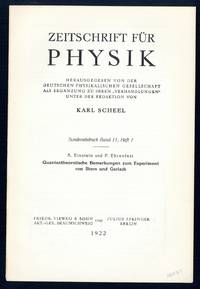
1922rif. 432871922. Einstein Albert 1879-1955 and Paul Ehrenfest 1880-1933. Quantentheoretische Bemerkungen zum Experiment von Stern und Gerlach. Offprint from Zeitschrift für Physik 11 1922. 31-34pp. 229 x 155 mm. Original printed self-wrappers. Light toning but fine otherwise. First Edition Offprint Issue. In 1922 the physicists Otto Stern and Walther Gerlach conducted a now-classic experiment in which a beam of silver atoms was streamed through an inharmonious magnetic field in order to observe the atoms' deflection patterns. Rather than a random and continuous distribution as predicted by classical theory the atoms passing through the field were deflected up or down by a specific amount demonstrating that they had intrinsically quantum properties. The Stern-Gerlach experiment corroborated the Bohr-Sommerfeld model of the atom and strongly influenced later developments in 20th century physics. However the experiment also created some serious difficulties for quantum physicists in the period before the rise of the "new" quantum mechanics. Einstein and Ehrenfest addressed one of these difficulties-connected with space quantization-in their joint paper in which "they dealt in particular with the problem of how the orbits of the atom would obtain their discrete directions which they exhibit while passing through the inhomogeneous magnetic field. Under the assumption that the mechanism causing the orientation was provided by the interaction with the radiation field Einstein and Ehrenfest estimated that for a field strength of 10000 G a change in the direction of the orbit would take place in roughly 1011 s; this long time interval would be reduced in the presence of heat radiation at room temperature . . . to about 109 s. How could they asked the experimental situation be explained which implied that the discrete orientations of the orbits in silver atoms were obtained in less than 10-4 s. In order to deal with this evident puzzle Einstein and Ehrenfest proposed two alternatives: first that the silver atoms were always in the states of spatial quantization; second the orientations of the electron orbits arose from an interaction of the atoms with the radiation field which involved much smaller reaction times . . . However they found that both alternatives created considerable difficulties in the understanding of the atomic processes . . . Thus Einstein and Ehrenfest concluded: 'The difficulties mentioned above show how unsatisfactory are both interpretations of the results found by Stern and Gerlach'" Mehra & Rechenberg The Historical Development of Quantum Theory 1 pp. 443-444. Pais Subtle is the Lord p. 328. Weil Albert Einstein Bibliography 121. . unknown books
1923rif. 433171923. Offprint from Sitzungsberichte der preussischen Akademie der Wissenschaften 1923. Single sheet pp. 76-77. 265 x 184 mm. A few marginal chips and tiny tears but very good. First edition offprint issue. The second of the four short papers Einstein published in 1923 on Eddington's program for a unified field theory. Weil Albert Einstein Bibliography 131n. unknown books
1907rif. 433121907. Offprint from "Zeitschrift für Elektrochemie" 1907. Single sheet pp. 41-42. 287 x 206 mm. Chipped several marginal tears some toning. Fair. First edition offprint issue. "In 1907 Einstein published a paper entitled 'Theoretical Observations on the Brownian Motion' in which he considered the instantaneous velocity of a Brownian particle. Einstein showed that by measuring this quantity one could prove that 'the kinetic energy of the motion of the center of gravity of a particle is independent of the size and nature of the particle and independent of the nature of its environment.' This is one of the basic tenets of statistical mechanics known as the equipartition theorem. However Einstein concluded that due to the very rapid randomization of the motion the instantaneous velocity of a Brownian particle would be impossible to measure in practice. "Einstein: The Formative Years. unknown books
1906rif. 432891906. Einstein Albert 1879-1955. Über eine Methode zur Bestimmung des Verhältnisses der transversalen und longitudinalen Masse des Elektrons. Offprint from Annalen der Physik 21 1906. 583-586pp. 223 x 145 mm. Original printed wrappers chipped spine splitting minor spotting. Light toning but very good. First Edition Rare Offprint Issue. In his landmark 1905 paper on special relativity Einstein used the velocity-dependent concepts of transverse and longitudinal mass for the moving electron these terms have now been replaced with the concept of relativistic mass first defined by Lewis and Tolman in 1909. In the present paper Einstein proposed an experimental method for determining the ratio of the transverse to the longitudinal mass and invited experimentalists to verify his special theory of relativity. Einstein later abandoned velocity-dependent mass concepts stating in 1948 that "it is better to introduce no other mass concept than the 'rest mass' m" quoted in L. B. Okun "The concept of mass" Physics Today 1989: 31-36. Lavenda A New Perspective on Relativity pp. 7-8. Weil Albert Einstein Bibliography 14. . unknown books
1908rif. 432171908. Einstein Albert 1879-1955 and Jakob Johann Laub 1884-1962. Über die elektromagnetischen Grundgleichungen für bewegter Körper. Offprint from Annalen der Physik 4th series 26 1908. 532-540pp. 225 x 146 mm. Original printed wrappers. Fine. First Edition Offprint Issue. Einstein's first paper written jointly with a collaborator on the relativistic electrodynamics of ponderable media. "In 1908 Laub wrote works together with Einstein on the basic electromagnetic equations which was aimed to replace the four-dimensional formulation of the electrodynamics by Minkowski by a simpler classical formulation. Both Laub and Einstein discounted the spacetime formalism as too complicated. However it turned out that Minkowski's spacetime formalism was fundamental for the further development of special relativity" Wikipedia. Pais Subtle is the Lord pp. 151 154. Shields 23. Weil 23. . unknown books
1915rif. 432951915. Einstein Albert 1879-1955 and Wander Johann de Haas 1878-1960. Notiz zu unserer Arbeit "Experimenteller Nachweis der Ampèreschen Molekularströme." Offprint from Verhandlungen der Deutschen Physikalischen Gesellschaft 17 1915. 1 sheet p. 420. 228 x 156 mm. Original printed wrappers. Fine copy. First Edition Offprint Issue. In 1915 Einstein and Dutch physicist Wander Johannes de Haas conducted gyromagnetic experiments leading to the discovery of the Einstein-de Haas effect which corresponds to the mechanical rotation induced in a ferromagnetic cylinder suspended inside a coil when an impulse of electric current is sent through the coil. Einstein was very enthusiastic about the experimental results stating that he and de Haas had "given firm proof of the existence of Ampère's molecular currents" quoted in Pais Subtle is the Lord pp. 245-246. Einstein and de Haas published their results in a paper published earlier in 1915 see Weil 73; the present "Notiz" is a response to a communication from American physicist Samuel Jackson Barnett who had begun performing similar experiments in 1909 and obtained results complementing those of Einstein and de Haas. Weil Albert Einstein Bibliography 73n. . unknown books