EINSTEIN, AlbertABAA

2534 risultati
1931rif. 021909New York: Covici Friede 1931. First Edition. hardcover. Some pencil markings in text title page and endpapers darkened not really affecting Einstein's inscription; covers a little soiled. Good to Very Good and quite scarce. With a long biographical note and an appreciation by George Bernard Shaw. Subjects include Disarmament Pacifism the Jewish Homeland and more. This copy INSCRIBED and SIGNED by the author with his scarcer full signature on the front endpaper: "To little Pauline/Albert Einstein/1933." An uncommon title to find signed by the man of the century. With a letter of authenticity from James Spence if you need that kind of security blanket. Covici Friede hardcover books
1996rif. UEINGER00drpContinuum 1996. Very Good. Einstein Albert. German Essays on Science in the 20th Century. Heisenberg Werner; Planck Max; Schirmacher Wolfgang. NY: Continuum 1996. 314pp. Bibliography. 8vo. Paperback. Book condition: Very good with gentle rubbing and bumping. Continuum paperback books
1983rif. 556751New York: Dover Publications Inc 1983. Softcover. Very Good. Reprint. 56pp. Pictorial wrappers. Ex-library with a label on the front cover and a stamp on the front fly spine partially unglued from text block faint dampstain in the margin of several pages about very good. Originally published by E.P. Dutton in 1923. Dover Publications Inc unknown books
1921rif. 450858New York: Harcourt Brace and Company 1921. Hardcover. Very Good. First edition. Octavo. Owner's pencil name a few easily erasable pencil notes in text small spots on front board and a little wear at the spine ends very good. Harcourt, Brace and Company hardcover books
1958rif. 33773Sporosky 1958. Flexible Covers. Very Good. Flexible Covers. Flexible green cloth boards with gilt title in Japanese to spine. Creasing to covers and spine. Housed in a beige cardboard slipcase with Japanese titling to spine and front panels. Wear and browning to case. All text in Japanese with one page in Russian. Includes several photographic illustrations many equations and a few diagrams. Foxing to fore-edge of textblock. Clean interior overall; however some passages have been underlined in pen. 339 pages. SCI/010220. (Sporosky) unknown books
1994rif. S11423New York:: Warner Books 1994. 1994. Small 8vo. 179 pp. Printed wrappers. Fine. ISBN: 0446670111 Warner Books, (1994). unknown books
2005rif. CNAP071San Francisco: The Arion Press 2005. Hardcover. New. 10-1/2 by 8 inches eighty pages. Printed by letterpress from lead-alloy type cast in the Mackenzie & Harris typefoundry the formulas were set by hand as was the display type while the prose was composed and cast in Monotype. The types are Modern for the text with special characters as needed for mathematical symbols; Egyptian for the interspersed annotations printed in blue; and Lining Gothic for display. The paper is Schiller a German mouldmade sheet. A pixelated portrait of Einstein is the frontispiece. This image is based on a photograph taken about 1910 rendered as a coarse halftone for reference then handset in units of six-point type: three sizes of solid squares and one centered dot. Over 4000 pieces of type make up the picture. The portrait is printed in gray as is the famous equation: E=mc2 which appears on the flyleaves. The binding is dark blue cloth over boards with a band of tie-dyed Thai paper to create an unusual spatial effect spanning the cover diagonally. The titling on the spine is stamped in silver foil. The edition is limited to 400 numbered copies for sale. One of the great achievements in science Albert Einstein's Theory of Relativity was set forth in two papers published in the Leipzig physics journal Annalen der Physik in 1905. The German text was translated into English in 1923 by W. Perrett and G. B. Jeffrey and this is the version with some later corrections that is presented in this book. The Einstein papers are annotated by Richard Muller who has also provided a foreword and afterword. The foreword gives a general overview of the problems Einstein addressed against the background of nineteenth-century physics. The afterword carries the story from the miraculous year of 1905 when Einstein was only twenty-six through the effects of the theory on twentieth-century science. Muller conjectures on the progress of physics had Einstein not appeared and considers his career as a whole its last thirty-five years devoted mainly to an unsuccessful attempt to create a unified field theory. ___POSTAGE: International customers please note that additional postage may apply as the standard does not always cover costs; please inquire for details. ___Swan's Fine Books is pleased to be a member of the ABAA ILAB and IOBA and we stand behind every book we sell. Please contact us with any questions you may have we are here to help. The Arion Press hardcover books
1918rif. 135751918. Mathematics Klein Felix. Autograph Letter Signed 10 November 1918 written in German to a former student and colleague directly references Einstein's recently published General Theory of Relativity and comments on the work of the International Mathematical Education Commission. Composed in the closing days of the First World War the letter places Klein within active scholarly exchange concerning the mathematical implications of relativity which had been formally presented in 1915 and widely disseminated by 1918. Klein long established for his foundational contributions to group theory non-Euclidean geometry and mathematical physics addresses questions raised by "Einstein's theory" noting that he required further reflection to clarify its implications for his own work. The document supports research in the history of relativity German mathematical networks scientific communication during wartime and the institutional organization of mathematics in the early twentieth century. Klein Felix. Autograph Letter Signed 10 November 1918. Two pages written on both sides of a single leaf. In German with accompanying English translation. Addressed to a former student the letter discusses the circulation of lecture manuscripts difficulties in securing copyists during wartime conditions and the intellectual demands posed by Einstein's theory: "A further exploration of my work does not exist yet as I had and still have more thinking to do about questions raised by Einstein's theory to clarify it for myself." Klein also comments critically on the IMUK observing that its published statements are "a display of wasted paper" while acknowledging the commission's broader social significance. He singles out contemporary educational treatises including studies by W. Trost Heinrich Emil Timerding and M. Girndt indicating his sustained engagement with mathematical pedagogy alongside theoretical research. The letter was written days before the November Revolution in Germany and at a moment when academic institutions faced political upheaval and material shortages. Klein's remarks regarding limited copyists and uncertainty about the coming months provide contemporaneous evidence of scholarly life under strained postwar conditions. His reference to Einstein situates the correspondence within the earliest phase of professional reception of general relativity among leading mathematicians while his comments on the International Mathematical Education Commission underscore his longstanding commitment to mathematical instruction and institutional reform. Clean and well preserved with strong legibility and a clear signature. Overall near fine condition. A substantive document of early relativity discourse and mathematical research at the end of the First World War. unknown books
1946rif. 110238New York: Rudolf Schick Publishing Co 1946. Hardcover. Near Fine. First edition. Modest offsetting from front endpapers from a clipping else near fine without dustwrapper. Rudolf Schick Publishing Co hardcover books
1981rif. 101451Reading Massachusetts: Addison-Wesley Publishing Company Inc 1981. Softcover. Fine. Third printing. Fine with slight bumping to the corners in wrappers. Addison-Wesley Publishing Company, Inc unknown books
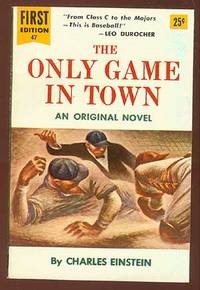
1955rif. 23282New York: Dell First Edition 1955. Softcover. Fine. Paperback original. Pages slightly yellowed else a fine unread copy. Leo Durocher blurb. Novel by the compiler of The Fireside Book of Baseball about an aging player-manager taking one last shot at the big time. McCue p.38. Dell First Edition unknown books
1962rif. 439676New York: Oxford University Press 1962. Softcover. Very Good. Later printing. Trade paperback. 492pp. Translated by Arthur Mendel and Nathan Broder. Pages lightly age-toned edges rubbed very good. Oxford University Press unknown books
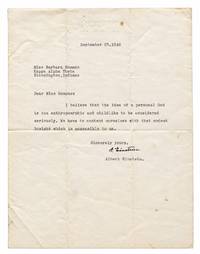
1948rif. 3094Princeton: np 1948. first edition. Very Good. ONE OF EINSTEIN'S MOST DIRECT STATEMENTS ON GOD: A POWERFUL AND CONCISE PRECURSOR TO HIS CELEBRATED "GOD LETTER". In the letter dated September 25 1948 and addressed to the Indiana University student Barbara Homans Einstein writes: "I believe that the idea of a personal God is too anthropomrphic sic and childlike to be considered seriously. We have to content ourselves with that modest insight which is accessible to us." The letter is a strikingly concentrated statement of Einstein's religious philosophy. In two sentences he rejects the notion of an anthropomorphic personal deity while setting against it a characteristically modest view of human knowledge: rather than claiming access to metaphysical certainty "we have to content ourselves" with the limited understanding available to us. That formulation places the letter squarely within one of the most important recurring themes of Einstein's later correspondence: his distinction between conventional belief in a personal God and his own sense of awe before the rational order of the universe. Six years later in his famous letter to the philosopher Eric Gutkind of 3 January 1954 Einstein would return to the same subject in far greater detail describing the word "God" as an expression of human weakness and rejecting traditional religious conceptions with exceptional directness. Christie's described the Gutkind letter as Einstein's most fully articulated statement of his religious and philosophical views; it sold in 2018 for $2892500 at Christie's. The present letter is remarkable because the essential position of the later "God Letter" is already present here in distilled form. The shared target is the anthropomorphic personal God: a conception Einstein repeatedly rejected while maintaining that a profound sense of wonder before the structure of nature could still be called religious. It is a direct statement of Einstein's mature religious philosophy anticipating the central argument of the 1954 "God Letter" by more than five years. Typed letter signed "A. Einstein" to Barbara Homans. Princeton 25 September 1948. One page 8 1/2 x 11 in typed on Einstein's Princeton stationery with embossed address at head; signed "A. Einstein" in ink. Folded for mailing with light toning and a few small stains. np unknown books
1996rif. 1418697New York: George Braziller 1996. First Edition. Hardcover. Quarto 92 pages. In Very Good condition and housed in publisher's Very Good blue cloth and tan paper slip case. Bound in publisher's blue cloth with tan lettering to spine. Minor shelf wear. Small indentations on top of first few pages. Shelved on the Front Table. 1418697. Shelved Dupont Bookstore. George Braziller hardcover books
1955rif. 65597NY: Dell 1955. Mass market paperback. Very good. Mass market paperback. Slight spine lean wraps creased and rubbed pen markings on the front and back else very good. Dell First Edition 47. Cover art by Fletcher Martin. Dell unknown books
1956rif. 65595NY: Dell 1956. Mass market paperback. Very good. Mass market paperback. Spine lightly creased wraps lightly rubbed else very good. Dell First Edition A-121. Cover art by John Fernie. Dell unknown books
1950rif. 6682New York: Philosophical Library 1950. First edition. Very Good in pretty good dust jacket. 21 cm; 279 pages portrait frontispiece. Turquoise cloth in plain cream-colored dust jacket. Dust jacket chipped at top of spine. Of the variant dust jackets and issues this is the one with the fewest number of titles advertised on the rear and the price of $4.75 on the inside flap. Philosophical Library hardcover books
1930rif. 10508Boston: Houghton Mifflin 1930. First Edition. Cloth. Near fine/good. First edition of Roosevelt: His Mind in Action by Lewis Einstein in scarce dust jacket. Octavo vii 5 259pp. Maroon buckram cloth title printed on label affixed to cover and spine. Some leaves unopened. Uncut outer edge. No additional printings mentioned on copyright page. Previous ownership inscription on front free endpaper. In publisher's scarce dust jacket $3.00 retail price on front flap long closed tear to front cover large chipping to spine and back panel archival repair to verso bright illustrations. A rare find in the publisher's dust jacket. Houghton Mifflin unknown books
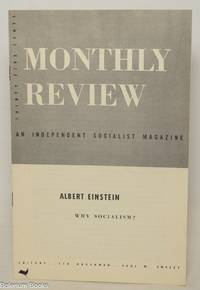
rif. 74322New York: Monthly Review n.d. 9p. staplebound pamphlet small ink mark at lower left corner crease otherwise very good. Reprinted from the May 1949 issue of Monthly Review. Monthly Review unknown books
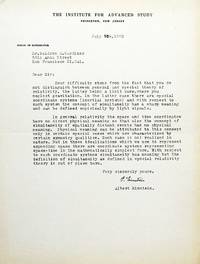
1952rif. 3091Princeton: np 1952. First edition. no binding. Very Good. EXTRAORDINARY EINSTEIN LETTER IN ENGLISH EXPLAINING SIMULTANEITY ONE OF THE CENTRAL TENETS OF RELATIVITY THEORY. Einstein's "1905 paper on special relativity is widely regarded as having destroyed the classical conceptions of absolute time and space along with absolute simultaneity and absolute length which had reigned in physics from the times of Galileo and Newton to the dawn of the twentieth century. The Special Theory teaches us that simultaneity is not as we supposed an absolute concept but is always relative to some inertial frame of reference. If we change the inertial frame of reference we change the events to be reckoned simultaneous." -Craig and Smith Einstein Relativity and Absolute Simultaneity The concept of simultaneity lies at the core of relativity theory. The very first sub-section of Einstein's legendary 1905 paper on Special Relativity is introduced by the title "Definition of Simultaneity" and "in the second paragraph of his 1905 relativity paper Einstein proved that simultaneity as defined in the first paragraph is a relative concept. This means as Einstein explained that 'we must not ascribe absolute meaning to the concept of simultaneity; instead two events that are simultaneous when observed from some particular coordinate system can no longer be considered simultaneous when observed from a system that is moving relative to that system.' In these words Einstein for the first time offered an explicit definition of what he means when he speaks of a relative concept. As we see it is a concept whose validity depends on the coordinate system chosen or in brief it is a frame-dependent concept. Simultaneity is no longer a binary relation depending also on the coordinate-frame involved. Furthermore Einstein's proof of the relativity of simultaneity in this paragraph is the first ever published rigorous proof of the relativity of a physical concept. The relativity of simultaneity became also the first major subject of dispute between proponents and opponents of the theory of relativity" Max Jammer Concepts of Simultaneity: From Antiquity to Einstein and Beyond. When Einstein expanded his relativity theory into his General Theory of 1916 the notion of simultaneity became less well-defined and more problematic and therefore much-debated. Einstein in the present letter is answering a question from Dr. Waldron Gardiner a physician apparently without any particular expertise in relativity theory about the concept of simultaneity in space the domain of general relativity. Dated July 10 1952 the letter reads in full: Dear Sir: "Your difficulty stems from the fact that you do not distinguish between general and special theory of relativity the latter being a limit case where you neglect gravitation. In the latter case there are special coordinate systems inertial systems and with respect to such system the concept of simultaneity has a sharp meaning and can be defined empirically by light signals. In general relativity the space and time coordinates have no direct physical meaning so that also the concept of simultaneity of spatially distant events has no physical meaning. Physical meaning can be attributed to this concept only in certain special cases which are characterized by certain symmetry qualities. Such case is not realized in nature. But in those idealizations which we use to represent expanding space there are coordinate systems representing space-time in the mathematically simplest form. With respect to such coordinate systems simultaneity has meaning but the definition of simultaneity as defined in special relativity theory is out of place here. Very sincerely yours SignedA. Einstein PrintedAlbert Einstein In short Einstein is explaining to Dr. Gardiner that since "space and time coordinates have no direct physical meaning" in cosmological terms i.e. there are no frames of reference that cover all of space his understanding of simultaneity in general relativity is flawed and based on the model of special relativity "a limit case" achieved only through a reductive and localized application of general relativity. Einstein concludes the letter with the provocative comment that in idealized systems representing expanding space simultaneity has meaning and in fact this "meaning" of simultaneity in general relativity has become a fertile area of exploration over the years see Jammer ibid. Note: A carbon of Dr. Gardiner's original letter to Einstein is included. Princeton: July 10 1952. One 8.5 x 11 inch page of Einstein's Institute for Advanced Study letterhead. Signed "A. Einstein" in ink. Date corrected from July 9th to July 10th. Usual but very light folds small spot of soiling at top left corner; a tiny bit of toning to extreme edges. Housed in custom presentation folder. LETTERS BY EINSTEIN DISCUSSING MAJOR ELEMENTS OF RELATIVITY PARTICULARLY IN ENGLISH ARE EXCEEDINGLY RARE. np unknown books
1945rif. 1292Princeton: Princeton University Press 1945. Second edition first printing. 1945 LANDMARK SUMMARY OF NOBELIST ALBERT EINSTEIN'S THEORIES THAT ESTABLISHED MODERN PHYSICS--COPY OF NOBELIST CARLETON GAJDUSEK WHO DISCOVERED KURU THE FIRST PRION DISEASE. 8 inches tall hardcover gray cloth binding gilt title to spine decorative bookplate of D. Carleton Gajdusek to front paste-down signature of D. Carleton Gajdusek to front free endpaper vi 135 pp near fine in very good unclipped jacket with faint splash mark to cover light wear to spine ends and corners in protective mylar sleeve. This first printing of the second edition contains an appendix added by the author discussing advances in the theory of relativity since the first edition in 1921. ALBERT EINSTEIN 1879 – 1955 was a German-born theoretical physicist widely acknowledged to be one of the greatest and most influential physicists of all time. Einstein is best known for developing the theory of relativity but he also made important contributions to the development of the theory of quantum mechanics. Relativity and quantum mechanics are together the two pillars of modern physics. In 1922 he was awarded the 1921 Nobel Prize in Physics "for his services to Theoretical Physics and especially for his discovery of the law of the photoelectric effect". The Meaning of Relativity: Four Lectures Delivered at Princeton University May 1921 is a book published by Princeton University Press in 1922 that compiled the 1921 Stafford Little Lectures at Princeton University given by Albert Einstein. The lectures were translated into English by Edwin Plimpton Adams. The lectures and the subsequent book were Einstein's last attempt to provide a comprehensive overview of his theory of relativity and is his only book that provides an accessible overview of the physics and mathematics of general relativity. The book is made of four lectures. The first is titled "Space and Time in Pre-Relativity Physics". The second lecture is titled The Theory of Special Relativity and discusses the special theory of relativity. The third and fourth lectures cover the general theory of relativity in two parts. Einstein added an appendix to update the book for its second edition published in 1945 offered here. PROVENANCE: DANIEL CARLTON GAJDUSEK 1923-2008 was an American medical doctor and researcher who was co-recipient of the Nobel Prize in Physiology or Medicine in 1976 for his work in Kuru the first prion disease. Gajdusek graduated from Harvard Medical school at age 23 served as head of virological and neurological research at the National Institute for Health in 1958; and inducted into the National Academy of sciences in 1974. Gajdusek's best-known work focused on kuru. This disease was rampant among the South Fore people of New Guinea in the 1950s and 1960s. Gajdusek connected the spread of the disease to the practice of funerary cannibalism by the South Fore. With elimination of cannibalism kuru disappeared among the South Fore within a generation. He proved his hypothesis by successfully transmitting the disease to primates and demonstrating that it had an unusually long incubation period of several years. This was the first demonstration of the infectious spread of a noninflammatory degenerative disease in humans. Subsequently additional human agents belonging to the same group were discovered. They include sporadic familial and variant Creutzfeldt–Jakob disease. Gajdusek recognized that diseases like Kuru and Creutzfeldt–Jakob disease were caused by a new infectious agent that had not yet been identified. Princeton University Press hardcover books
1922rif. 792Berlin: Springer 1922. First Edition. Wrappers. Near fine. 2 vols. in German the first appearance of 2 distinct papers in 2 separate periodical issues September 13 and November 17. Both are complete in original wrappers. Near fine small pencil name on the Nov. cover. Seems to be surprisingly rare. RBH lists no auction sales of Friedmann's article title and date since 1975 and only one copy of it is listed by OCLC but copies of the bound annual Zeitschrift für Physik are regularly available and should not in this case be considered in any way equivalent to our set in publisher's wrappers. 1. Friedmann's pioneering paper the first to seriously apply general relativity to cosmology without the stabilizing cosmological constant theorizing and mathematically formularizing an expanding universe dragging cosmology into a branch of physics. In Zeitschrift für Physik Band 10 He 16 September 13 1922 pages 377-386 "Here we have for the first time the idea of an expanding universe originating in a singularity-a big-bang." -Helge Kragh Cosmology and Controversy page 24. 2. Einstein's critical remarks on Friedmann's paper that he retracted in 1923. In Zeitschrift für Physik Band 11 He 4/5 November 17 1922 page 326. Springer unknown books
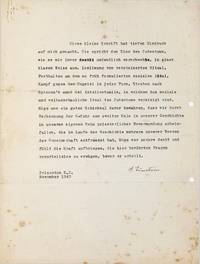
1943rif. 3079Princeton NJ: np 1943. first. Very Good. AN EXTRAORDINARY SIGNED 1943 STATEMENT DEFINING EINSTEIN'S CONCEPTION OF JUDAISM THROUGH REASON AND SPINOZA WHILE WARNING AGAINST "CLERICAL DOMINATION" IN A FUTURE JEWISH HOMELAND. Of course we all know Einstein as the great scientist. From the theoretical physicists among us to those of use who barely survived high school physics we are all captivated by the man and accept his place at the outer limits of human intellectual capacity. Yet it's when Einstein leaves the world of relativity and theoretical physics that we are often most drawn to his never-ending charisma. Especially exciting to so many of us are his deep convictions about human affairs especially politics and religion. Einstein famously was irreligiously religious. Born to a secular Jewish family his upbringing lacked the complex ritual we associate with Orthodox Judaism. He briefly became curious about religiosity as a child but his attempts at following religious ritual and doctrine ended a few years later as he confronted the conflict between scientific ideas and Biblical stories. Yet one still sees a deep spirituality in Einstein who saw a special camaraderie in the 17th-century Dutch Jewish philosopher Baruch Spinoza. Spinoza was a Jewish radical who had little patience for endless ritual. He did not see God as a being intervening in human affairs but as a great rational force who formed the universe using rational methods. We become close to God therefore by trying to understand the natural world not obeying endless rituals. One can easily see Spinoza's approach as appealing to Einstein. In Spinoza's view the scientist is the holyman his work bringing him closer to God's creations. While in 1943 many of Einstein's contemporaries could accept such a view in seventeenth-century Amsterdam it was another matter: Spinoza was formally expelled from his Jewish community. Shikmoni's Pamphlet & Einstein's Views Humanistisches Judentum Humanistic Judaism was not a conventional commercial publication. It was issued privately in Haifa in 1948 "on behalf of a Circle of Friends" with Einstein's contribution prominently advertised on the title page as a "Geleitwort von Prof. Albert Einstein." Shikmoni's short pamphlet aligns closely with Einstein's view of religion. Its central proposition is quite radical: a genuinely renewed Jewish culture must recover what Shikmoni regards as Judaism's original combination of humanism and a rational worldview. He traces that tradition through Moses and the Prophets incorporates Jesus "the Nazarene" and sees it culminating in Spinoza. For Shikmoni as for Einstein Spinoza offered a way of reconciling Jewish intellectual identity with reason and freedom from religious orthodoxy. Shikmoni's devotion to Spinoza extended beyond this pamphlet. In 1950 he founded the Spinoza House Bet Shpinozah or Spinozaeum in Haifa a center devoted to promoting Spinoza's philosophy in the newly established State of Israel. The organization attracted prominent supporters including David Ben-Gurion and Albert Einstein. The Document The typescript we have here was written by Einstein on his Princeton letterhead in November 1943 in response to Shikmoni's pamphet and would eventually be published as Einstein's foreword to the pamphlet. The pamphlet would not appear until 1948 five years after Einstein wrote these words. It is not difficult to understand why Shikmoni's manuscript made such an impression on Einstein. He recognized in it many of his own ideas about Judaism religion and Spinoza. Indeed in the typescript Einstein begins by admitting that Shikmoni had articulated something that he himself had long felt but had struggled to define: "This little work has made a deep impression on me. It expresses in a clear manner the meaning of Judaism as it had always hovered indistinctly before me." What follows is almost a miniature statement of Einstein's own religious philosophy: "liberation from petrified ritual; adherence to the social ideal formulated so early; struggle against the spirit of unreason in every form; striving toward Spinoza's amor dei intellectualis." Like Spinoza Einstein's Judaism is not defined principally by ritual observance but by ethics reason intellectual freedom and the pursuit of understanding. But Einstein then moves from religion to politics. The typescript is dated November 1943 five years before the establishment of Israel. We see Einstein already contemplating the character of a future Jewish homeland and warning against allowing religious authority to dominate it: "May a favorable fate preserve us from failing to recognize the danger and for a second time in our history falling in our own homeland under clerical domination which over the course of history has alienated several of our finest people from the community." The warning brings us directly back to Spinoza. Einstein had just invoked a Jewish thinker who had himself been expelled from his religious community for his unorthodox ideas; in the very next paragraph he warns of religious authority once again alienating "several of our finest people" from the Jewish community. There is another important feature of the present typescript. When Einstein's statement was finally published as the foreword to Shikmoni's pamphlet in 1948 one of its most forceful phrases had disappeared. Einstein's original reads: "Kampf gegen den Ungeist in jeder Form" "struggle against the spirit of unreason in every form". The entire phrase is omitted from the published version. The present signed typescript therefore preserves a substantive passage from Einstein's original statement that did not survive into its eventual publication. Full German Transcription Diese kleine Schrift hat tiefen Eindruck auf mich gemacht. Sie spricht den Sinn des Judentums wie er mir immer dunkel undeutlich vorschwebte in einer klaren Weise aus. Loslösung vom versteinerten Ritual Festhalten an dem so früh formulierten sozialen Ideal Kampf gegen den Ungeist in jeder Form Streben nach Spinoza's amor dei intellectualis in welchem das soziale und weltanschauliche Ideal des Judentums vereinigt sind. Möge uns ein gutes Schicksal davor bewahren dass wir durch Verkennung der Gefahr zum zweiten Male in unserer Geschichte in unserem eigenen Heim priesterlicher Bevormundung anheimfallen die im Laufe der Geschichte mehrere unserer Besten der Gemeinschaft entfremdet hat. Möge wer anders denkt und fühlt die Kraft aufbringen die hier berührten Fragen vorurteilslos zu erwägen bevor er urteilt. Princeton N.J. November 1943 A. Einstein English Translation This little work has made a deep impression on me. It expresses in a clear manner the meaning of Judaism as it had always hovered indistinctly before me: liberation from petrified ritual; adherence to the social ideal formulated so early; struggle against the spirit of unreason in every form; striving toward Spinoza's amor dei intellectualis in which the social and philosophical ideals of Judaism are united. May a favorable fate preserve us from failing to recognize the danger and for a second time in our history falling in our own homeland under clerical domination which over the course of history has alienated several of our finest people from the community. May those who think and feel differently summon the strength to consider without prejudice the questions touched upon here before passing judgment. Princeton N.J. November 1943 A. Einstein In a single page later published in an obscure German pamphlet Einstein brings together some of the convictions that defined his life beyond physics: his Jewish identity his reverence for Spinoza his distrust of religious orthodoxy and his belief that reason humanism and intellectual freedom should prevail over dogma. Typescript on Einstein's Princeton letterhead with his embossed Mercer Street address at top; signed by Einstein "A. Einstein." at bottom right. Princeton New Jersey November 1943. One page approx. 8.5 x 11 in; rust mark from paper clip at top left; scattered foxing; two binder punch holes at right margin. A RARE CLEAR EXPLANATION OF EINSTEIN'S RELIGIOUS BELIEFS AND HIS RELATIONSHIP TO JUDAISM. np unknown books
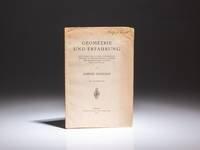
1921rif. 17649Berlin: Verlag Von Julius Springer 1921. First Trade Edition. Wraps. Very good. The first trade edition of Geometrie Und Erfahrung Geometry and Experience by Albert Einstein from the collection of Einstein's English translator Dr. Wilfrid Perrett. Octavo 20pp. Publisher's original wraps bound with two staples. Light soiling and wear on wraps internally clean. Includes two illustrations advertisements on verso of rear flap. Staples showing rust some wear to edges of original wraps. Weil 115 Schlipp-Shields 143 This copy is signed by Wilfrid Perrett on the front cover. This work first appeared in the Sitzungsberichte der Preussischen Akademie der Wissenschaften accompanied by an "author's offprint" which was bound in orange wrappers. Weil 114. This work is the first separate trade edition. The recipient of this copy Dr. Wilfrid Perrett worked with Dr. George Barker Jeffery to translate many of Einstein's most notable works into English. Perrett was a "distinguished German scholar" and would "overlook the literary side of the work" while Jeffery would oversee the mathematical translations. The two worked together on Das Relativitätsprinzip On the Relativity Principle beginning in 1922 and numerous other works by Einstein over his career. Jammer 113-114. Verlag Von Julius Springer unknown books
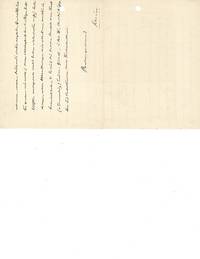
1930rif. 2349np: np 1930. First edition. Fine. EINSTEIN ON THE CONCEPT OF PEACE: A POWERFUL AUTOGRAPH STATEMENT IN EXCEPTIONALLY LARGE FORMAT. Translated from the original German: "No person has the moral right to call himself a Christian or Jew so long as he is prepared to engage in systematic murder at the command of an authority or allow himself to be used in any way in the service of war or the preparation for it." Beginning in 1925 the World League for Peace Ligue mondiale pour la paix under the direction of its president Georges Dejean solicited statements on peace from prominent scientists writers artists political leaders and other public figures throughout the world sending them large 11.5x16.5 inch sheets for their submissions. The resulting collection of more than 1000 original manuscripts was assembled between 1925 and 1932. A selection was reproduced in facsimile in the limited-edition volume Pax Mundi: Livre d'or de la paix published in Geneva by Paxunis in 1932. This is Einstein's original manuscript contribution to the project. A highly unusual format with exceptionally large Einstein signature 2.25 in / 6 cm of an important Einstein statement consistent with his life-long dedication to pacifism. c.1925-1930. One large folio page 11.5 x 16.5 inches. In German. Fine condition. np unknown books