Einstein: A BiographyBiblio.com
EINSTEIN; FreudBiblio.com
Warum Krieg
réf. 7406992-nnew. unknown

GreatBookPrices · États-Unis91,24 $US≈ 81,52 €
1 949 résultats
réf. DADAX0374146640New unknown
réf. DADAX0817640304New unknown
réf. DADAX0801893100New unknown
réf. 7406992-nnew. unknown
réf. Q-3257200285Diogenes Verlag AG. Paperback. New. New. In shrink wrap. Looks like an interesting title! Diogenes Verlag AG paperback
réf. DADAX0198505949New unknown
1979réf. P-18052Princeton NJ: Princeton University Press 1979. Hardcover. As New/First Edition. Octavo. With the reeata slip laid in. First publication of these letters by Einstein. A clean unmarked and unclipped copy. Princeton University Press hardcover
réf. 0886712173New. paperback. New. Satisfaction Guaranteed or your money back. paperback
1986réf. Q-0886712173Brand: 1986-01-01. Paperback. New. In shrink wrap. Looks like an interesting title! Brand: paperback
réf. U02B-05388Macmillan Pub Co. Used - Good. Good condition. Very Good dust jacket. A copy that has been read but remains intact. May contain markings such as bookplates stamps limited notes and highlighting or a few light stains. Macmillan Pub Co unknown
réf. 6200789614.GGood. Access codes and supplements are not guaranteed with used items. May be an ex-library book. unknown
1918réf. 135751918. Mathematics Klein Felix. Autograph Letter Signed 10 November 1918 written in German to a former student and colleague directly references Einstein's recently published General Theory of Relativity and comments on the work of the International Mathematical Education Commission. Composed in the closing days of the First World War the letter places Klein within active scholarly exchange concerning the mathematical implications of relativity which had been formally presented in 1915 and widely disseminated by 1918. Klein long established for his foundational contributions to group theory non-Euclidean geometry and mathematical physics addresses questions raised by "Einstein's theory" noting that he required further reflection to clarify its implications for his own work. The document supports research in the history of relativity German mathematical networks scientific communication during wartime and the institutional organization of mathematics in the early twentieth century. Klein Felix. Autograph Letter Signed 10 November 1918. Two pages written on both sides of a single leaf. In German with accompanying English translation. Addressed to a former student the letter discusses the circulation of lecture manuscripts difficulties in securing copyists during wartime conditions and the intellectual demands posed by Einstein's theory: "A further exploration of my work does not exist yet as I had and still have more thinking to do about questions raised by Einstein's theory to clarify it for myself." Klein also comments critically on the IMUK observing that its published statements are "a display of wasted paper" while acknowledging the commission's broader social significance. He singles out contemporary educational treatises including studies by W. Trost Heinrich Emil Timerding and M. Girndt indicating his sustained engagement with mathematical pedagogy alongside theoretical research. The letter was written days before the November Revolution in Germany and at a moment when academic institutions faced political upheaval and material shortages. Klein's remarks regarding limited copyists and uncertainty about the coming months provide contemporaneous evidence of scholarly life under strained postwar conditions. His reference to Einstein situates the correspondence within the earliest phase of professional reception of general relativity among leading mathematicians while his comments on the International Mathematical Education Commission underscore his longstanding commitment to mathematical instruction and institutional reform. Clean and well preserved with strong legibility and a clear signature. Overall near fine condition. A substantive document of early relativity discourse and mathematical research at the end of the First World War. unknown
2003réf. x-0520215036Univ of California Pr 2003. Paperback. New. 1st edition. 491 pages. 9.75x7.00x1.00 inches. Univ of California Pr paperback
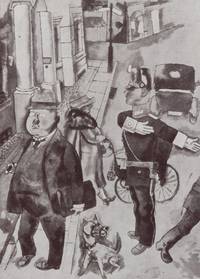
1926réf. 39022Berlin: Das Kunstarchiv Verlag 1926. First edition. Softcover. g. Quarto. 36pp. Original printed wrappers. Catalog published on the occasion of an exhibition of paintings and drawings by George Grosz held during the Spring of 1926 in Berlin at the Galerie Alfred Flechtheim. This catalog features 24 duo-tone and b/w photographic reproductions. Includes a poem by Gottfried Benn and four essay on the artist and his work by Carl Einstein Marc Neven Max Herrmann and Florent Fels. Some age-wear and moderate soiling on wrappers. Upper corners bumped thus slightly affecting pages throughout. Text in German gothic script with one of the four essays in French. Wrappers in overall good- to good interior in good to very good condition. Alfred Flechtheim 1878-1937 was a German art dealer art collector journalist and publisher. Flechtheim appeared in the art world shortly after 1900 with a collection of paintings by Vincent van Gogh and Paul Cézanne; French Avant garde early works of Pablo Picasso Georges Braque and André Derain; paintings of Wassily Kandinsky Maurice de Vlaminck Alexej von Jawlensky Gabriele Münter and the Rhein Expressionists Heinrich Campendonk August Macke Heinrich Nauen de and Paul Adolf Seehaus de. Flechtheim opened his first gallery in Düsseldorf in 1913 followed by galleries in Berlin Frankfurt Cologne and Vienna. Flechtheim served in the German Army during World War I but not at the front. His art business collapsed during the war but he re-opened in Düsseldorf in 1919. In 1921 he founded "Der Querschnitt" the Cross Section a cultural magazine. Legendary glamorous parties in Flechtheim's gallery overflowed with the glitterati of the new Berlin: movie stars titans of finance prizefighters and artists of every stripe. As Hitler rose to power in the late 1920s and early 1930s Flechtheim became a bête noire because of the art he espoused and championed. In 1933 Sturmabteilung men broke up an auction of Flechtheim's paintings. The Nazis aryanized Flechtheim's gallery as they would many other Jewish businesses and turned it over to Flechtheim's business manager Alex Vömel. After the war former party member Vömel said he didn't even remember who Flechtheim was. The Nazis seized and sold off Flechtheim's private collection as well as the contents of his gallery. Emigration and Death Six months after the Nazis came to power in 1933 Flechtheim penniless fled to Paris and tried to find work with his former business partner Daniel-Henry Kahnweiler. Flechtheim subsequently organized exhibits in London of the paintings of exiled German artists. In London Flechtheim slipped on a patch of ice was taken to a hospital punctured his leg on a rusty nail in his hospital bed developed septicemia leading to amputation of his leg and died. Das Kunstarchiv Verlag unknown
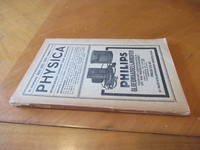
1925réf. 032126Physica / Nederlaandsch Tijdscrift Voor Natuurkunde 1925. 1st Edition 1st Printing. Soft cover. Very Good. Double Issue Nov-Dec 1925. Einstein Article Is In German. Einstein Temporarily Abandons The Search For A Unified Theory. Original Grey Card Covers Printed In Black Small "Lorentz" Printed On Label On Spine. Lightly Used Some Loss Of Paper On Spine Corner Crease On Front Cover Beginning To Split. Physica / Nederlaandsch Tijdscrift Voor Natuurkunde paperback
1914réf. 1199Braunschweig: Friedr. Vieweg & Sohn 1914. 1st Edition. FIRST EDITION FULL VOLUME OF THE FRANCK-HERTZ EXPERIMENT: THE FIRST ELECTRICAL MEASUREMENT TO CLEARLY SHOW THE QUANTUM NATURE OF ATOMS - PROOF OF THE QUANTIZED MODEL OF THE BOHR ATOM & OF PLANCK'S QUANTUM THEORY. Note that this volume includes both the first and second Franck-Hertz experiment. In the first they demonstrate that atoms can only absorb and be excited by specific amounts of energy; in the second experiment performed the same year they demonstrate that the frequency of the light emitted following the collision of electrons with mercury atoms corresponds precisely with the energy lost by the electrons in the collision. Franck and Hertz received the Nobel Prize for this work specifically "for their discovery of the laws governing the impact of an electron upon an atom" Nobel Prize Committee. Of equal import this volume also contains a paper by Einstein in which he uses the light quantum hypothesis to give new derivations of Planck's radiation law and Nernst's third law of thermodynamics. His "proofs introduced the quantum hypothesis" Calaprice The Einstein Almanac 40. In 1914 James Franck and Gustav Hertz were working together in the Physics Institute of Berlin and were "particularly interested in ionization i.e. in the process in which an electron is removed from an atom" The Harvest of a Century" p. 102-103. The experiment they devised now known commonly as the Franck-Hertz experiment is "a vivid illustration of the quantization of energy" that relied on methodology so simple "that it is now carried out regularly by undergraduates. They accelerated electrons through a low-pressure gas of mercury. When the electrons' energy reach the energy of a stationary state of mercury they gave up a quantum of energy to the mercury resulting in a stepwise shape to the curve of current through the apparatus. This demonstrated that atoms could absorb energy only in discrete amounts" Peacock The Quantum Revolution 40. "Franck and Hertz had not only shown for the first time that electrons lose their kinetic energy to mercury atoms in energy quanta but also that these energy quanta are equal to the energy of the light emitted by the same atoms if interpreted with Einstein's light-quantum hypothesis.This was the first experimental determination of Planck's constant not using blackbody radiation" Brandt 103. CONDITION & DETAILS: Braunschweig: Friedr. Vieweg & Sohn. 8vo. Unobtrusive stamp on front paste down and title page. In-text figures throughout. Tightly bound in leather over marbled paper boards; gilt-lettered and tooled at the slightly faded and spotted spine which looks worse in the image due to the bright light than it does to the eye. Unusually beautiful marbled paper edges. Bright and very clean throughout. Near fine. Friedr. Vieweg & Sohn hardcover
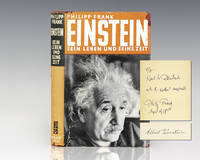
1949réf. 133215Munchen: Paul List Verlag 1949. First German edition of this classic work by Frank a famed contemporary of Einstein. Octavo original cloth. Signed by Albert Einstein on the slip to the title page and inscribed by the author on the front free endpaper "To Karl W. Deutsch with the author's compliments Philipp Frank August 10 1950." Philipp Frank was a physicist mathematician and also a philosopher during the first half of the 20th century. He was a logical-positivist and a member of the Vienna Circle. He was influenced by Mach and was one of the Machists criticised by Lenin in Materialism and Empirio-criticism. He studied physics at the University of Vienna and graduated in 1907 with a thesis in theoretical physics under the supervision of Ludwig Boltzmann. Albert Einstein recommended him as his successor for a professorship at the German Charles-Ferdinand University of Prague a position which he held from 1912 until 1938. Very good in a good dust jacket. Much has been written about Albert Einstein technical and biographical but very little remains as valuable as this unique hybrid of a book written by Einstein's colleague and contemporary. Both rich in personal insights and grounded in a deep knowledge of twentieth-century science Phillip Frank's biography anchors the reader with a lucid overview of physics and draws an intimate portrait of the Nobel Prize–winner. Paul List Verlag hardcover
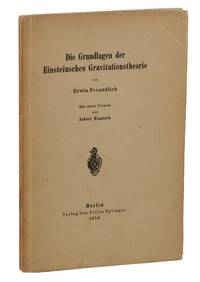
1916réf. 140945574Berlin: Verlag von Julius Springer 1916. First edition. First edition. 64 pp. Bound in publisher's wraps. Very Good with slightly toned wraps tiny stain to back wrap slightly bumped corners bookplate on verso of front wrap. An early German language work on Einstein's theory of gravitation with a foreword by the man himself. Freundlich's first book. Verlag von Julius Springer unknown
réf. 12591171-nnew. unknown
1924réf. 25388London:: Methuen 1924. Second edition revised and enlarged. publisher's cloth in dust jacket. . Very good or better in a jacket with an L-shaped closed split at the bottom of the jacket spine a label had been removed from the bottom of the spine which has skinned a few of the letters in the imprint; also there is some splitting along folds. An uncommon book in jacket. . 8vo. With a Preface by Albert Einstein. Methuen, hardcover
1922réf. 34667Berlin Julius Springer 1922-24. 8vo. In: "Zeitschrift für Physik" Vol. 10 pp. 377 ff.Vol.11 pp.326 vol.16 pp.228 vol.21 pp.326-332. The entire four volumes offered here. Contemporary half cloth bindings. Two landmark papers in the history of cosmology: All first editions. In 'Über die Krümmung des Raumes' Friedman derived the non-stationary solutions to Einstein's field equations. Einstein quickly responded in a short comment 'Bemerkung' in which he expressed his suspicion of such a model of the Universe and apparently pointed out an error in Friedman's calculations. However Friedman now wrote a letter to Einstein in which he enclosed his full calculations. Shortly after this Einstein submitted a short notice Notiz in which he admitted that he himself had performed a calculation error and that Friedman's solutions which shed new light on the matter were valid. Friedman's expanding universe model was corroborated by Edwin Hubble's red-shift observations in 1929. In 'Über die Möglichkeit einer Welt mit konstanter negativer Krümmung des Raumes' Friedman derived the Friedman-equations and demonstrated that he had command of all three Friedman-models describing positive zero and negative curvature respectively nearly a decade before the independent discoveries of the same models by Lemaître Robertson and Walker. hardcover
1922réf. 49429Berlin Julius Springer 1922-24. 8vo. 4 contemporary half cloth binding: two in uniform half green cloth and two en uniform grey/blue half cloth. In "Zeitschrift für Physik" Bd. 10 11 16 & 21. Entire volumes offered. All volumes with stamp to title page and front free end paper otherwise a fine and clean set. Friedmann: Bd. 10: Pp. 377-386; Bd. 21: P.p. 326-332. Einstein: Bd. 11:P. 326; Bd. 16: P. 228. First printing of these four landmark paper in which Friedman "introduced into cosmology two concepts of revolutionary importance the age og the world and the creation of the world" Kragh Cosmology and Controversy. "In his paper of 1922 Friedmann offered a complete analysis of the solutions of Einstein's cosmological field equations that went beyond the earlier solutions of Einstein and de Sitter as it also included nonstatic solutions. Friedmann did so clearly and explicitly: "The purpose of this note" he wrote "is firstly to show that the cylindrical Einsteinand spherical de Sitter worlds are special cases of more general assumptions and secondly to demonstrate the possibility of a world in which the curvature of space is independent of the three spatial coordinates but does on time".Ibid.In 'Über die Krümmung des Raumes' Friedman derived the non-stationary solutions to Einstein's field equations. Einstein quickly responded in a short comment 'Bemerkung' in which he expressed his suspicion of such a model of the Universe and apparently pointed out an error in Friedman's calculations. However Friedman now wrote a letter to Einstein in which he enclosed his full calculations. Shortly after this Einstein submitted a short notice Notiz in which he admitted that he himself had performed a calculation error and that Friedman's solutions which shed new light on the matter were valid. Friedman's expanding universe model was corroborated by Edwin Hubble's red-shift observations in 1929. In 'Über die Möglichkeit einer Welt mit konstanter negativer Krümmung des Raumes' Friedman derived the Friedman-equations and demonstrated that he had command of all three Friedman-models describing positive zero and negative curvature respectively nearly a decade before the independent discoveries of the same models by Lemaître Robertson and Walker. "Friedmann made a valuable contribution to Einstein's general theory of relativity. As always his interest was not limited simply to familiarizing himself with this new field of science but led to his own remarkable investigations. Friedmann's work on the theory of relativity dealt with one of its most difficult questions the cosmological problem. In his paper "Über die Krümmung des Raumes" 1922 he outlined the fundamental ideas of his cosmology: the supposition concerning the homogeneity of the distribution of matter in space and the consequent homogence of "world" time for which at any moment in time the metrics of space will be identical at all points and in all directions. This theory is especially important because it leads to a sufficiently correct explanation of the fundamental phenomenon known as the "red shift." This solution of the Einstein field equations obtained from the above propositions is the model for any homogeneous and isotropic cosmological theory. It is interesting to note that Einstein thought that the cosmological solution to the equations of a field had to be static and had to lead to a closed model of the universe. Friedmann discarded both conditions and arrived at an independent solution. Einstein welcomed Friedmann's results because they showed the dispensability of the ad hoc cosmological term Einstein had been forced to introduce into the basic field equation of general relativity". DSB. Weil 122 & 130. hardcover
1922réf. 792Berlin: Springer 1922. First Edition. Wrappers. Near fine. 2 vols. in German the first appearance of 2 distinct papers in 2 separate periodical issues September 13 and November 17. Both are complete in original wrappers. Near fine small pencil name on the Nov. cover. Seems to be surprisingly rare. RBH lists no auction sales of Friedmann's article title and date since 1975 and only one copy of it is listed by OCLC but copies of the bound annual Zeitschrift für Physik are regularly available and should not in this case be considered in any way equivalent to our set in publisher's wrappers. 1. Friedmann's pioneering paper the first to seriously apply general relativity to cosmology without the stabilizing cosmological constant theorizing and mathematically formularizing an expanding universe dragging cosmology into a branch of physics. In Zeitschrift für Physik Band 10 He 16 September 13 1922 pages 377-386 "Here we have for the first time the idea of an expanding universe originating in a singularity-a big-bang." -Helge Kragh Cosmology and Controversy page 24. 2. Einstein's critical remarks on Friedmann's paper that he retracted in 1923. In Zeitschrift für Physik Band 11 He 4/5 November 17 1922 page 326. Springer unknown
réf. DADAX0521045711New unknown
réf. DADAX0521827507New unknown